Inspiration
Most investors today hold assets across multiple platforms - brokers for equities, banks for fixed income, separate providers for gold, real estate, and cash. This fragmentation makes it difficult to understand true portfolio performance, risk exposure, and diversification.
The inspiration for this project came from observing how existing tools focus either on transactions or reporting, but rarely provide a unified, risk-aware view across asset classes. The goal was to design and build a platform that could consolidate investments, surface meaningful insights, and remain architecturally ready for real financial integrations.
What it does
The application provides a single consolidated view of an investor’s portfolio, spanning:
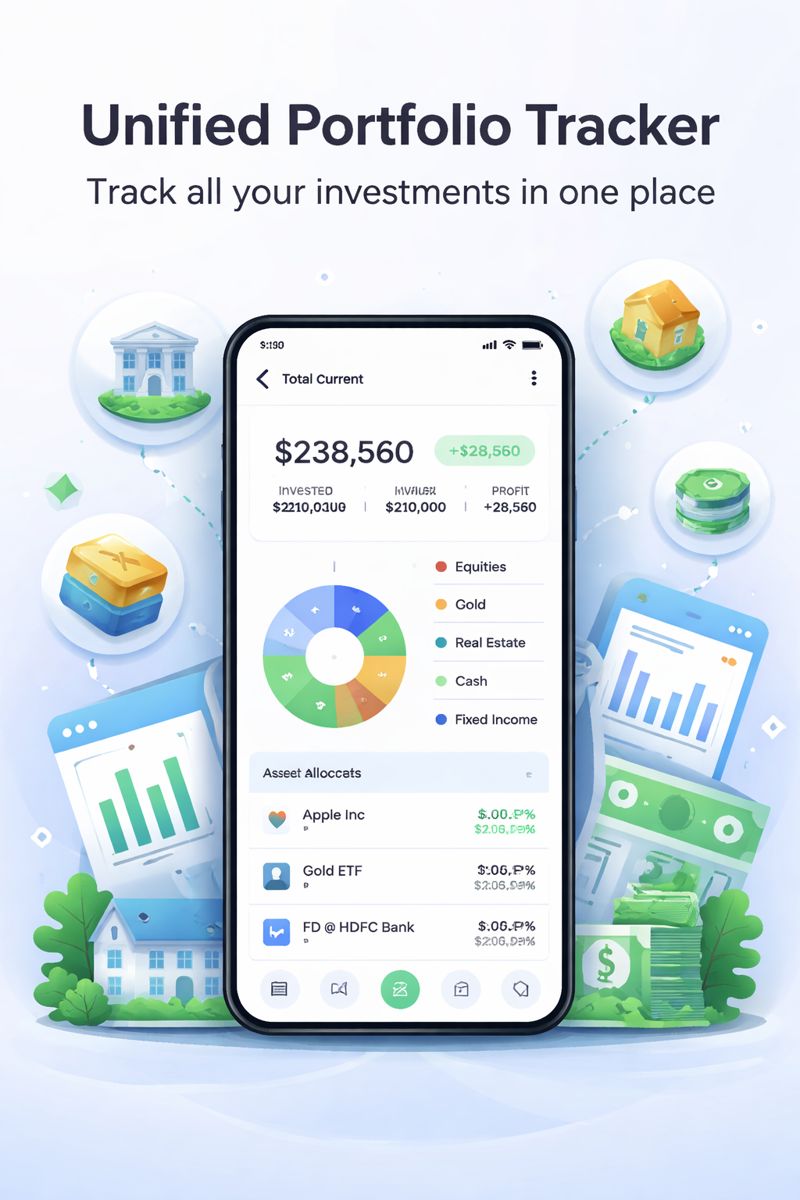
Equities, gold, fixed income, real estate, and cash
Aggregated invested value, current value, and overall P/L
Asset-class allocation with visual indicators
Fixed-income maturity awareness with proactive alerts
Risk and diversification insights across asset class, sector, and geography
Actionable recommendations derived from portfolio analysis
Consent-based connected accounts and provider integrations
A notification center for maturity alerts and risk events
The system is designed so that manual data entry is minimized, and real-world usage flows naturally through bank and broker integrations.
How we built it
The project was built using a modular, API-first architecture:
Frontend: Flutter (iOS and Android) for a unified, responsive user experience
Backend: NestJS with clearly separated modules for portfolio, analysis, accounts, integrations, and notifications
Architecture approach:
Backend as the single source of truth for calculations
Stateless APIs with in-memory storage for fast iteration and demos
Clean separation between domain logic and integration layers
Risk analysis and recommendations are derived server-side, enabling consistent behavior across platforms and future scalability. The integration layer models real-world consent and synchronization patterns similar to account aggregators, without hard-coding provider logic into the UI.
Challenges we ran into
One of the main challenges was balancing realism with simplicity.
Real financial integrations require credentials, compliance, and live data, which are not feasible in a demo environment
Designing realistic consent and synchronization flows without actual providers required careful abstraction
Maintaining a clean UX while presenting advanced concepts like risk exposure and recommendations required several iterations
Avoiding premature persistence (databases) while keeping the architecture production-ready required disciplined design decisions
Another challenge was ensuring that portfolio insights were meaningful, not just visual -recommendations needed to be explainable and clearly tied to underlying risk analysis.
Accomplishments that we're proud of
Designing a unified portfolio model that supports diverse asset classes
Implementing risk and diversification analysis rather than simple reporting
Building a consent-driven integration architecture aligned with real fintech systems
Delivering a clean, intuitive UI that keeps the portfolio as the primary focus
Producing a fully signed, store-ready mobile build suitable for internal distribution and demos
Most importantly, the project demonstrates how product thinking and system design can coexist, even in a small, focused build.
What we learned
This project reinforced several key lessons:
Consolidation alone is not enough - insights create value
Backend-driven calculations lead to consistency and scalability
Good UX often means removing features, not adding them
Designing for future integrations early prevents costly rewrites later
In-memory prototypes are powerful tools when used intentionally
It also highlighted the importance of aligning technical decisions with real-world user behavior, especially in financial applications.
What's next for Investment Tracker for All Assets
Future iterations could include:
Persistent storage with a relational database
Live bank and broker integrations using real APIs
Historical performance and trend analysis
Tax-aware reporting and goal-based insights
Push notifications for critical portfolio events
Role-based access and multi-user support
The current foundation is intentionally designed so these enhancements can be added without restructuring the core system.
Test mail Id/pwd : unifiedportfolio@gmail.com/Tester@0001 , this has been added to play store Internal testing
Built With
- android-studio
- ios-apis:-restful-apis
- javascript-frameworks:-flutter
- jwt-authentication
- languages:-dart
- nestjs-(node.js)-platforms:-android
- ngrok-(tunneling)-storage:-flutter-secure-storage-(mobile-secure-storage)-tools:-git
- otp-apis-services:-revenuecat-(in-app-subscriptions)
- typescript
- vscode
- xcode

Log in or sign up for Devpost to join the conversation.