-
-
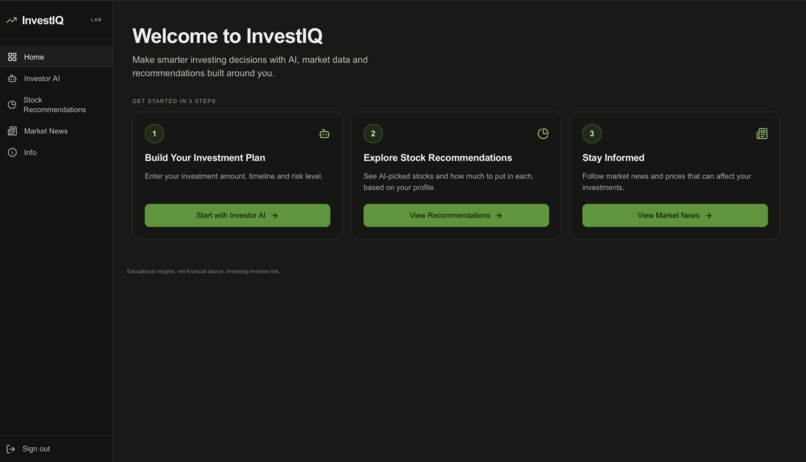
Start here to learn how InvestIQ works and explore the platform in three simple steps.
-
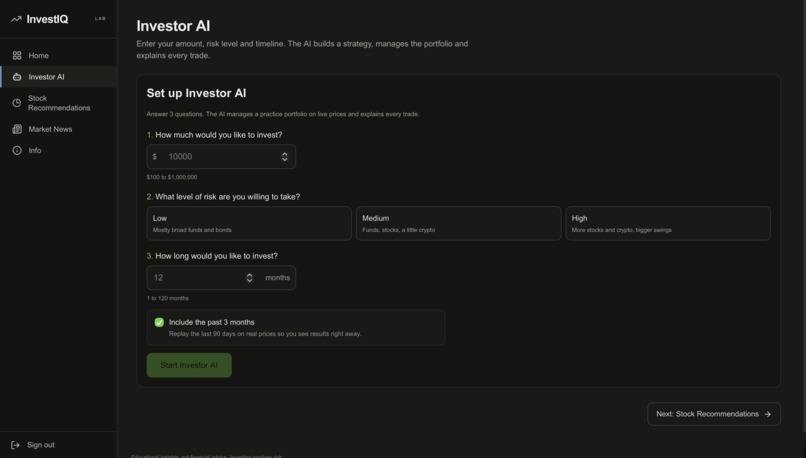
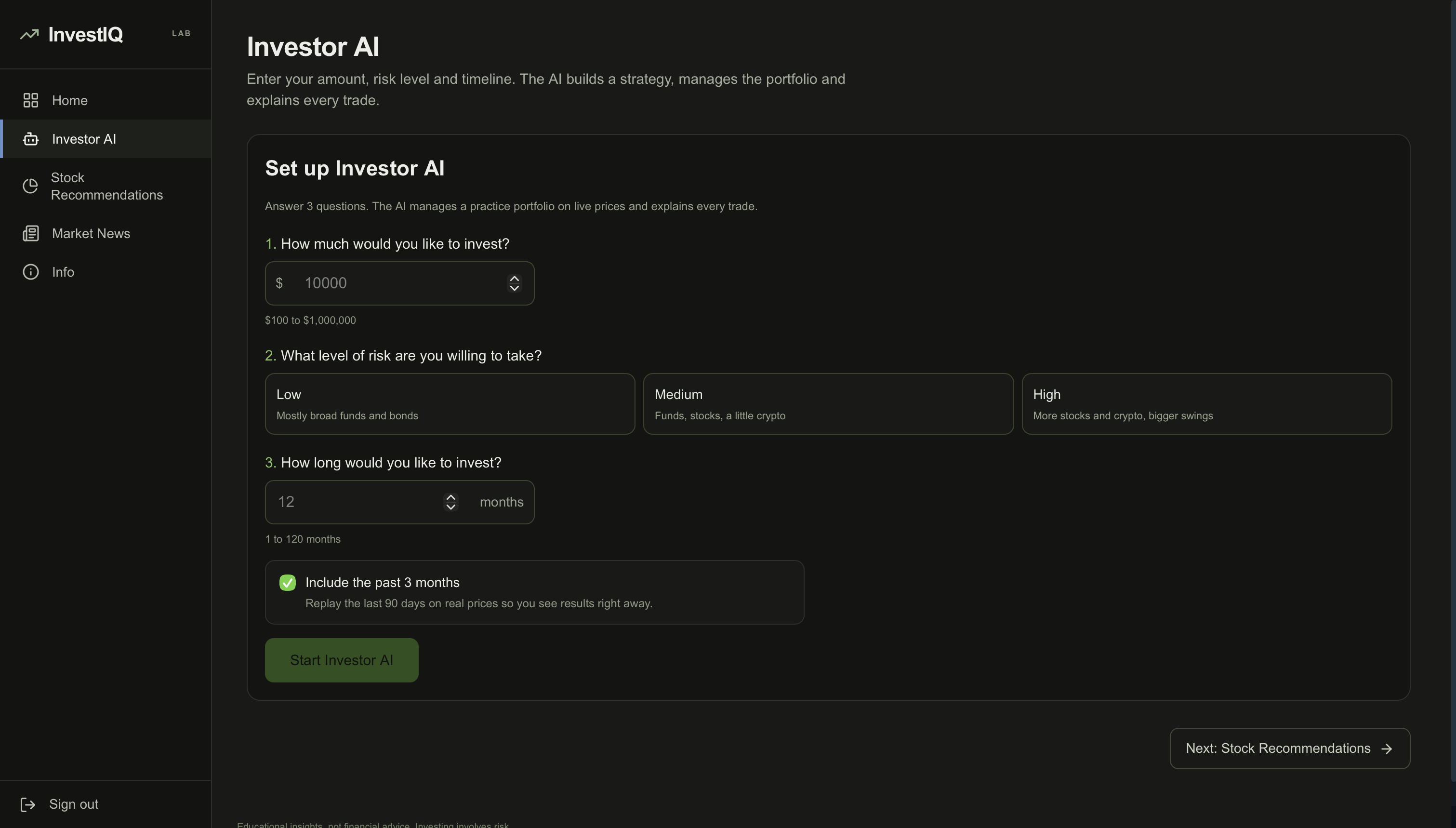
See how AI can manage a practice portfolio based on your risk level, timeline, and investment amount.
-
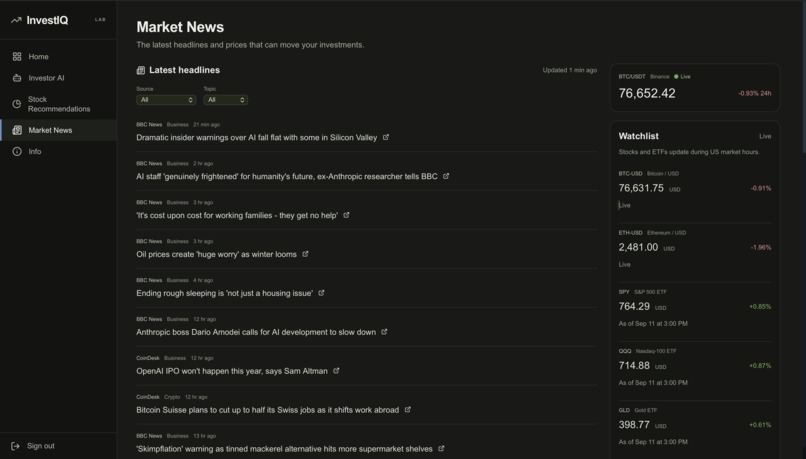
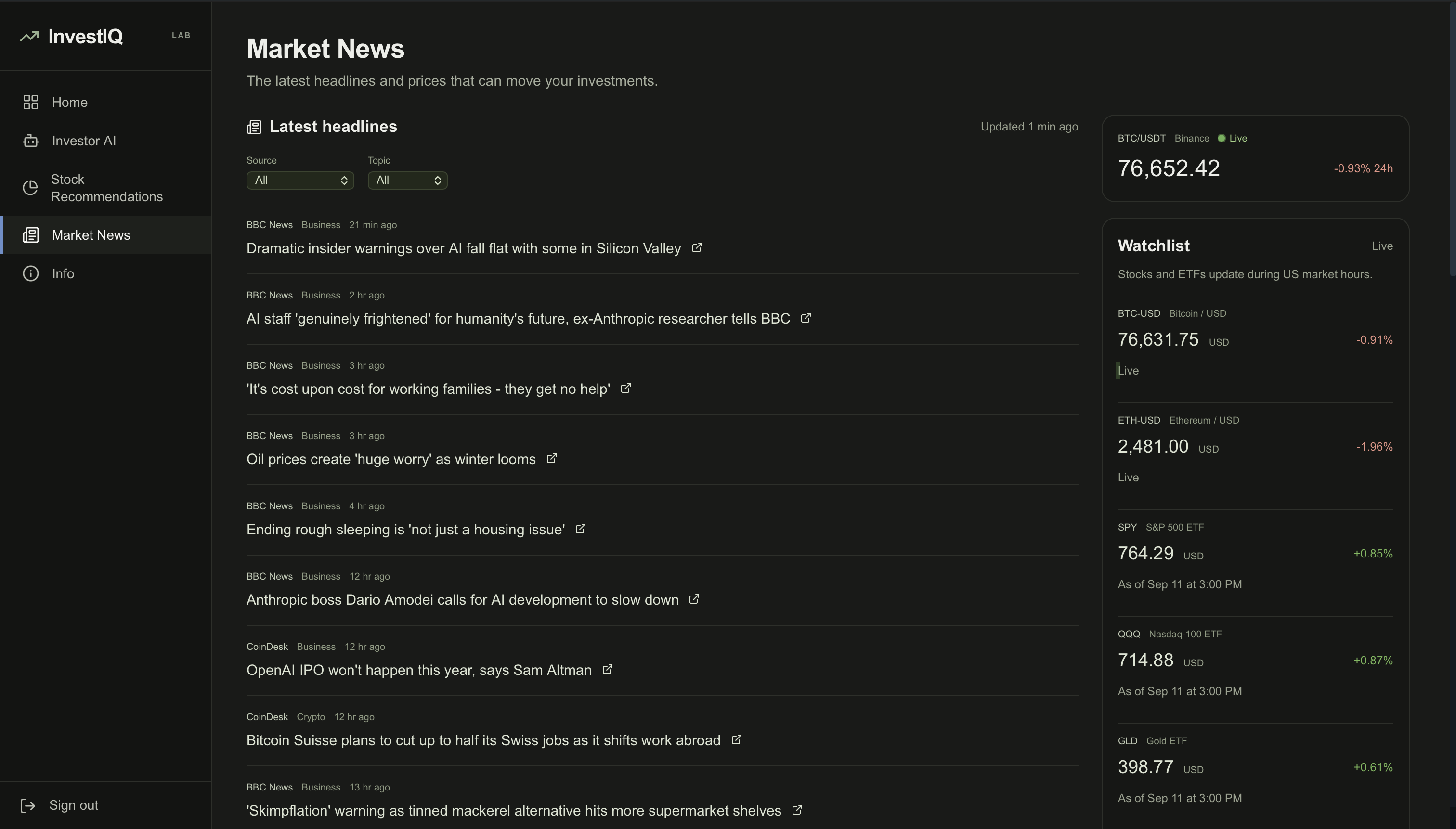
Stay updated with current market headlines, live prices, and news that may affect investment decisions.
-
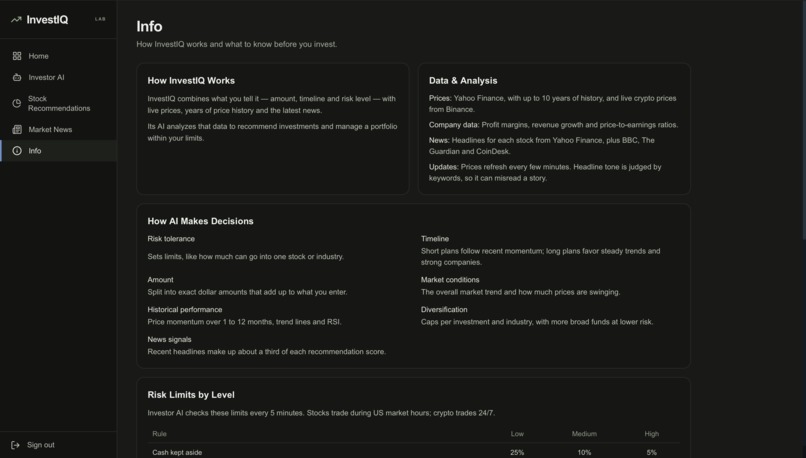
Learn how InvestIQ analyzes the market, makes decisions, manages risk, and uses financial data.
-
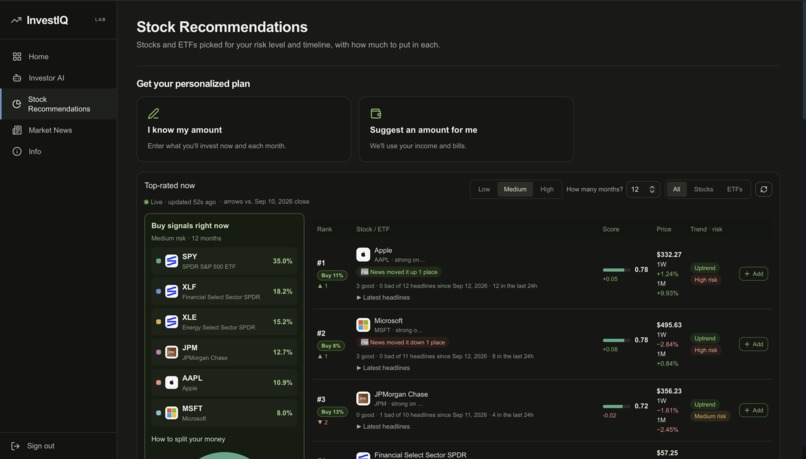
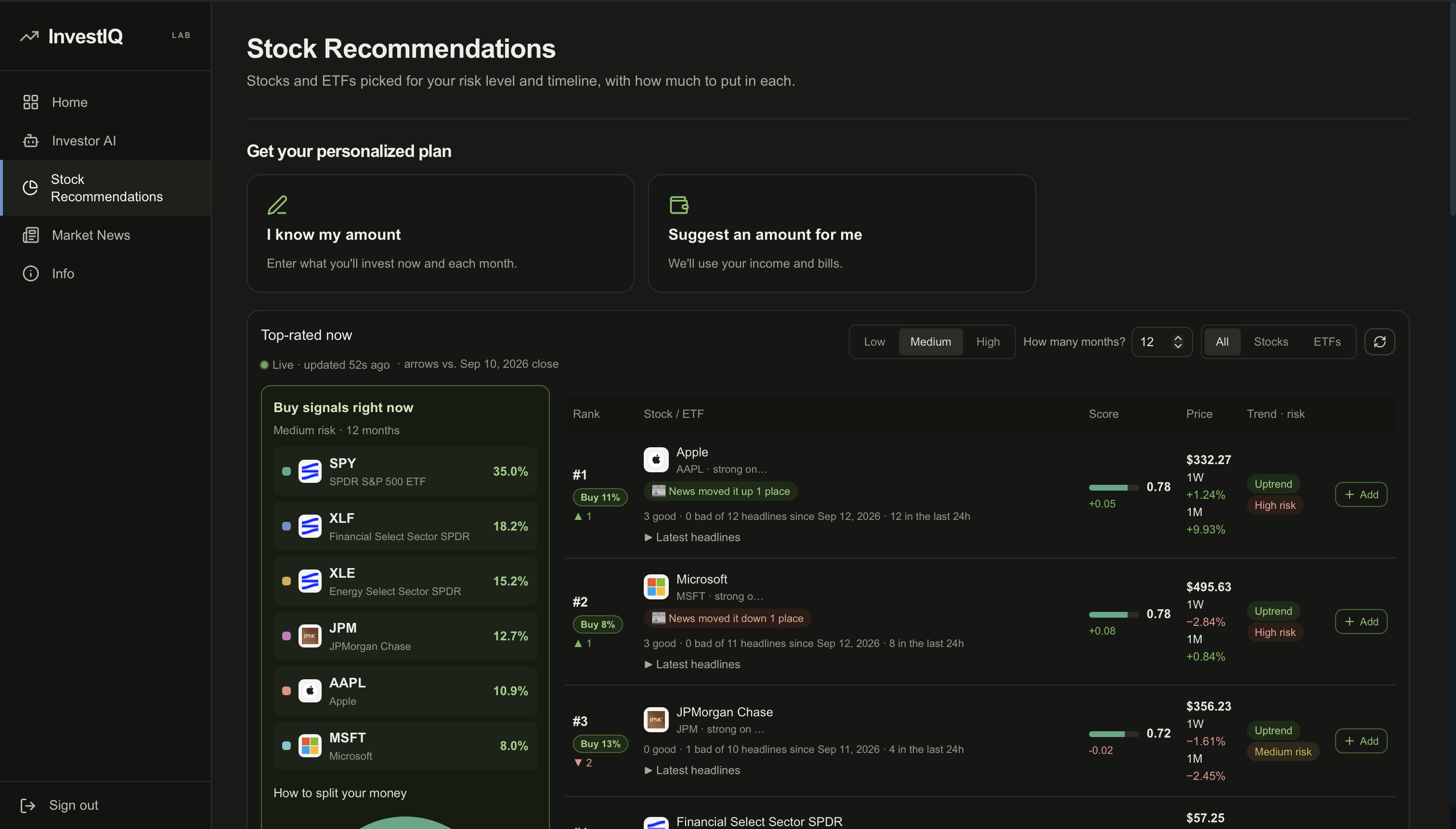
Get personalized stock and ETF recommendations with suggested allocations and clear reasoning.
Inspiration
Investing can feel overwhelming, especially for beginners who do not know what to invest in, how much to allocate, or when a decision makes sense. We wanted to create a platform that makes investing easier to understand instead of presenting users with complicated charts and financial terminology.
That inspired us to build InvestIQ, a beginner-friendly investment platform that combines real market data, personalized recommendations, and transparent AI analysis. Our goal was to help users better understand investment decisions while showing them the reasoning behind each recommendation.
What it does
InvestIQ helps users answer three main questions: what should I invest in, how much should I invest, and why does the recommendation make sense?
The platform includes five main sections:
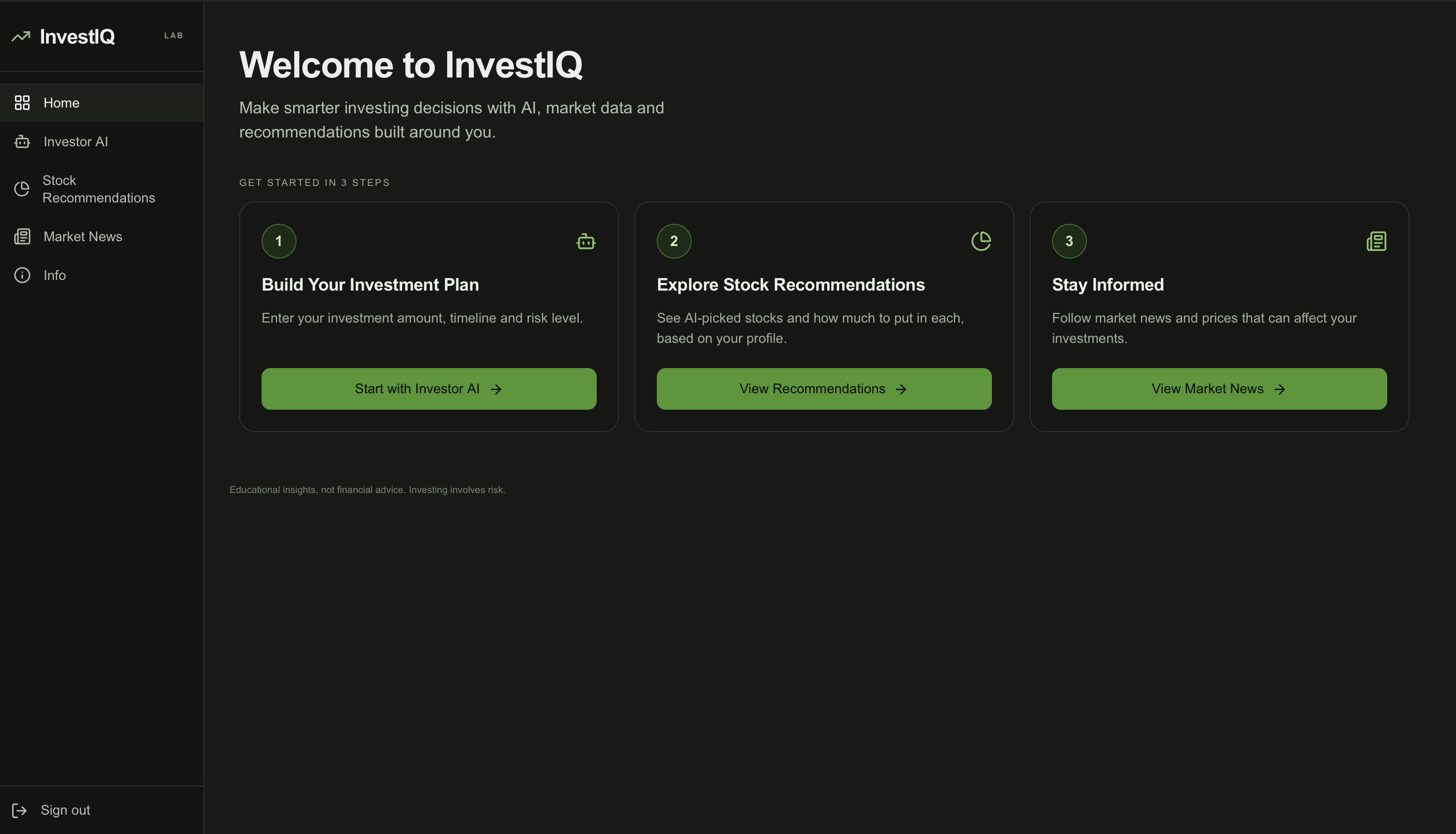
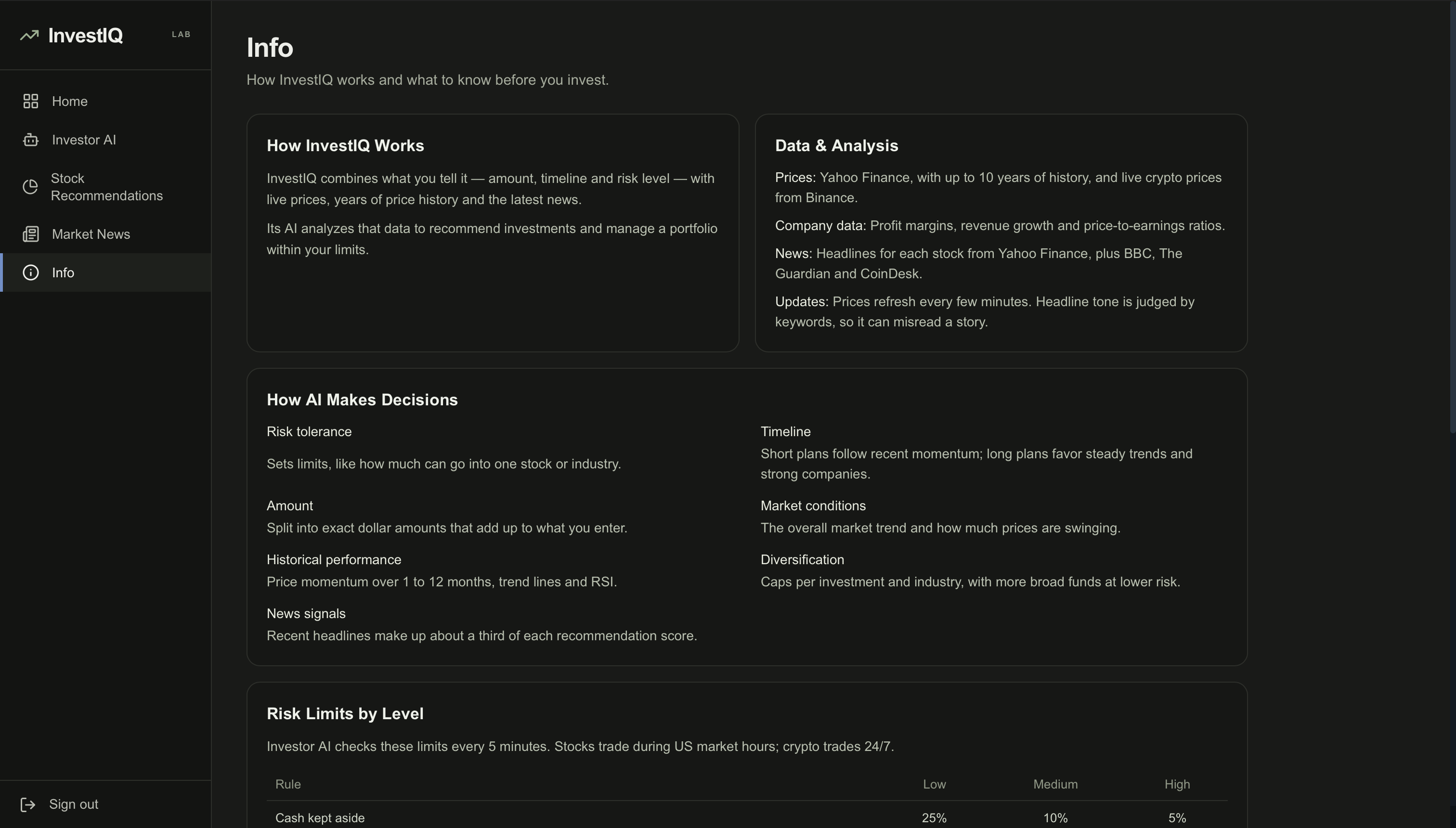
Home: A simple three-step guide that helps new users navigate the platform. Investor AI: Manages a practice portfolio based on the user's investment amount, risk level, and timeline. Users can view portfolio performance, holdings, trade history, and explanations for each decision. Stock Recommendations: Creates personalized investment allocations and ranks stocks and ETFs using current market information. Market News: Displays current business, economic, crypto, and market headlines alongside live market prices. Info: Explains how InvestIQ analyzes investments, its data sources, risk controls, and the reasoning behind its decisions.
InvestIQ analyzes factors including momentum, price trends, RSI, company fundamentals, volatility, and market news to score different assets. Every recommendation includes understandable reasoning instead of presenting users with a black-box result.
How we built it
We built InvestIQ as a full-stack web application.
For the frontend, we used React, TypeScript, Vite, React Router, Recharts, Axios, and Tailwind CSS to create an interactive and beginner-friendly interface.
For the backend, we used Python and FastAPI to handle the API, portfolio logic, market analysis, authentication, and scheduled updates. We used pandas and NumPy for investment calculations such as returns, moving averages, RSI, volatility, scoring, and portfolio allocation.
InvestIQ pulls market information from sources including Yahoo Finance, Binance, and RSS news feeds. We also use WebSockets and Server-Sent Events to update live market prices.
Instead of using a black-box generative AI model, InvestIQ uses a transparent rule-based scoring engine. Each asset receives a score based on market momentum, trends, RSI, fundamentals, news, and volatility. The importance of those signals changes depending on the user's investment timeline and risk tolerance.
Challenges we ran into
One of our biggest challenges was combining multiple types of market information into one consistent recommendation system. Price movement, company fundamentals, volatility, and news can all tell different stories, so we had to determine how each factor should influence an investment score.
Accomplishments that we're proud of
We are proud that InvestIQ became more than a basic stock recommendation tool. We built a complete experience that connects personalized investing, portfolio tracking, market news, live data, and understandable explanations in one platform.
One of our favorite features is "Why This Trade?", which shows users the reasoning behind an Investor AI decision instead of simply displaying a buy or sell action.
What we learned
Building InvestIQ taught us how much complexity exists behind what appears to be a simple investment recommendation.
We learned how to combine financial concepts such as momentum, volatility, diversification, technical indicators, and company fundamentals with real-time software systems.
We also gained experience working with React, TypeScript, FastAPI, Python, pandas, NumPy, WebSockets, APIs, authentication, databases, and live financial data.
What's next for InvestIQ
We would like to integrate licensed real-time financial data, improve news analysis using more advanced AI models, expand beyond the current set of supported assets, and perform larger multi-year backtests against market benchmarks.

Log in or sign up for Devpost to join the conversation.