Inspiration
The inspiration behind InventoryPulse stemmed from the critical need for a more intelligent and proactive approach to inventory management. Traditional systems often fall short in predicting demand, identifying anomalies, and providing actionable insights, leading to inefficiencies like stockouts, overstocking, and missed sales opportunities. We envisioned a solution that leverages the power of AI and real-time data processing to transform inventory management from a reactive task into a strategic advantage, enabling businesses to optimize stock levels, reduce costs, and enhance customer satisfaction.
What it does
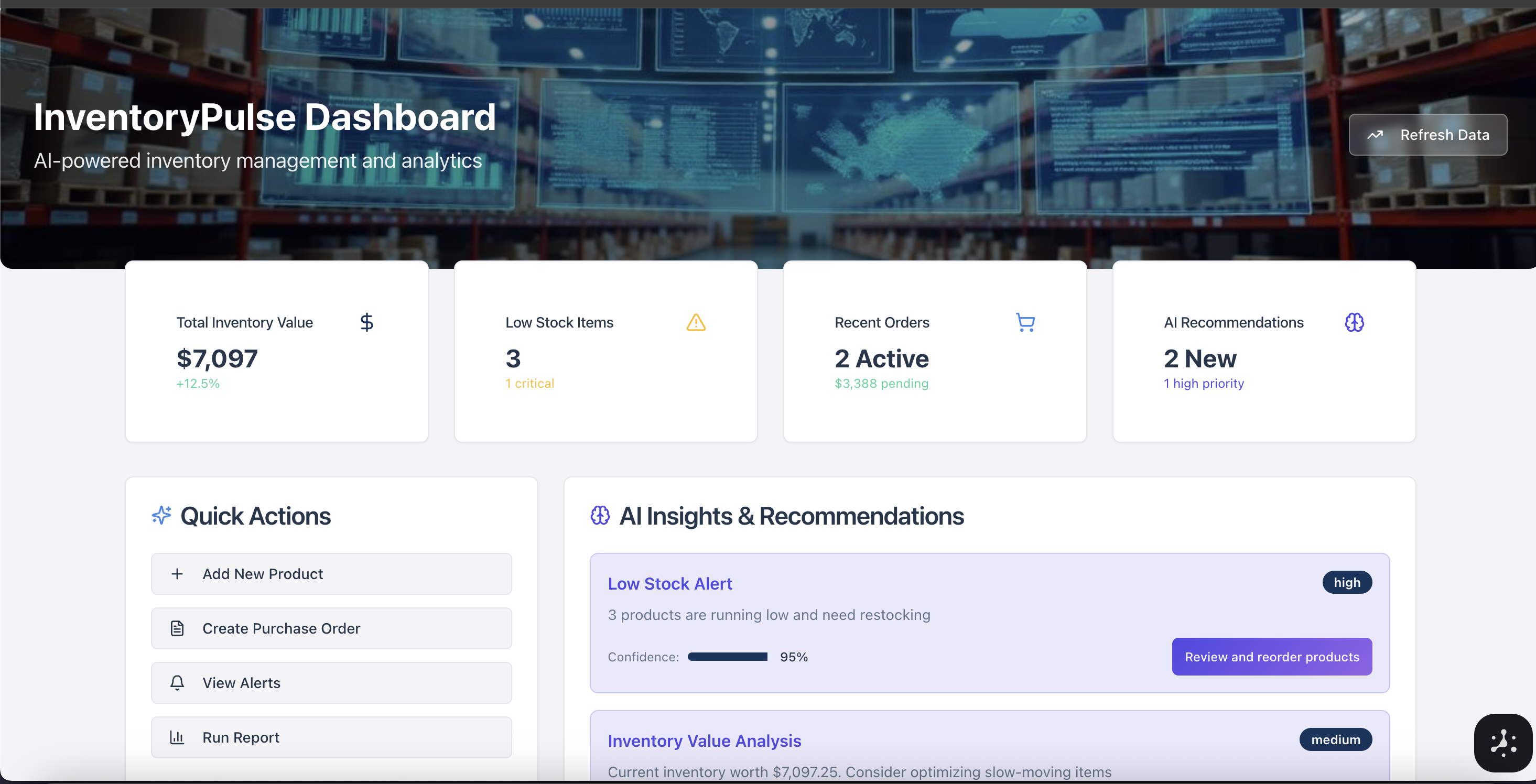
InventoryPulse is an AI-powered inventory management system designed to provide real-time visibility, predictive analytics, and automated decision support. It offers a comprehensive suite of features:
- Real-time Inventory Monitoring: Continuously tracks stock levels, movements, and status across all products.
- AI-Powered Demand Forecasting: Utilizes advanced AI models (like MiniMax LLM, in this case) and historical sales data to predict future demand with high accuracy, considering trends, seasonality, and external market conditions.
- Intelligent Restock Recommendations: Generates optimal reorder quantities and timings based on AI forecasts, current stock, safety stock levels, and supplier lead times.
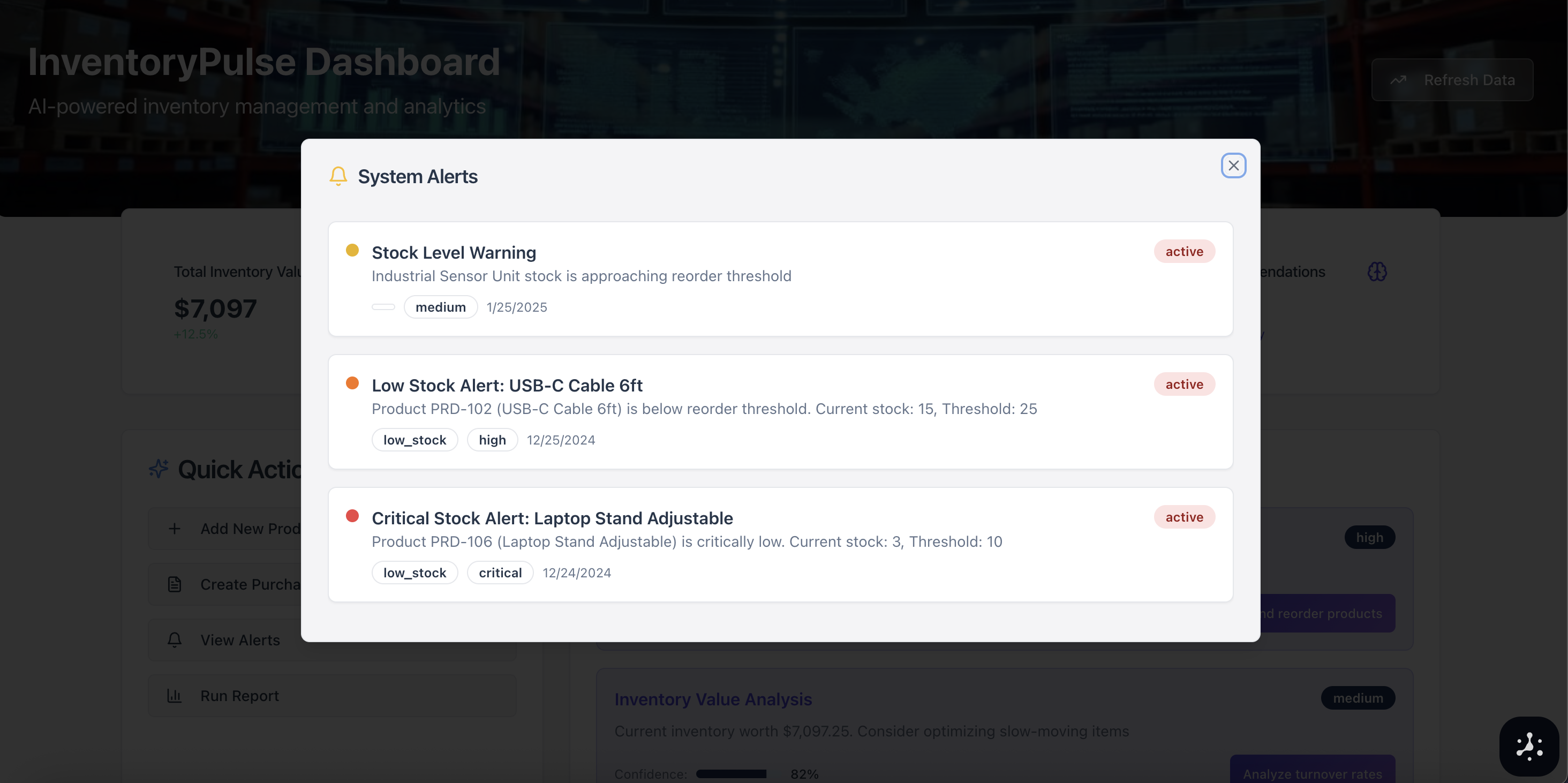
- Anomaly Detection and Smart Alerting: Proactively identifies unusual patterns (e.g., sudden demand spikes, negative stock, excess stock) and triggers real-time alerts with customizable severity and notification channels (e.g., WebSockets, email).
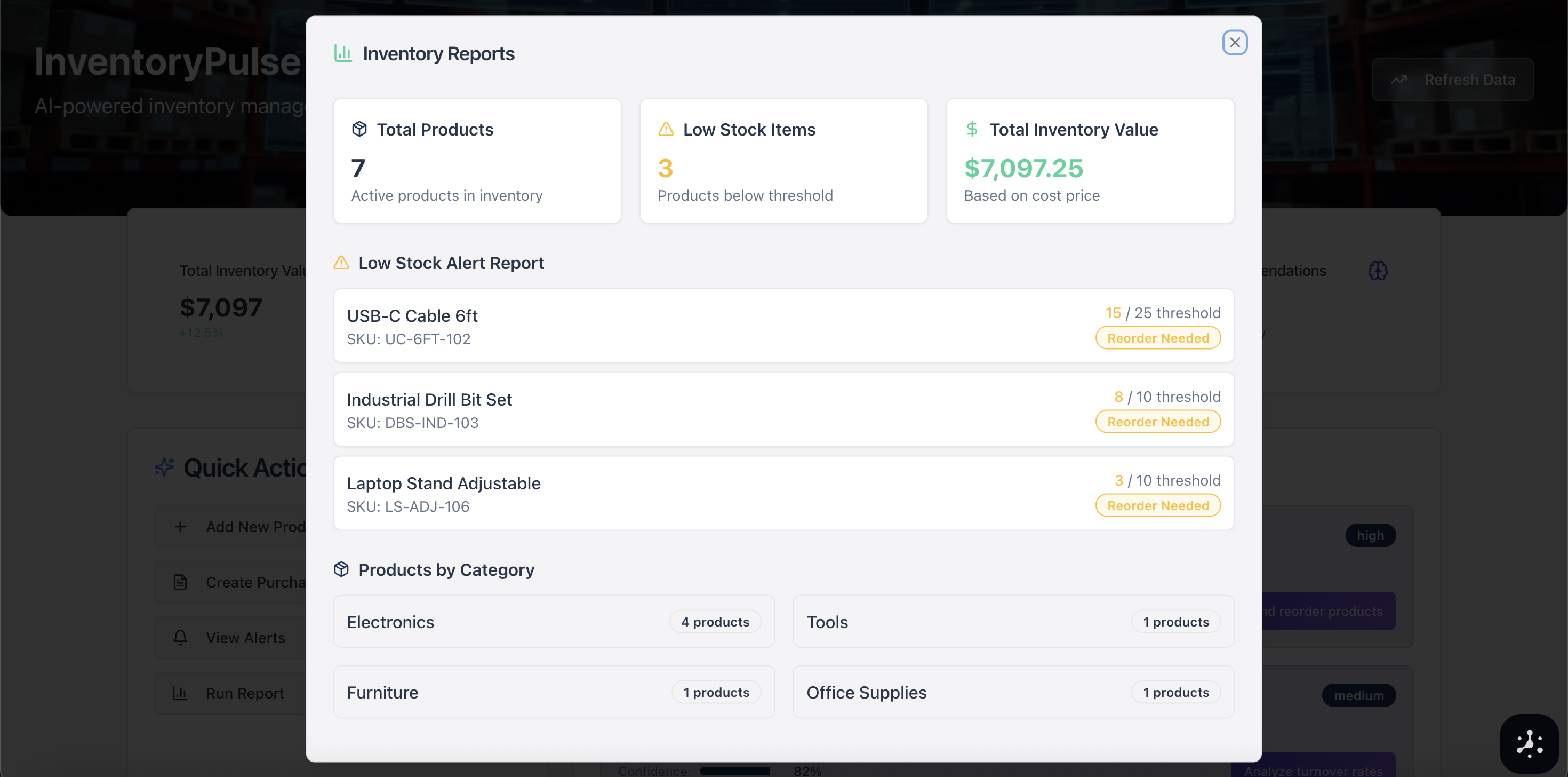
- Comprehensive Analytics Dashboard: Provides Key Performance Indicators (KPIs) such as inventory turnover rate, stock-out rate, carrying cost, and forecast accuracy, presented through an intuitive dashboard.
- Supplier Performance Analysis: Evaluates supplier reliability, quality, and cost-effectiveness to inform procurement decisions.
- Scenario Simulation: Allows users to simulate various inventory scenarios (e.g., demand spikes, supplier delays) to understand potential impacts and plan mitigation strategies.
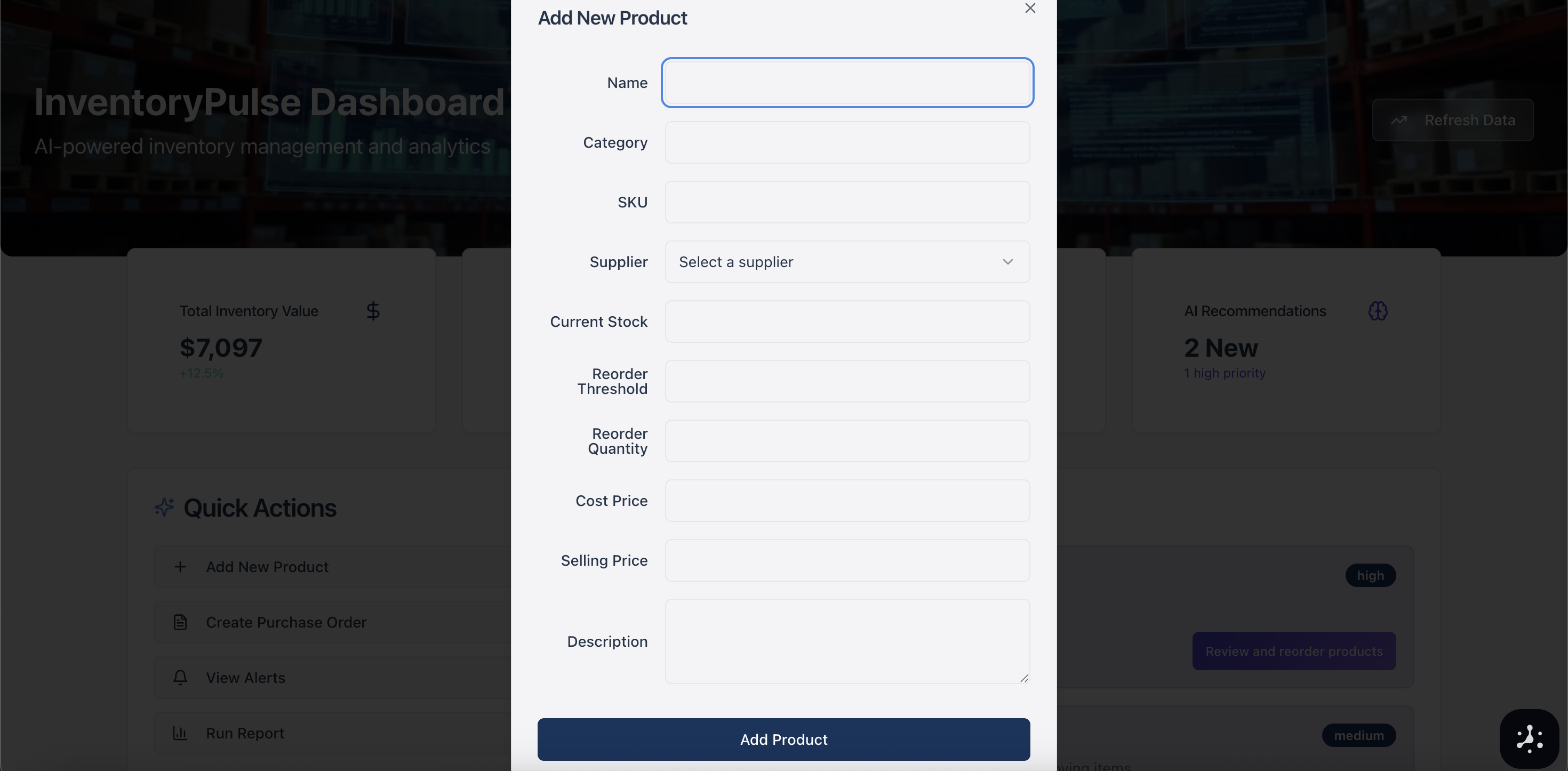
- Centralized Data Management: Manages products, suppliers, purchase orders, and user data within a robust database.
- Model Context Protocol (MCP) Server: Exposes a rich set of 24 standardized tools and their schemas, allowing AI agents to programmatically interact with the system's capabilities for advanced automation and intelligent operations.
How we built it
InventoryPulse is built as a robust and scalable backend application using a modern tech stack:
- Flask & Flask-RESTX: The core of the application is a Python Flask framework, providing a RESTful API with Flask-RESTX for clear API documentation and structure.
- MongoDB: Used as the primary NoSQL database for flexible and scalable storage of operational data like products, suppliers, orders, users, and alerts.
- Snowflake: Integrated as an analytical data warehouse to store and process historical sales and inventory data, enabling complex queries for advanced analytics and AI model training.
- MiniMax LLM: Leveraging MiniMax as the AI engine for sophisticated demand forecasting, anomaly detection, and generating actionable business insights. The integration involves crafting detailed prompts and parsing structured AI responses.
- Temporal.io: Utilized for building resilient and scalable long-running workflows for real-time inventory monitoring, automated restock processes, and continuous anomaly detection. This ensures critical operations are durable and recoverable.
- Python: The entire backend logic, services, and integrations are developed in Python.
- Structured Logging (Structlog): For enhanced observability and easier debugging, ensuring logs are in a machine-readable JSON format.
- Pytest: For comprehensive unit and integration testing to ensure code quality and reliability.
- Docker: For containerization of the application, ensuring consistent deployment across environments.
The architecture is designed with a clear separation of concerns, with models for data structures, routes for API endpoints, and services for business logic and external integrations (DB, AI, Snowflake, Temporal).
Challenges we ran into
Building InventoryPulse presented several interesting challenges:
- Integrating Diverse Technologies: Orchestrating seamless communication and data flow between MongoDB (operational DB), Snowflake (analytical DW), MiniMax (AI), and Temporal (workflow orchestration) required careful design and implementation of service layers and data transformations.
- AI Model Integration and Prompt Engineering: Effectively leveraging the MiniMax LLM for complex tasks like demand forecasting and insight generation was challenging. It involved significant prompt engineering to ensure the AI understood the context, produced accurate, actionable forecasts, and adhered to desired output formats (especially with structured output). Handling potential "hallucinations" or non-compliant responses from the LLM also required robust parsing and fallback mechanisms.
- Real-time Processing with Temporal: Designing and implementing durable workflows with Temporal, especially for continuous monitoring and alert escalation, introduced a new paradigm of state management and error handling across long-running operations. Ensuring proper activity execution and workflow state persistence was key.
- Data Consistency and Synchronization: Maintaining consistency between operational data in MongoDB and analytical data in Snowflake, and ensuring timely updates for accurate forecasting, posed synchronization challenges.
- Scalability and Performance: Architecting the system to handle increasing data volumes and concurrent requests, particularly for real-time analytics and AI inferences, required attention to efficient queries and resource management.
- Mocking for Testing: For robust unit and integration testing, extensive mocking of external services like Snowflake, MiniMax, and Temporal was necessary to ensure tests were fast, reliable, and isolated.
Accomplishments that we're proud of
We are particularly proud of several key accomplishments:
- Successful AI-Powered Forecasting and Insights: Successfully integrating the MiniMax LLM to provide intelligent demand forecasts and actionable business insights is a significant achievement, moving beyond basic statistical models.
- Robust Real-time Alerting with Temporal: Implementing a durable and scalable real-time alerting system using Temporal workflows demonstrates a sophisticated approach to proactive inventory management, ensuring critical issues are detected and escalated immediately.
- Comprehensive MCP Tooling: Developing a comprehensive Model Context Protocol (MCP) server that exposes 24 standardized tools for AI agents is a testament to the system's extensibility and its potential for advanced automation and intelligent decision-making by other AI systems.
- Clean and Modular Architecture: The backend's well-organized and modular design, with clear service boundaries and robust error handling, makes the system maintainable, testable, and scalable.
- Functional Data Integrations: Establishing reliable connections and data flows between MongoDB and Snowflake for both operational and analytical workloads highlights the system's capability to handle diverse data needs.
What we learned
Throughout the development of InventoryPulse, we gained valuable insights:
- The Power of AI in Operations: LLMs like MiniMax can dramatically enhance traditional business processes by providing predictive capabilities and generating actionable intelligence from complex data.
- Importance of Workflow Orchestration: Tools like Temporal are invaluable for building resilient, scalable, and observable long-running processes, especially for mission-critical operations like inventory monitoring and automated procurement.
- Data is King (and its Quality Matters): The accuracy and completeness of historical data directly impact the effectiveness of AI models and analytics. Robust data pipelines and quality checks are paramount.
- Designing for AI Interaction: When building systems that interact with AI agents, providing well-defined tools and structured APIs (like our MCP server) is crucial for enabling effective and predictable AI behavior.
- Iterative Development and Testing: Breaking down complex features into smaller, testable components and using a strong testing framework (Pytest) allowed us to identify and resolve issues early in the development cycle.
- Understanding LLM Limitations: While powerful, LLMs require careful prompt engineering and validation of their outputs, especially when relying on structured responses for automated actions. Fallback mechanisms are essential.
What's next for InventoryPulse
InventoryPulse has a bright future with many exciting possibilities:
- Frontend Development: Building a intuitive and interactive user interface to visualize dashboards, manage inventory, and interact with AI recommendations.
- Integration with ERP/WMS: Developing connectors to integrate with existing Enterprise Resource Planning (ERP) and Warehouse Management Systems (WMS) for seamless data synchronization and workflow automation.
- Advanced AI Features: Exploring more sophisticated AI models for predictive maintenance of inventory equipment, optimizing warehouse layouts, and dynamic pricing strategies.
- Supplier Relationship Management (SRM): Enhancing supplier-facing features, including automated communication for purchase orders, delivery tracking, and performance feedback.
- Mobile Application: Developing a mobile app for on-the-go inventory checks, alerts, and quick actions.
- Blockchain Integration: Investigating blockchain for transparent and secure supply chain tracking.
- More Notification Channels: Expanding alert notification options to include SMS, Slack, Microsoft Teams, and custom webhooks for even broader reach.
- Machine Learning for Anomaly Detection: Implementing more advanced machine learning algorithms (e.g., time-series analysis models) within the
anomaly_detection_workflowto continuously learn and adapt to normal inventory patterns and more accurately flag deviations.
Built With
- minimax-ai
- mongodb
- nlx
- snowflake
- temporal

Log in or sign up for Devpost to join the conversation.