-
-
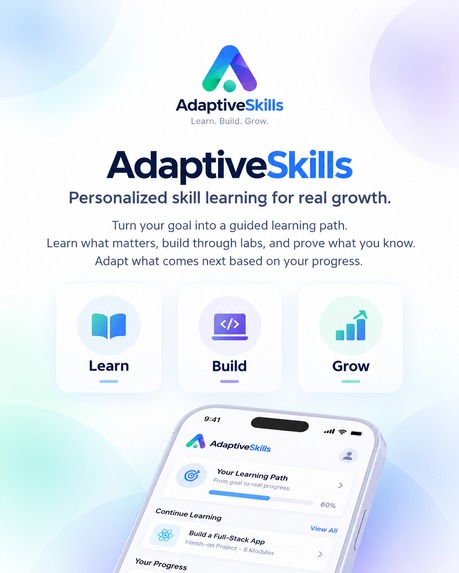
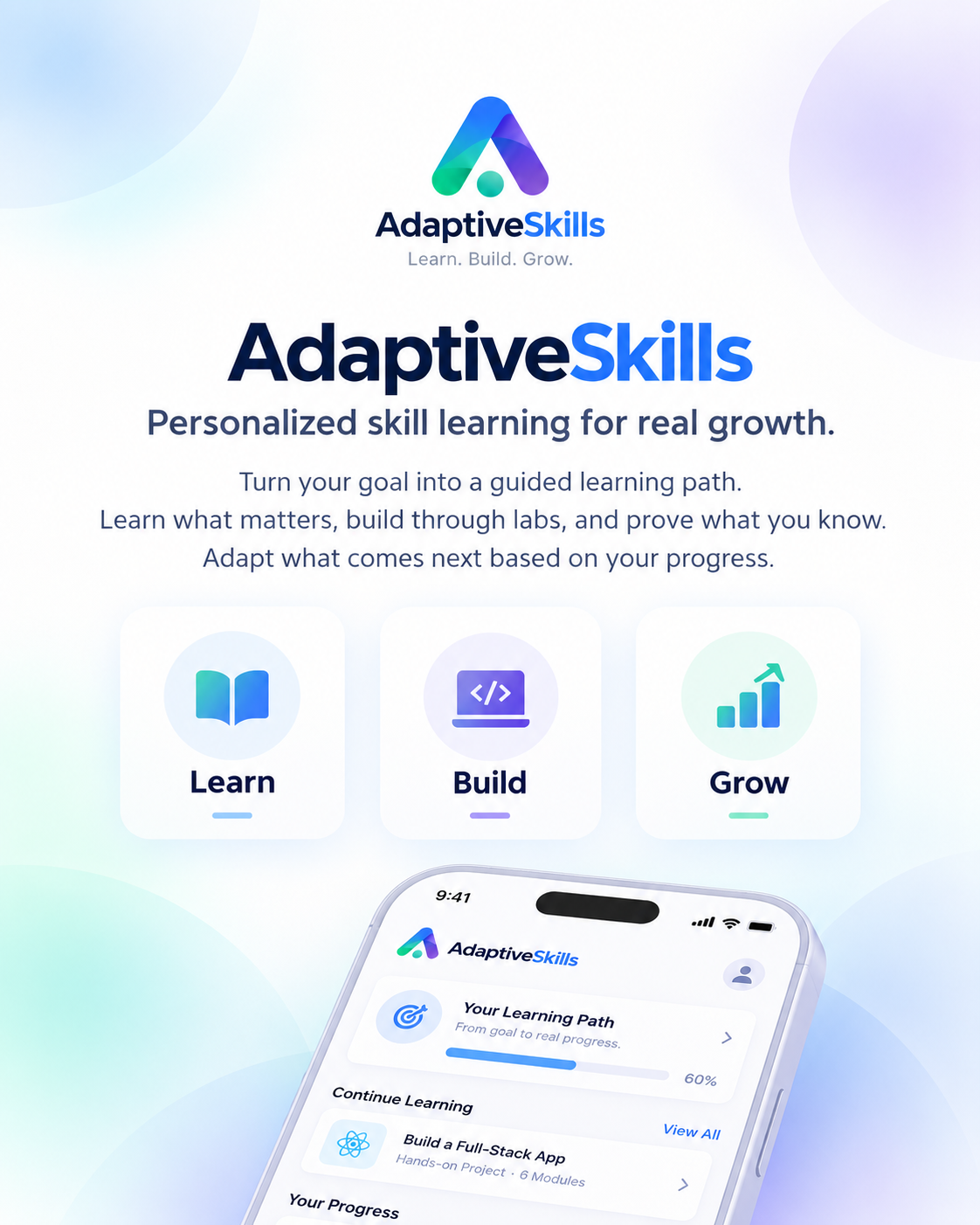
AdapativeSkills
-
Icon
-
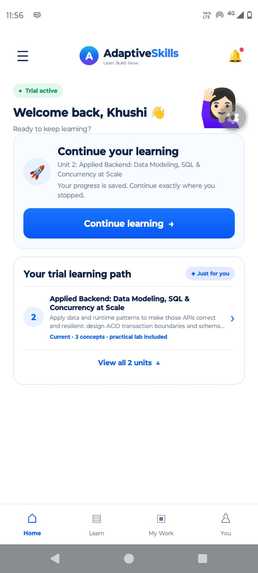
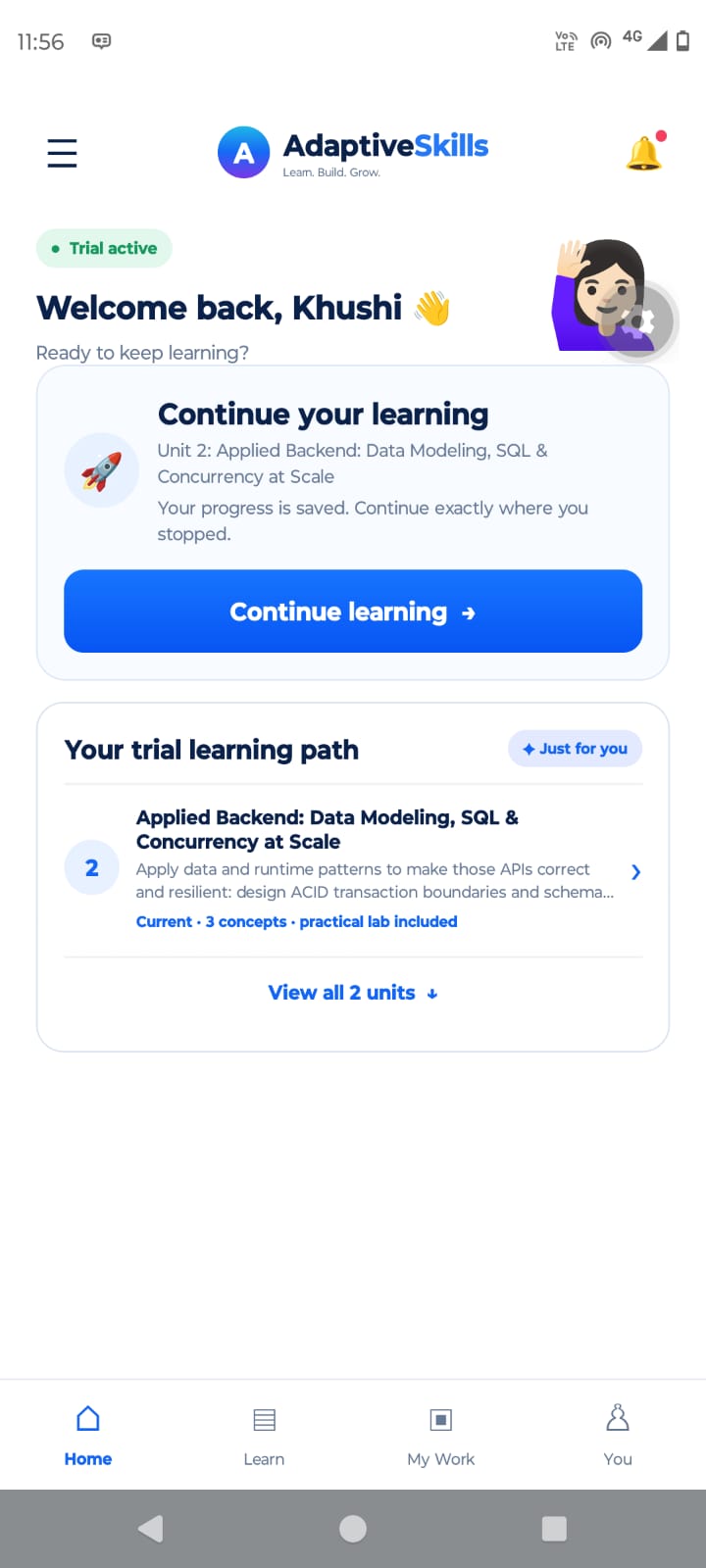
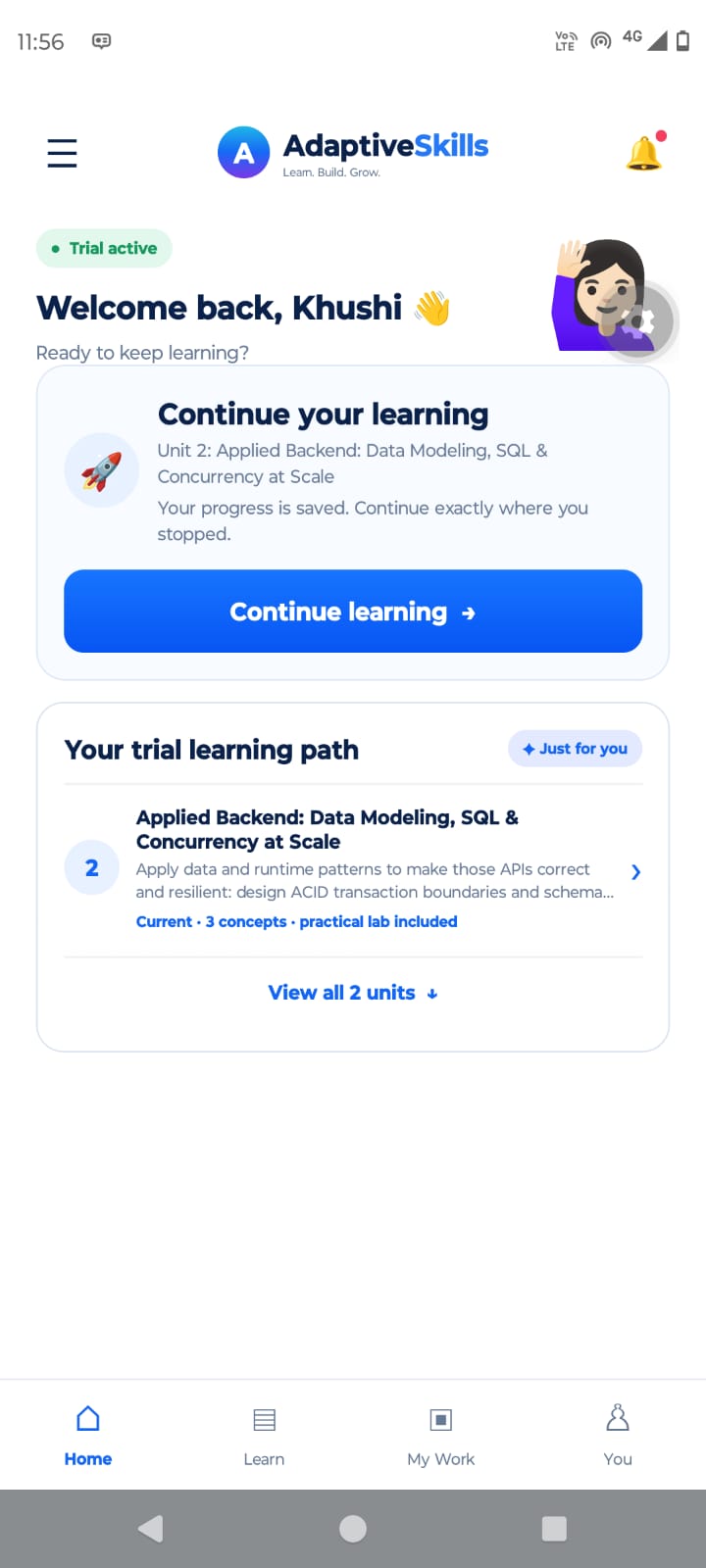
App home screen
-
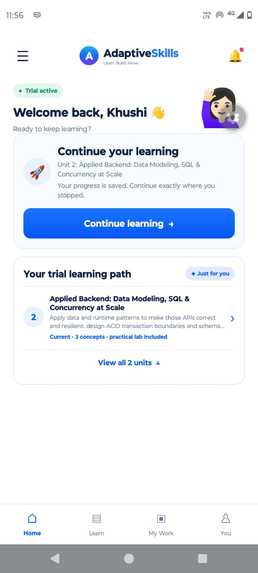
App home screen with units and labs.
-
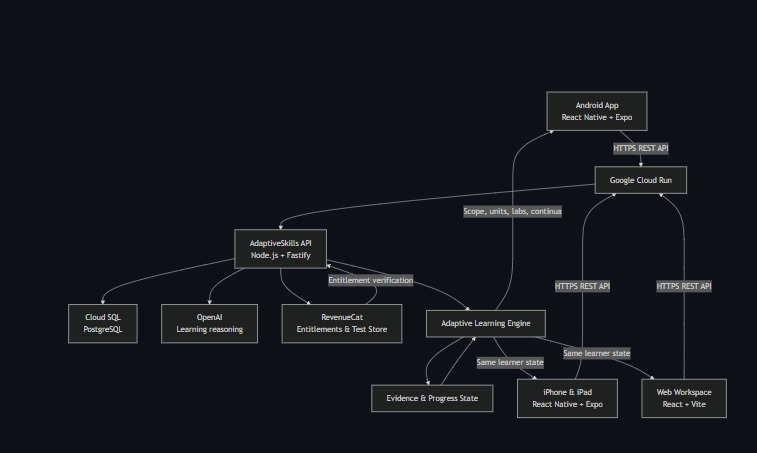
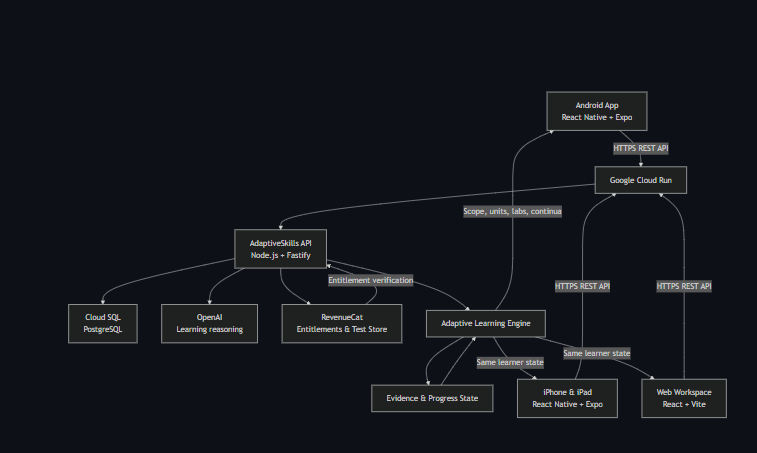
architecture diagram
Inspiration
Learning platforms often teach the same fixed path to everyone, even though people start with different skills, goals, confidence, and pace. We were inspired by how expensive and inefficient it can feel to keep changing courses or platforms just to learn what actually matters for the next step.
AdaptiveSkills is built around a different idea: the learning journey itself should adapt. What comes next should depend on the learner’s goal, current understanding, chosen depth, completed work, and evidence from labs — not on a static syllabus.
As skills grow and goals change, the path should grow with the learner.
What it does
AdaptiveSkills helps people upgrade any skill through a learning path that changes with them.
It:
- maps the learner’s goal, existing knowledge, experience, and desired depth
- builds only the skills and concepts actually needed
- teaches concepts progressively instead of forcing a fixed course
- uses labs and practical work to measure what the learner can really do
- captures notes, doubts, weak areas, and proven knowledge throughout the journey
- adapts upcoming units based on learning evidence, not just course completion
- lets learners go deeper where needed and move faster through what they already know
- continuously creates the next learning runway as the learner improves
V1 focuses on technical and software-engineering skill development, including frontend, backend, APIs, databases, cloud, DevOps, system design, AI/application engineering, and related programming skills.
The learning engine is designed so the same adaptive model can later support additional skill domains beyond software engineering.
The goal is not simply to finish a course. It is to continuously strengthen the skills needed for the learner’s real goal.
How we built it
We built AdaptiveSkills around the idea that skill development should begin with understanding the learner’s target deeply, rather than immediately placing them inside a fixed course.
1. Learner context
The first step is building the learner profile. AdaptiveSkills collects the learner’s current role, experience, existing skills, resume or background, learning goal, preferred depth, and the type of role, product, or capability they are trying to reach.
This becomes the context used throughout the learning journey instead of asking the learner to start from the same generic syllabus as everyone else.
2. Target and skill-gap analysis
If the learner provides a job description, role, project goal, or specific learning objective, AI analyzes that target and breaks it into the capabilities, sub-skills, concepts, dependencies, and practical abilities required to reach it.
AdaptiveSkills then compares that target with what the learner already knows and builds a structured skill map around the remaining gap.
3. Learner-controlled scope and depth
The generated skill map is not treated as final automatically.
The learner can review the proposed scope, keep recommended concepts, remove areas they do not need, add missing topics, and choose how deeply they want to study each area.
That selected depth influences how much theory, implementation detail, practice, and reasoning the system should provide.
4. Small adaptive learning runways
AdaptiveSkills does not generate an entire course upfront.
Instead, it creates a small learning runway first. In the current V1 trial, the learner receives two coherent learning units with practical labs.
This gives the system enough structure to begin teaching while also allowing future units to depend on real evidence collected from the learner rather than assumptions made at the beginning.
5. Goal-aware teaching
Each learning unit is generated around the learner’s target, selected concepts, current level, and chosen depth.
During learning, the learner can:
- create notes
- mark important material
- raise doubts
- request deeper explanations
- indicate that a concept is already known
- identify areas they do not understand
These interactions become part of the learner’s evolving learning context.
6. Practical labs as evidence
After the teaching portion, the learner enters a practical lab based directly on the concepts from that unit.
The learner works inside an editable workspace, can run their work, use a limited hint system, and submit the final result.
The lab is not just an exercise at the end of a lesson. It is one of the main sources of evidence AdaptiveSkills uses to understand the learner’s actual capability.
7. Learning evidence
AdaptiveSkills records more than whether a unit was completed.
It can capture evidence such as:
- what was completed independently
- where hints were required
- where additional explanation was requested
- which concepts were demonstrated successfully
- what the learner already knew
- what still appears weak
- what needs reinforcement
This allows progression to depend on demonstrated understanding rather than only completion percentage.
8. Continuation and adaptation
After the initial two-unit trial, AdaptiveSkills performs a continuation analysis.
It considers the original target together with:
- the remaining skill scope
- completed concepts
- practical lab evidence
- assistance and hints used
- concepts marked as already known
- unresolved doubts and weaknesses
- the learner’s selected depth
AI then proposes the next learning runway from the remaining gap, rather than returning the learner to a predefined course sequence.
As the learner improves, the same cycle continues and the path evolves with them.
9. Access and entitlement layer
RevenueCat is used for the access layer.
The initial trial and continued learning can be represented through entitlements, while AdaptiveSkills itself remains responsible for the learner profile, skill map, learning evidence, progress, adaptation state, and runway generation.
This keeps payment and access control separate from the actual learning intelligence.
10. AI and backend responsibilities
We deliberately separated adaptive intelligence from authoritative product state.
AI is responsible for tasks such as:
- understanding the learner’s target
- decomposing skills
- generating learning material
- explaining concepts
- interpreting learning evidence
- proposing the next learning runway
The backend remains responsible for:
- persistent learner state
- selected skill scope
- progress
- notes and learning evidence
- lab state
- entitlements
- workflow state
- deterministic product rules
The overall system therefore operates as a continuous loop:
target analysis → skill map → selected scope → focused teaching → practical lab → learning evidence → adaptation → next runway
Instead of creating a course once and asking the learner to follow it, AdaptiveSkills continuously rebuilds what should come next from the learner’s actual progress.
Challenges we ran into
Keeping adaptation simple for the learner
AdaptiveSkills has many moving parts — goal analysis, skill mapping, depth selection, teaching, labs, evidence, continuation, and payments. One of the hardest product challenges was making all of that feel like one clear learning journey rather than a complicated system.
Designing our first mobile learning app
This was our first mobile app, so we had to rethink interactions that are much easier on desktop. Code examples, editable lab files, notes, text selection, navigation, and contextual actions all had to stay usable on a small screen without reducing the depth of the experience.
Building practical labs on mobile
The lab experience was especially challenging. We had to handle editable and read-only files, autosave, run results, hints, submissions, file navigation, and touch interactions while still making the workspace feel practical for real learning.
Separating AI from product truth
AI generates explanations, skill scopes, labs, hints, and continuation plans, but learner progress, completed work, evidence, purchases, and resume state must remain reliable. We therefore separated AI reasoning from the deterministic backend rules that control the actual learner journey.
Generating only what the learner needs next
Generating a full course upfront would be expensive and could quickly become irrelevant. We moved to small learning runways generated progressively, using new learning evidence before deciding what should come next.
Keeping learner state persistent
Learners may leave halfway through a concept or lab and return later. Notes, markers, doubts, code, hint usage, progress, and exact resume position all needed to stay synchronized across the journey.
Reconciling RevenueCat with learning access
RevenueCat introduced another important state boundary. A purchase event alone could not define learning state, so entitlements had to stay consistent with our backend progression and continuation logic.
These challenges led us to a clear architecture: AI for understanding and adaptation, persistent backend state for truth, and a mobile interface that reveals complexity only when the learner needs it.
Accomplishments that we're proud of
Building our first complete mobile learning app
AdaptiveSkills became more than an AI demo. We connected onboarding, skill analysis, learning, labs, evidence, payments, continuation, and resume state into one working mobile journey.
Closing the adaptive learning loop
The product can analyze a learner’s target, create a skill scope, teach selected concepts, test them through practical labs, capture evidence, and use that evidence to shape what comes next.
The full loop is:
goal → skill analysis → learning → lab → evidence → continuation → next adaptive runway
Making practical labs work on mobile
We are especially proud of the mobile lab experience, which brings editable files, code, hints, run results, submissions, notes, doubts, and learner state together on a small screen.
Integrating RevenueCat into the learning journey
RevenueCat is not just a checkout button. Entitlements are tied to learning access, so a learner can complete the initial runway, unlock continuation, and move into the next adaptive path while the backend remains responsible for progression and state.
What we learned
Adaptation is more than content generation
We learned that an adaptive learning product needs a clear separation between AI and product state. AI is useful for analysis, explanations, labs, hints, and continuation planning, while the backend should own progress, evidence, access, and deterministic rules.
Mobile changes the learning experience
Building our first mobile app showed us that code editing, text selection, navigation, notes, lab execution, and resume state require much more careful design on a phone than on the web.
Entitlements are product state
RevenueCat changed how we thought about payments. A purchase is not just a transaction; it unlocks a specific stage of the learner journey, while the application still decides what that learner should receive next.
Generate less, adapt more
We learned not to create an entire course upfront. Smaller learning runways are more useful because each new section can be shaped by fresh evidence from the learner.
Most importantly, we learned that real personalization comes from continuously combining goal, prior knowledge, chosen depth, learning behavior, practical evidence, assistance used, and remaining gaps to decide what should happen next.
What's next for AdaptiveSkills
Building a deeper learner model
The next step is to make AdaptiveSkills understand learners across longer periods, not just unit by unit. The system should learn how quickly someone progresses, where they repeatedly struggle, what they can do independently, which types of practice help most, and how their goals change as their skills improve.
Expanding into deep labs
We want to move beyond short exercises into realistic, multi-stage labs where learners build complete features, debug failures, make architecture decisions, work under constraints, and prove skills through sustained practical work.
These labs should adapt from the learner’s evidence instead of giving everyone the same project.
Adding human guidance where it matters
AdaptiveSkills should become more human-centered over time.
AI can prepare context, summarize the learner’s history, identify the exact gap, and suggest where help is needed. Mentors, reviewers, peers, and domain experts can then step in when human judgment adds more value than another automated response.
Supporting collaborative learning
Real professional capability is often demonstrated through teamwork.
Future versions can include shared labs where learners take different roles, contribute to the same project, review one another’s work, resolve dependencies, and build evidence around communication, ownership, collaboration, and technical skill.
Adapting experiences, not just lessons
The long-term adaptive model should combine concept mastery, lab performance, assistance usage, repeated mistakes, project outcomes, collaboration evidence, and long-term progress.
The goal is to move from:
“What lesson should come next?”
to:
“What experience will most effectively improve this learner’s capability next?”
Evolving monetization with the learning model
We want paid access to reflect the value being created rather than wrapping a generic subscription around a fixed content library.
Future paid experiences could include deeper learning runways, advanced labs, long-term adaptive progression, expert review, team environments, and specialized skill tracks.
RevenueCat can continue to manage access and entitlements while AdaptiveSkills determines what each learner actually receives.
Long-term vision
The goal is for AdaptiveSkills to become a platform where AI adaptation, practical evidence, human guidance, deep labs, and collaborative learning work together to help people continuously build real capability rather than simply complete courses.
Demo
Short product demo:
https://youtu.be/2JkxeX9O-Xg
Full demo:
https://youtu.be/QO217C8iUvc
Live web app:
https://adaptive-skills-web-na4j.vercel.app
Android APK:
https://expo.dev/accounts/adaptive-labs/projects/adaptive-skills/builds/56b22098-acfd-47c4-9e20-1a644afe718c
Targeting / Eligibility
AdaptiveSkills is being submitted for the Next Gen Award.
I am currently a Master’s student at Liverpool John Moores University (LJMU), which makes this project eligible for the student-focused Next Gen category.
The project is being submitted with a public GitHub repository:
https://github.com/khushira2244/AdaptiveSkills
The repository contains the source code for AdaptiveSkills, including the mobile application, adaptive learning flow, practical labs, backend logic, and RevenueCat integration used for access and continuation.
For this submission, we are specifically targeting the Next Gen Award.
Built With
- adaptive
- ai
- android
- api
- expo.io
- express.js
- learning
- mobile
- native
- node.js
- openai
- postgresql
- prisma
- react
- rest
- revenuecat
- typescript

Log in or sign up for Devpost to join the conversation.