VentureScout
Formerly InventionScout
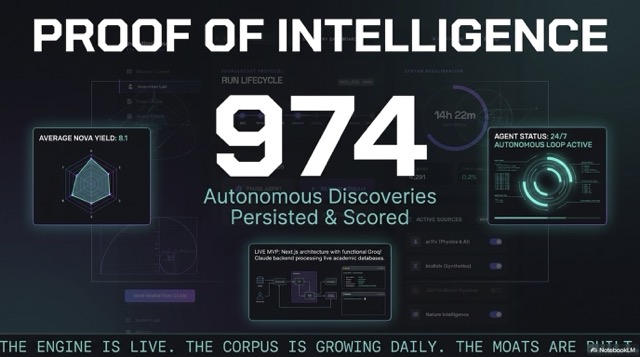
VentureScout is an AI-native operating system for venture creation that discovers commercially promising breakthroughs in research, evaluates their real-world viability, and transforms them into evidence-backed venture opportunities—before a company exists.
Inspiration
VentureScout started with a paper I wrote myself: a theoretical framework called the Triadic Field Model. It was never intended to be a business plan.
After finishing it, I went back through the citations, implications, and logical extensions and realized the paper contained far more than its central argument. Buried inside were the outlines of two books, a curriculum, a coaching methodology, and a scalable business model—a compressed archive of potentially valuable ideas that might never see daylight because my attention had been focused on publishing the theory itself.
That raised a much bigger question:
If one paper could contain this much unrealized commercial potential, how many others do?
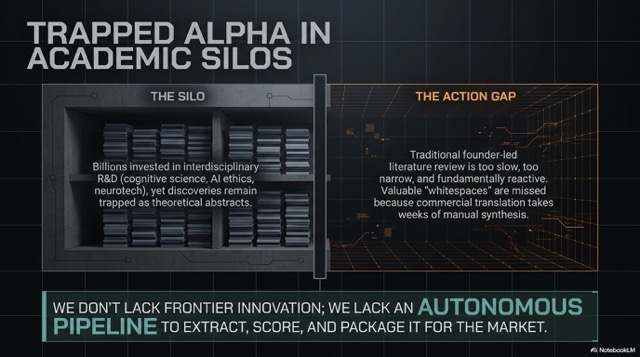
Millions of research papers are published every year, yet only a fraction of scientific and technical discoveries make the leap from knowledge to useful products, companies, or technologies.
The problem isn't simply discovering research. We already have excellent tools for that.
The missing layer is translation.
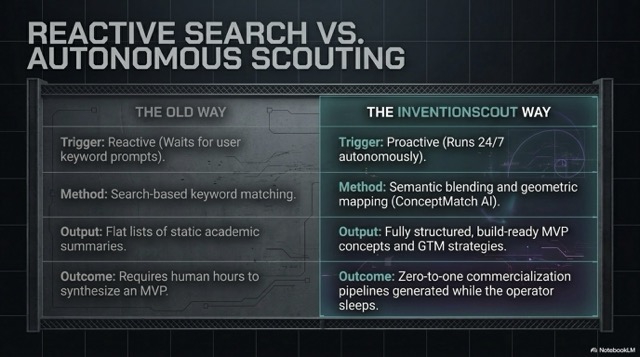
Research tools help people find what is known. Startup and market-intelligence platforms track companies and markets that already exist. VentureScout operates between those worlds: identifying what could exist next.
The best startup idea someone hasn't built yet may already be sitting in a PDF.
VentureScout was created to find it.
What it does
VentureScout continuously analyzes public research and innovation signals the way a venture builder would—not simply asking "What did these researchers discover?" but:
"What could someone build because this discovery exists?"
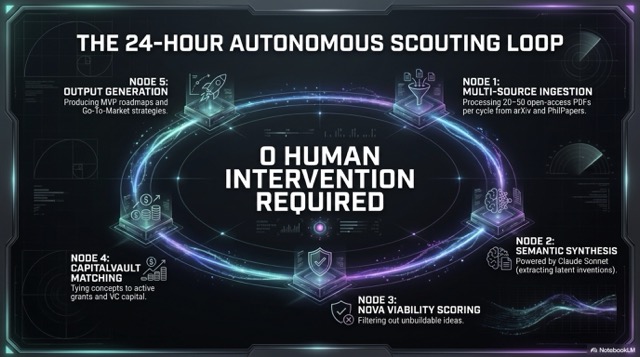
The platform turns that question into an autonomous pipeline:
Discover — Monitor research and innovation sources for emerging technical signals.
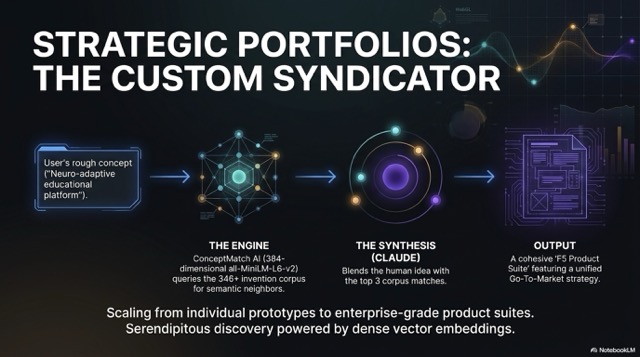
Connect — Cluster related discoveries across papers, disciplines, institutions, patents, and technical domains to identify opportunities that may not be obvious from any single source.
Evaluate — Score opportunities using VentureScout's NOVA framework across four venture-relevance dimensions:
NOVA = (20% × Novelty) + (25% × Utility) + (25% × Feasibility) + (30% × Commercial Potential)
Verify — Preserve the evidence and provenance behind conclusions while identifying uncertainty, prior art, conflicting evidence, and areas requiring additional validation.
Translate — Convert promising research signals into concrete venture concepts: potential products, target markets, technical roadmaps, commercialization strategies, IP considerations, and funding paths.
Route — Connect opportunities with relevant SBIR/STTR programs, capital sources, founders, researchers, and other commercialization pathways.
Instead of returning a list of interesting papers, VentureScout produces an actionable venture thesis explaining what could be built, why it matters, what evidence supports it, what could invalidate it, and what should happen next.
NOVA + the Decision Envelope
A numerical score alone isn't enough for a consequential decision.
VentureScout therefore separates the intrinsic attractiveness of an opportunity from the confidence and context surrounding that judgment.
The canonical NOVA score measures the underlying opportunity.
A complementary Decision Envelope evaluates factors such as:
- Evidence confidence and source diversity
- Discovery breadth
- Reproducibility and verification
- Systemic or technical risk
- Strategic fit and portfolio redundancy
- The appropriate next action
The system can then recommend outcomes such as promote, validate, investigate, request human review, defer, or reject.
This lets VentureScout remain decisive without pretending uncertainty doesn't exist.
How I built it
VentureScout was designed as an AI-native business, not simply a conventional SaaS product with an AI feature added to it.
AI agents participate throughout the operating loop—from discovering opportunities and evaluating evidence to producing venture intelligence and helping improve VentureScout itself.
The architecture is divided into two major planes.
Data Plane
The Data Plane handles the research-to-venture pipeline:
Sources → Ingestion → Normalization → Semantic Retrieval → Clustering → Evidence Analysis → NOVA Scoring → Decision Envelope → Venture Generation
Research signals can be collected from sources such as arXiv, bioRxiv, medRxiv, Semantic Scholar, CORE, and USPTO data.
PostgreSQL provides the structured system of record, while pgvector supports semantic similarity, prior-art retrieval, deduplication, and discovery of relationships that keyword searches alone can miss.
Control Plane
The Control Plane manages autonomous operation and continuous improvement.
Several specialized components divide responsibility:
- SourceScout discovers and ingests new research signals.
- Research Executor verifies evidence, investigates prior art, and tests hypotheses before opportunities are promoted.
- MetaBrain analyzes product telemetry, research patterns, codebase changes, user feedback, platform health, and other internal context to identify improvement opportunities.
- MetaForge turns approved improvement proposals into implementation work.
- Rollup Daemon aggregates execution, latency, service-level, and usage telemetry into an operational picture of system health.
This creates an unusual feedback loop:
VentureScout helps build VentureScout.
The system can analyze research relevant to its own architecture, identify capability gaps, propose improvements, and help implement validated changes.
That dogfooding is intentional. If VentureScout cannot help identify and prioritize meaningful improvements to its own venture, it cannot credibly claim to do so for someone else's.
Gemini and Google Cloud
Gemini is integrated into the production intelligence pipeline for tasks including structured research extraction, evidence analysis, opportunity reasoning, scoring support, and the interactive VentureScout copilot.
The architecture also uses Google Cloud services for model infrastructure, embeddings, observability, and production operations, while supporting additional model providers where useful for resilience and specialized workloads.
The application itself is built primarily with:
Next.js · TypeScript · PostgreSQL · pgvector · Python · FastAPI · Gemini · Google Cloud · Google OAuth · Tailwind CSS
The goal wasn't to make Gemini a chatbot sitting beside the product.
The goal was to make AI part of how the business itself operates.
Challenges I ran into
The hardest challenge wasn't making the system look intelligent.
It was making its decisions trustworthy enough to act on.
An autonomous system can easily produce impressive-looking opportunities. Agents can run continuously, dashboards can fill with telemetry, and models can generate persuasive explanations.
But persuasion isn't the same as evidence.
Early scoring approaches placed too much emphasis on novelty. That produced ideas that sounded fascinating but could be technically impractical, poorly supported, or commercially weak.
That realization fundamentally changed the architecture.
Feasibility had to gate excitement.
Rather than continually modifying the NOVA score whenever a new signal became available, I kept the four-axis score canonical and introduced the Decision Envelope around it. That allowed evidence confidence, strategic fit, discovery breadth, systemic risk, and other contextual signals to influence decisions without destroying score comparability over time.
Another challenge was provenance.
A venture thesis assembled by AI isn't particularly useful to an investor, founder, researcher, or technology-transfer office if nobody can determine where its claims came from. Evidence therefore became a first-class architectural concern rather than metadata added afterward.
Every important conclusion needs a path back to its supporting research.
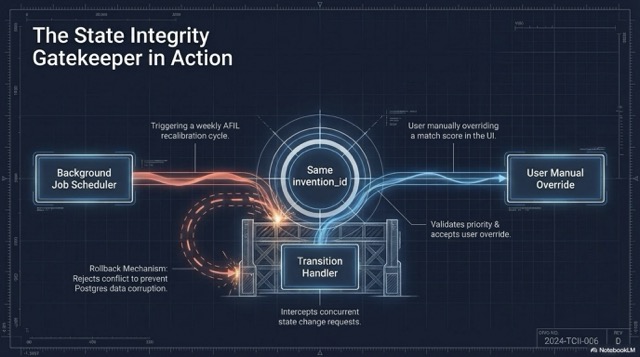
The engineering foundation presented its own challenges as the prototype became a production system. Legacy reference code introduced dependency and TypeScript conflicts. Database-to-worker mappings exposed inconsistent state representations. Retry and backoff behavior created edge cases in autonomous workers.
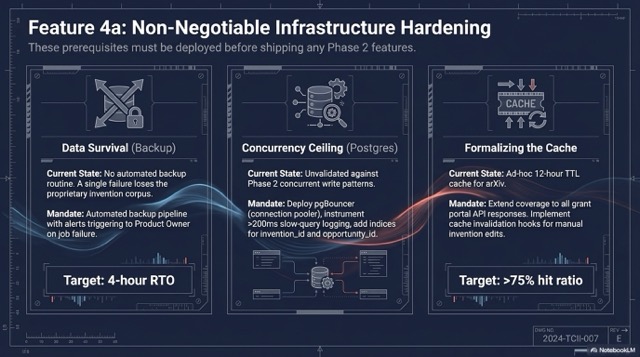
Solving those problems required stronger typed contracts, clearer workspace boundaries, normalized mappings, regression tests, telemetry, and explicit failure handling.
The larger lesson was simple:
Autonomy without operational discipline creates faster failure, not intelligence.
Accomplishments that I'm proud of
I'm most proud that VentureScout became more than an AI research demo.
I built an end-to-end system capable of moving from raw research signals toward structured venture opportunities while preserving the evidence used to reach those conclusions.
I developed NOVA as a stable framework for separating novelty from utility, feasibility, and commercial potential—and the Decision Envelope as a mechanism for expressing confidence and uncertainty without hiding either behind artificial numerical precision.
I built an architecture where specialized AI agents don't merely generate content; they participate in recurring operational workflows with explicit responsibilities, telemetry, evidence, and decision boundaries.
I also built MetaBrain and MetaForge, creating a feedback mechanism through which VentureScout can identify and help execute improvements to its own operating environment.
Most importantly, I shifted the product's unit of value.
The output isn't a paper.
It isn't a summary.
It isn't even an idea.
The output is a decision someone can act on.
That distinction changed almost every part of the system.
What I learned
The biggest thing I learned is that the research-commercialization gap is primarily a translation problem.
The world doesn't suffer from a shortage of discoveries. It suffers from an inability to systematically connect discoveries with problems, markets, capital, builders, and execution pathways.
I also learned that AI-native businesses require a different architecture than AI-enabled software.
Adding an LLM to an application is relatively straightforward. Allowing AI to participate responsibly in the operation of a business requires explicit authority boundaries, observability, provenance, fallback behavior, uncertainty handling, and human escalation.
Another major lesson was that source attribution may be more valuable than model cleverness.
An extraordinary conclusion without evidence is speculation.
A surprising conclusion accompanied by a traceable chain of evidence becomes something a researcher can investigate, an investor can diligence, and a founder can build upon.
Finally, I learned that the most useful AI systems shouldn't eliminate human judgment.
They should make human judgment dramatically more leveraged.
The goal isn't to have VentureScout autonomously declare:
"Build this company."
It's to give someone enough evidence, context, analysis, and execution support to confidently say:
"This is worth finding out."
What's next for VentureScout
The next phase is closing the remaining distance between discovery and formation.
VentureScout will move beyond identifying opportunities toward helping users execute them: generating validation plans, technical MVP specifications, financial models, commercialization strategies, and ready-to-develop SBIR/STTR funding packages.
I'm also building toward deeper integration with university technology-transfer offices, where valuable research and intellectual property can remain dormant simply because commercialization teams lack the bandwidth to investigate every promising signal.
Another major step is an investor, researcher, and founder matching network that can route opportunities toward people with the expertise, capital, or experience required to move them forward.
And as ventures discovered by the platform progress, their real-world outcomes can feed back into NOVA's longitudinal calibration—creating a growing dataset connecting early research signals with eventual commercialization outcomes.
The long-term vision is larger than research discovery.
Imagine an always-on intelligence layer continuously reading humanity's expanding body of knowledge, recognizing when previously disconnected discoveries suddenly make something possible, evaluating whether that possibility is technically and commercially credible, and then assembling the evidence, people, capital, and execution path required to pursue it.
The original insight behind VentureScout (formerly InventionScout) was that one paper could contain a library of unrealized ventures.
VentureScout is being built to find that library—
and help people build what comes next.
Built With
- anthropic
- azure-ai
- bigquery
- docker
- firestore
- google-ai-studio
- google-cloud
- google-cloud-functions
- google-cloud-run
- google-cloud-sql
- google-gemini
- google-notebook
- groq
- next.js
- nextauth.js
- openai
- openrouter
- postgresql
- qwen
- react
- supabase
- tailwind-css
- typescript
- vercel
- vertex-ai


Log in or sign up for Devpost to join the conversation.