-
-
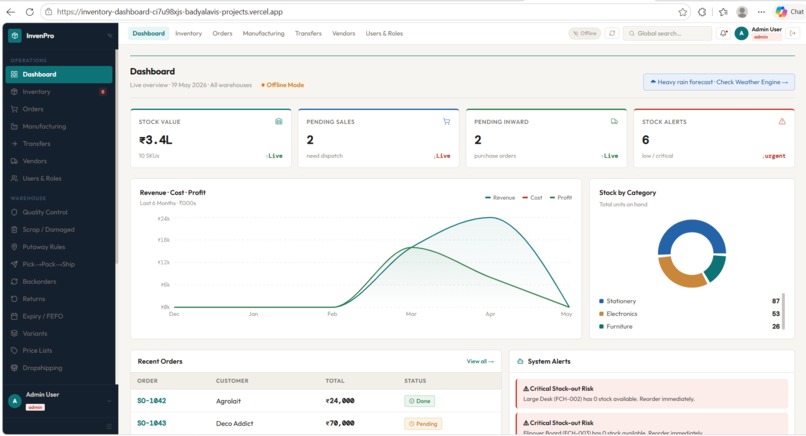
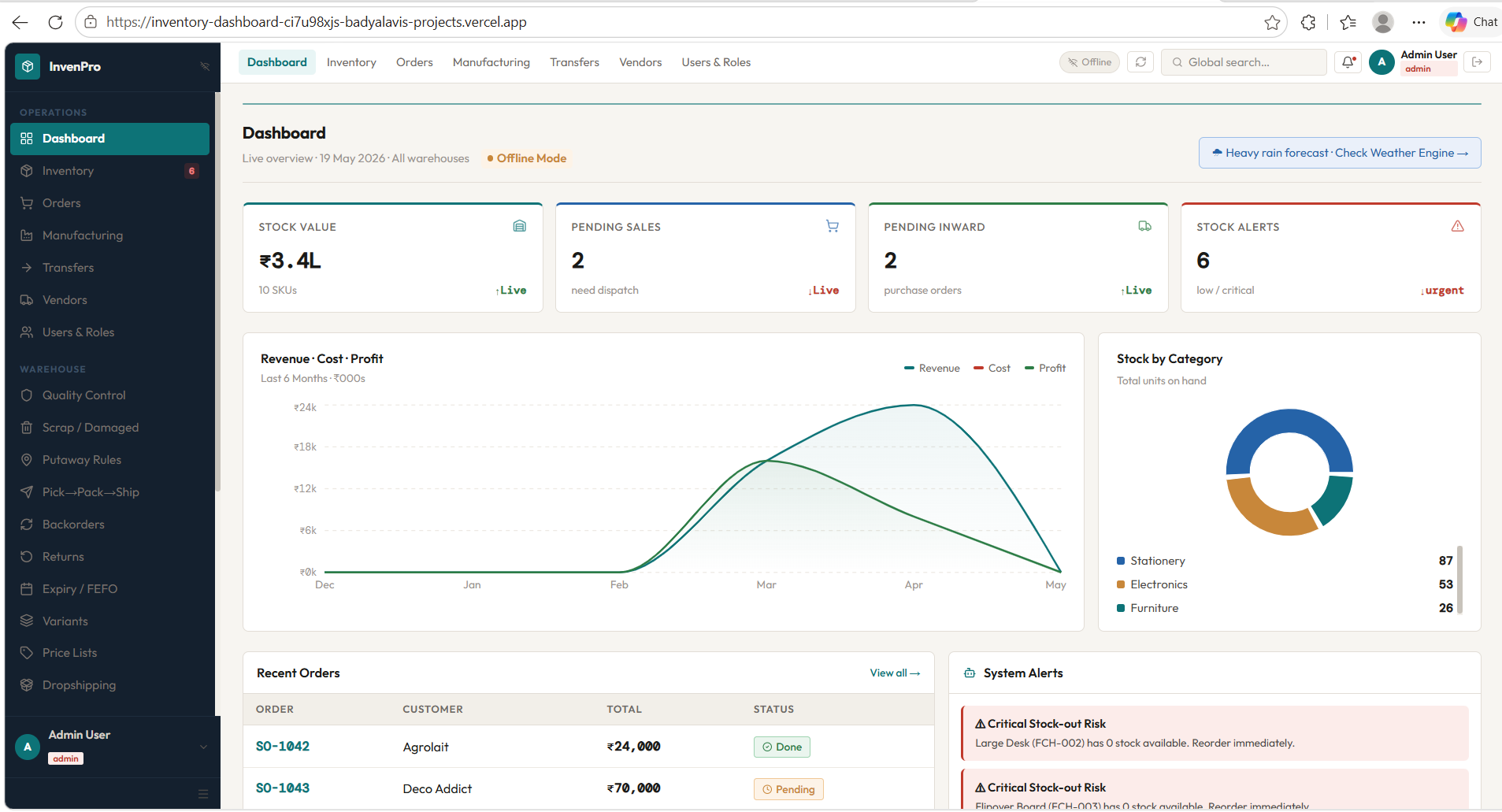
dashboard
-
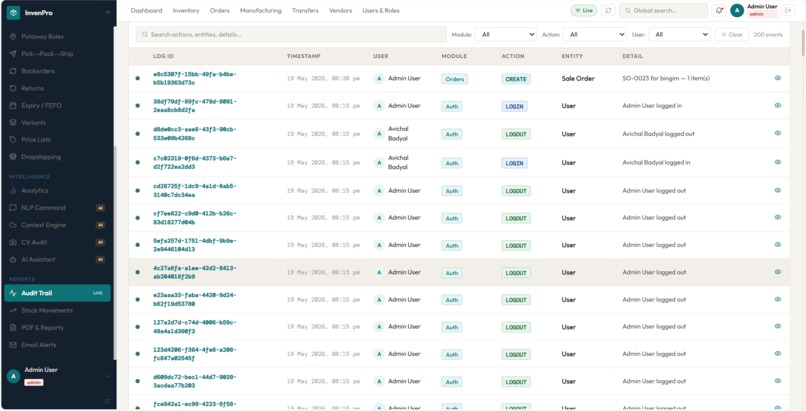
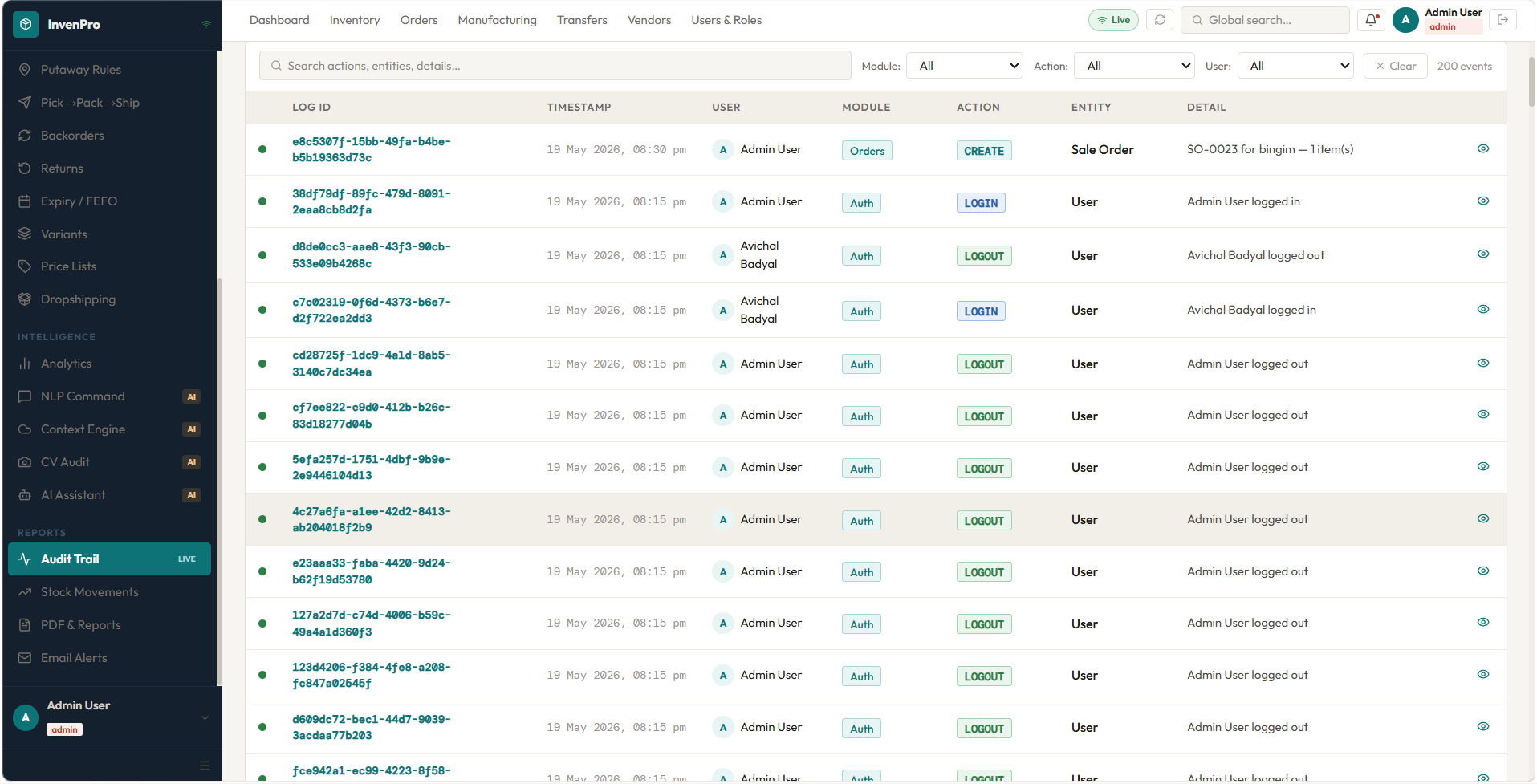
audit trail
Inspiration
The motivation behind InvenPro was to bridge the gap between academic computer science theory and real-world, enterprise-level software engineering. I wanted to build a portfolio piece that goes beyond a standard CRUD application and tackles actual business logic—specifically the complexities of warehouse logistics, order life cycles, and role-based access. Building an ERP from scratch was the perfect way to prove my ability to architect a full-stack system that is scalable, secure, and ready for production environments.
What it does
How we built it
InvenPro is constructed using a modern, decoupled full-stack architecture:
Frontend: Built with React and Vite, utilizing Tailwind CSS for a highly responsive, editorial-quality user interface.
Backend: A robust Node.js and Express.js REST API.
Database: Supabase (PostgreSQL) handles complex relational data and real-time syncing.
Security: Implemented a stateless JWT (JSON Web Token) authentication system with rotating refresh tokens and strict Role-Based Access Control (RBAC) to separate Admin, Manager, and Staff privileges.
Core Modules: Features a custom-built Pick-Pack-Ship fulfillment engine to track order stages and automate inventory allocation dynamically
Challenges we ran into
The most significant hurdles were not just in writing the business logic, but in orchestrating the cloud deployment pipeline. Moving from a local development environment to a live production environment (Vercel for the frontend, Render for the API) exposed me to several strict networking and configuration challenges. I had to deeply troubleshoot Vite build caching mechanisms, resolve misconfigured root directory deployments, and securely configure Cross-Origin Resource Sharing (CORS) policies to allow communication across different cloud domains while protecting the API endpoints.
What we learned
Building and deploying InvenPro solidified my understanding of the entire software development lifecycle. I gained hands-on experience in managing monolithic repositories, debugging hidden environment variable structures, and handling secure network requests. It reinforced the importance of methodical debugging—reading console error logs, tracing network preflight requests, and understanding how cloud platforms route internal traffic.
What's next for InvenPro smart inventory
Here is a comprehensive draft for your "About the Project" section. It highlights your technical architecture, reflects the exact deployment battles you just won, and naturally incorporates an advanced mathematical concept to show off your computer science foundation.You can copy and paste this directly into your GitHub README or portfolio:About the ProjectThe InspirationThe motivation behind InvenPro was to bridge the gap between academic computer science theory and real-world, enterprise-level software engineering. I wanted to build a portfolio piece that goes beyond a standard CRUD application and tackles actual business logic—specifically the complexities of warehouse logistics, order life cycles, and role-based access. Building an ERP from scratch was the perfect way to prove my ability to architect a full-stack system that is scalable, secure, and ready for production environments.How It Was BuiltInvenPro is constructed using a modern, decoupled full-stack architecture:Frontend: Built with React and Vite, utilizing Tailwind CSS for a highly responsive, editorial-quality user interface.Backend: A robust Node.js and Express.js REST API.Database: Supabase (PostgreSQL) handles complex relational data and real-time syncing.Security: Implemented a stateless JWT (JSON Web Token) authentication system with rotating refresh tokens and strict Role-Based Access Control (RBAC) to separate Admin, Manager, and Staff privileges.Core Modules: Features a custom-built Pick-Pack-Ship fulfillment engine to track order stages and automate inventory allocation dynamically.The Challenges FacedThe most significant hurdles were not just in writing the business logic, but in orchestrating the cloud deployment pipeline. Moving from a local development environment to a live production environment (Vercel for the frontend, Render for the API) exposed me to several strict networking and configuration challenges. I had to deeply troubleshoot Vite build caching mechanisms, resolve misconfigured root directory deployments, and securely configure Cross-Origin Resource Sharing (CORS) policies to allow communication across different cloud domains while protecting the API endpoints.What I LearnedBuilding and deploying InvenPro solidified my understanding of the entire software development lifecycle. I gained hands-on experience in managing monolithic repositories, debugging hidden environment variable structures, and handling secure network requests. It reinforced the importance of methodical debugging—reading console error logs, tracing network preflight requests, and understanding how cloud platforms route internal traffic.Future Enhancements: Algorithmic OptimizationIn future iterations, I plan to implement predictive analytics for stock management, moving beyond simple thresholds to dynamic restocking algorithms. Specifically, I intend to integrate the Economic Order Quantity (EOQ) model to minimize total inventory holding costs and ordering costs. The core optimization will calculate the ideal order quantity using the following formula:$$EOQ=\sqrt{\frac{2DS}{H}}$$Where $D$ represents the annual demand quantity, $S$ is the fixed cost per order, and $H$ is the annual holding cost per unit. Implementing this will require complex database aggregations and optimizing API time complexities to ensure the dashboard metrics remain highly performant at scale.
Built With
- axios
- css3
- express.js
- node.js
- postgresql
- react
- tailwind


Log in or sign up for Devpost to join the conversation.