Invariant Forge
About the project
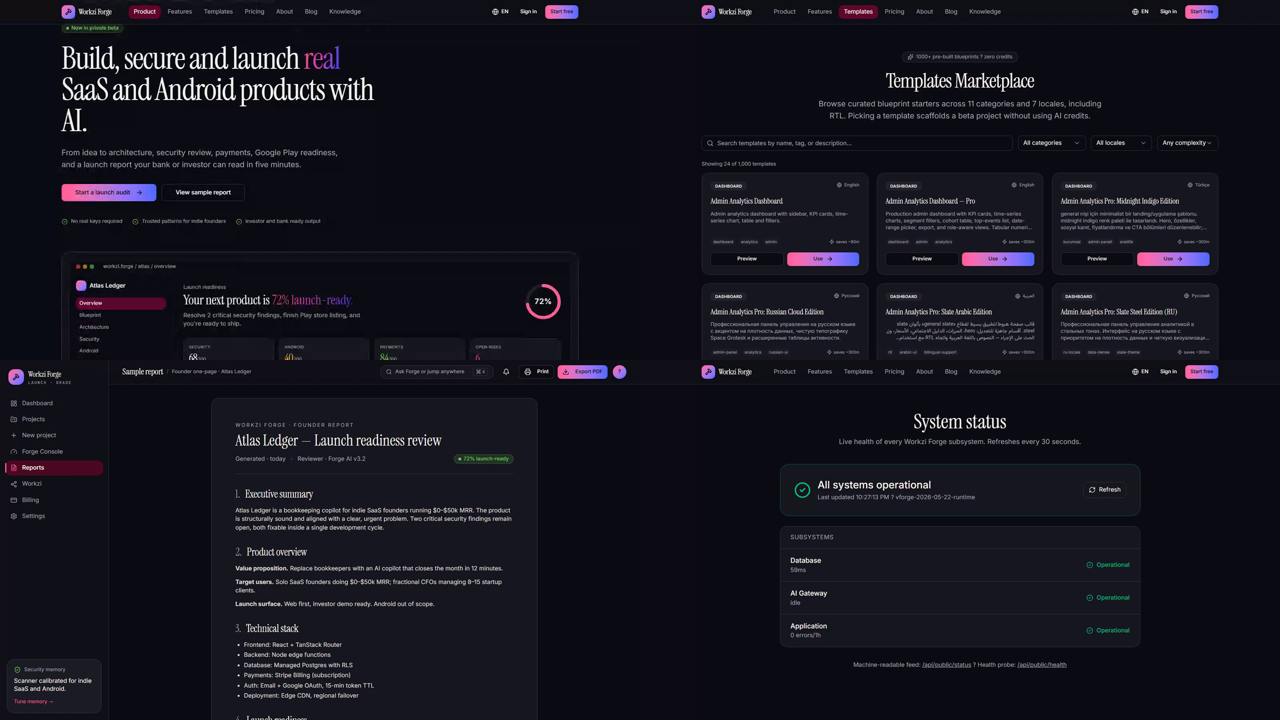
Invariant Forge turns an AI-generated product idea into a launch-ready, reviewable delivery system.
Most AI builders optimize for a fast first screen. That is useful, but it leaves founders with the expensive questions unanswered: Is the architecture coherent? Which security risks still block launch? What must be true before payments, an Android release, or an investor conversation? And can a small team see the evidence behind every recommendation?
Invariant Forge answers those questions by treating product delivery as a chain of verifiable invariants rather than a single chat response. A founder starts with an idea. Forge converts it into a structured blueprint, maps the architecture and implementation plan, routes specialist capabilities, records quality gates, and produces an evidence-led launch report. The result is not just generated output; it is a path a team can inspect, challenge, and ship from.
What it does
- AI Blueprint transforms a product brief into personas, features, risks, milestones, and a prioritized roadmap.
- Architecture Planner translates intent into frontend, backend, data, storage, and deployment decisions.
- Skill Packs and Orchestration compose specialist capabilities into checkpointed work instead of a single opaque agent run.
- Security and migration gates surface risks and hold sensitive changes for review before they become release work.
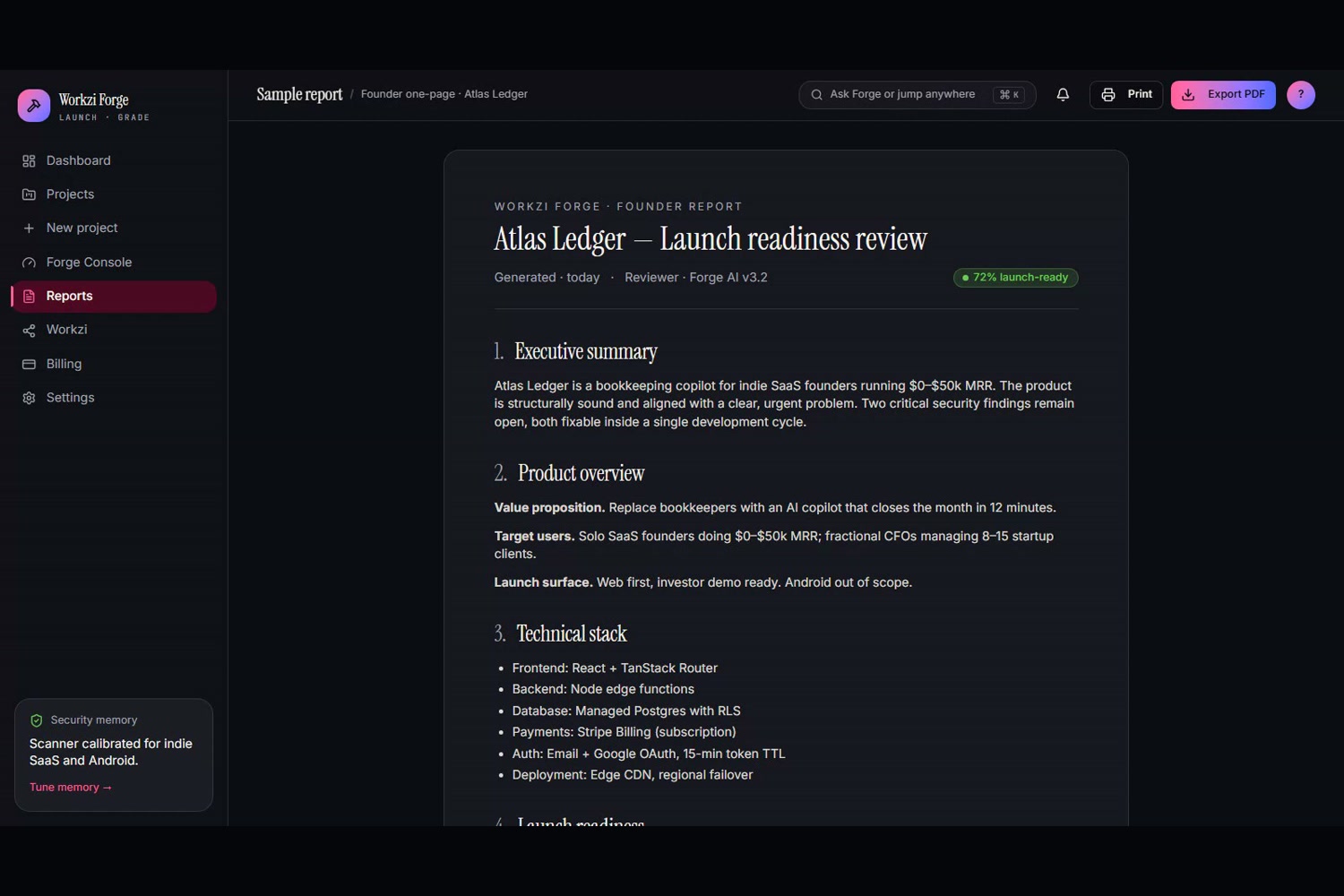
- Launch readiness brings security, Android, payments, and reporting into one operational picture.
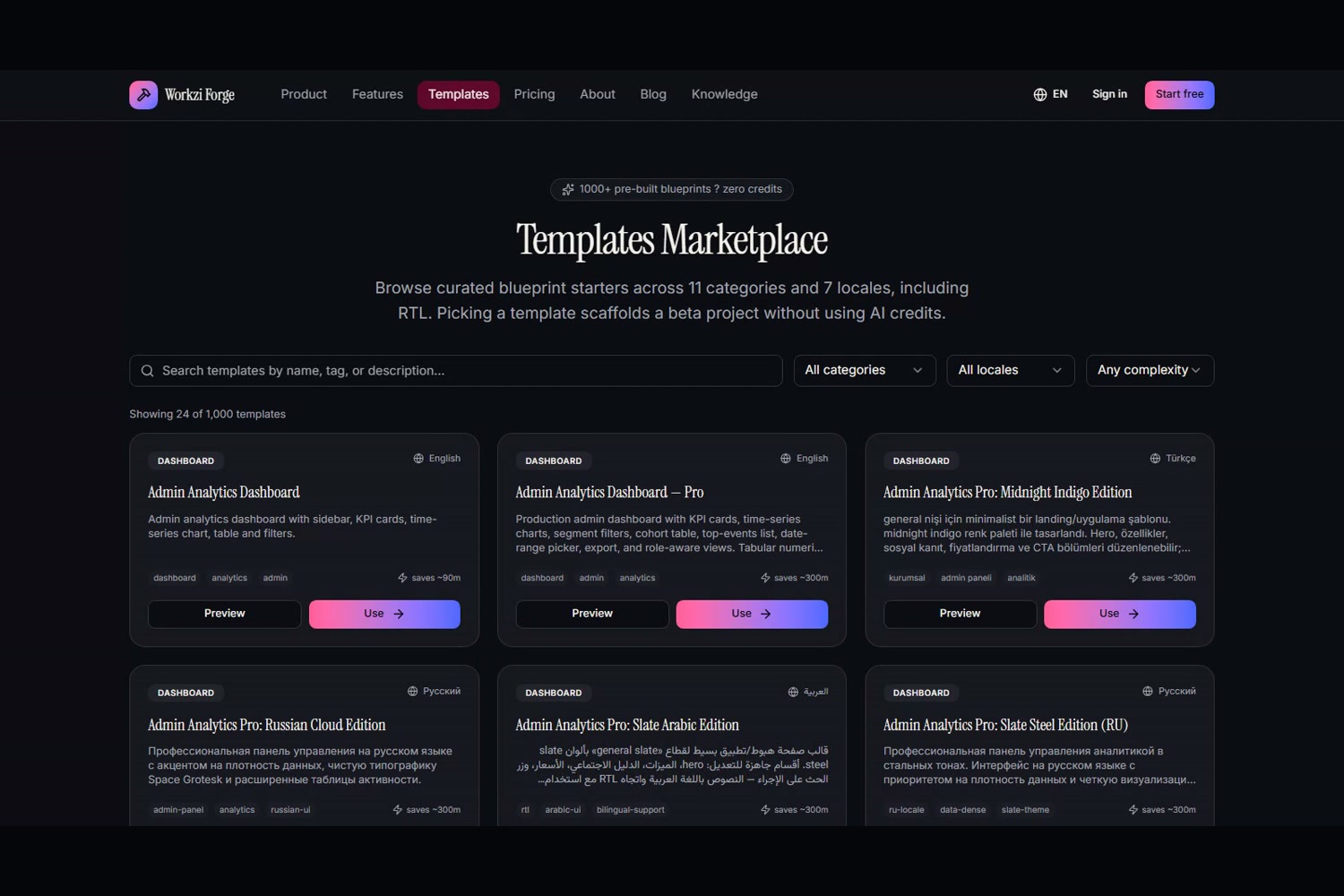
- Templates Marketplace provides reusable, localized starting points so teams can begin from a structured foundation rather than an empty prompt.
- Multilingual product surface supports English, Russian, Arabic, Persian, Turkish, Uzbek, and Kazakh, including RTL behavior where needed.
Why we built it
I have spent months building product and engineering systems where shipping fast cannot mean losing control. The recurring failure mode was clear: teams could generate pages, code, and prototypes quickly, but they still had to manually reconstruct the architecture, risk register, launch checklist, and evidence needed to make a confident release decision.
I built Invariant Forge to close that gap. It gives AI generation a disciplined delivery context: every plan has a place in the product system, every critical recommendation can be reviewed, and every launch decision can point back to concrete evidence.
The team behind it
Invariant Forge is built within Workzi, our product-engineering organization. Workzi develops public product experiences, internal control surfaces, and production application infrastructure with a strong emphasis on typed systems, server-controlled services, access policies, and operational clarity. Forge turns that accumulated delivery practice into a product founders and small teams can use directly.
Founder perspective
Invariant Forge is not a surface-level prompt experiment. It is the result of months of hands-on product work and a deliberate collaboration between my own design, UI/UX, graphics, product, and engineering judgment and AI capabilities.
I do not treat AI as a replacement for taste or technical responsibility. I use it as a force multiplier: give it the right context, structured constraints, visual direction, verification steps, and clear quality bars, then turn its output into something that can be reviewed and improved. That is the difference between generating an attractive first draft and delivering a product that holds together.
My goal is to make that working method reusable. Forge models design direction, visual and graphic requirements, architecture, security, and launch readiness as explicit skills and checkpoints. In the future, I see it as a complementary capability layer for ChatGPT and Codex: a way to help AI-assisted builders bring stronger product design, UI/UX judgment, graphics direction, and delivery discipline into their work without pretending that a single prompt solves everything.
I am genuinely excited by the future of AI and by the possibility of contributing this builder-and-designer perspective to the OpenAI ecosystem. I would be proud to work with the OpenAI team and help shape AI tools that give more people the ability to build ambitious, beautiful, and responsible products.
How OpenAI is used
Forge uses the OpenAI API through a server-side AI gateway for structured product and engineering work. Requests run against explicit provider and model allowlists; credentials never enter the browser. The gateway supports controlled model routing, structured task execution, and embeddings-backed knowledge retrieval so planning outputs can use project context rather than generic advice.
OpenAI-powered workflows help generate and refine blueprints, architecture proposals, risk-oriented checklists, implementation plans, and report narratives. Forge then places those outputs into a workflow with checkpoints, validation, and human review rather than presenting them as unquestionable answers.
What makes it different
The core idea behind Invariant Forge is simple: AI should accelerate delivery without removing accountability.
Instead of asking an agent to "build an app" and trusting a long response, Forge keeps a traceable chain from idea to blueprint, build plan, security gate, launch report, and public product page. This makes it useful for founders who need speed, but also need to explain what they are shipping to collaborators, customers, reviewers, and stakeholders.
Competitive context
Lovable sets a serious benchmark for fast AI app creation. Invariant Forge does not try to reduce that work to a slogan or pretend that rapid generation alone solves product delivery. Our focus begins where the first generated app becomes a real release decision: structured blueprints, specialist capability routing, security and migration gates, launch evidence, and a workflow a team can review together.
Technical approach
Invariant Forge is built with TypeScript, React, TanStack Start, Vite, Supabase, PostgreSQL with pgvector, Cloudflare Workers, Tailwind CSS, shadcn/ui, i18next, Vitest, and Playwright. The application uses server-side execution for provider credentials, Supabase for product data and access controls, Cloudflare Workers for the public runtime, and a hardened browser policy for the deployed surface.
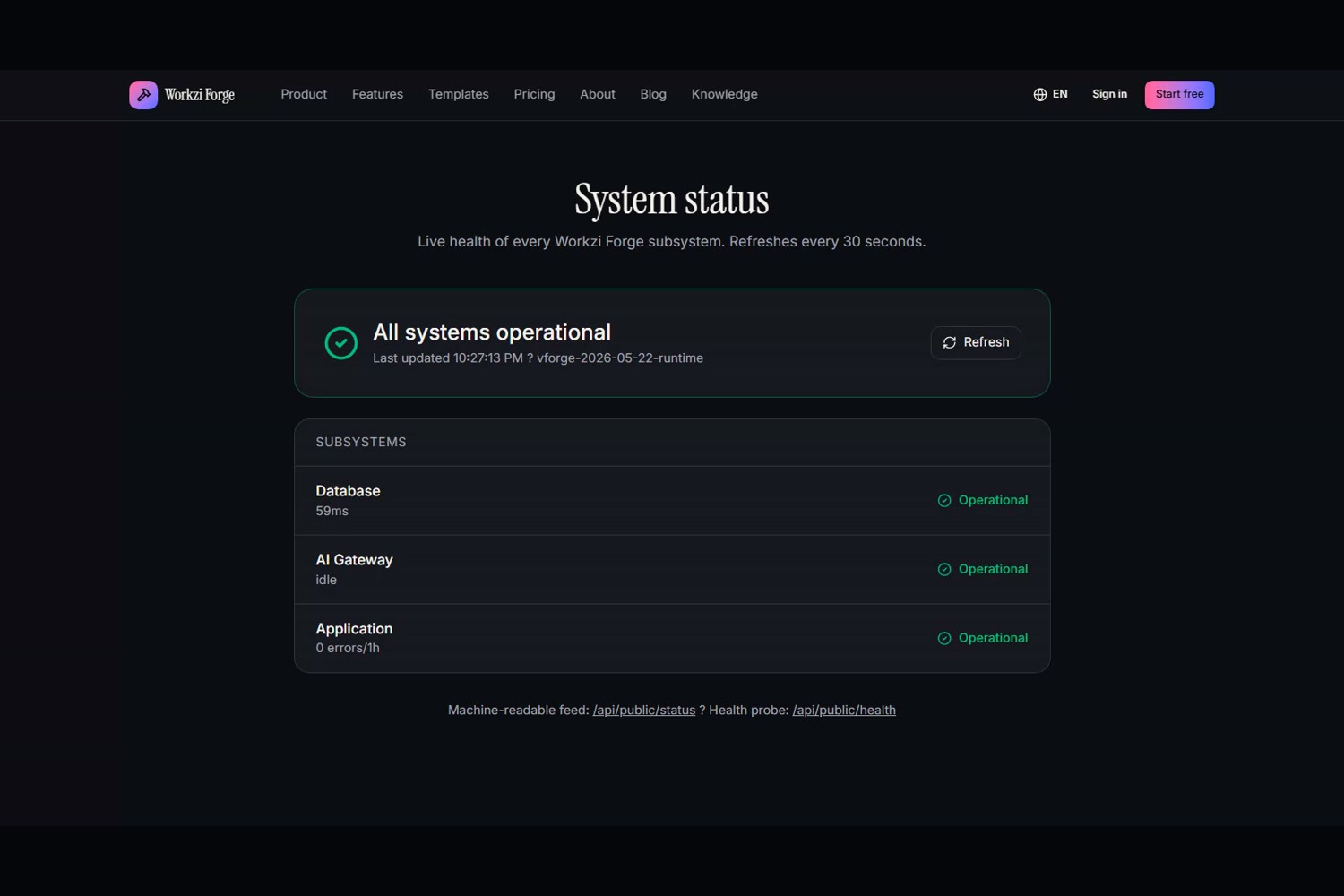
The product includes focused tests around AI gateway routing, template and capability validation, public-page behavior, and server security headers. During final deployment, we found that an overly strict Content Security Policy blocked the framework's streamed hydration state, leaving the client page blank even though server-rendered HTML was valid. We corrected the policy, retained the other browser protections, added regression coverage, rebuilt, and redeployed. That experience reinforced the principle behind Forge itself: a green status code is not enough; the real product path must be verified.
What we learned
The hard part was not generating more content. The hard part was deciding what must remain inspectable when AI moves faster than a team can manually audit every output. We learned that useful AI product tooling needs explicit boundaries: model routing must be intentional, sensitive actions need review gates, and the release path needs evidence that survives beyond a demo.
What is next
Next, we are expanding end-to-end evaluation suites for Forge workflows, deeper report verification, and richer team review loops. The goal remains constant: make AI-assisted delivery faster while keeping the product, the risks, and the final launch decision understandable.
Built With
- api;
- cloudflare
- cloudflare;
- css;
- dompurify;
- embeddings;
- gpt-5;
- i18next;
- openai
- pgvector;
- playwright;
- postgresql;
- react;
- shadcn/ui;
- start;
- supabase;
- tailwind
- tanstack
- typescript;
- vite;
- vitest;
- workers;
- zod;


Log in or sign up for Devpost to join the conversation.