-
-
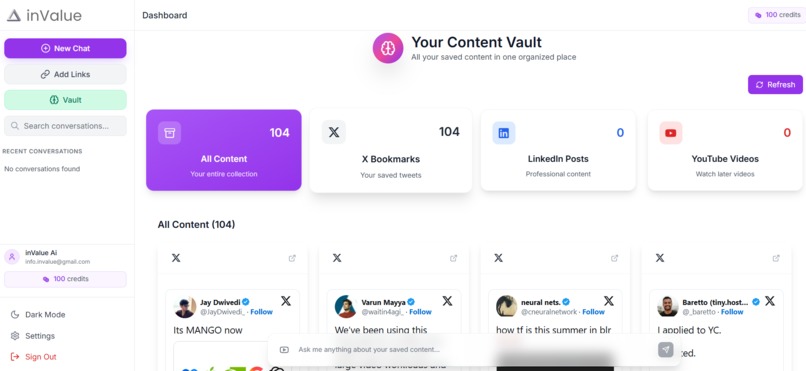
inValue.app
-
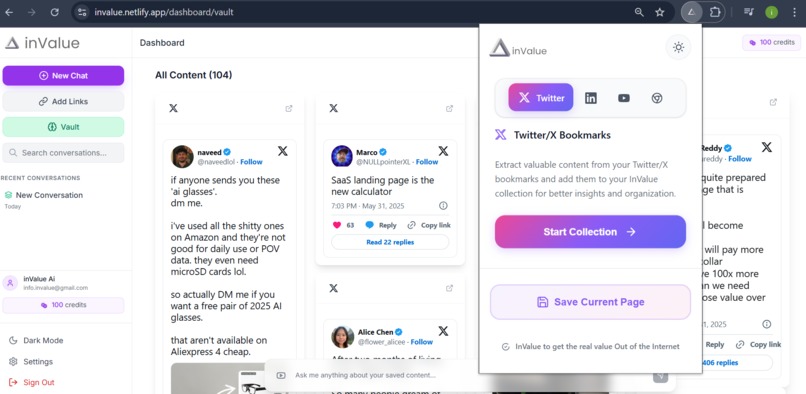
inValue Chrome Extension
Inspiration
I’ve always struggled with managing my bookmarks. I’ve jumped from one bookmark manager to another, trying to bring order to the chaos, but none of them truly solved the problem. Over time, my bookmarks became a mix of clutter and gold: about 60% are noise, but the remaining 40%? They’re a goldmine of insights, ideas, and resources I’ve intentionally saved.
The issue is, traditional bookmark managers and even modern knowledge base tools just store and categorize links. That’s it. No summaries, no context, no way to interact with or extract value from the content I’ve saved. I wanted something smarter, a tool that not only remembers what I saved but helps me use it.
That frustration the feeling of sitting on top of valuable content I couldn’t easily access or repurpose inspired me to build InValue.
What it does
InValue is a personal AI-powered knowledge base that brings all your saved content from X, LinkedIn, YouTube Watch Later, and Chrome bookmarks — into one searchable, interactive space.
You can chat with your bookmarks, ask questions, get summaries, and even fetch sources — making it easy to rediscover valuable insights. It also lets you repurpose any saved content (like posts, threads, or articles) into high-quality LinkedIn or X posts using AI.
It’s like having a second brain for your saved content one that’s actually useful.
How we built it
The core of InValue was built using Bolt.new, which made it surprisingly easy to craft a polished, production-ready UI with minimal overhead. Bolt’s powerful components, real-time collaboration, and instant deploys allowed me to focus more on product thinking rather than setup or styling. It felt like building with superpowers I could go from idea to a working interface in days, not months.
For backend logic and AI orchestration, I used Lyzr, which managed the agent workflows and pipelines. The chat with bookmarks feature is powered by GPT-4o, backed by a vector database for semantic retrieval. For content repurposing, I used Claude 3.5 Sonnet to generate high-quality posts.
Content ingestion is handled via ScrapeCreators API for X, LinkedIn, and YouTube, and Firecrawl for articles. A custom Chrome extension brings in browser bookmarks directly into the system.
Challenges we ran into
The biggest challenge I ran into was bringing structure and intelligence to completely unstructured data especially bookmarks and saved posts that often had no consistent metadata or content preview. Turning that raw data into something you can chat with, search semantically, and repurpose meaningfully required stitching together multiple services and tools.
Another challenge was getting clean, reliable content from platforms like X, LinkedIn, and YouTube, which don’t always have public APIs for what I needed. I had to rely on a mix of APIs, scraping, and extensions to unify the data into a single source of truth.
Lastly, integrating multiple LLMs (GPT-4o + Claude 3.5) while keeping latency low and responses relevant was tricky — especially when chaining tasks like retrieval → summarization → generation. But with some prompt engineering and async pipeline tuning, I got it working smoothly.
Accomplishments that we're proud of
I’m proud that InValue went from idea to fully working product within the hackathon window complete with multi-platform content ingestion, real-time chat over saved data, and AI-powered content repurposing.
Getting multiple LLMs working together seamlessly (GPT-4o for chat, Claude 3.5 for generation) was a huge win, especially with the complexity of chaining retrieval and generation across messy input data.
I'm also proud of how polished and intuitive the UI turned out, thanks to Bolt.new. It doesn't just work it feels like something people would actually use every day.
What we learned
Building InValue taught me the power of composable AI workflows how chaining LLMs with retrieval and structured pipelines can turn raw data into real utility. I also learned a lot about handling unstructured content at scale, and how important clean data is for building reliable AI experiences.
On the product side, I realized that UX matters just as much as AI. Bolt.new showed me how much faster and better you can build when the interface layer gets out of the way and lets you focus on solving the actual problem.
Most importantly, I learned that the difference between a cool AI demo and a genuinely useful tool is often just thoughtful integration and a little persistence.
What's next for InValue
Next, I’m planning to expand InValue into a full personal knowledge base. That includes adding integrations with tools like Slack, Notion, Google Docs, and even email, so users can truly centralize and interact with all the content they engage with across the web, I've talked about it in the demo also.
I also want to make the content repurposing experience smarter and more personalized, allowing users to define tone, audience, and platform preferences for more tailored outputs.
Lastly, I’m working on making InValue collaborative so teams can share, chat over, and repurpose knowledge together. The goal is to help people not just save information, but actually unlock and reuse it.
Built With
- bolt
- firecrawl
- lyzr
- pinecone
- python
- rag
- render
- scrapecreators.com
- supabase


Log in or sign up for Devpost to join the conversation.