-
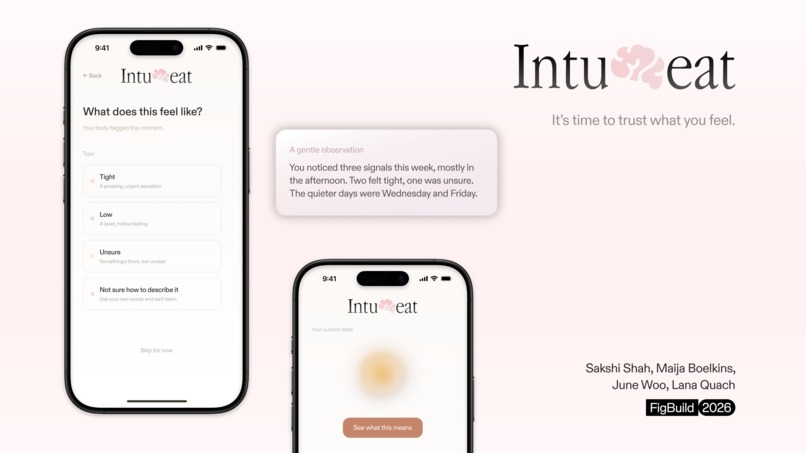
Intueat Sneak Peek
Inspiration
In today's age of mukbangs, extreme dieting culture, and everything in between, most of us don't actually know when we're hungry anymore. Between remote work collapsing the boundaries between our desks and our dining tables, ultra-processed foods engineered to override our body's satiety signals, and apps that pull us away from our bodies to stare at a screen mid-meal. We've lost access to a sense we were born with. We called this the Interoceptive Gap, and we wanted to design something that closed it rather than added to the noise.
What it does
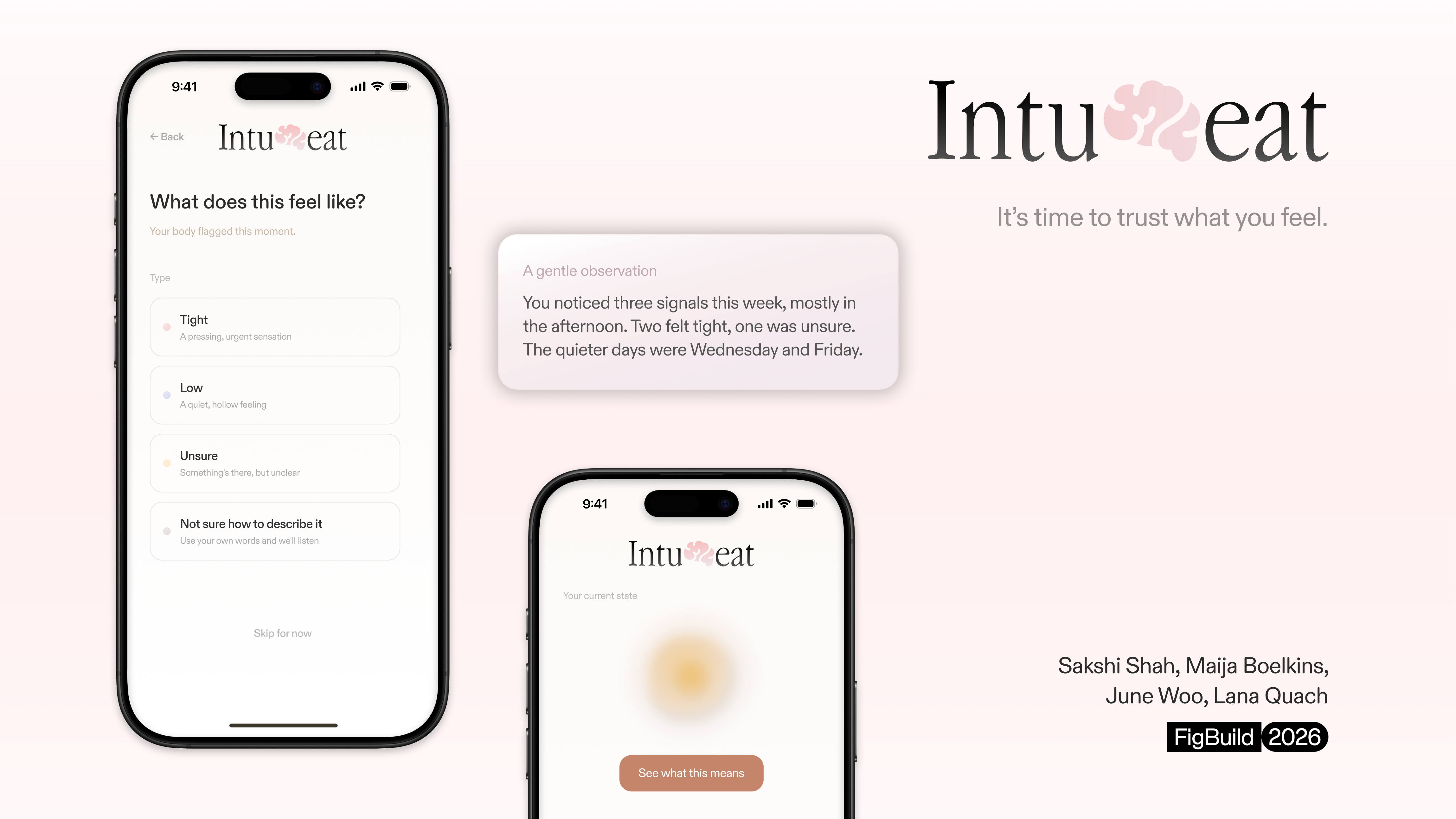
Intueat is a speculative wellness app that makes your body's internal hunger and satiety signals legible: no calorie counting, no meal logging. Our user research (a survey of 13 participants) surfaced a consistent pattern: people knew something was off with their eating, but lacked the vocabulary or awareness to act on it in the moment. Intueat addresses exactly that gap.
How we built it
We grounded the concept in primary research, a survey distributed to 13 participants examining eating behaviors, interoceptive awareness, and digital distraction patterns, and synthesized findings into a design brief, persona, and user journey. The system was designed across three artifacts: the wearable hardware concept, the Soma app interface, and the speculative "Enteric AI" processing layer. The deck and prototype were built in Figma.
Challenges we ran into
The hardest design constraint was self-imposed: we didn't want to build another screen-first wellness tool. Every decision about the interface had to pass a test, does this add cognitive load, or reduce it? Designing the information hierarchy so that haptics always lead and the app only surfaces when the user chooses to investigate required us to rethink what "helpful" actually looks like. We also had to navigate the ethical complexity of designing around disordered eating risk, making sure the system couldn't be weaponized as a restriction tool.
Accomplishments that we're proud of
We're proud of how tightly the concept holds together across hardware, software, and behavior change theory. The framing of gastro-chroniception as a sense, not a metric, kept the entire system honest. We're also proud of the safeguards slide, which we treated as a design problem rather than a disclaimer. And honestly, we're proud that our solution doesn't have a single calorie in it.
What we learned
Speculative design is most powerful when it's specific. Early versions of Intueat were vague about the technology and heavy on the vision, which made it feel like a mood board rather than a proposal. The project got sharper the more concrete we got: naming the sense, describing the exact moment the ring warms, writing the app copy in qualitative language. Precision made the speculation feel real.
What's next for Intueat: A third eye for the gut
The immediate next step is validating the core sensing concept with gastroenterologists and interoception researchers — specifically around the feasibility of reading Gastric Myoelectrical Activity non-invasively on-skin. From a design perspective, we want to prototype the Soma app interface at higher fidelity and run usability testing with our three target user groups. Longer term, we're interested in exploring the neurodivergent use case more deeply, as the gap between existing tools and the needs of ADHD/ASD users around eating feels significantly underserved.
Built With
- claude
- figma
- make


Log in or sign up for Devpost to join the conversation.