-
-
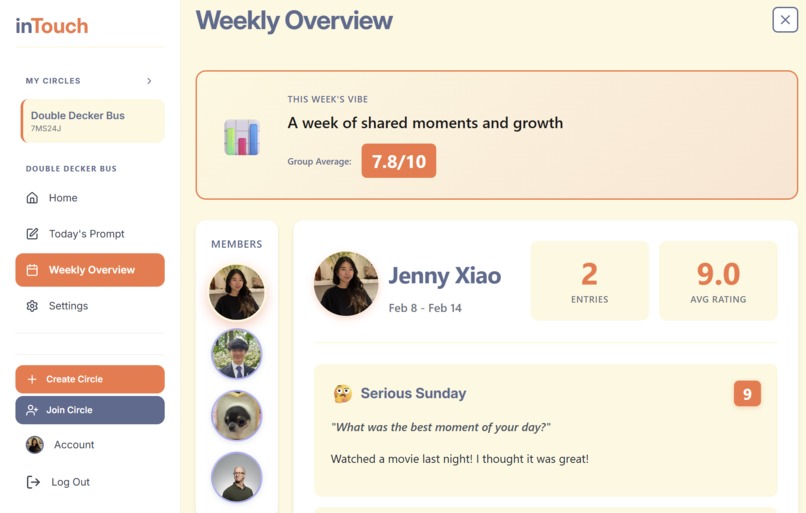
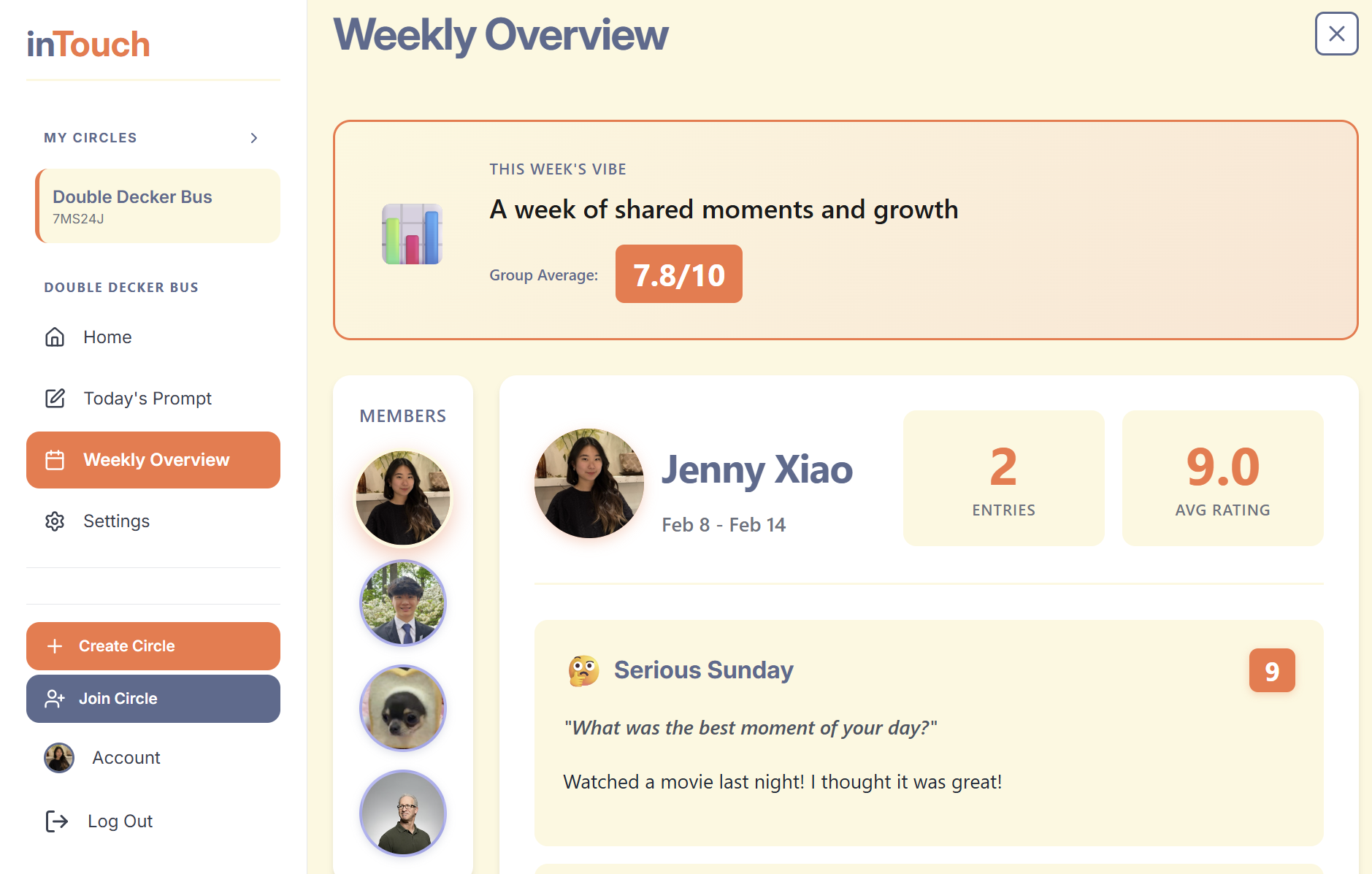
Photo of the Weekly Overview Page
Inspiration
We were inspired by how hard it is to stay emotionally connected with friends, especially old high school friends, once everyone gets busy. Texting feels shallow, social media is noisy, and journaling is often a solo habit that never leaves your notes app. We wanted to build something that sits in between a calm space where reflection and connection. inTouch was born from the idea that small, intentional check-ins can make people feel genuinely seen.
What it does
inTouch is a journaling and social reflection app that helps users stay connected through shared prompts and small circles. Users can log in, write short journal entries based on daily prompts, and share reflections with trusted groups instead of broadcasting to everyone. A friends feed lets users see who has posted and gently engage without pressure. The goal is low-friction connection, not performance.
How we built it
We built inTouch as a full-stack web app. The frontend is written in React, focusing on a clean, minimal UI that keeps the experience calm and distraction-free. The backend uses Node.js with Express to handle API routes for prompts, circles, and posts. For authentication and user management, we integrated Firebase Auth, which allowed us to quickly support login and user profiles. We structured the app so features like circles, feeds, and prompts could be expanded later, even when some data was initially mocked during development.
Challenges we ran into
One of our biggest challenges was wiring together the frontend and backend while still iterating on the data model. We ran into issues with missing users in the feed, API fetch errors, and environment configuration (especially around Firebase and secrets). Debugging async requests and understanding where data was breaking between layers took more time than expected. Balancing feature scope with stability during a short build window was also tough.
Accomplishments that we're proud of
We’re proud that we shipped a working end-to-end product with authentication, user flows, and a clear core experience. Designing and implementing circles as a more intentional alternative to traditional social feeds was a big win. We also learned how to debug real-world integration issues and keep pushing forward instead of restarting when things broke.
What we learned
We learned how important clear data contracts are between frontend and backend, especially as features evolve. We gained hands-on experience with authentication, API design, and debugging network issues. Just as importantly, we learned how to prioritize user experience and emotional intent, not just technical features.
What's next for inTouch
Next, we want to fully connect the backend to a persistent database, polish the friends feed, and improve error handling and loading states. We also plan to add better prompt customization with full agentic AI integration. Long term, we see inTouch becoming a private, meaningful alternative to traditional social platforms, one small check-in at a time.


Log in or sign up for Devpost to join the conversation.