Inspiration Have you ever walked into a technical interview feeling prepared, only to completely freeze when asked to code live while someone watches you? We certainly have.
Current interview preparation tools are fundamentally flawed. They are either prohibitively expensive, completely static, or fail to simulate the actual psychological pressure of a real-world interview. We realized there was a massive gap between studying for an interview and experiencing one.
We built InterVue to democratize career preparation. Our goal was to create a hyper-realistic, fully autonomous AI mock interview platform that makes high-quality, personalized interview practice accessible to everyone.
What it does InterVue is an end-to-end simulated interview environment. The workflow is completely tailored to the candidate:
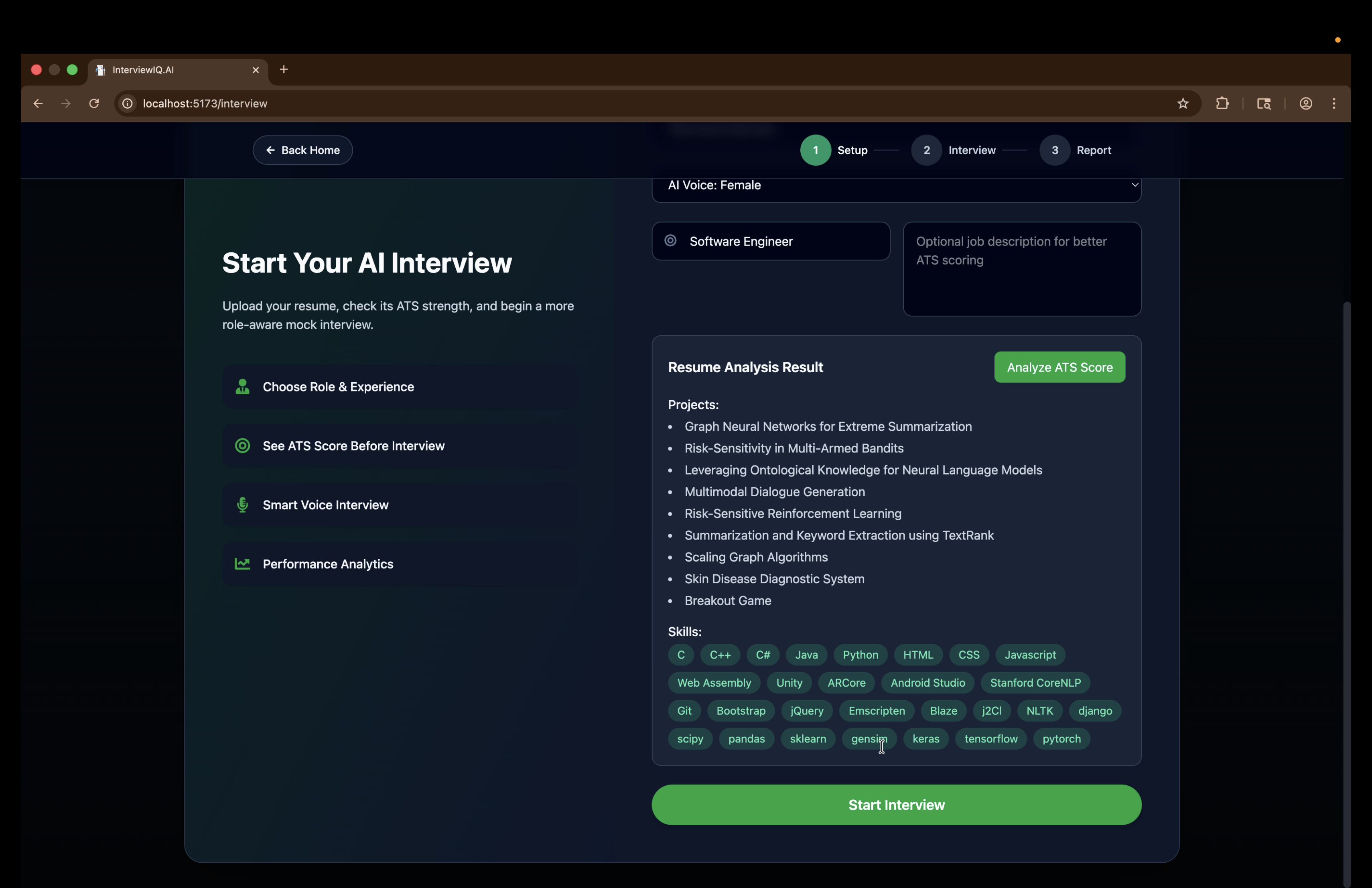
ATS Analysis: The user uploads their resume and target role. Our AI analyzes it for formatting and keyword optimization.
Adaptive Generation: Instead of generic questions, the platform generates a custom interview loop based strictly on the user's past projects and the specific job requirements.
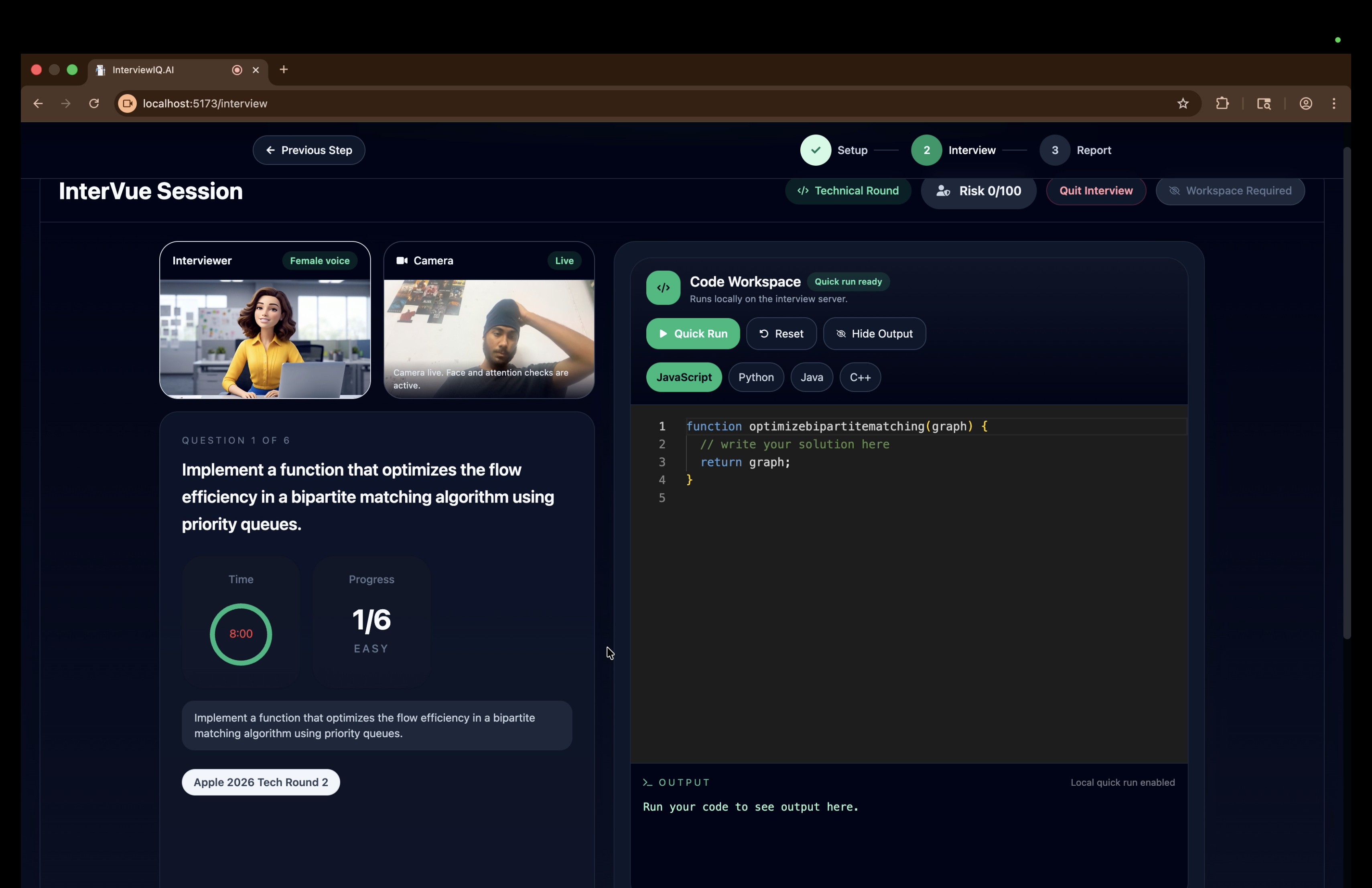
The Simulation: The user enters a hyper-realistic environment. They converse with an Interactive AI Voice Assistant that listens, evaluates, and asks dynamic follow-ups. For software roles, they must write and compile logic in our Live Code Sandbox, all while Google MediaPipe AI Proctoring tracks their eye movement to simulate high-stakes pressure.
Deep Analytics: Post-interview, the user receives a detailed, exportable PDF report grading their performance.
How we built it We architected InterVue to be highly scalable and responsive:
Frontend: Built with React 19 and Vite, utilizing Tailwind CSS v4 and Framer Motion for a stunning, modern UI. We used Redux Toolkit for state management and integrated @monaco-editor/react for the in-browser coding sandbox.
Backend: A robust Node.js and Express.js server, with MongoDB handling user data and interview history.
AI Engine: We utilized the OpenRouter API to orchestrate multiple models. We rely on gpt-4o-mini for rapid Resume/ATS parsing and qwen-2.5-coder-7b-instruct to dynamically generate technical, contextual question sets.
Proctoring and Voice: We integrated browser-native webkitSpeechRecognition for voice-to-text, and @mediapipe/tasks-vision for real-time, client-side face tracking.
The InterVue Scoring Algorithm To calculate the candidate's final performance rating, we apply a weighted scoring model across technical and behavioral metrics, heavily penalized by proctoring flags.
We represent this mathematically as:
Final Score=( i=1 ∑ n (w T ⋅T i +w C ⋅C i ))−(α⋅P flags ) Where:
T i and C i are the Technical and Communication scores for question i.
w T and w C are the dynamic weights based on the role type.
P flags represents the number of proctoring violations.
α is the penalty multiplier for suspicious behavior.
Challenges we ran into Our biggest technical hurdle was orchestrating real-time latency. Creating a natural conversation with an AI requires minimizing the delay between the browser's speech recognition capturing the user's voice, the backend generating an intelligent response, and the frontend converting that text back to speech. We had to optimize our API calls and state updates to prevent the AI from talking over the candidate.
Additionally, isolating the execution environment for the live code sandbox while securely handling memory allocation in the browser was a significant challenge that required careful component unmounting and error handling.
Accomplishments that we are proud of We are incredibly proud to have built a cohesive, fully functioning pipeline in such a short amount of time. Getting a conversational LLM, a live code compiler, and a computer-vision proctoring model to run simultaneously on a single web page without crashing the browser is a massive technical win.
What we learned We gained deep, practical experience in AI orchestration. We learned how to effectively prompt-chain different models to optimize both cost and speed. We also leveled up our skills in managing complex, asynchronous browser APIs like MediaPipe and Web Speech.
What is next for InterVue This is just the beginning. In the future, we plan to:
Expand the Code Sandbox: Support for multiple backend compilation languages.
B2B Recruiter Dashboard: Allow companies to send InterVue links as a preliminary screening round.
VR Integration: Bring the experience into WebXR to completely immerse the candidate.

Log in or sign up for Devpost to join the conversation.