Inspiration
What it does
InterviewOS: Scaling Initial Round Interviews with AI
Inspiration
Every year, companies receive thousands of applications, but conducting the initial round interviews takes an enormous amount of time, thus causing a lot of potentially great employees to not even reach the first round of interviews. Recruiters repeatedly ask similar questions, coordinate schedules, and screen candidates before moving them forward.
We asked ourselves: What if AI could conduct personalized initial round interviews at scale, without requiring a human interviewer to be present? This could allow companies to conduct a way larger amount of first round interviews where they can choose from a greater pool of candidates where this time they know a lot more about them then their resumes.
That's why we built InterviewOS, an AI-powered platform designed to make initial interviewing more scalable, accessible, and consistent while leaving hiring decisions to humans.
What It Does
InterviewOS is designed to automate the first round of hiring through structured, adaptive AI interviews.
Candidates answer interview questions through a webcam and a mic, review and confirm their responses, and receive follow-up questions generated using their actual answers. The system validates evidence and organizes insights that hiring teams can review afterward.
Our approach combines several technologies:
- AMD-powered AI: Qwen2.5-7B-Instruct, accelerated with ROCm and llama.cpp, generates adaptive questions and evidence-backed feedback.
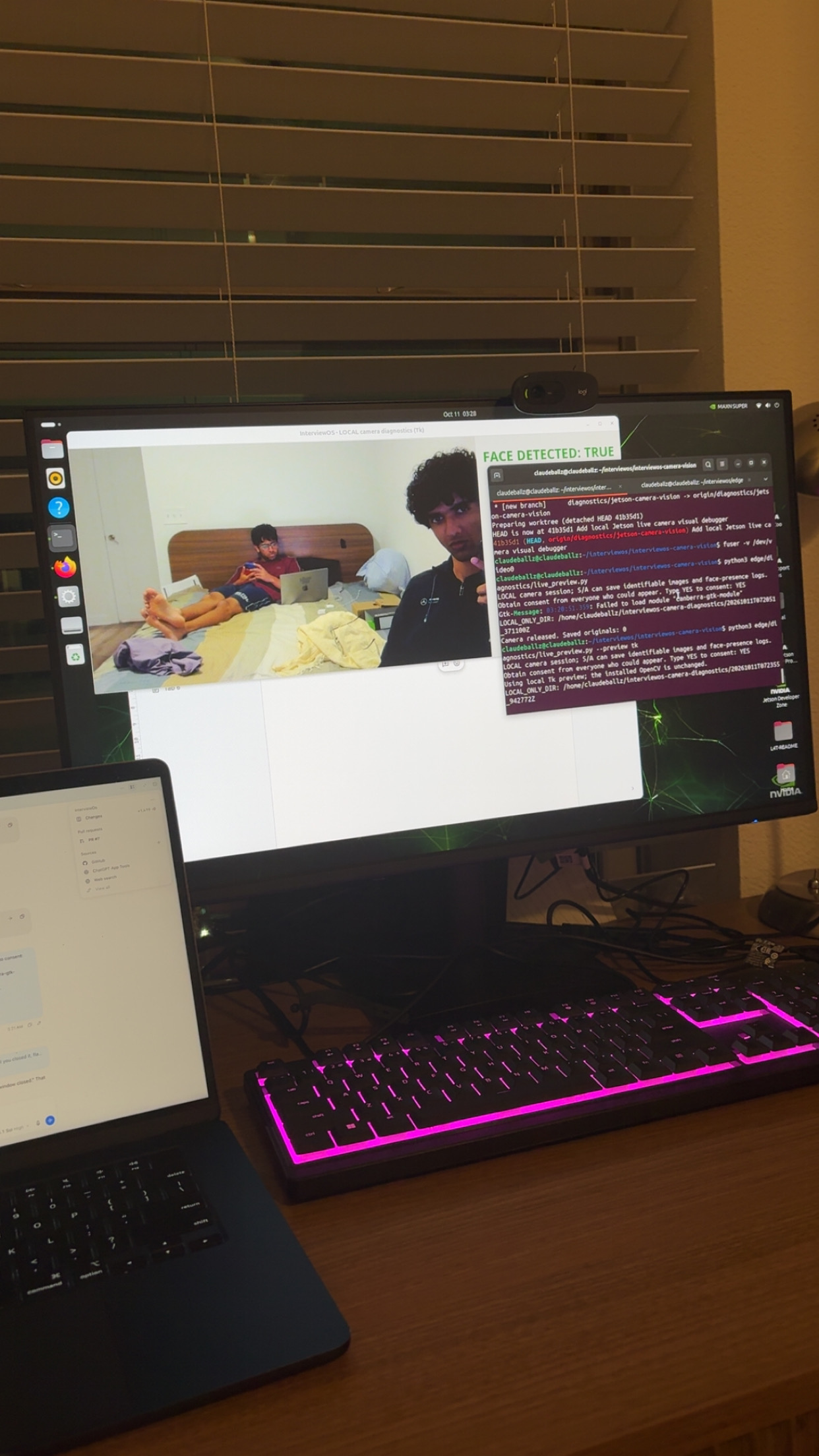
- NVIDIA edge AI: A Jetson Orin Nano runs OpenCV face detection and YOLO11 pose estimation using TensorRT, keeping webcam frames local.
- Google Gemini multi-agent exploration: Specialized ADK agents explore evidence extraction, identifying missing details, question generation, and quality review.
- Full-stack interview experience: A React frontend and FastAPI backend handle interview interactions, confirmed transcripts, session management, and AI integration.
- Privacy-conscious design: Video remains on the edge device, with a metadata-only architecture and safeguards against unsupported candidate judgments.
How We Built It
We built the frontend using React, TypeScript, and Vite, and the backend using Python, FastAPI, and Pydantic.
For our core language model, we used Qwen2.5-7B-Instruct on AMD ROCm, running through llama.cpp. This enables follow-up questions based on candidate responses and feedback grounded in direct transcript quotes.
We deployed YOLO11n-Pose on an NVIDIA Jetson Orin Nano 8GB, exporting the model and optimizing it with TensorRT for real-time webcam inference.
We also built an experimental Google Agent Development Kit (ADK) pipeline with six specialized agents, exploring how multiple AI components could collaborate to produce more reliable interviewer-facing insights.
The system's components were developed across multiple devices, with backend contracts and network communication designed to connect them.
Challenges We Faced
Getting AI Models Running on Real Hardware
Deploying computer vision on the Jetson meant working through CUDA compatibility, TensorRT optimization, model exports, camera capture, and Linux GUI issues.
After extensive debugging, we successfully ran live YOLO11 pose estimation at 1280×720 resolution.
Preventing AI Hallucinations
A convincing AI response isn't necessarily a correct one. We implemented deterministic validation to verify that cited evidence comes directly from a confirmed candidate answer and to reject unsupported feedback.
Connecting Different Systems
Our architecture spans AMD-accelerated inference, NVIDIA edge hardware, FastAPI, and React. Coordinating different machines, environments, API contracts, and network configurations was a major engineering challenge.
Building Trust Into Interviewing
Automating interviews raises serious questions about privacy, fairness, and transparency. We focused on explicit consent, local video processing, evidence validation, and keeping AI observations separate from actual hiring decisions.
What We Learned
We learned how to deploy and optimize machine learning models on specialized hardware, build reliable AI-backed APIs, and design safer workflows around generative AI.
More importantly, we learned that the hardest part of an AI product often isn't generating an answer. It's ensuring that the answer is grounded, useful, and appropriately delivered.
What's Next
Our goal is to expand InterviewOS into a complete autonomous first-round interviewing platform that organizations can use at scale.
Next steps include completing end-to-end hardware integration, expanding adaptive interview conversations, and connecting validated insights to secure dashboards for authorized hiring teams.
InterviewOS isn't about replacing human hiring decisions. It's about allowing every applicant to complete a meaningful first-round interview without requiring a recruiter to conduct each one personally.

Log in or sign up for Devpost to join the conversation.