-
-
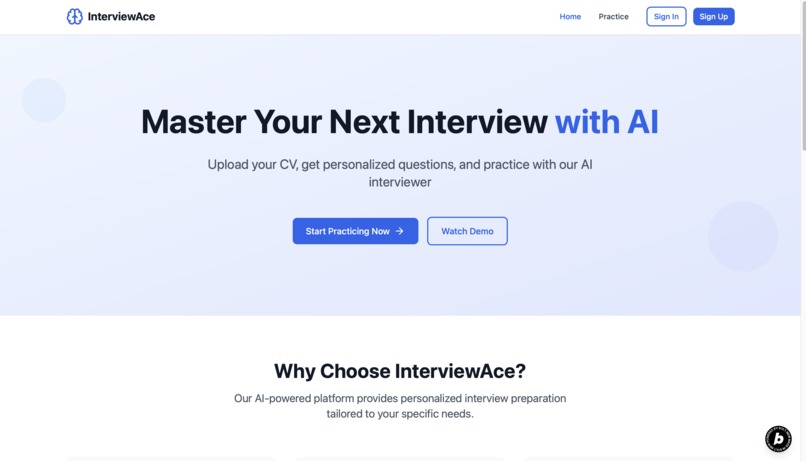
Homepage
-
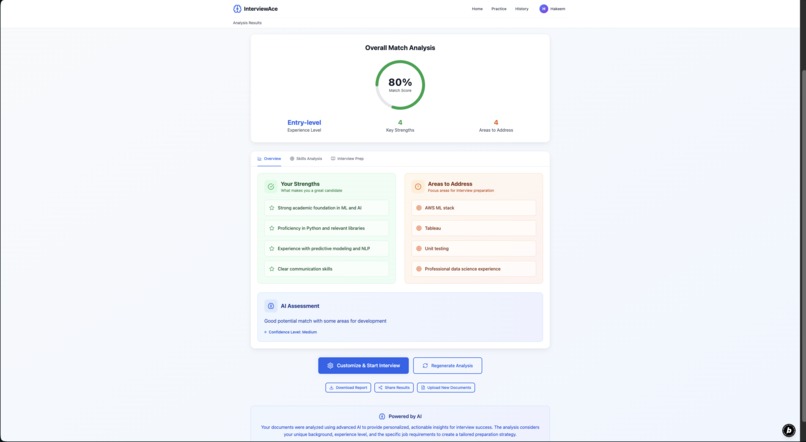
Analysis Result
-
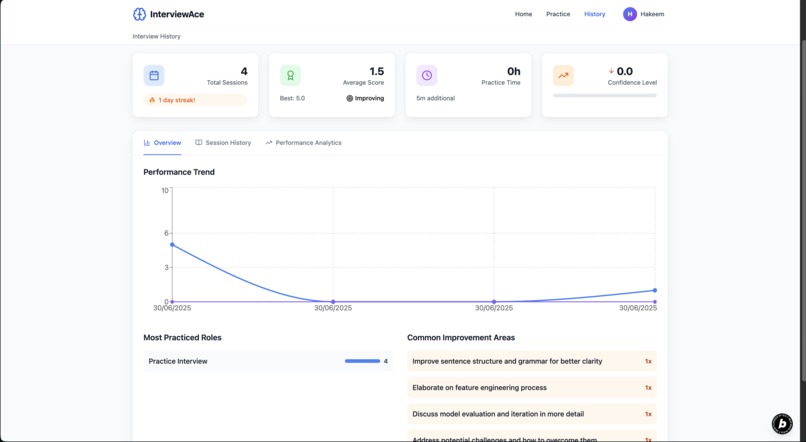
Dashboard


Inspiration
The idea for InterviewAce came from a deeply personal frustration. After watching countless friends and colleagues struggle with interview preparation—myself included—I realised the fundamental problem: interview prep is a bit too generic.
Traditional preparation methods give you generic questions like "Tell me about yourself" or "What's your greatest weakness?" But in reality, every interview is unique. A software engineer applying to Google faces different challenges than someone interviewing for a startup. A recent graduate needs different preparation than a senior executive. The inspiration struck during a conversation with my friend, a fellow recent graduate who kept getting rejected after rounds of interviews. he was using generic practice platforms and behavoral question lists, but nothing addressed specific gaps or the nuanced requirements of the roles he was targeting.
Then, I thought: "What if we could create an AI interview coach that actually knows your background and the specific job you're applying for?"
The vision was clear—build a platform that analysis your actual resume against real job descriptions and creates personalised practice sessions. No more one-size-fits-all preparation. No more guessing what questions might come up. Just intelligent, tailored interview training powered by cutting-edge AI.
What it does
InterviewAce is an intelligent interview practice platform that transforms generic preparation into personalised mastery.
InterviewAce uses AI to analyse CVs and job descriptions, identifying skill matches and experience gaps. It generates personalised interview questions covering technical, behavioural, and situational aspects, tailored to role difficulty and industry trends. Users practice with a voice-enabled AI interviewer using Eleven Labs technology, offering real-time feedback on confidence and clarity. The platform provides live performance metrics, post-interview analysis, progress tracking, and an interview readiness score.
How I built it
InterviewAce was built in an impressive single day using Bolt.new AI, showcasing the power of modern AI-assisted development tools. The frontend leverages React with TypeScript for the main application, enhanced by Tailwind CSS for responsive and modern styling, Lucide React for consistent iconography, Recharts for comprehensive data visualization and analytics, and Framer Motion for smooth animations and transitions that create a polished user experience. The backend infrastructure is powered by Supabase for database, authentication, and backend services, utilising Edge Functions for serverless AI processing, PostgreSQL for robust data storage and user management, and Row Level Security to ensure data privacy and multi-tenancy capabilities.
AI and voice integration form the core of the platform through Claude API from Anthropic for sophisticated document analysis and question generation, Eleven Labs for natural text-to-speech synthesis that powers the AI interviewer, Web Speech API for real-time speech recognition during practice sessions, and TensorFlow.js for client-side performance analysis.
The development process was remarkably compressed into a single day thanks to Bolt.new AI, starting with core document upload and text extraction functionality, rapidly progressing through Claude API integration, dynamic question generation, voice integration with Eleven Labs, real-time speech analysis, comprehensive analytics dashboard development, and finally UI/UX polish with professional design systems and responsive layouts.
Key architectural decisions included using Supabase Edge Functions to securely handle API keys while maintaining fast response times, implementing WebSocket connections for live performance metrics with client-side analysis for instant feedback, and designing a scalable database schema with efficient indexing and row-level security for data privacy - all accomplished within 24 hours using Bolt.new's AI-powered development capabilities.
Challenges we ran into
Despite being built in just one day using Bolt.new AI, InterviewAce faced several significant challenges that required creative solutions and strategic thinking. Technical challenges emerged early, particularly with AI response consistency where Claude API sometimes returned inconsistent JSON formats, leading to the implement of robust parsing with fallback mechanisms and retry logic, teaching me the har way to always validate AI responses and maintain backup strategies.
Real-time speech analysis proved problematic as browser speech recognition accuracy varied dramatically across different devices, prompting the text fallback options.
Accomplishments that we're proud of
InterviewAce is personally a big achievement for time especially considering the final product and the duration of the build.
From a technical perspective, the successful integration of multiple AI services including Claude and Eleven Labs into a cohesive, seamless experience while building real-time speech analysis that functions consistently across different browsers and devices, and creating dynamic question generation that intelligently adapts to specific roles and industries is a major landmark for me, as this is the first time I'm combining multiple AI services into a single product.
What we learned
Through the intensive development process of building InterviewAce in a single day using Bolt.new AI, I gained invaluable technical insights that will shaped my approach to AI-powered applications.
Working with multiple AI APIs taught me that consistency is far more valuable than perfection, as users consistently prefer reliable, fast responses over occasionally brilliant but inconsistent ones, leading me to prioritise building robust fallback mechanisms and always validating AI outputs rather than chasing perfect accuracy.
Perhaps most importantly, we learned that failure is an essential component of learning, with every bug and failed feature, teaching me something the value of patience.
What's next for InterviewAce
InterviewAce's roadmap includes ambitious expansion plans designed to transform the platform into a comprehensive career development ecosystem accessible across all devices and markets. I'm prioritising mobile app development with native iOS and Android applications that will enable seamless practice on-the-go, allowing users to conduct interview sessions during commutes, breaks, or any convenient moment.
The introduction of video interview simulation will revolutionise practice sessions by incorporating full video analysis with sophisticated body language assessment, providing users with comprehensive feedback on non-verbal communication, posture, eye contact, and professional presenc.
Additionally, I'm thinking about Integration with major platforms including LinkedIn for seamless profile importing, job boards for automatic job description analysis, and Applicant Tracking Systems (ATS) to help users optimise their applications for specific company requirements.
Advanced AI coaching will elevate the practice experience through real-time interruptions and dynamic follow-up questions during sessions, creating more realistic and challenging scenarios that mirror actual interview environments. Also , I plan to monetise and expand the app through multiple revenue streams including tiered subscription models, enterprise licensing for corporations and universities, API access fees for third-party integrations, and premium add-on services.
Finally, multiple language support will open international markets by providing localised experiences in Spanish, French, German, and other major languages, enabling global expansion while adapting to regional interview customs and cultural expectations, ultimately positioning InterviewAce as the world's leading AI-powered interview preparation platform.
Built With
- bolt.new
- claudeai
- elevenlabs
- javascript
- react
- react-native
- supabase
- typescript

Log in or sign up for Devpost to join the conversation.