-
-
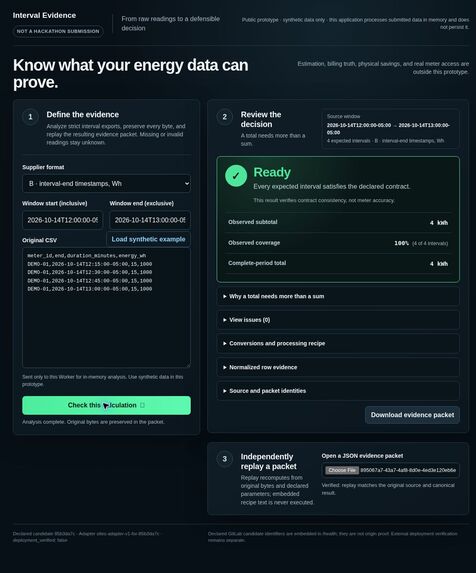
Live v4: current analysis and independently replayed packet are separate results. Synthetic data; totals require completeness.
Inspiration
An energy subtotal can look convincing while hiding missing or invalid readings. Interval Evidence starts with a narrower question: does this interval CSV actually support a complete-period total?
What it does
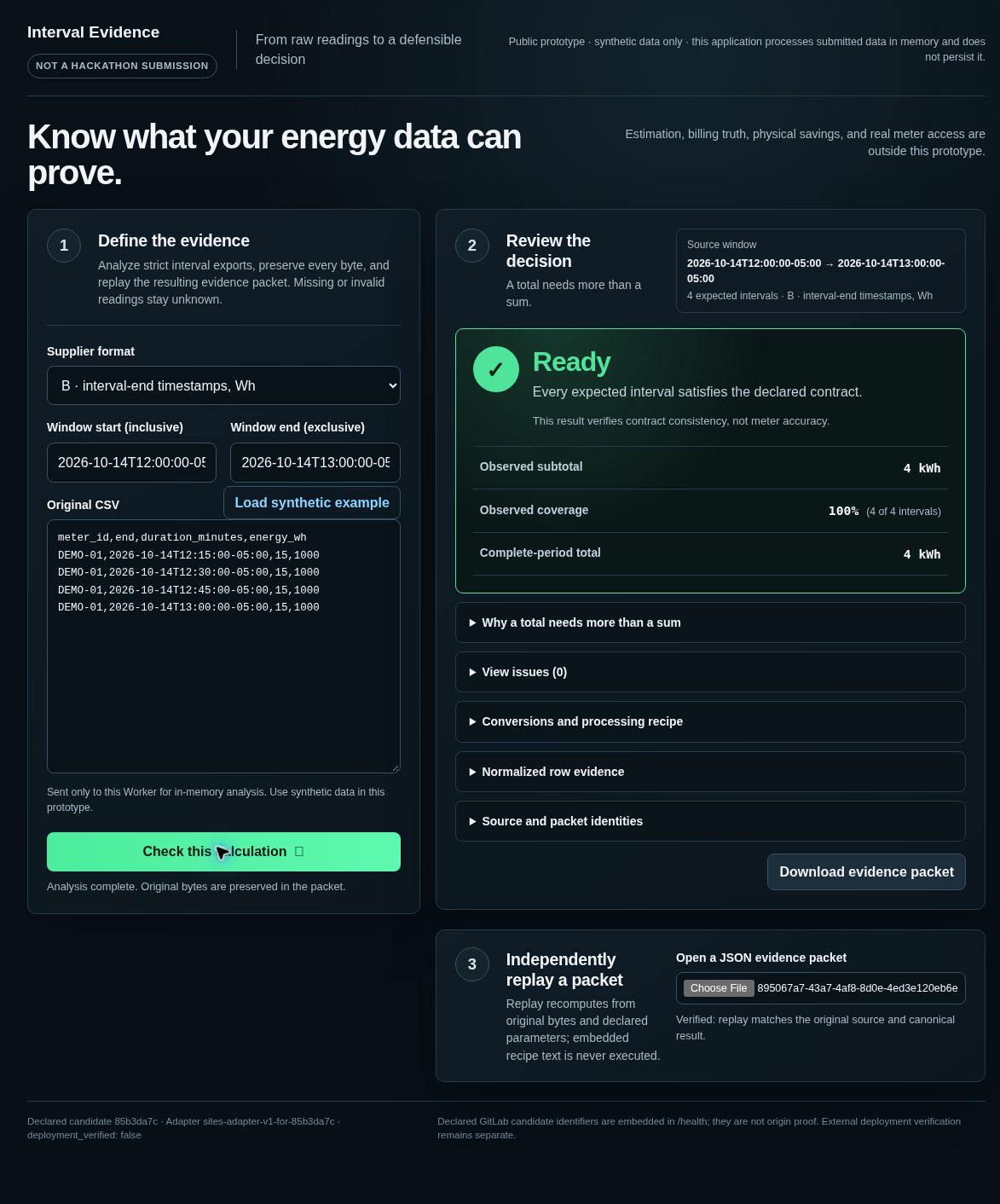
The live prototype analyzes synthetic interval-energy exports, preserves the original bytes, makes Wh-to-kWh conversion explicit, and exposes gaps and invalid records. It distinguishes observed energy from a complete-period total, which remains unknown when the declared contract is not satisfied. A downloadable evidence packet can be independently replayed from its original data and parameters; edited calculations are rejected rather than silently trusted.
How it was built
The project started fresh for Path A. A standard-library Python implementation supplies the reference behavior. A JavaScript Worker adapter powers the live browser application, with 53 local parity cases checked against the reference. GitLab provides public MIT-licensed source, commit history, CI jobs, merge-request review, and auditable release evidence.
GitLab Duo made a substantive Python repair in commit 85b3da7. The JavaScript port was implemented independently, rather than being attributed to Duo. Duo also reviewed the later merge request; its two findings were fixed in 710df9c6 and the re-review approved the fix before merge.
Hands-off autonomy demonstrated
A bounded native-agent run pushed release commit 7bba799 at 17:01:22 UTC on October 16, 2026, followed the three GitLab CI jobs in pipeline 2956362424, verified the exact artifact against the release gate, and published Site version 3 at 17:05:37 UTC without human intervention during that sequence.
This is evidence for that bounded commit-to-publication run. The external agent coordinated the release; it is not an always-on or GitLab-native deployment service. The subsequent Duo review improved the project after publication and was not a pre-publication review gate.
Challenges and lessons
Strict parsing, time-window completeness, reproducible hashes, and matching Python and JavaScript semantics matter more than a plausible-looking total. The release work also showed why a green pipeline alone is insufficient: artifact identity and the live deployment need separate checks.
Final audit and current release
A final audit caught a stale-response race in the served interface. The actual served UI was fixed and covered by 25 race cases. The corrected v4 release followed commit aa8137a through pipeline 2956553046 to publication at 18:12:40 UTC on October 16, 2026, with live browser verification afterward. Current analysis and an independently replayed packet are displayed as separate results.
The demo video documents the original v3 bounded run. The current live v4 fix preserves the calculation semantics. The footer's historical adapter declaration is not the current release identity; /__release provides the current release binding. Public v4 release evidence.
Try it
Open the live application, load a synthetic example, and analyze its interval window. Inspect the observed subtotal, coverage, and completeness decision. Download the evidence packet and replay it. Remove an interval to see the complete-period total remain unknown; alter a packet calculation to test replay rejection.
Limits
Use synthetic data only. This prototype does not establish meter accuracy, billing truth, real-meter integration, physical energy savings, or measured software-emissions reductions. Core live identity and browser flows have been checked, while broader HTTP and mobile verification remain separate work. No Google Cloud or environmental-measurement bonus is claimed.
Links
- Live application: https://transcend-interval-evidence.aggie-king21.chatgpt.site
- Public source and release evidence: https://gitlab.com/gitlab-ai-hackathon/transcend-october-2026/43132373/showcase
- Demo: https://youtu.be/A4E5jYcf89Y
Built With
- css
- gitlab
- gitlab-ci
- gitlab-duo
- html
- javascript
- python
