-
-
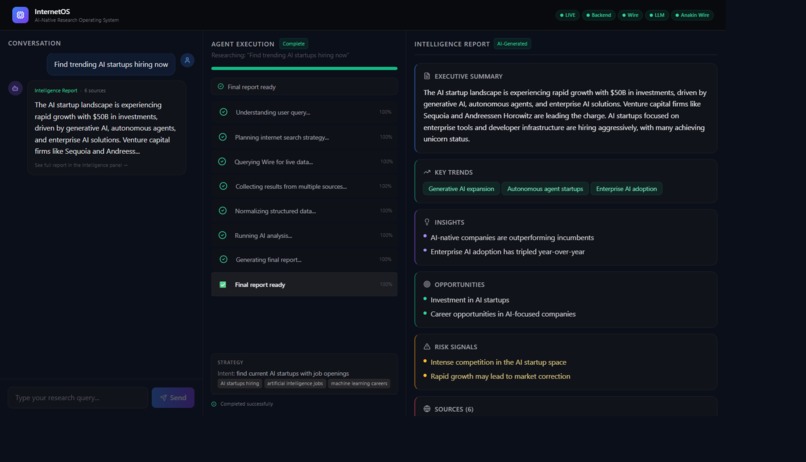
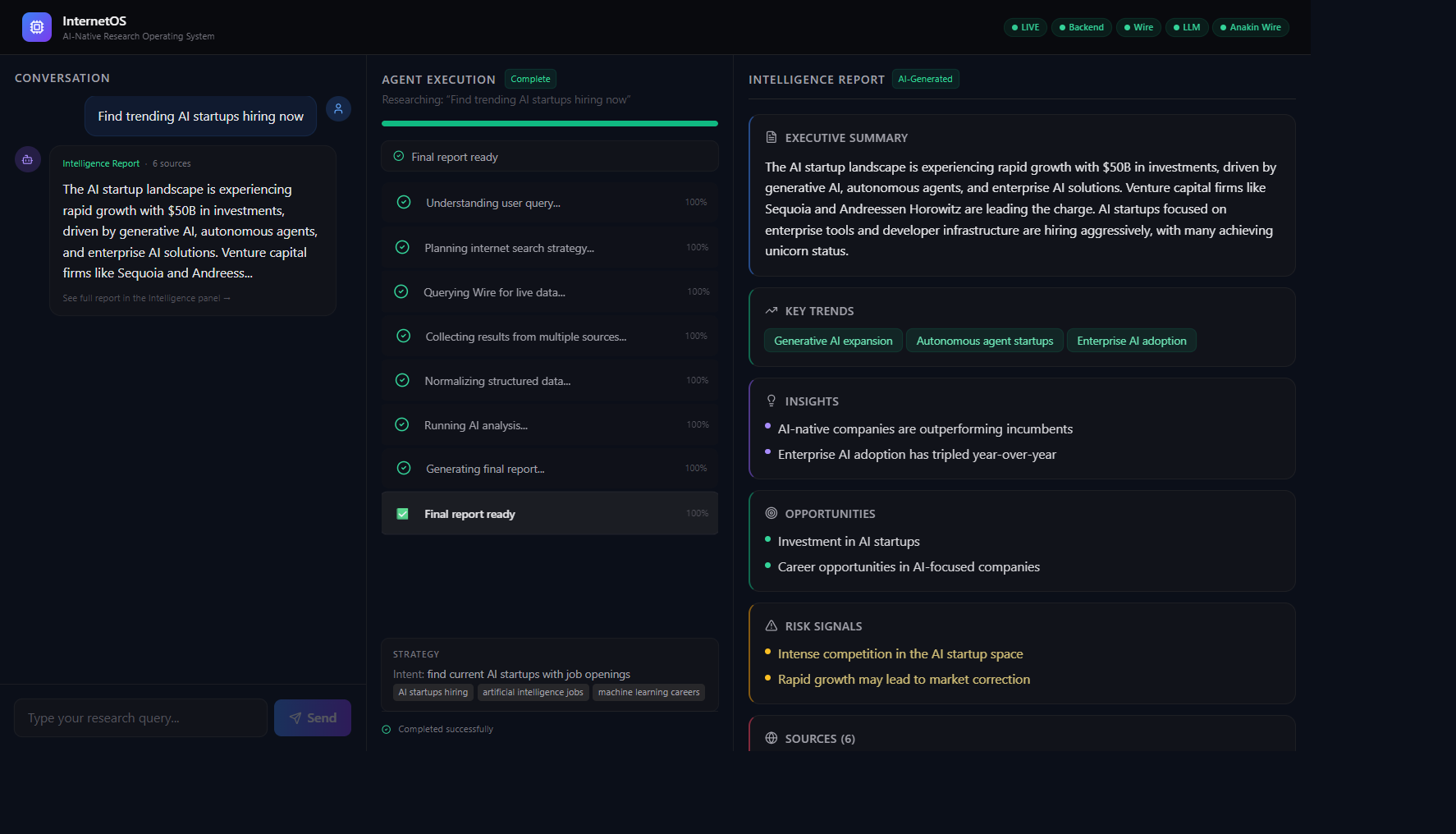
Live intelligence report generated from multi-source web data using AI agents.
-
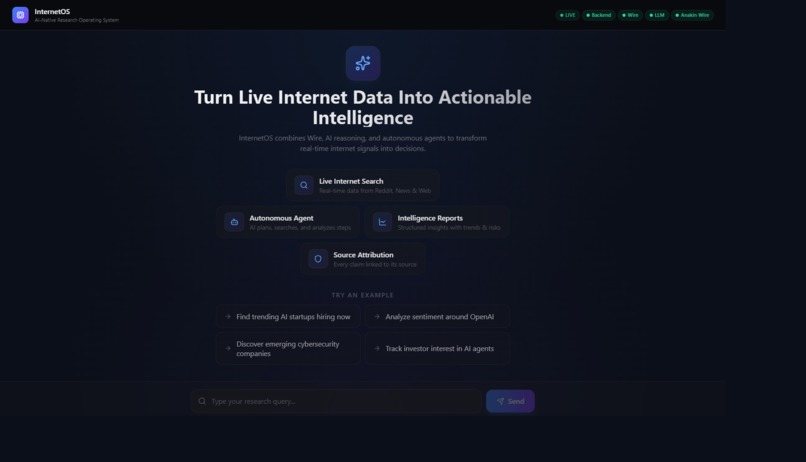
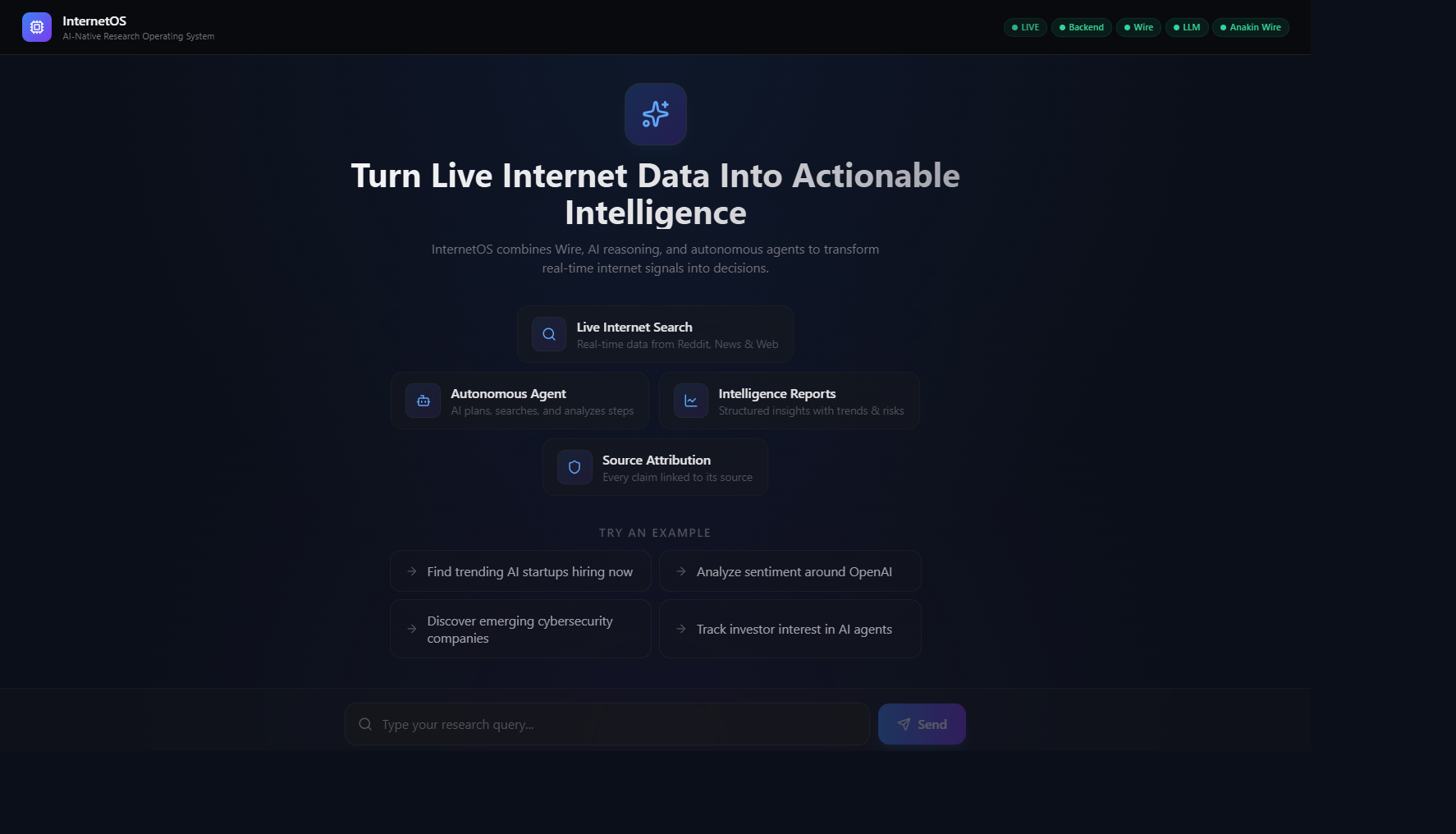
AI research interface with autonomous query execution and live results.
Inspiration
Modern search engines return fragmented information, forcing users to manually read, compare, and synthesize insights. We built InternetOS to eliminate this friction by transforming live internet data into structured AI-generated intelligence.
Live research today is slow, unstructured, and repetitive — so we designed an AI system that reads the internet for you and outputs clear, actionable insights in seconds.
What it does
InternetOS is an AI-powered research intelligence engine that collects real-time data from Reddit, News, and the Web, then uses an autonomous AI agent to generate structured insights.
It converts raw search input into:
Key findings Trends and patterns AI-generated summaries Source attribution
🌐 Live App: https://hackathon-navy-eta.vercel.app/ ⚙️ Backend API: https://hackathon-9a3r.onrender.com/ 💻 GitHub Repo: https://github.com/ramnath23112005/Hackathon 🎥 Demo Video: https://drive.google.com/file/d/1gKTB31S1JD8D-GdSK7gMVUX8WXASKK06/view?pli=1
How we built it
We built InternetOS using a full-stack AI architecture:
Frontend
Next.js Tailwind CSS Framer Motion
Backend
FastAPI (Python) Async agent orchestration system
AI Layer
Groq LLM (LLaMA 3) Prompt-based reasoning + structured output generation
Data Layer
Anakin Wire API for real-time Reddit, News, and Web data
Architecture Overview
InternetOS runs an autonomous 8-step agent pipeline:
Query interpretation using LLM Search strategy planning Multi-source connection setup Parallel internet search execution Data normalization and cleaning AI-based analysis and summarization Structured intelligence generation Final report rendering in UI
This allows real-time transformation of raw internet data into actionable insights.
Challenges we ran into
The biggest challenge was handling multi-source live data without increasing latency. We solved this using asynchronous parallel API calls across all data sources.
Another challenge was ensuring consistent AI output formatting, which we solved using structured prompt engineering and schema-based response constraints.
We also optimized frontend polling to make agent execution appear real-time and smooth.
What we learned
We learned how to design autonomous AI systems that combine:
Live data ingestion Parallel API execution LLM reasoning pipelines Real-time UI synchronization
We also gained experience in building production-like AI systems with scalable architecture.
Future improvements
WebSocket-based streaming instead of polling Persistent user sessions Exportable intelligence reports (PDF/CSV) Multi-agent collaboration system Advanced trend visualization dashboards


Log in or sign up for Devpost to join the conversation.