
Redshift Wireless
This is a project of Redshift Wireless. Check us out on the Internet at http://www.redshiftwireless.com
Our video is online at http://youtu.be/P_QrtqPwxB0
Inspiration
With the cost of electricity rising, the cost of heating Chocolate Fondue is making an impact on household budgets. We believe that a lot of energy is being wasted constantly heating Chocolate Fondue, and that the Chocolate Fondue industry needs a paradigm shift
What it does
There are three core functions within the Chocolate Fondue machine:
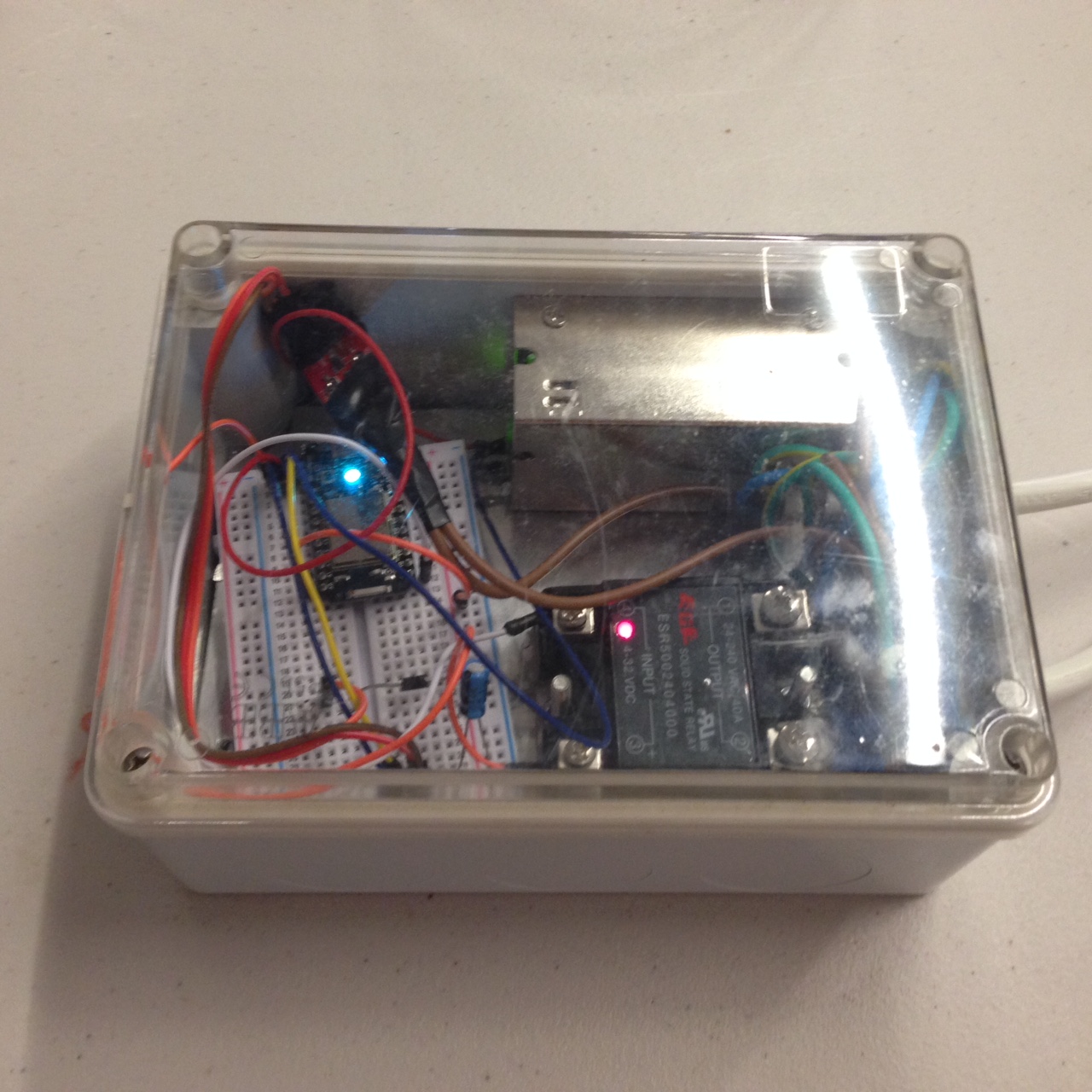
- An internet controlled timer to turn the heater on and off. The hardware as presented can control 40A at 240V, more than enough for the 80W average Chocolate Fondue machine
- An energy meter recording the consumption of the fondue machine, giving timely feedback of consumption and costs
- An override control, for when you have run out of hot Chocolate Fondue, and don't care how much it costs. In this case, the it will be heated for you, and you will be told how much it costs to for the food.
The Real Product - Hot Water
The real product is as an intelligent controller for Electric Storage Hot Water. The opportunity here is:
- Many people are being moved to Time Of Use electricity. This is particularly the case in new developments on the North Shore of Sydney and the Central Coast
- Electricity which is normally about $0.25/kWh (or $0.10/kWh for Off Peak Hot Water - Where available) becomes something like
| Approx. Price (kWh) | Common Time |
| $0.10 | 1am to 7am |
| $0.25 | 2pm to 8pm |
| $0.40 | All other times |
If people start heating their hot water between 2PM and 8PM, the price of electricity is four times heating the water overnight
Normally people would install an 'Off Peak' meter for hot water. The problem is that Multiple Dwelling Units only have one cable to each unit from the meter box, so this is not possible. It also brings opportunity
With this project, we can have an accurate timer controlling the heating of hot water, so you always pay the cheapest. BUT, if you run out of hot water, you can press a button on your phone at any time and heat the water, knowing it will be more expensive.
But this project also provides feedback on how much hot water is costing, both during normal operations and during overrides. We can present this in kWh, Dollars and CO2 output.
What does the research say?
We are basis most of this on the little known report 'Energy Use In The Australian Residential Sector 1986-2020' which notes that Electric Hot Water consumes about 11% of household energy use, decreasing to about 8% by 2020 with increase in renewable. Households consume about 110L of Hot Water per day, the the penetration of electric hot water just above 50% of households.
With a base water temperature of 15C, and a hot temperature of 65C, that means water needs to be heated by 50C. These numbers vary slightly by season, but not by much. This equates to about 6.4 kWh/Day/Household. Heaters also generally lose over 2 kWh of energy a day from losses caused by non-perfect insulation. These numbers refer to resistive heaters, not heat pumps which consume about 60% less.
| Price kWh | $0.10 | $0.25 | $0.40 |
| Cost/Day | $0.84 | $2.10 | $3.36 |
| Cost/Year | $306 | $766 | $1226 |
By moving users from a higher tariff to a lower one, the savings can be substantial.
So how much would this cost?
We are looking at charging $150 per year for a fully installed and managed system, on a four year contract. The electrician who installed the system would receive $75 per unit per year for installation and maintenance. Given that this will be targeted at multiple dwelling units, a 60 dwelling complex with 50% uptake would bring in $2,250/year for the electrician.
But this costs the electricity companies money - Won't they outlaw this?
No. First, that would be a restraint of trade, and that is illegal. More importantly, this provides the electricity companies with something called 'Demand Management'. This device has the potential to reduce their need to build more infrastructure and reduce their need to purchase electricity on the spot market in times of peak demand.
Since wholesale electricity prices can get up to $5/kWh, each water heater can cost the electricity company just under $25/hour for $2/hour income at worst case. In the future we could do a deal where if the price goes that high we will turn off units for possibly $10 each, and share this with the owners.
During the Victorian Bushfires, blackouts were triggered at 1:00 AM when 100 MW of hot water services were automatically switched on. With this type of system, they could have disabled until the power system was more stable.
Is there an environmental impact?
One of the problems with the current electricity bills is that come in commonly every three months, and are often aggregated between all services. If you want to operate a closed loop control system, having such a large time frame with consolidated usage data does not permit meaningful decisions to be made on behavioral changes.
Once the loop is closed, be it on a daily, weekly or monthly basis, people can see how their actions are affecting their consumption of energy and therefore can modify their behavior accordingly.
There is also an environmental impact from the electricity companies being able to shift load, with the ability to use energy when there is an excess of generation, such as when 'un-scheduled generation' is available and must be used according to AEMO rules, even if this would force the wholesale price of energy into the negative!
What parts did you use?
The major parts are:
| WiFi Module | Spark Core |
| Solid State Relay | ESR5002404000 - from WES Components |
| Current Sensor | Sparkfun Low Current Breakout |
| Power Supply | 5V 2A Frame Switchmode Power Supply from Aliexpress |
| Certified Power Plugs | Woolworths 5M Extension Cable |
| Case | ABB IP55 rated ABS case |
Why not just a timer or the off peak relay already in use?
The Off Peak relays in use work well, but cannot be used in many Multiple Dwelling Units where the meter boxes are centralized, since they require a second cable from the meter box to the hot water heater.
Timers are good, but they are hard to keep accurate. They also require that the customer know what times of the day the electricity is cheapest. Informal surveys have shown that a large proportion of the community believe that they are on Time Of Use when this is actually not the case.
How it works
The device is based on the Spark.IO Spark Core. Being a hardware and software project, there are certain limitations with the form of the competition. The hardware is the same as would be used in production, although the parts would to a large extent be installed on a PCB to reduce the manufacturing costs.
Why no custom PCB?
Given that this device will be controlling at least 230V at 20A, there is some serious design work to ensure not only is the product safe, but that it is economical to manufacture. We have used the exact parts as far as possible we plan to use in production, but have used modules rather than produced a custom board. We do not believe that a custom PCB is essential to demonstrate the concept, but we feel that there are potential safety risks involving 230V 20A circuits, surface mount parts and hand made boards.
Is the product as presented safe? Is it legal?
It is our belief that the prototype meets AS/NZS 3100, meaning it would be legal to be wired into a house or office under AS/NZS3000, if installed by a licensed electrician, or someone authorised under the various acts. The prototype connects to external equipment using a standard extension cord that has been cut in half. By doing this, the plugs and sockets comply with AS/NZS 3112. The prototype is not required to comply with EMR/EMC legislation, but the production device will required to be tested in accordance with these standards.
To reduce risks, we have used a 5V power supply with metal case, rather than using a 'frame' power supply, or placing the power supply parts onto the PCB. In production, we may well place the power supply on the main PCB, but this will come down to cost and safety.
Describe the market and sales channels
The target market is for:
- Multiple Dwelling Units
- With Time Of Use electricity
- Electric Storage Hot Water
- Body Corporate
We would sell the service through Body Corporates. Where individual owners are responsible for paying, we would be requiring a percentage of owners to sign up before installing. In either case, we would offer either a lump sum payment, or a monthly fee with install charge.
We would sell through installers, who would then have the relationship with the customers.
Challenges I ran into
There were major WiFi challenges at the event. It has not been determined if this was 2.4 GHz spectrum congestion, IP Exhaustion on the DHCP or a combination of these. Using an alternate WiFi module seemed to work better, although this had a small sample size.
Accomplishments that we're proud of
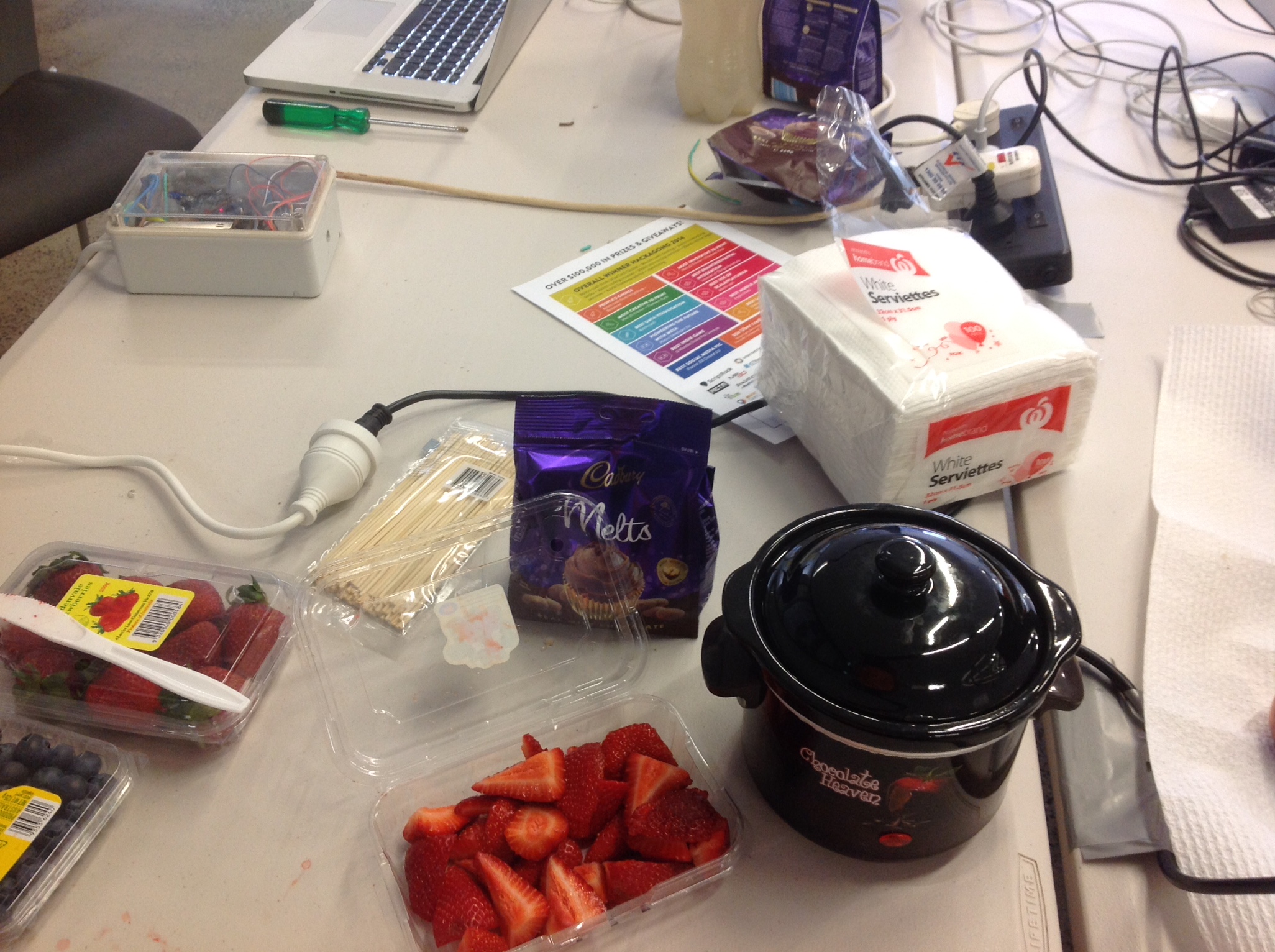
Being able to cook Chocolate Fondue using the Internet, and use it as a way to explain a business concept is probably the most amazing thing.
What we learned
Traditional thinking is that hardware is hard. In this project, the hardware with the associated firmware was the easy bit, with the software taking more effort. Ruby On Rails 'out of the box' does not work with asynchronous jobs 'out of the box' particularly well, and needed to use a different external library since the one we had chosen for asynchronous events performed poorly.
What's next for Internet Controlled Chocolate Fondue
Now that the concept has been verified, the next step will be to look at productizing the device. This will involve PCB design, Design for Manufacture, testing to AS/NZS3100, talking to installers and potential users, councils and electricity companies.
One of the key components will be building for reliability. Given that it is likely to cost in the vicinity of at least $100, and likely a lot more to repair faulty units, extra money ensuring reliability will be well spent. This would include higher temperature parts, particularly in the power supply, and over-engineering the switching. This is why we went for a 40A relay in the prototype when a 15A or 20A unit would likely work in production, and a 1A one would work in demonstration.
Testing to AS/NZS3000 is likely to be expensive, so will C-Tick testing, but these are essential requirements for a product to legally be placed onto the Australian or New Zealand marketplace.
The device will probably be offered under the existing Redshift Wireless company brand, placing it along side the existing Air Conditioner IoT product.
What about measuring hot water usage?
We have thought about measuring the usage of water in real time, but there are some reasons that this is not a direction we want to go. The reasons include:
- This requires a plumber to install the hardware to measure the water flow. This adds significant cost to the install
- There is actually not a net benefit to the customer for measuring water consumption, since water costs about $0.002/L, and you can gain insight into the heating cost by monitoring the daily usage.
Translation: Monitoring and control of energy provides the best bang per buck
What are the Risks
With any product, you can never be sure that the market will be there when it is released to the market. Market research can help, but since hardware projects tend to have a long lead time, and often do not meet schedule, care needs to be taken to ensure any market expectations are met.
There are numerous engineering challenges to productizing this. Design for Manufacture will help, as will Design for Installation. Talking to installers during the design process will reduce the risk of issues during installation.
The WiFI technology is definitely a risk. The issue here is that some of the modules are less reliable than others, and this needs to be taken into account. Risk can be reduced by using an advanced off the shelf solution.
Supply Chain issues are always a challenge. Most of the parts that we are looking at using are reasonably available, with the only issue being the single sourced WiFi module. There are suppliers of WiFi modules from other companies that can be used although that would require more firmware to be developed.
Market Research & Validation
We have talked to a number of installers and marketing professionals, and the feedback is that the product has a huge potential.
Based on the feedback from other Redshift Wireless products, we have decided on a subscription 'Pay By The Month' model in order to reduce the up front expense for the customer. This will require us to fund the development of the first batch of hardware ourselves, before talking to a financial institution about a business loan.
By using the electricians to do sales, they can leverage existing clients, gaining passive income for little work on their behalf. In return, they are required to cover install and warranty exchange
From John D. of Wollondilly - former pilot and property investor:
I love the concept - I see a huge potential in this. This would save me a LOT of money. How can I help you guys, and more importantly, how can I invest?
From one of the Volunteers:
I validate the concept
From one of the other contestants
I wish I had electric hot water - I have gas hot water at home, but if I had electric got water I would totally go for this
From another contestant
You know, I have no idea how much hot water costs me. This has to save me money. However much it costs, just having the feedback will help me reduce my bill.
Some Numbers
Occupied Households
| State | 2007 | 2020 | Annual Increase |
| NSW | 2,676k | 3,132k | 47k |
| VIC | 1,999k | 2,353k | 43k |
| QLD | 1,619k | 1,111k | 42k |
| WA | 821k | 1,026k | 22k |
| TAS | 203k | 221k | 2k |
Approximately 10% of households are unoccupied in each state at any time.
Penetration of Electric Hot Water is projected to go from 53% to 45% of households between 2007 and 2020. This means that the number installed units is staying basically constant over time. In addition, people who replace a Hot Water Heater tend to replace it with a unit of the same type. Solar penetration is slowly increasing, and is at about 11%, but does not affect the multiple dwelling units appreciably.
Savings for heat pumps are possible, but lower, since heat pumps generally consume only about 40% of the energy of resistive units. Solar electric heaters are once again less likely to make savings, but some savings are possible since solar electric units still consume energy, at a level of about 15% of storage hot water

Log in or sign up for Devpost to join the conversation.