-
-
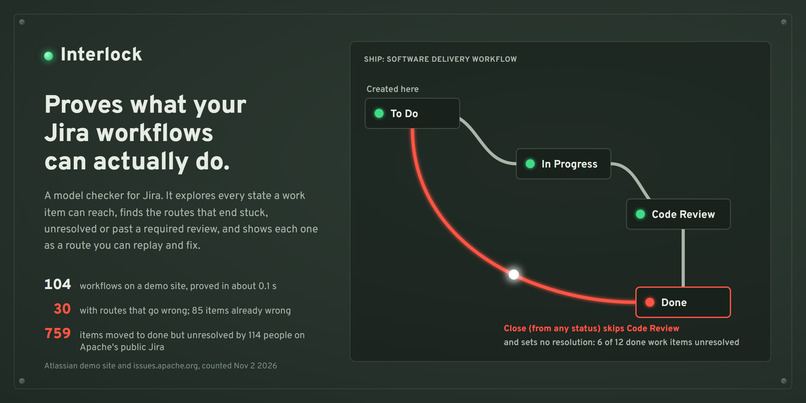
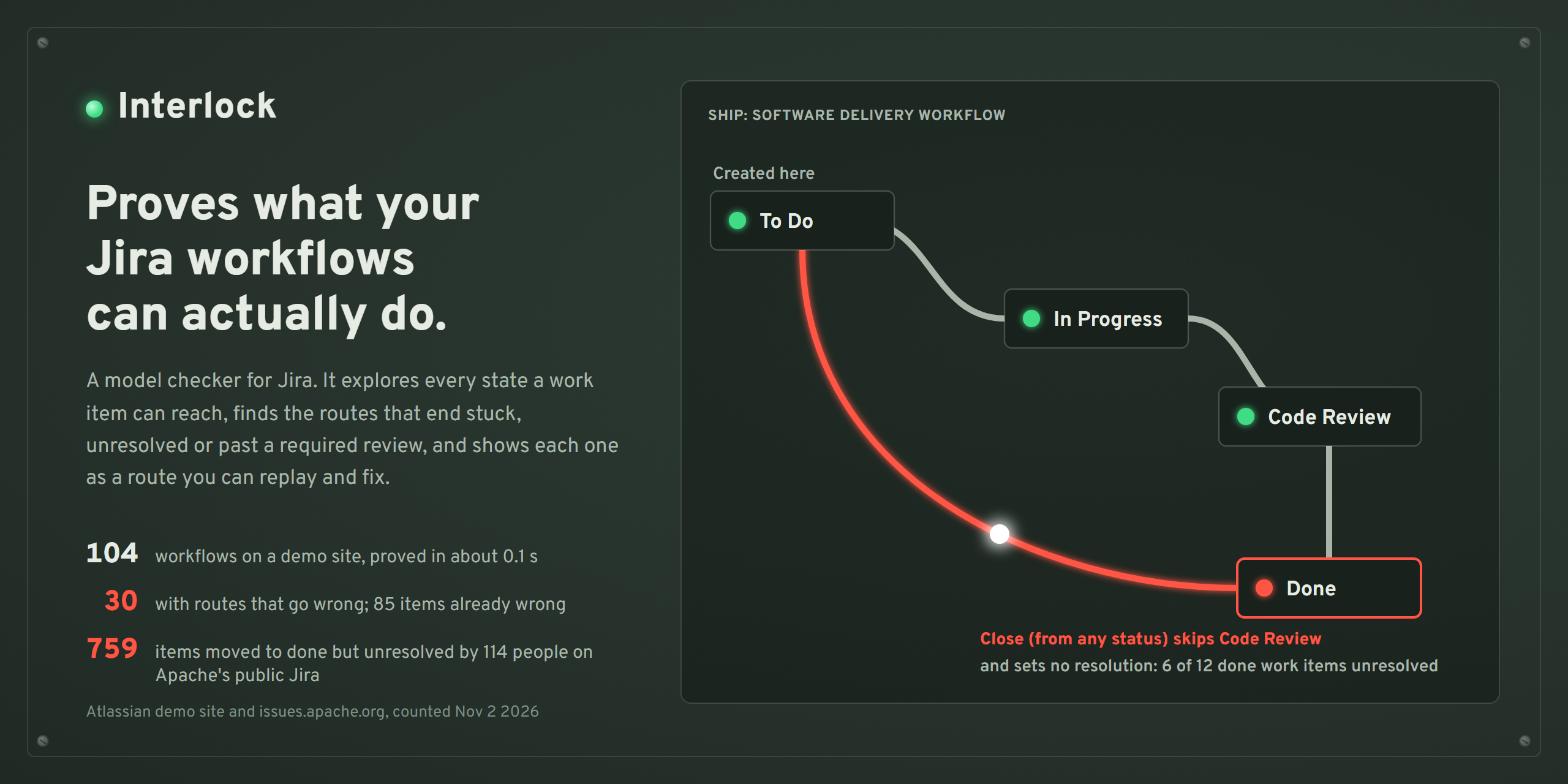
Interlock: proves what your Jira workflows can actually do. On a demo site, 104 workflows proved; 30 have routes that go wrong.
-
 GIF
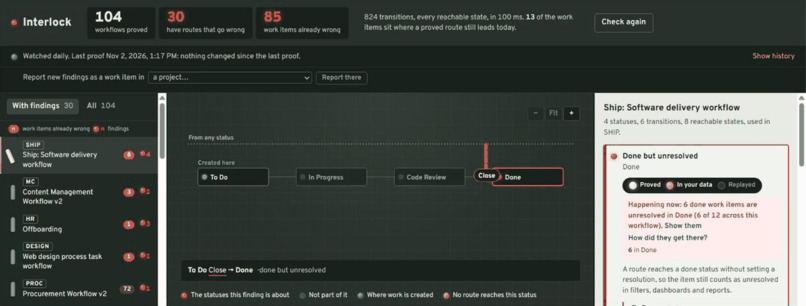
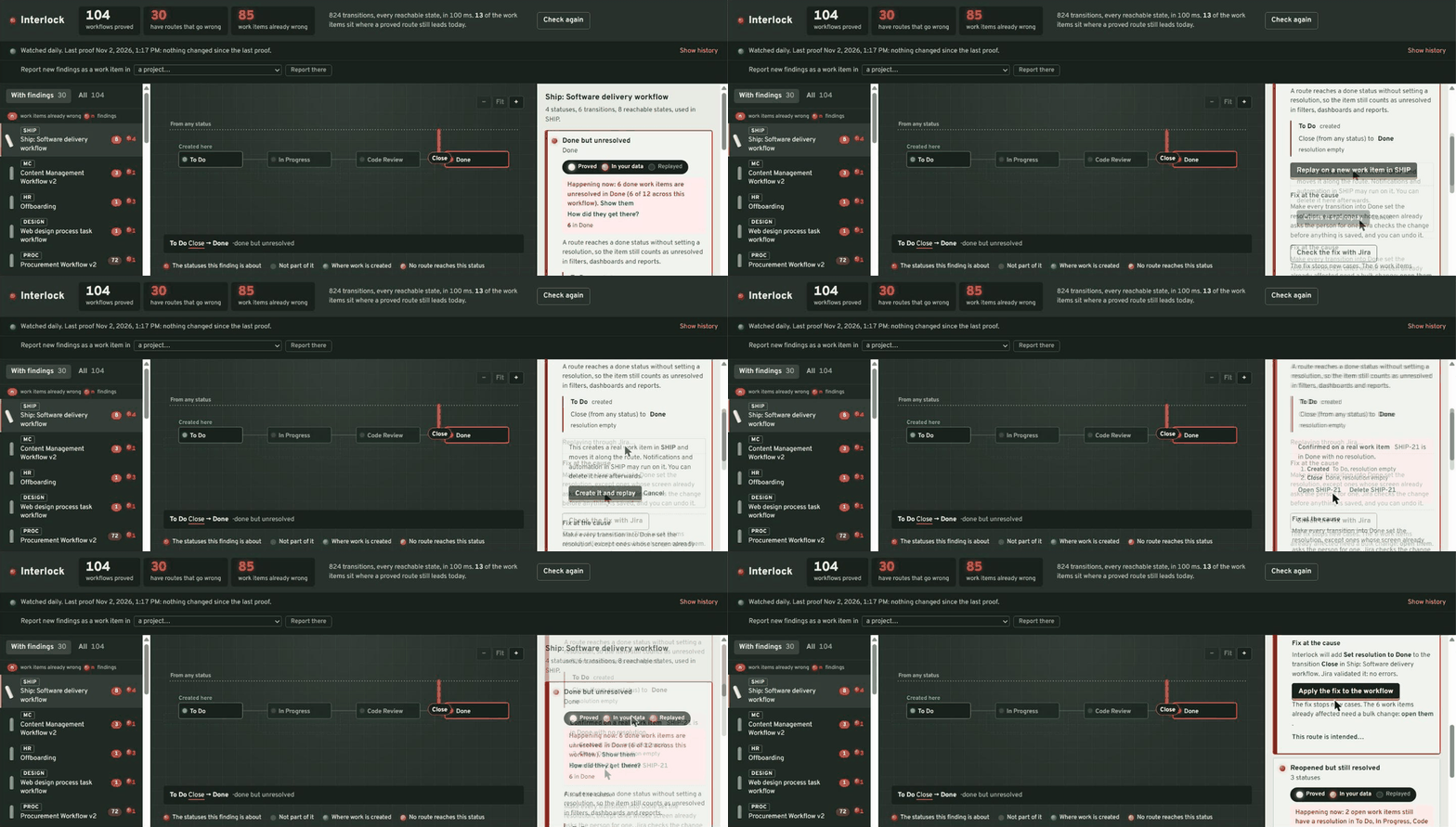
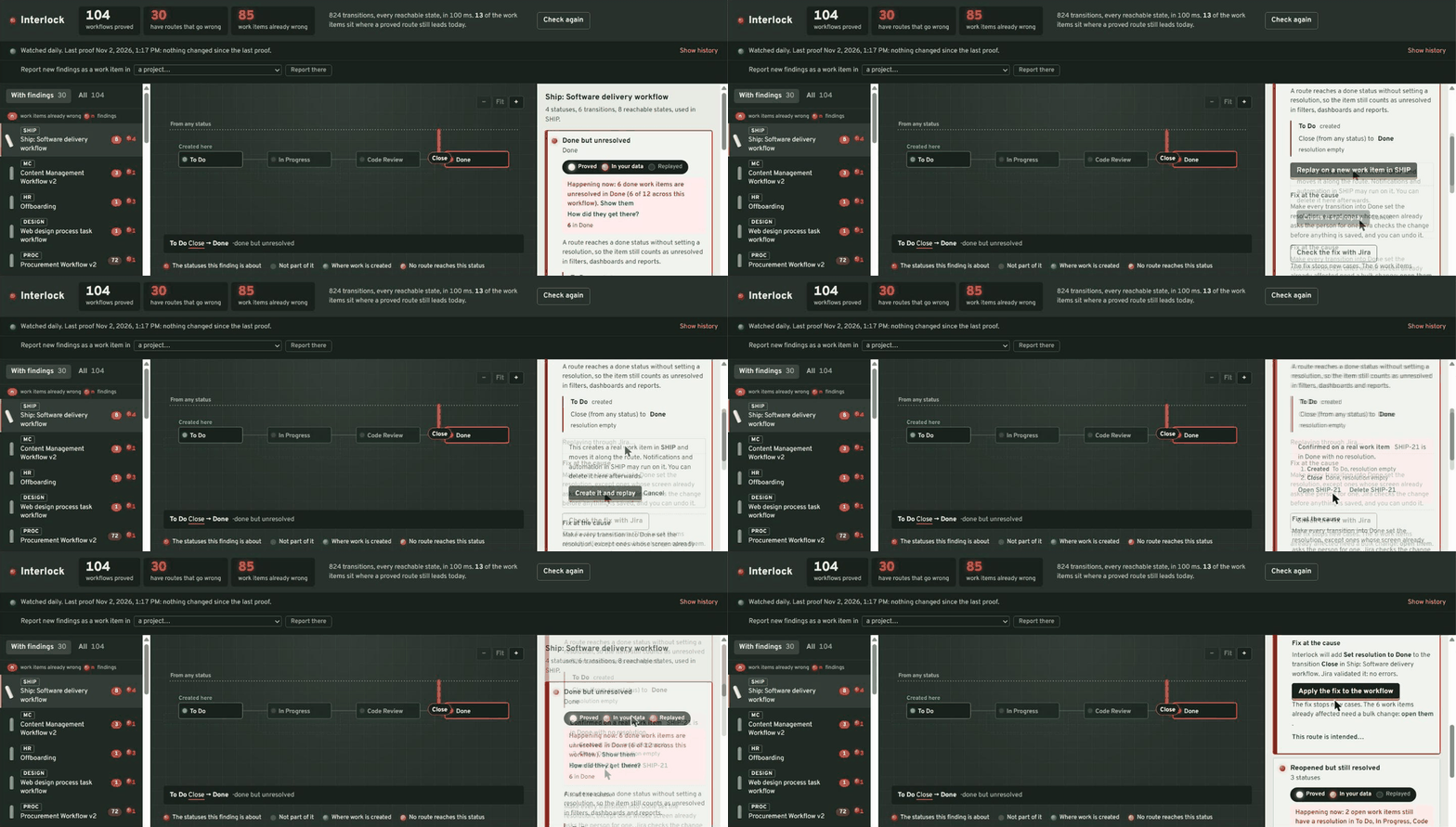
Live on a Jira site: the Ship shortcut lights up, a replay confirms it on SHIP-21, and Jira validates the fix before anything is saved.
-
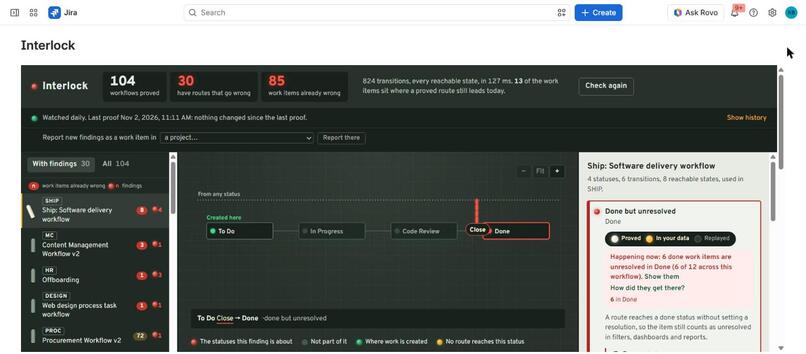
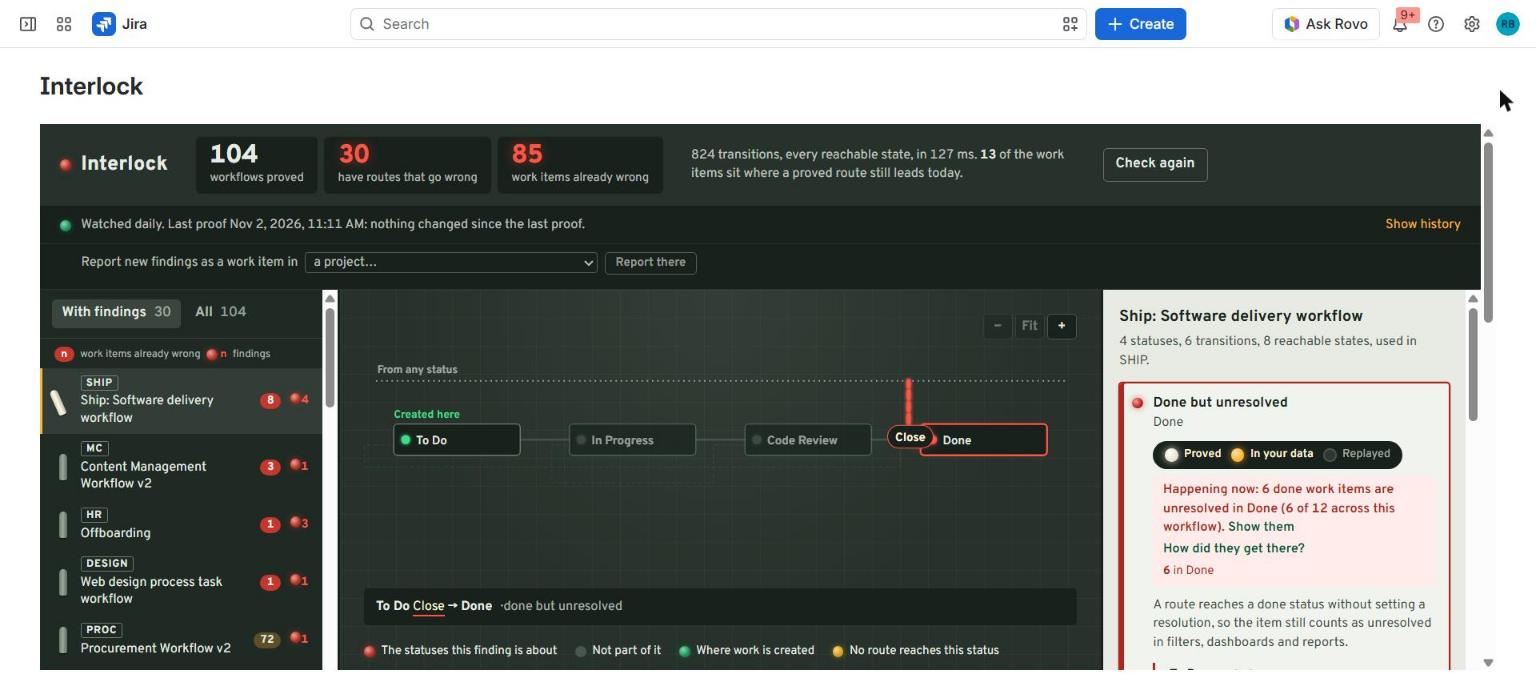
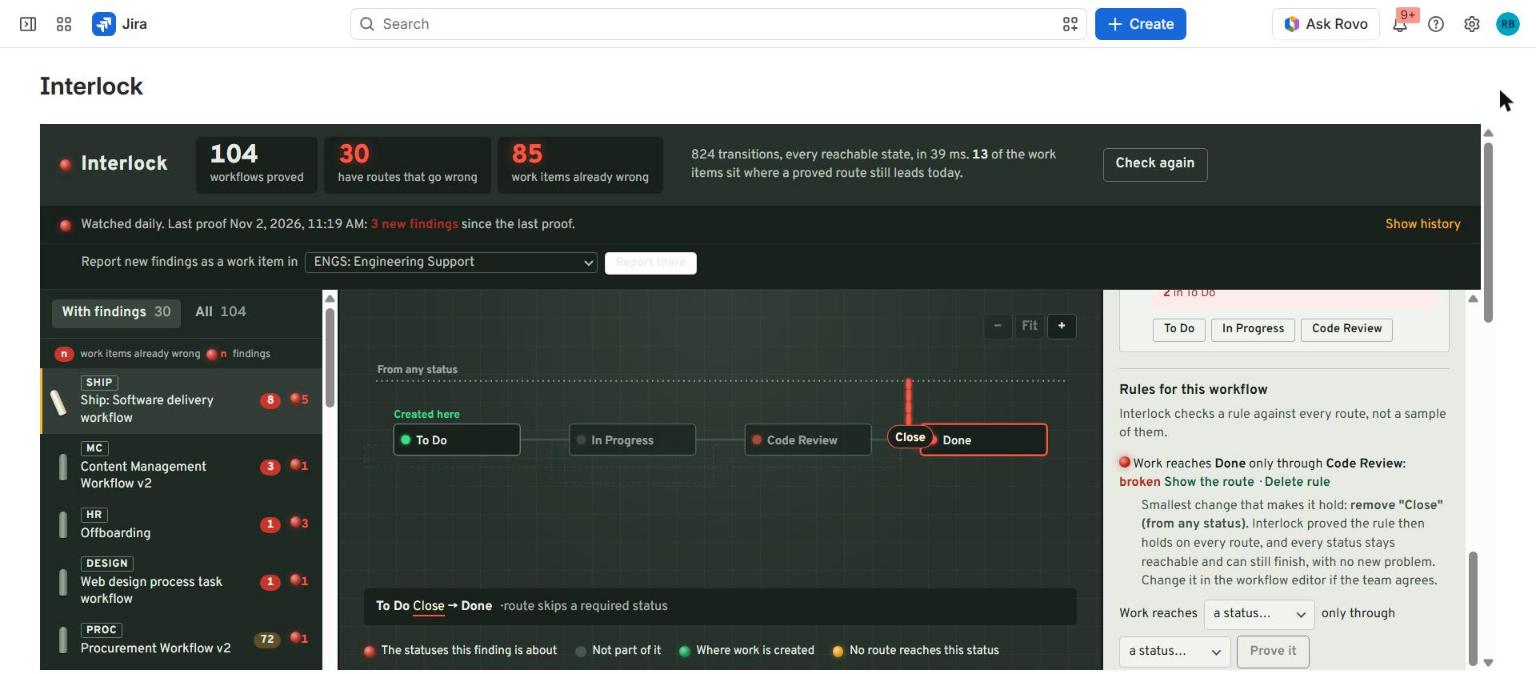
Every workflow on the site, proved in milliseconds. The worst route lights up: on Ship, Close skips Code Review.
-
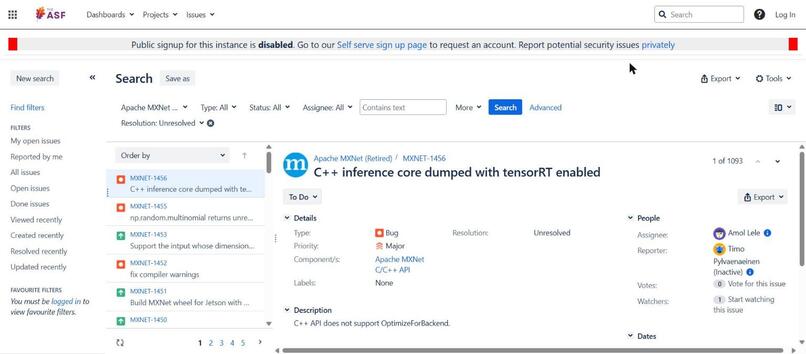
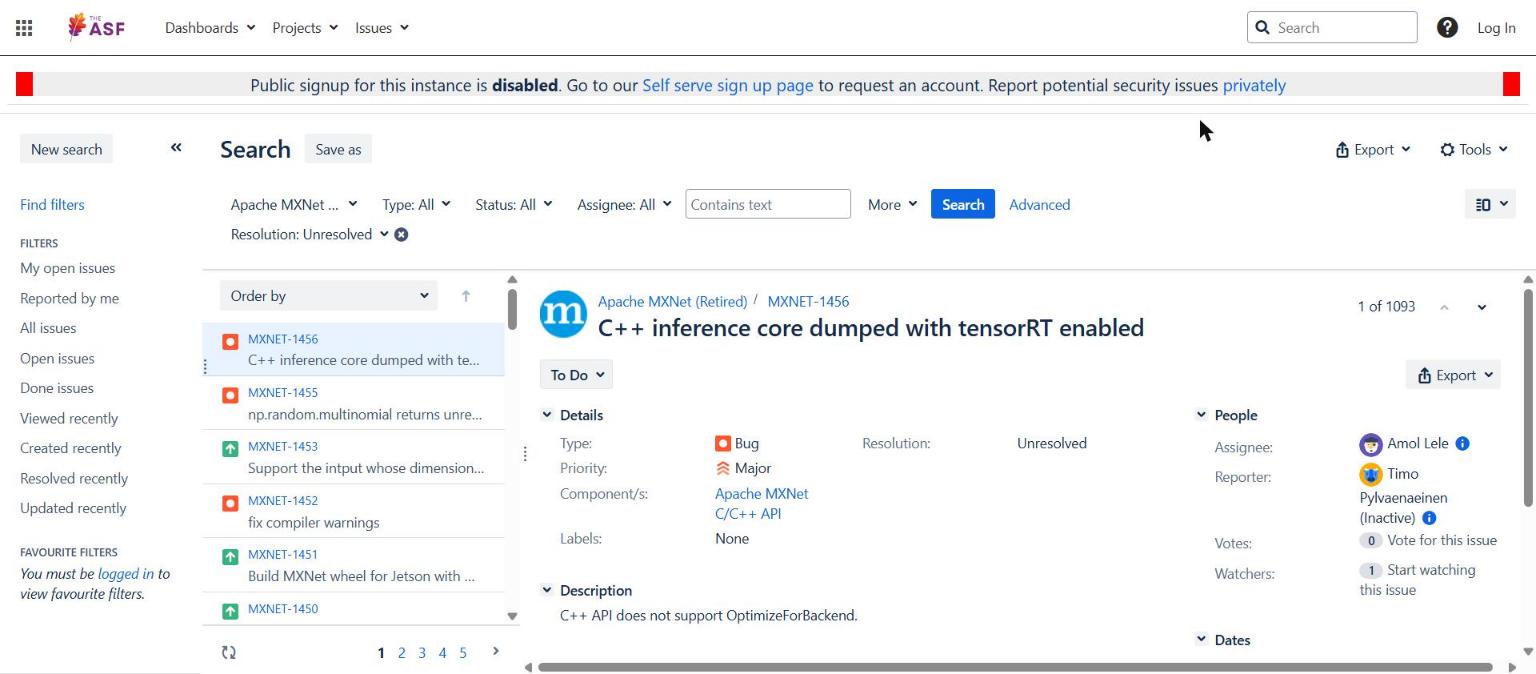
Apache MXNet's public Jira (now retired): its filters count 1,093 work items as unresolved; 333 of them are done.
-
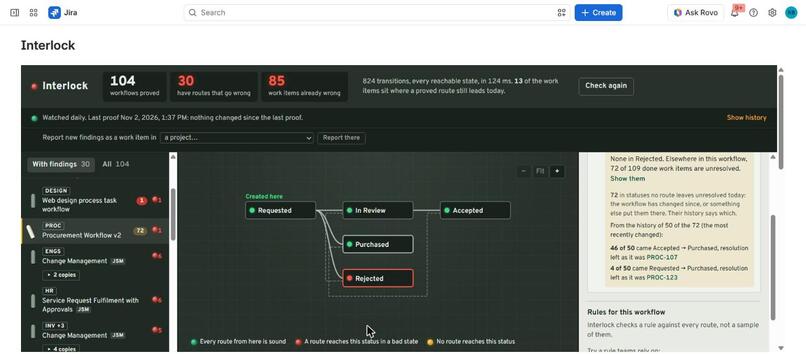
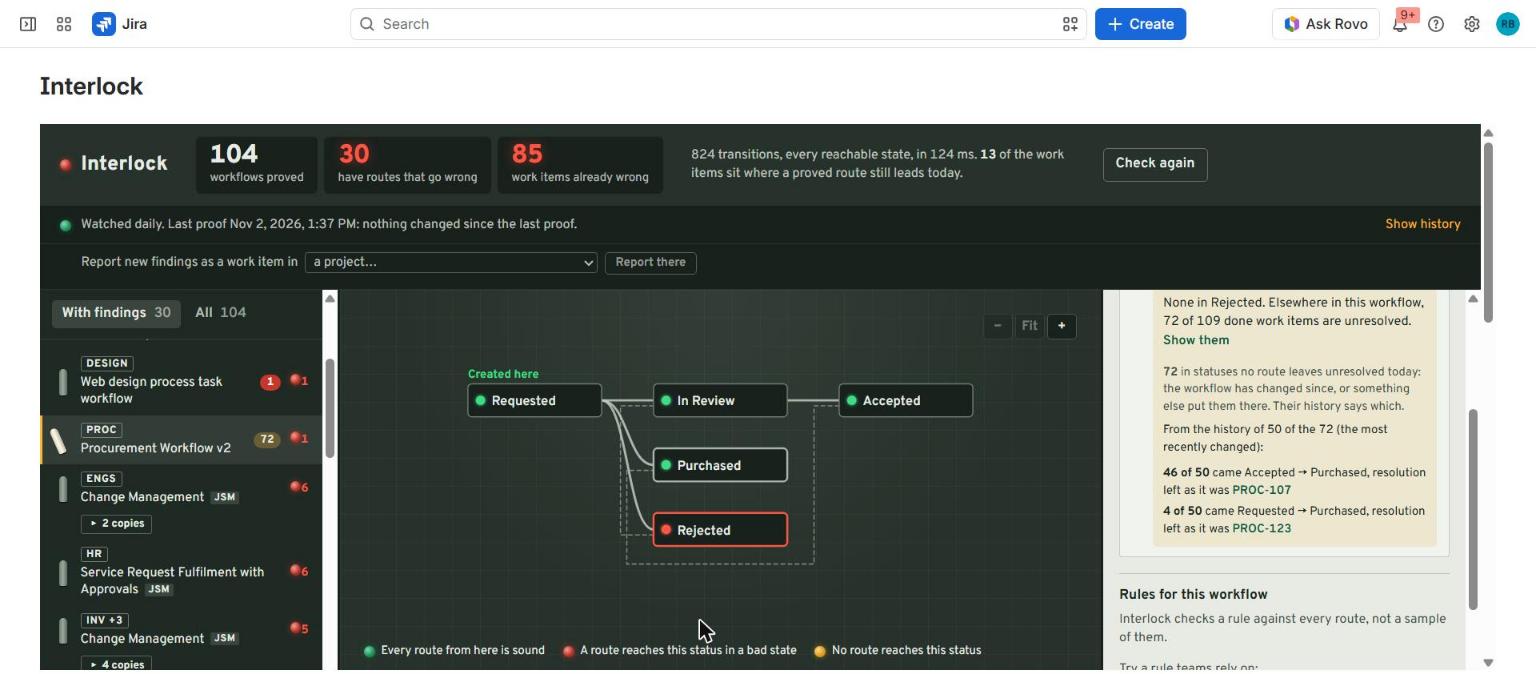
How did they get there? 46 of the 50 most recent unresolved purchases came Accepted to Purchased: the step the proof flagged.
-
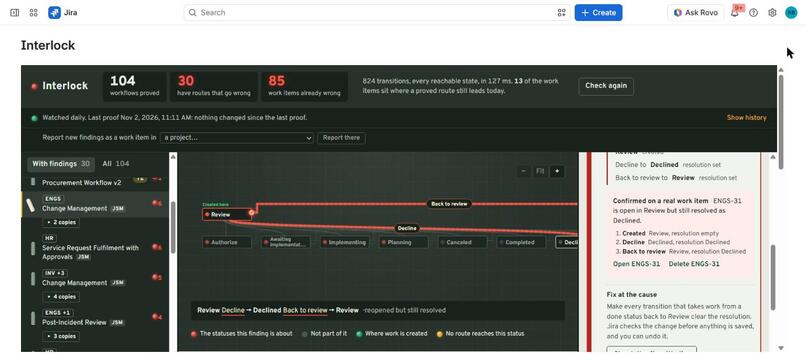
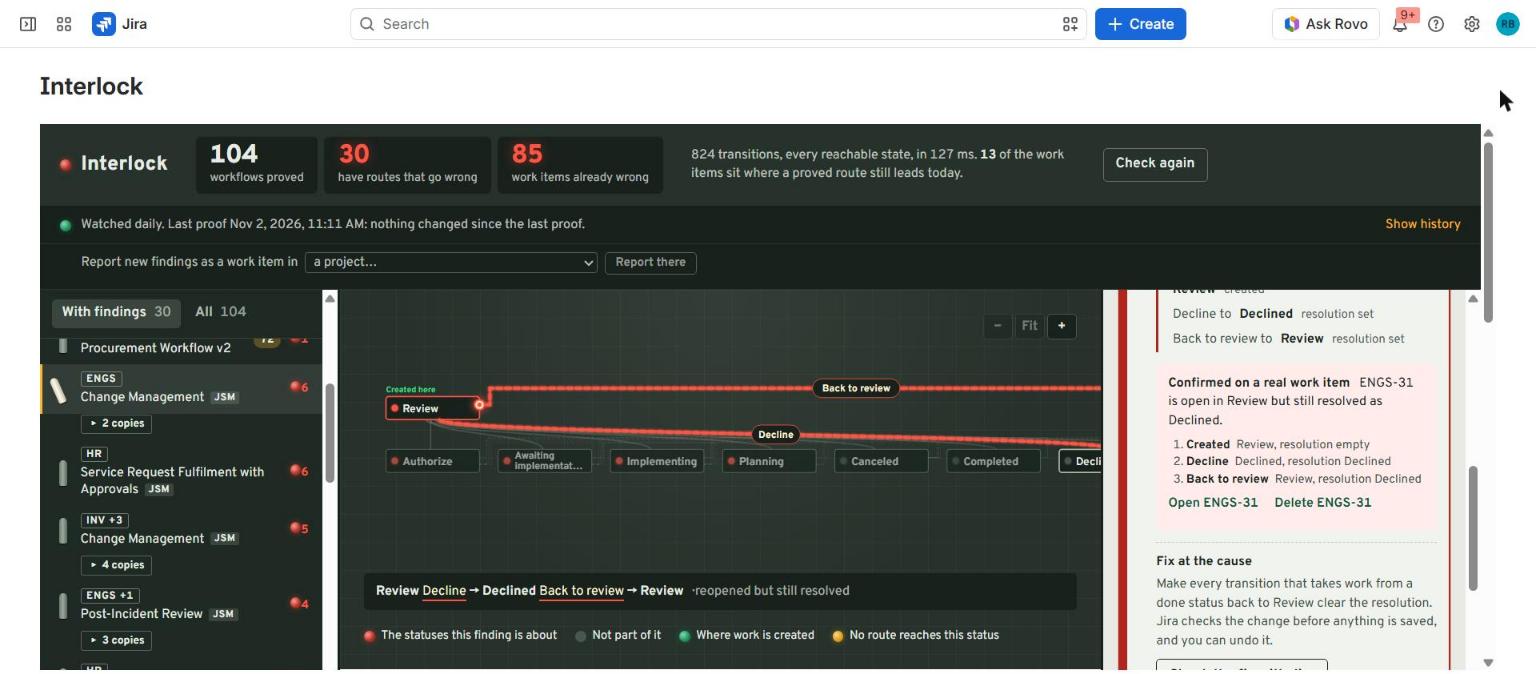
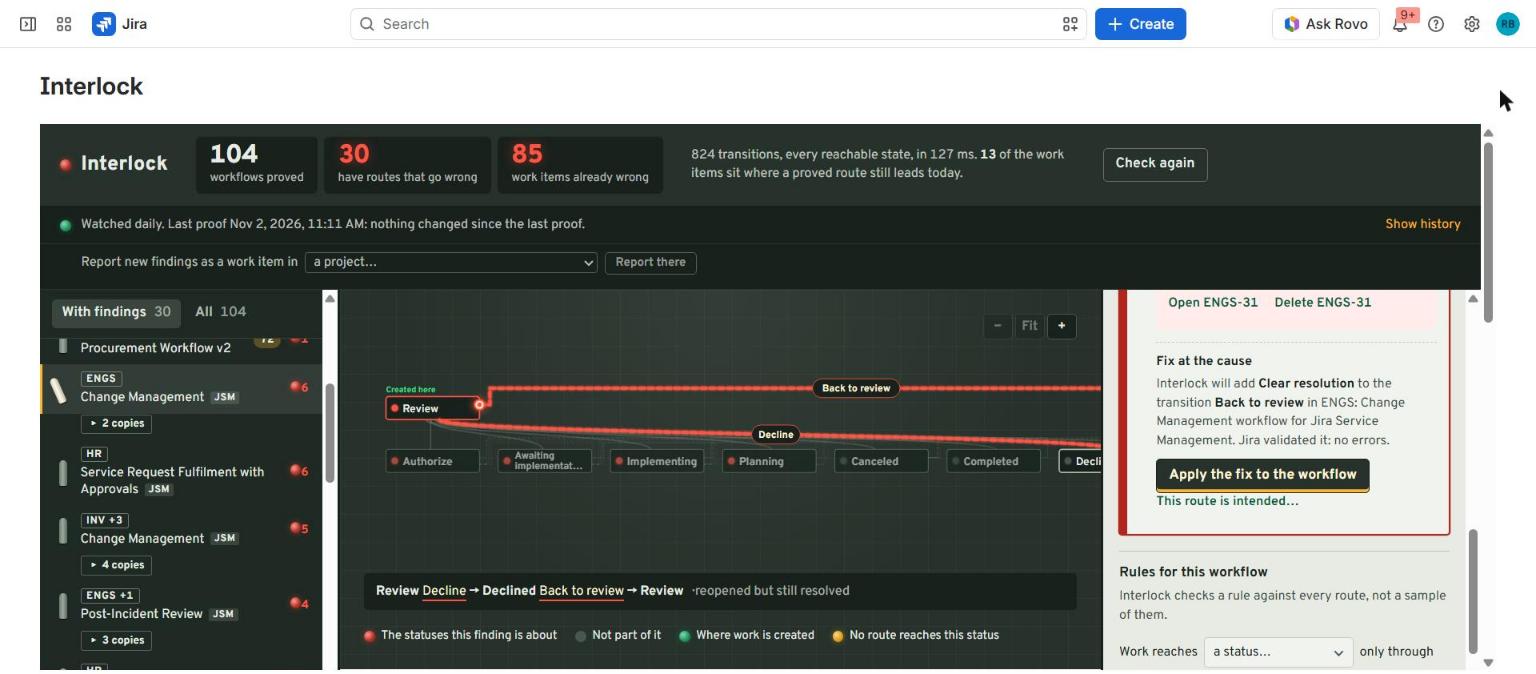
Replay walks the route on a new work item: ENGS-31 is open in Review but still resolved as Declined.
-
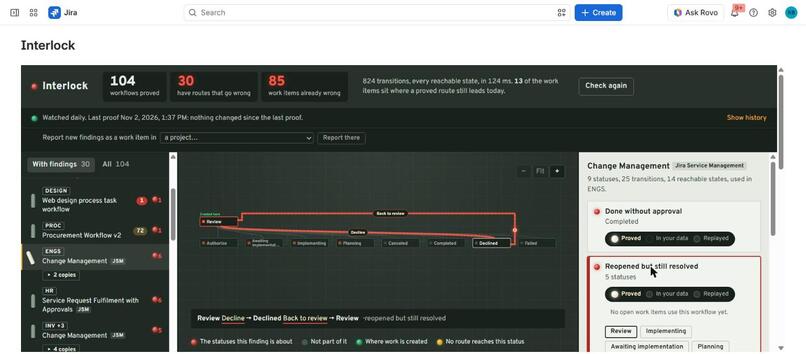
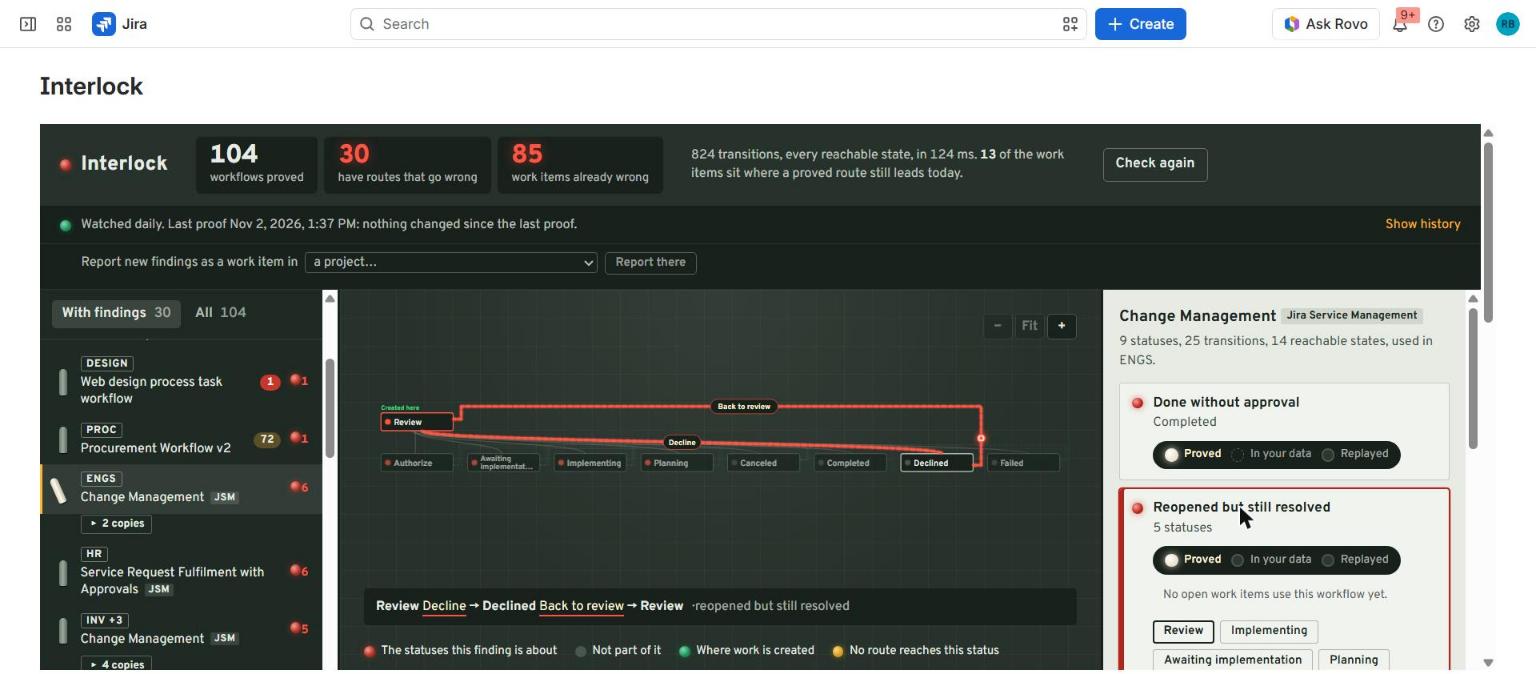
A finding is a route: a declined change goes back to review and stays resolved.
-
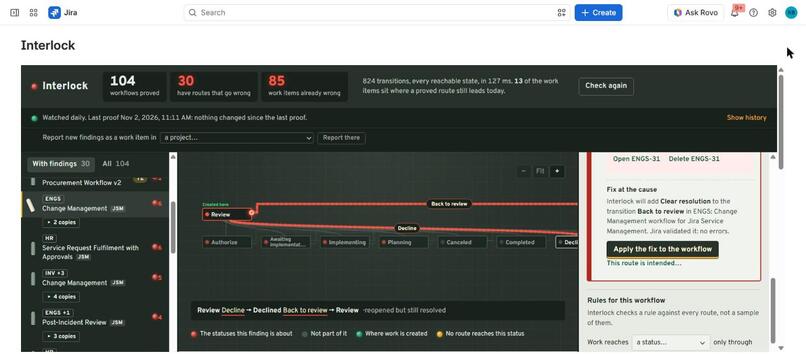
Fix at the cause: Interlock adds Clear resolution to the transition, and Jira validates the change first.
-
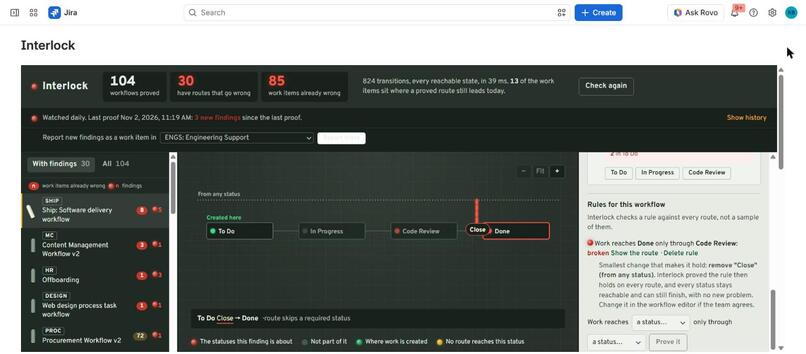
A rule like "Done only through Code Review" comes with the smallest change that makes it hold, proved on every route.
-
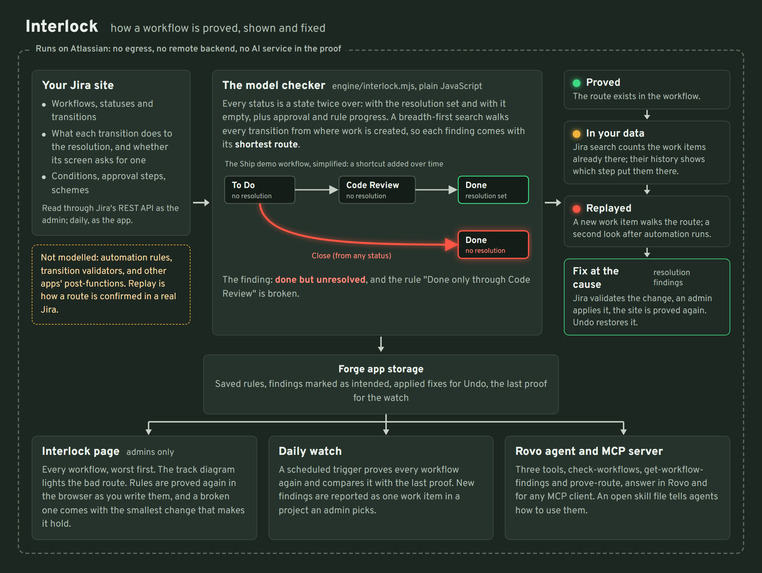
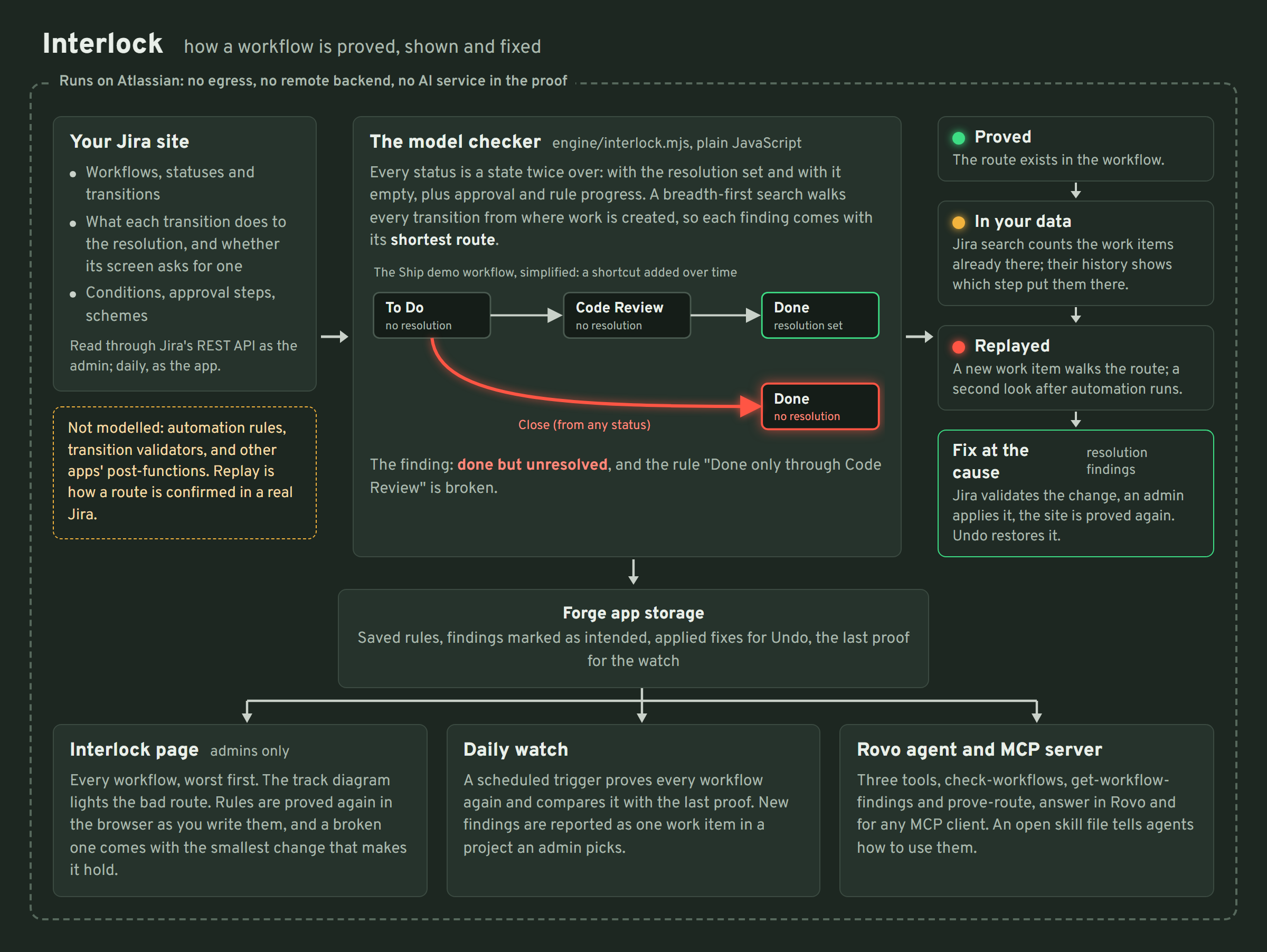
How it works: the model checker, the evidence ladder, the fix for resolution findings, and where the proof answers.
-
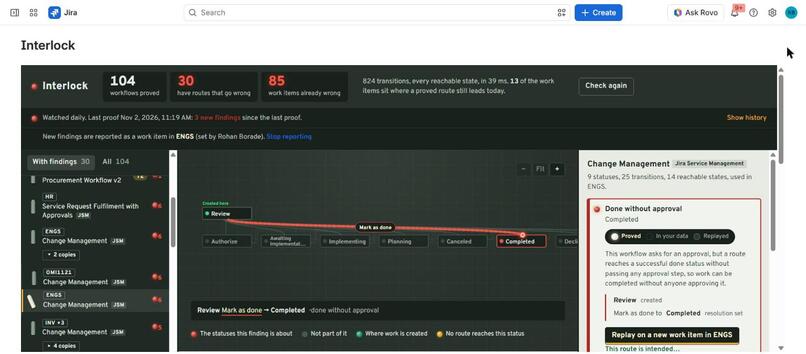
The daily watch: new findings since the last proof, reported as a work item in a project you pick.
-
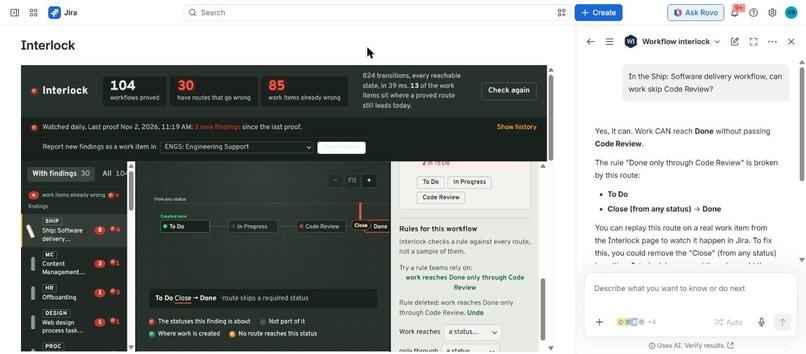
Ask the Rovo agent; the same three tools are published as an MCP server.
-
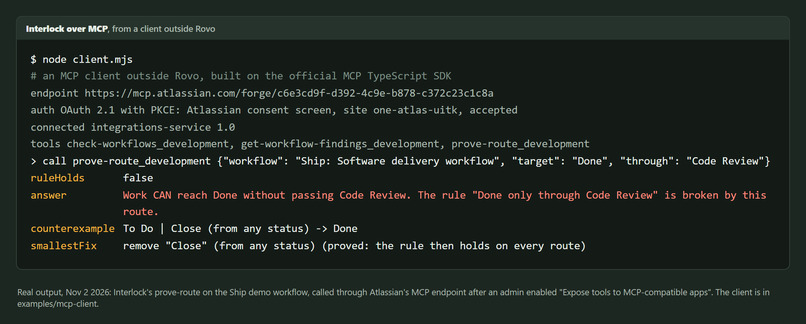
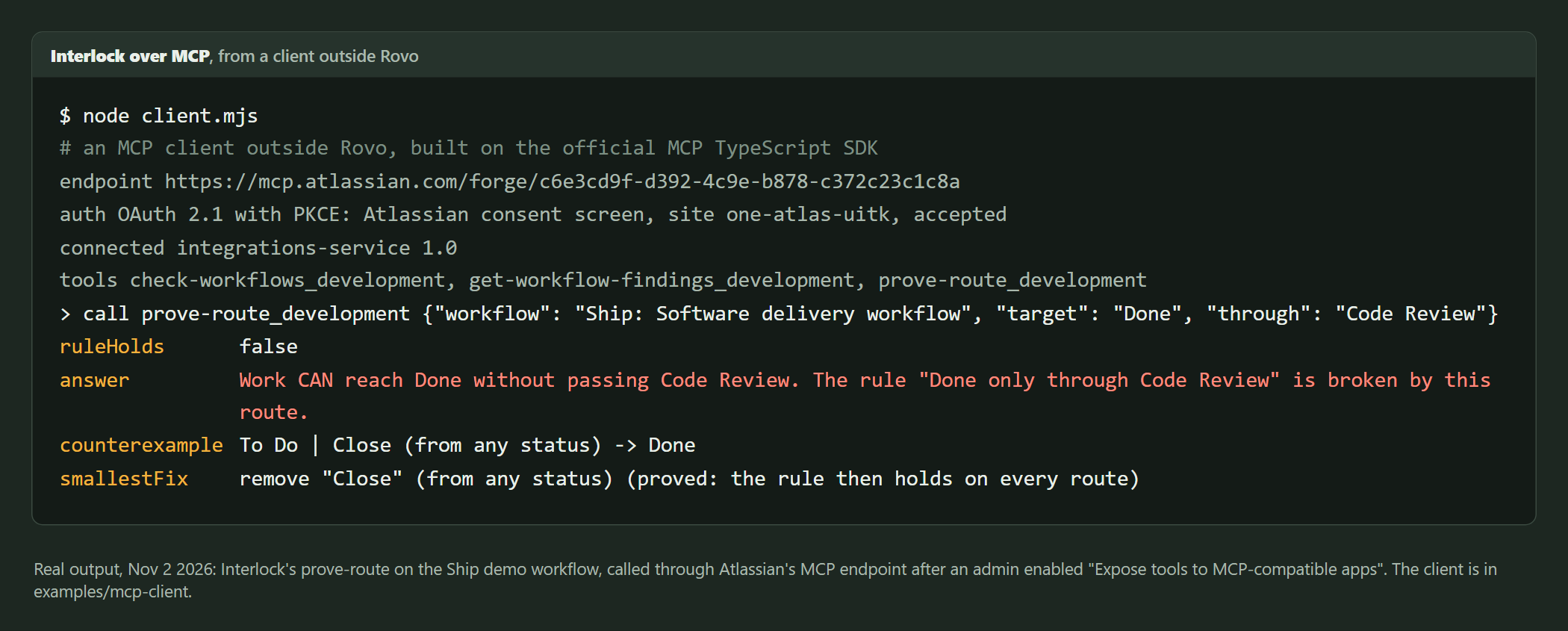
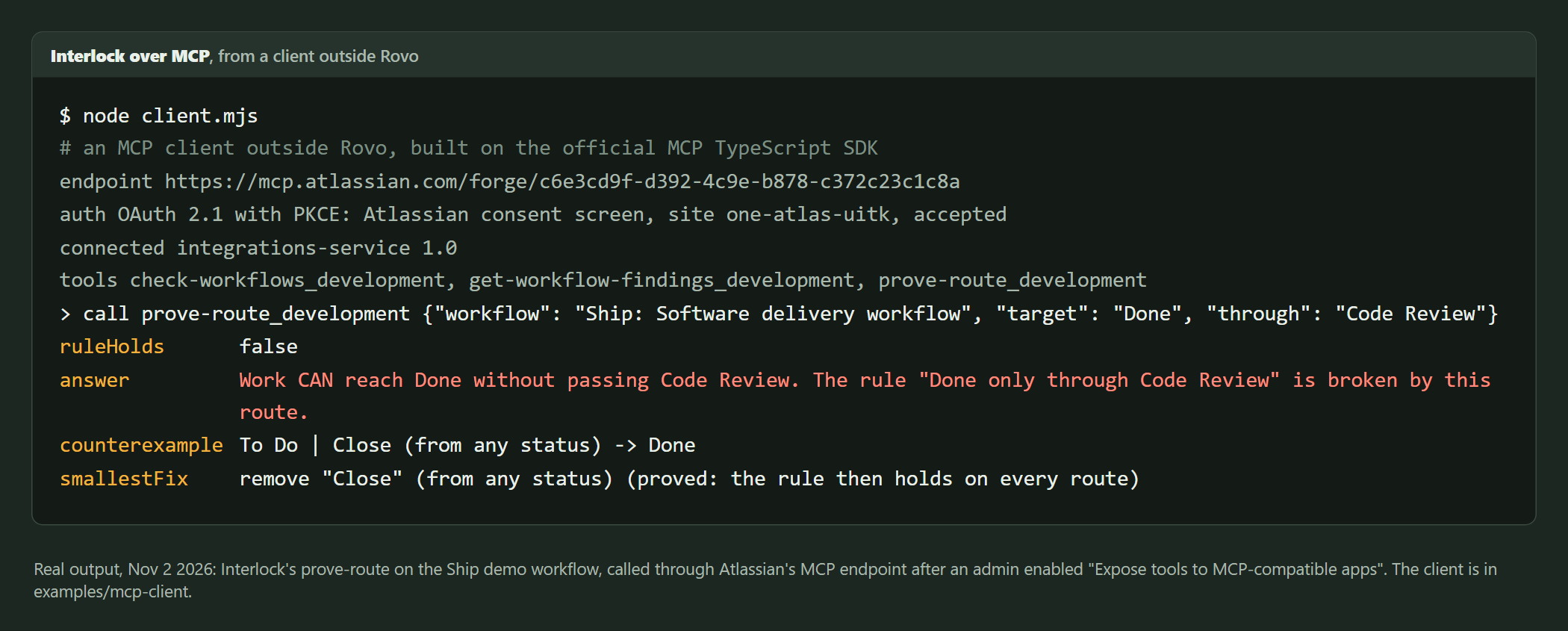
Any MCP client outside Rovo: signed in with Atlassian OAuth, it called prove-route on Ship (dev install, hence _development names).
Try it: install it on your Jira Cloud site. Code: github.com/RohanGlitched/interlock.
In short: a Jira workflow can mark work Done without a resolution, reopen it without clearing one, or skip the review your team promises, and Jira never checks. Interlock checks every route of every workflow on the site, counts the work items already caught in each bad state, replays the route on a new work item, and fixes resolution gaps at the cause, with Undo. On Apache's public Jira, reading each item's history the same way, 114 people moved 759 work items into "done but unresolved" through ordinary transitions.
Inspiration
Many Jira filters, gadgets and reports (every "resolution = Unresolved" filter, Created vs Resolved, Resolution Time, Average Age) run on the resolution field, not on the status. A workflow that reaches Done without setting a resolution makes finished work count as open; one that reopens work without clearing it makes open work count as finished. Teams also rely on promises such as "nothing is done without code review" or "every change is approved". Jira never checks any of these, and one global transition added for a hotfix can quietly break them. Railway signal boxes solved the same problem with interlocking: the lever frame physically prevents a combination of levers that would set conflicting routes.
What it does
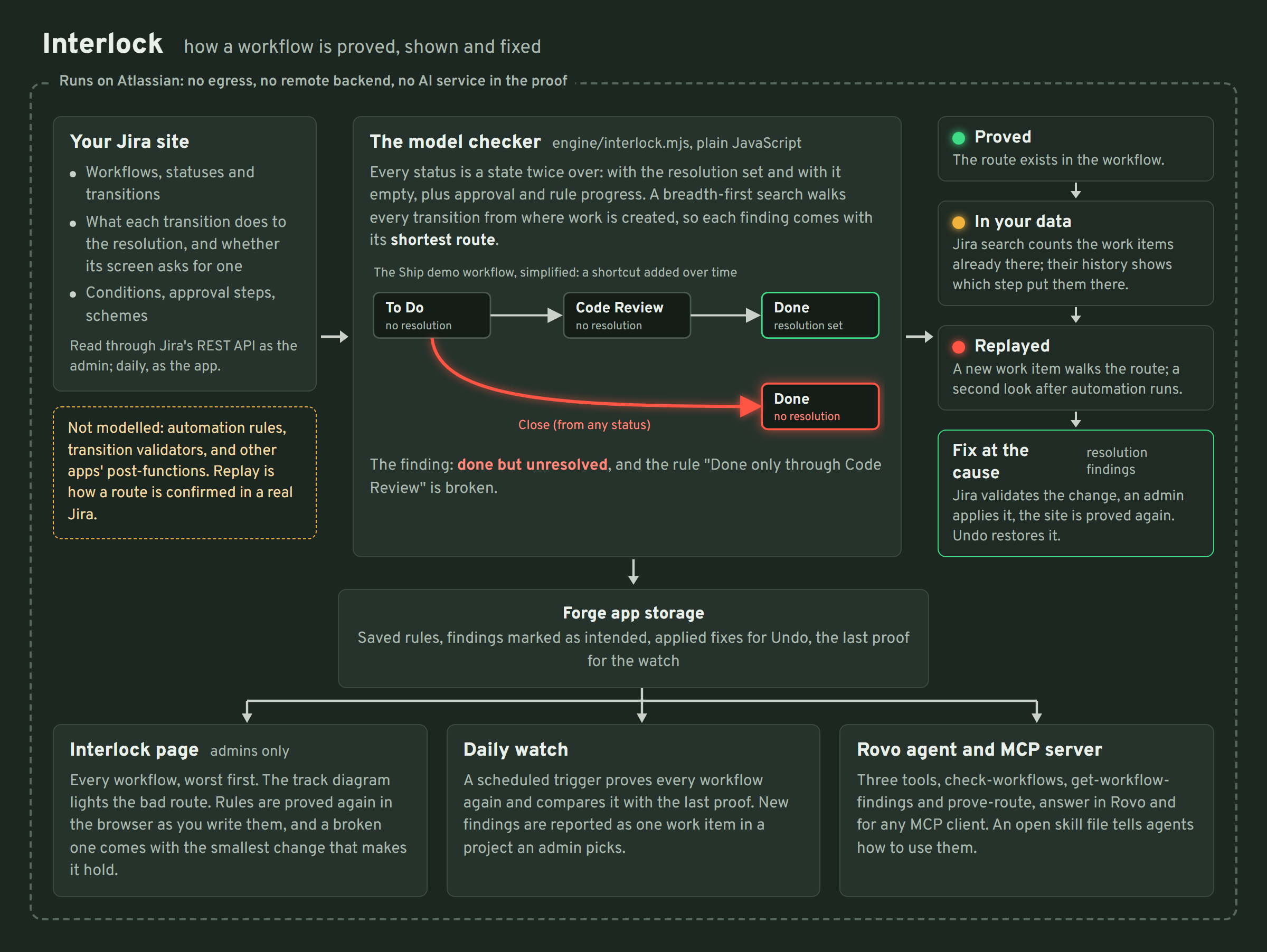
Interlock reads every workflow on the site and works through every situation a work item can be in (each status, with the resolution set or empty, and for approval and rule checks, whether the required step has been passed), not a sample of work items. It finds:
- work that can get stuck, reach Done unresolved, or reopen still resolved;
- statuses nobody can reach and transitions nobody can use;
- done without approval: a route to a successful outcome that skips the workflow's approval step;
- your own rules, such as "Done only through Code Review". A broken rule comes with the smallest change that makes it hold, checked on every route first, with any side effects listed.
Each finding comes with its exact route, and is taken as far as it can go:
- Proved: the route exists in the workflow.
- In your data: Jira's own search counts the work items already in that bad state, and their history shows which step put them there.
- Replayed: a new work item, titled "Interlock replay: …", walks the route through Jira, filling in each transition screen as a person would, with a second look after automation has run. Its notifications and automation run like any work item's; Interlock offers Delete.
Then fix at the cause: for resolution findings, Interlock adds Set resolution or Clear resolution to the transitions involved. Jira validates the change first, an admin applies it, the whole site is proved again, and Undo puts back exactly what was there, refusing if someone has edited those transitions since. The workflow's card names every project that uses it, because a fix reaches all of them. A daily watch proves every workflow again and reports new findings as one work item in a project an admin picks.
What the proof covers: statuses, directed and global transitions, resolution post-functions, transition screens, condition trees (a condition that depends on who is asking counts as passable unless it allows no one) and approval steps. Automation rules, transition validators (Jira's own and other apps') and other apps' post-functions (ScriptRunner, JMWE and the like) are not in the proof, so a route another app already repairs can still show as a finding; when a finding's route runs another app's post-function, Interlock says so on the finding. Replay settles it, because it walks the route through Jira and looks again after automation has run, and an admin can mark any route as intended.
Evidence on an Atlassian demo site
On an Atlassian demo site (a sandbox Atlassian fills with sample projects for each Jira template), on Nov 2, 2026, Interlock proved 104 workflows and 824 transitions in 39 to 127 ms. 30 workflows have routes that go wrong, and 85 work items are already in a wrong state. These are the numbers in the screenshots and the video; they include our own Ship demo project and a project made from today's service template (as Atlassian provisioned the site on Nov 1: 97, 29 and 78).
- The data points back at the route. On the procurement project, 72 requests are purchased but unresolved. "How did they get there?" read the history of the 50 most recently changed: 46 came Accepted → Purchased with the resolution left as it was, the step the proof flagged. We applied Interlock's fix to that step; the 72 are now shown as left over, to clean up.
- A declined change stays resolved. The Change Management workflow, copied six times on the site, lets a declined change go "Back to review" without clearing the resolution. Replayed on ENGS-31 (in the gallery): open in Review, still resolved as Declined, and unchanged when Interlock looked again. A project made from today's template no longer has that route, but template fixes never reach the projects already made from it.
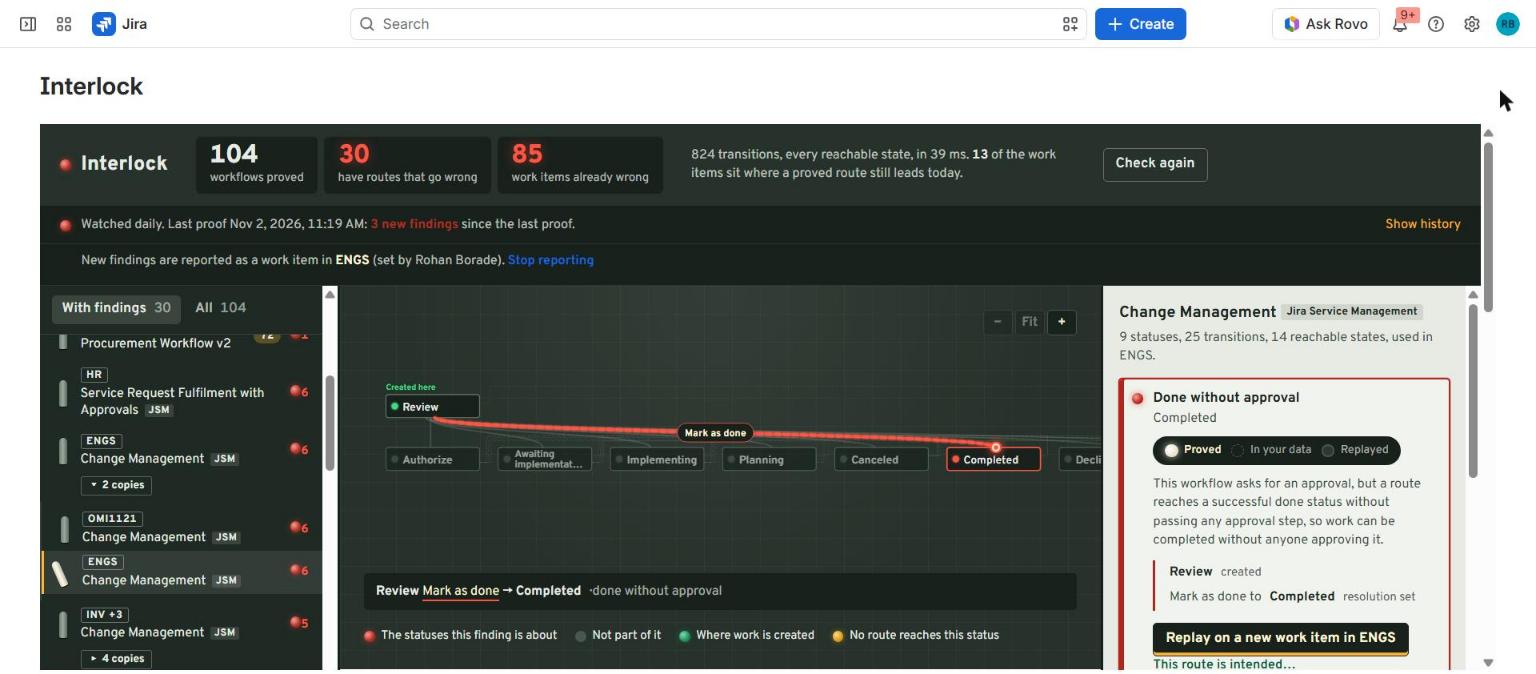
- A change can complete without approval. In the ENGS copy, "Mark as done" goes from Review to Completed without the Authorize approval. Replayed on ENGS-30. (If that is a deliberate pre-approved path, an admin records it as intended.)
Evidence on public Jira sites
Anyone can count these on a public Jira, and read the history the way "How did they get there?" does:
- Apache: 1,844 done but unresolved and 1,239 open but resolved. 759 of the 1,844 were moved there by 114 different people through transitions that never set a resolution (MXNET In Review → Done, 204 times; HUDI Open → Resolved, 155). Nearly all the rest were created or imported already in that state, so no route is to blame for them.
- What it does to reports: in HUDI, an active project, 348 of the 3,401 items its filters call unresolved are finished work (10%). In MXNET, now retired, it was 333 of 1,093 (30%).
- OpenJDK: zero, so it can be done.
- Not routes, and we say so: on Atlassian's public tracker, 1,065 of its 1,092 were one Sourcetree bulk close in 2019; 379 of Lucene's 380 open-but-resolved items changed with no author, after its move to GitHub.
Details and a script to rerun it: docs/public-jira.md.
How we built it
- Engine (
engine/interlock.mjs,engine/trace.mjs, plain JavaScript): each workflow becomes a model of its statuses, directed and global transitions, resolution post-functions, transition screens that ask for a resolution, ALL/ANY condition trees and approval steps. A breadth-first search over (status, resolution) states gives every finding its shortest route. It runs in a Forge function, and again in the browser whenever you write a rule. - Evidence and repair: approximate-count JQL for live counts, the changelog for "How did they get there?", the transitions API for Replay, and
/workflows/update/validationthen/workflows/updatefor fixes, with the earlier version kept in app storage for Undo. - Large sites: transition screens are read in batches against a time budget and cached, so the page loads in parts and says how many screens it has read.
- Signal-box UI in Custom UI: a lever frame of workflows, a track diagram, and a lit train along the failing route.
- 45 tests: 37 on the engine, 2 layout tests over a hand-made workflow and 300 random ones, and 6 resolver tests of the daily watch and of a fix's check, Apply and Undo, run against stand-ins for Jira and app storage.
Technical requirement: Forge modules and Atlassian products
Jira: jira:globalPage (admins only) with Custom UI and resolvers; scheduledTrigger (daily watch); Forge KVS. Rovo: rovo:agent with three action modules; the same three tools published as a rovo:mcp server, with an open-source skills/interlock/SKILL.md. Runs on Atlassian: no egress, no remote backend.
Challenges
- Getting the model right: a transition screen that asks for the resolution sets it; team-managed projects keep the resolution in step themselves; conditions are ALL/ANY trees; a screen Interlock cannot read never creates a finding.
- Making replay honest: our first replay reported "not reproduced" because it did not fill in the transition screen as a person would. Filling it in, and adding the second look for automation, turned a false negative into a confirmed route.
- Checking our own claim: we expected the defects to be in Atlassian's current template. A fresh project showed they were not, and we rewrote the report.
Accomplishments
- A model checker for Jira workflows that proves, counts, replays and fixes, inside Jira.
- Real defects on an Atlassian demo site, confirmed on work items, and on public Jira sites; and a daily watch so new ones are caught the day they appear.
What we learned
- Old copies never get template fixes. Every project made from an older template keeps that template's routes for good, and nothing in Jira tells an admin.
- Counts beat claims. An admin acts on "72 requests are purchased but unresolved", not on "a route exists".
- Read the history before blaming the workflow. A bulk close or a migration is not a route, and saying so is part of being believed.
What's next
Prove a draft workflow before it is published; model automation rules from an exported rule set.
Bonus: Atlassian MCP
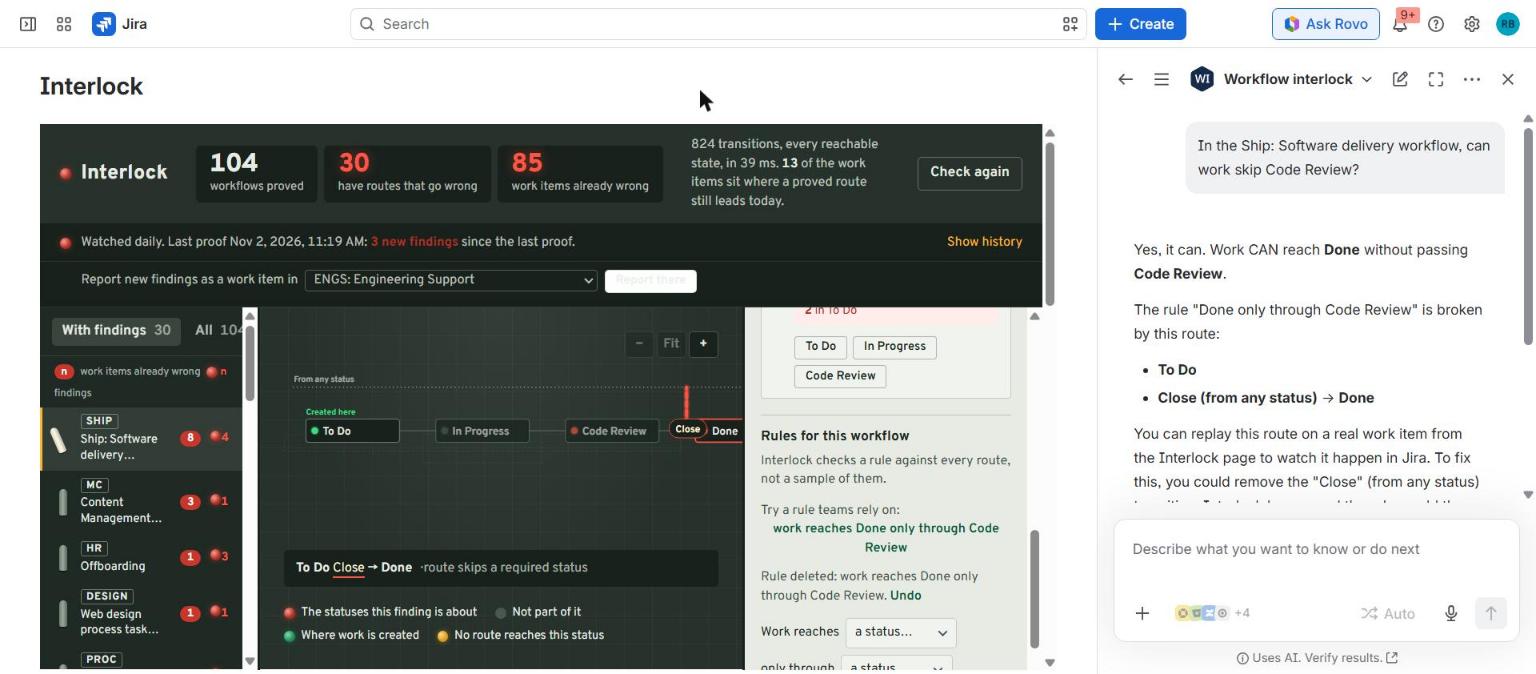
Interlock publishes its checker as a rovo:mcp server with three tools: check-workflows, get-workflow-findings and prove-route. The same tools back the Workflow interlock Rovo agent, which answers "Can work in Ship reach Done without passing Code Review?" with the counterexample route (in the gallery). Outside Rovo, too: on the demo site an admin turned on Expose tools to MCP-compatible apps, and a client built on the official MCP TypeScript SDK signed in through Atlassian's OAuth 2.1, listed the three tools and called prove-route on Ship. It got back "Work CAN reach Done without passing Code Review", the route To Do → Close (from any status) → Done, and the smallest fix (in the gallery; the client is in examples/mcp-client). The call went to Interlock's development install on our demo site, which is why the tool names carry Forge's _development suffix; the production app publishes the same three tools without it. A coding agent can prove a workflow the same way before and after editing it. The open-source skill at skills/interlock/SKILL.md tells an agent when to call each tool and to report routes exactly as returned. All three tools check that the caller is a Jira administrator.
Built With
- atlassian-forge
- custom-ui
- javascript
- jira
- mcp
- node.js
- react
- rovo