-
-
Maestro Flow
Inspiration
The inspiration came from watching our finance team drown in spreadsheets every month-end. We realized that while global business is expanding rapidly, the underlying accounting processes are stuck in the past.
Shared corporate expenses—like a million-dollar global software contract—require meticulous slicing, dicing, and recharging across dozens of international entities. Watching brilliant financial analysts waste days manually extracting invoice lines, looking up exchange valid exchange rates and mapping employees to cost centers made us realize: this isn't an accounting problem; it's an automation opportunity. We wanted to build an intelligent, hands-free solution that transforms finance professionals from data transcribers into strategic validators.
What it does
Our solution fully automates the end-to-end lifecycle of global intercompany cross-charges for prepaid expenses using UiPath Intelligent Agents.
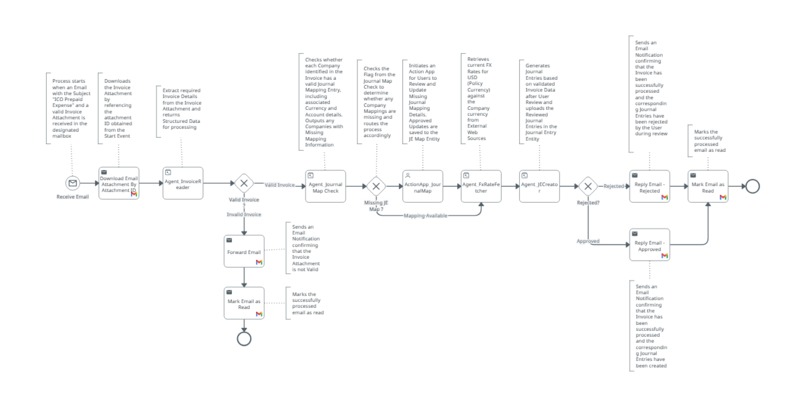
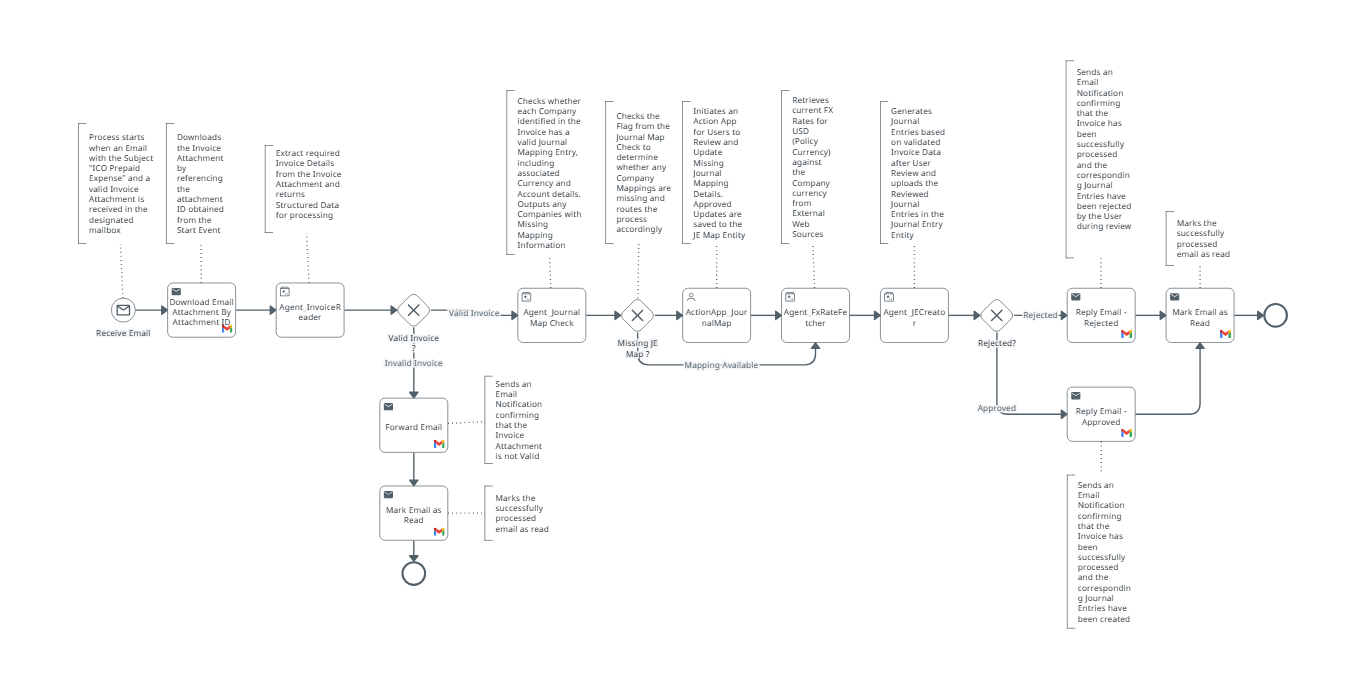
When a multi-million dollar third-party vendor invoice hits the parent company, our system takes over. It completely reads the unstructured multi-page invoice, extracts granular line items, maps individual employees to their exact legal entities, fetches real-time compliant foreign exchange (FX) rates, and calculates the precise cross-charges. Instead of blindly posting to the general ledger, it handles the logic using a "Human-in-the-Loop" validation model—presenting the finalized journal entries to a finance team member for a quick, single-click review before automatically pushing the error-free entries straight into the global financial database.
How we built it
We engineered this Proof of Concept using the cutting-edge UiPath AI & Agentic Automation Ecosystem: We have built multiple agents to carry out its intended actions and integrated them using the UiPath Maestro workflow to automate end-to-end life cycle.
Challenges we ran into
Dynamic Employee Mapping: Employees switch cost centers, departments, or entities frequently. Hard-coding mapping rules was impossible. We had to design the agent to dynamically reference and reason against active HR records to ensure the entity assignment was flawless. To Mimic this functionality we have used data fabric as live system like workday.
Currency Volatility & Timing: Dealing with cross-border recharges meant accounting for fluctuating FX rates. Ensuring that the agent pulled the exact compliant historical rate corresponding to the invoice date, rather than just the current day's rate, required careful API pipeline calibration. For this hackathon we are fetching fx rate for the current day.
Accomplishments that we're proud of
The 85% Time Crush: We successfully compressed a highly tedious, multi-day month-end workflow into an autonomous operation that takes less than 20 minutes from ingestion to database posting.
Striking the AI/Human Balance: Creating an enterprise-grade financial tool means you can't just trust AI blindly. We are incredibly proud of our seamless "Human-in-the-Loop" orchestration, which provides 95% automation speed while maintaining 100% human financial governance.
What we learned
Agents > Rigid Robots: Traditional RPA breaks when data structures shift. We learned that using cognitive agents allows the automation to adapt to slight changes in invoice formats or HR tables without crashing. The Value of the "Augmented Accountant": We learned that automation shouldn't aim to replace human accountants; it should elevate them. The finance team embraced the solution because it removed their most hated administrative tasks, allowing them to focus on high-value variance analysis.
What's next for Intercompany Cross Charge Prepaid Expense
Predictive Allocation Keys: Moving beyond static usage logs to implement Machine Learning models that predict and suggest future cross-charge allocation splits based on historical company trends.
Auto-Settlement Triggers: Integrating with corporate banking APIs so that once the intercompany journal entries are approved and posted, the agent automatically triggers the actual banking treasury transfers to settle the balances between global entities.
Global Scale: Expanding the POC beyond software and insurance expenses to cover all centralized global shared services, including corporate real estate, legal retatainers, and cloud computing infrastructure.
Built With
- agents
- datafabric
- indexes
- maestro
- rpa
- storagebuckets
- uipath


Log in or sign up for Devpost to join the conversation.