Inspiration
The idea was inspired by the increasing need for secure, reliable, and tamper-proof drone data transfer in fields like manufacturing, infrastructure monitoring, and motorsports. During inspections or surveillance, huge visual data streams are generated, and ensuring that this data remains intact and authentic is critical. We wanted to create a system that not only transmits visual data safely but also intelligently monitors network health and verifies data integrity.
What it does
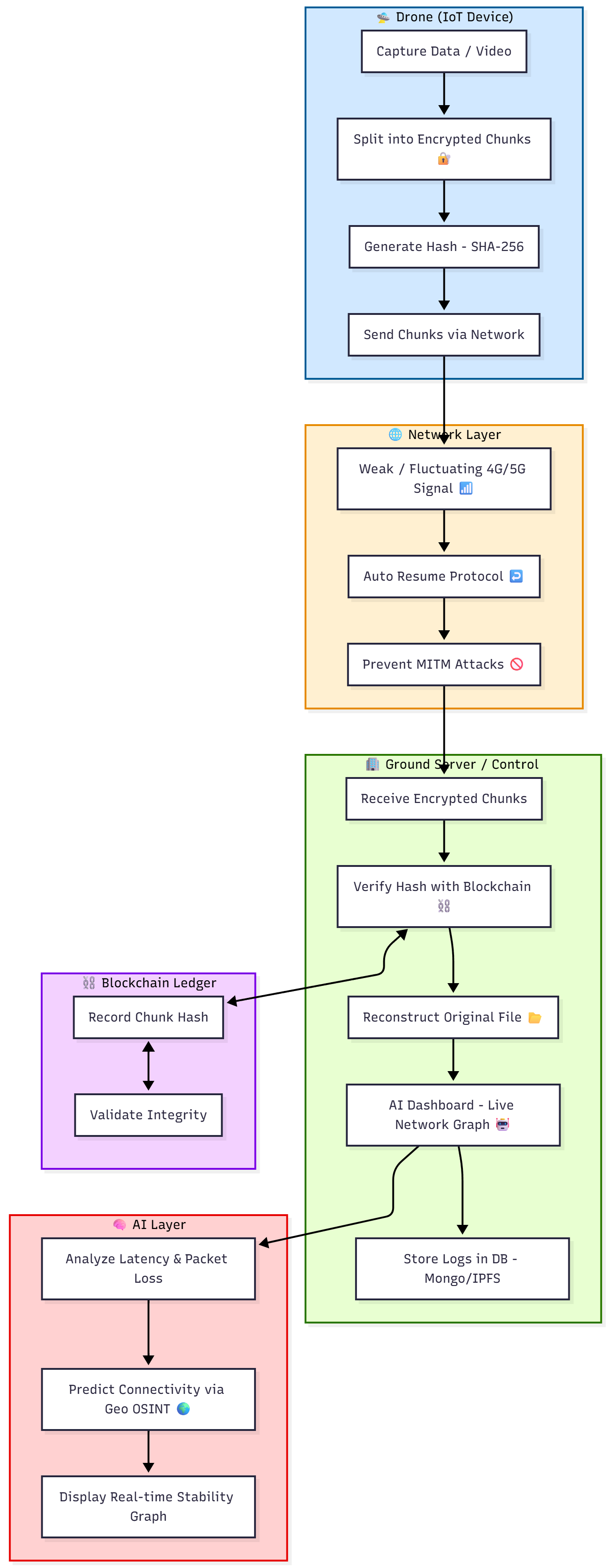
Our system enables secure and intelligent transmission of drone-captured visual data to a central analysis hub. It ensures that no image or video frame is lost, tampered, or corrupted during transfer. The AI module continuously monitors network performance and adjusts transmission parameters, while blockchain verifies and timestamps every data packet using SHA-256 hashing. This creates a fully transparent, tamper-proof data pipeline for visual inspection systems.
How we will build it
We plan to build the system using a modular architecture combining IoT, AI, and Blockchain. A drone (IoT device) will continuously capture video or telemetry data, which will be processed through a local Raspberry Pi unit acting as an edge node. This edge node will handle chunking, encryption (AES-256), and temporary caching of data. Each chunk will then be checksummed using SHA-256 and transmitted over a secure channel (TLS). In case of network drop, the system will automatically resume transmission from the last verified chunk, ensuring zero data loss. A Flask or Streamlit backend will coordinate all transfers, manage AI-based network analytics (built using Scikit-learn or TensorFlow Lite), and update real-time latency and stability graphs. The blockchain ledger (private network + IPFS) will record each verified transmission, providing tamper-proof logging and future auditability. This layered design ensures data security, automatic recovery, and reliability even in unstable network environments.
- IoT layer: Drones and Raspberry Pi devices capture and relay image data.
- Blockchain layer: A private blockchain ledger combined with IPFS stores file hashes and metadata for integrity verification.
- AI/ML layer: Predicts and optimizes network routes, analyzes latency, and ensures smooth data streaming.
- Security layer: Implements encryption and SHA-256 for data validation.
- Database layer: MongoDB and IPFS are used for structured and decentralized storage.
Challenges we will run into
As we move forward with development, we expect to face challenges in synchronizing drone data streams with blockchain logging and ensuring real-time AI monitoring without latency issues. Another potential difficulty will be balancing speed and security - maintaining high-speed video transmission while verifying data authenticity on-chain. Integrating decentralized storage (IPFS) with live drone feeds might also require optimization to prevent data lag or inconsistency.
Additionally, making the system fully blockchain-based could be limited initially due to infrastructure and resource requirements, but this remains a key future goal to enhance transparency, data integrity, and scalability.
What we will learn
We will learn how to synchronize IoT data streams with blockchain transactions, handle decentralized storage efficiently, and apply AI for predictive network optimization in real-world conditions. This process will also help us understand how to maintain data integrity, ensure secure communication, and balance performance with reliability across unstable network environments.
Use of Major Technologies and what they add to the project
- AI: Used for live latency and network analysis charts, scraping GEO OSINT data to detect connectivity strength near the drone’s location.
- Blockchain: Ensures data authenticity, integrity, and traceability using a private ledger and SHA-256 hashing on IPFS
- IoT: Drones and Raspberry Pi devices act as IoT nodes to capture and transmit real-time image data.
- Database (MongoDB/IPFS): Stores metadata and media references for fast retrieval and decentralized storage.
- Security Layers: Multi-level encryption and secure API communication for end-to-end protection.
How our idea fits the “Visual Difference Engine” challenge
Our system lays the foundation for an intelligent visual difference engine by ensuring that high-quality, tamper-proof visual data from drones is securely transmitted and stored. By maintaining data integrity and enabling lossless transfer, it allows accurate visual comparison across time-series images - such as detecting terrain changes, track damage, or vehicle wear. In future versions, integrated AI modules can automatically compare incoming drone footage with historical data to classify and highlight visual differences in real time. Although the original challenge focuses on F1 teams and racing environments, our implementation prioritizes drone technology as the primary use case. Drones operate in fast, dynamic, and often borderless environments, where maintaining real-time connectivity and data integrity is even more critical than on a fixed racing track. If the system performs reliably under these high-mobility, low-latency drone conditions, it can easily be adapted for F1 cars, autonomous vehicles, or other machinery requiring secure and loss-resistant visual data transfer.
What's next for Untitled
We are initially focusing on drone technology to establish a strong and practical foundation for real-time visual data transmission and integrity validation. However, the same underlying architecture and technologies can be adapted for engines, manufacturing systems, or any other equipment that requires visual change detection - aligning directly with the Visual Difference Engine challenge. In the next phase, we plan to expand the project by adding automated visual comparison APIs and integrating machine learning models that can detect anomalies or environmental changes from the received visual data, ultimately transforming it into a complete Visual Difference Engine ecosystem.
Built With
- aes-256
- flask
- ipfs
- javascript
- jwt
- mongodb
- multi-layer-network-security
- private-ledger
- python
- raspberry-pi
- sha-256
- streamlit
- tensorflow
- tls


Log in or sign up for Devpost to join the conversation.