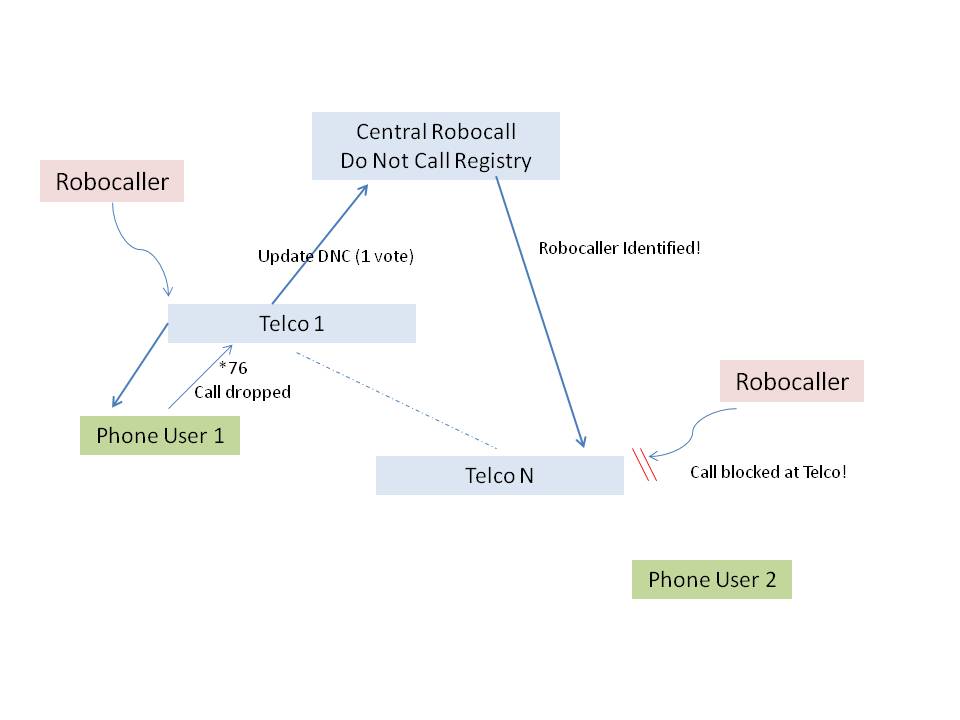
Intercarrier Robocall Do Not Call Registry and Service Due to the need for a solution that would work on any type of phone, we must centralize the solution as a service that any telco could enable as a bundled service to their customers. This solution would consist of a shared Do Not Call Registry database and a programmatic solution at the telco level that would be either revenue neutral or would generate revenue by making it a fee-based feature or at least a marketing attractor for new business.
Optimally, Robocall Caller ID legislation should be finally passed to require Robocall operators to use real Caller ID data, making spoofing illegal and enabling the ability to populate a Do Not Call registry for Robocalls. Additionally, legislation could be passed to make it illegal to call people who register their number to opt out of such calls.
A central Robocall DNC registry would be created as a national database of Robocallers and enabling the various telcos the ability to provide Robocalling number updates as they are detected.
The telcos could choose to opt-in to provide Robocall DNC service to their customers. They would use the Robocall DNC Regsitry as their source for numbers to block when such a number originates a call to one of their Robocall DNC customers. As the registry quickly evolves, the call blocking improves dramatically. Telcos could optionally report on the customer's phone bill detail the number of Robocalls they blocked each month.
To populate the Robocall DNC registry, telco customers who opt in for the paid service would have the ability to the last incoming as a Robocall with a telco-designated vertical service code (e.g. *76) on their phone after an unregistered Robocaller makes it through. This action would send a "vote" to the central registry. If the registry sees an appropriate number of "votes" for a given number, it will activate that number in their registry so that telcos can start blocking incoming calls to their paying customers. Voting avoids blocking numbers that were improperly marked (e.g. "I mistook Aunt Harriet for a Robocaller"). Perhaps the telcos can offer some amount off their charge for this service in a given month for each "vote" a customer has to make to compensate them for having to take a Robocall; a sort of warranty.
Over a short amount of time, Robocallers would find more and more of their calls blocked, discouraging them from continuing. This would especially be the case if the telcos opted not to charge their customers for this service, but rather add it to their bundle of standard features that can be enabled by request of a customer. Paying for the Robocall DNC registry service would be similar to what is done for the current telemarketing DNC registry.

Log in or sign up for Devpost to join the conversation.