-
-
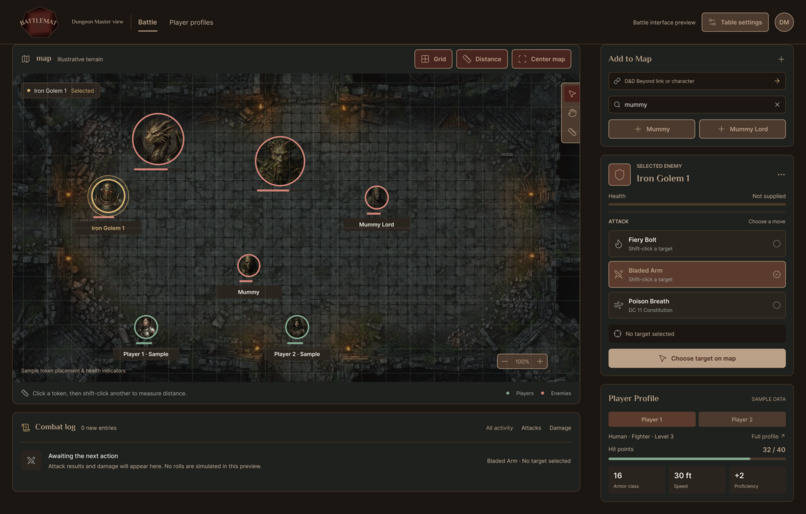
Dungeon encounter
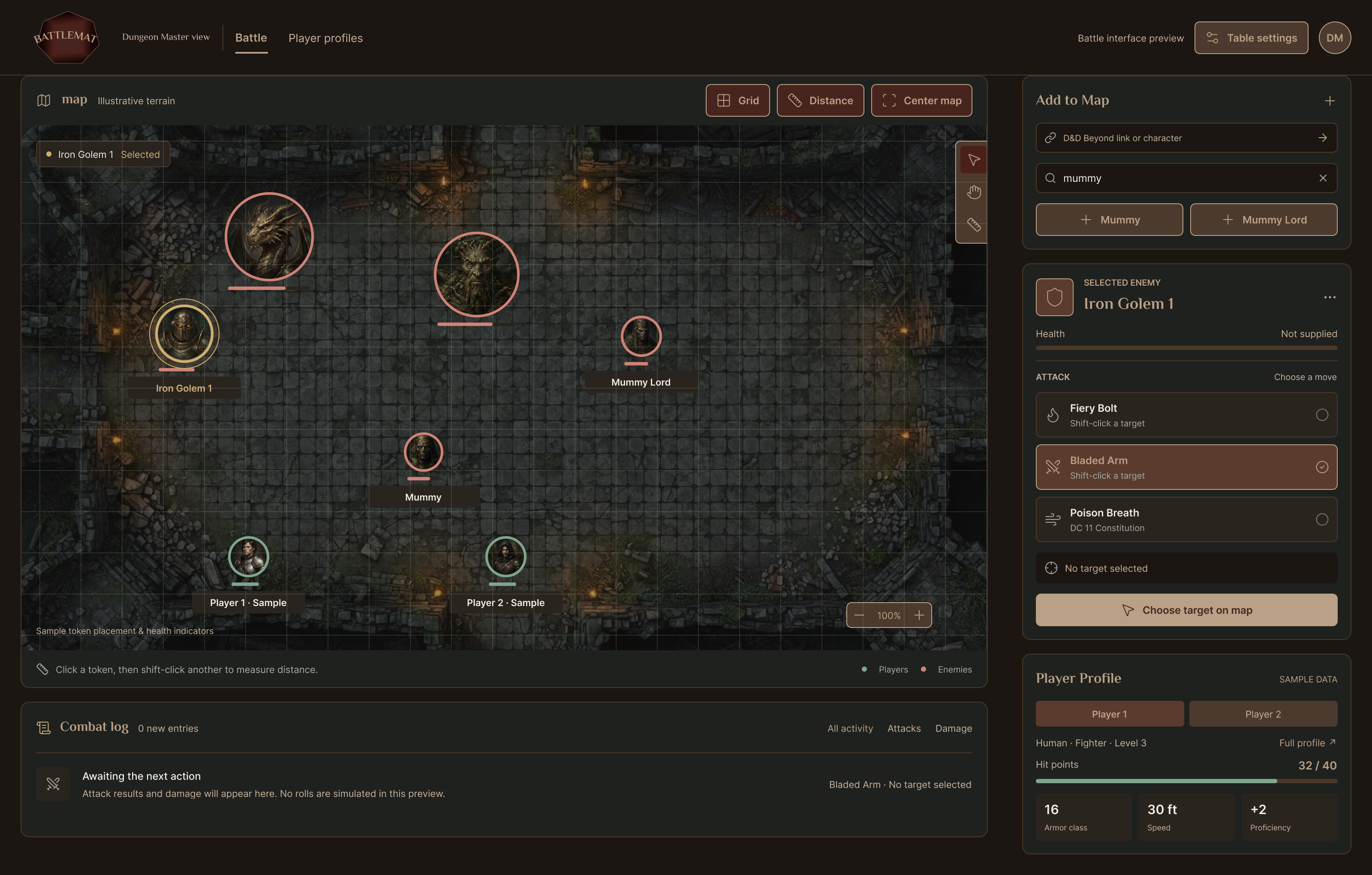
Inspiration
Many of our teammates are enthusiastic about tabletop roleplaying games, and though virtual tabletops (VTT) exist, none address some crucial problems. Most VTTs only serve as a drawing board for the players to use as a visual aid, but they do not, however, assist with many of the calculations such a game involves. Hence the need for BattleMat
What it does
BattleMat seeks to make virtual tabletop games incredibly easy to manage. Nearly all calculations necessary in Dungeons & Dragons are automated for example, including processing character attributes and abilities, calculating and keeping track of turn order, automatically managing character health and available actions per turn, and so on. Plus, enemies in BattleMat are capable of acting on their own, allowing for fun and exciting sessions with minimal input from a guiding player, making previously tedious tasks trivial.
How we built it
We started our preliminary interface with a simple grid and character tokens. When talking about differentiating our VTT from others, we really wanted to have a lot of elements that are traditionally performed manually to be baked into our design.
Following the open-source rules of DnD 5e, we utilized json files in incorporating preexisting character, mechanic, dice roll, and respective data. We also added function into inputting your own characters based on DnD Beyond profiles. We used a hugging face model to create adaptive enemy moves in fight sequences.
For our UX/UI design, we implemented Figma to first create the design we wanted based on this, and then utilized Figma's mcp within VSCode to connect our existing infrastructure and function to the updated web app.
Challenges we ran into
The road to building BattleMat has been plagued with challenges we have steadfastly been overcoming as a team. The first challenged was, of course, planning the design for BattleMat since none of us have done a project quite like this before. Then we ran into issues using other assets, importing characters using external tools like those from DnD Beyond, creating a system to manage combat, working on the aesthetics, and, most of all, implementing the AI for enemy's actions.
Accomplishments that we're proud of
Excuse me, but BattleMat looks AWESOME. Every core functionality works; it keeps track of turns, does the dice calculations, offers a list of available actions and movement ranges and all sorts of things. And the enemies act by themselves!
What we learned
We learned how to reduce a complex project into manageable steps, keeping the entire thing modular so that we could work parallelly as a team. We learned about the interaction between front-end and back-end, and we learned how to use Figma to improve the user interface.
What's next for BattleMat
We would first like to work more on the enemy AI and really polish it, as we believe it is one of the most useful and unique things about BattleMat. In particular, we would like to design a way for AI actions to be guided by the enemies' lore for even greater immersion. We would also like to make the online multiplayer functionalities more robust before moving on to adding additional quality-of-life features, and then pivoting from there into making BattleMat more broadly compatible with other tabletop games, of which there are many.
Built With
- figma
- github
- javascript
- json

Log in or sign up for Devpost to join the conversation.