


Inspiration. I've been a fan of interactive video games for years, and I've always dreamed of shipping one of my own. But every time I looked into it, the answer was the same: you need a team — a writer, a storyboard artist, a film crew, voice actors, an editor, a game programmer. As one person, I never got past the first page of ideas.
Qwen Cloud changed that math. For the first time, everything a studio does lives behind one API key: a model that writes (qwen3.7-max), models that see and paint (wan t2i), a model that films (happyhorse i2v), and a model that speaks (qwen tts). So I asked the obvious question: if the whole crew is in one place, can one autonomous agent be the studio? Once Upon a Line is my answer — and my first game credit. The economics are almost absurd: a complete voiced, subtitled, branching interactive film costs a few dollars of API calls and one sentence of imagination.
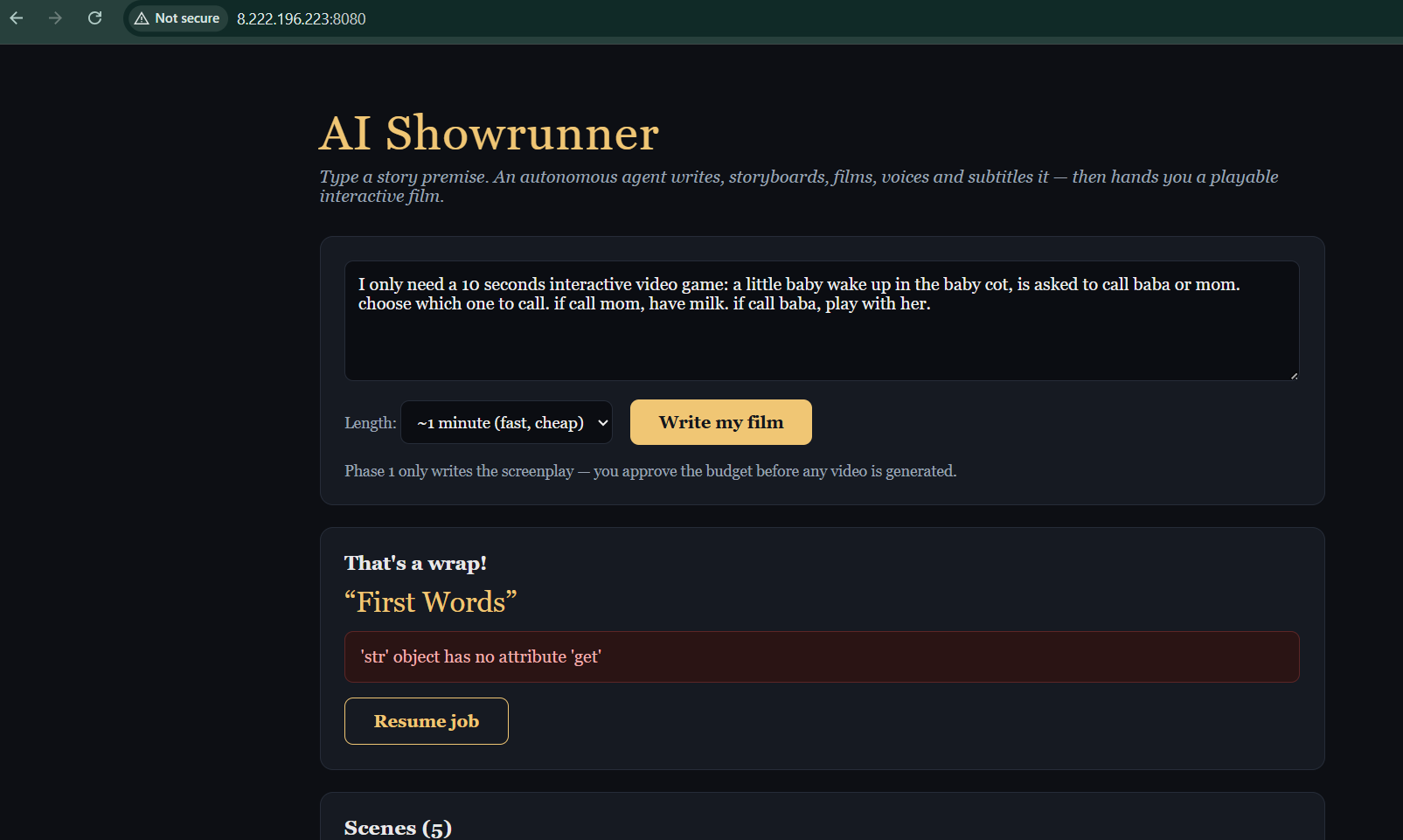
What it does. You give it a premise ("a physics graduate facing two offers, data engineer and…"). The agent:
- writes a production-grade screenplay (qwen3.7-max),
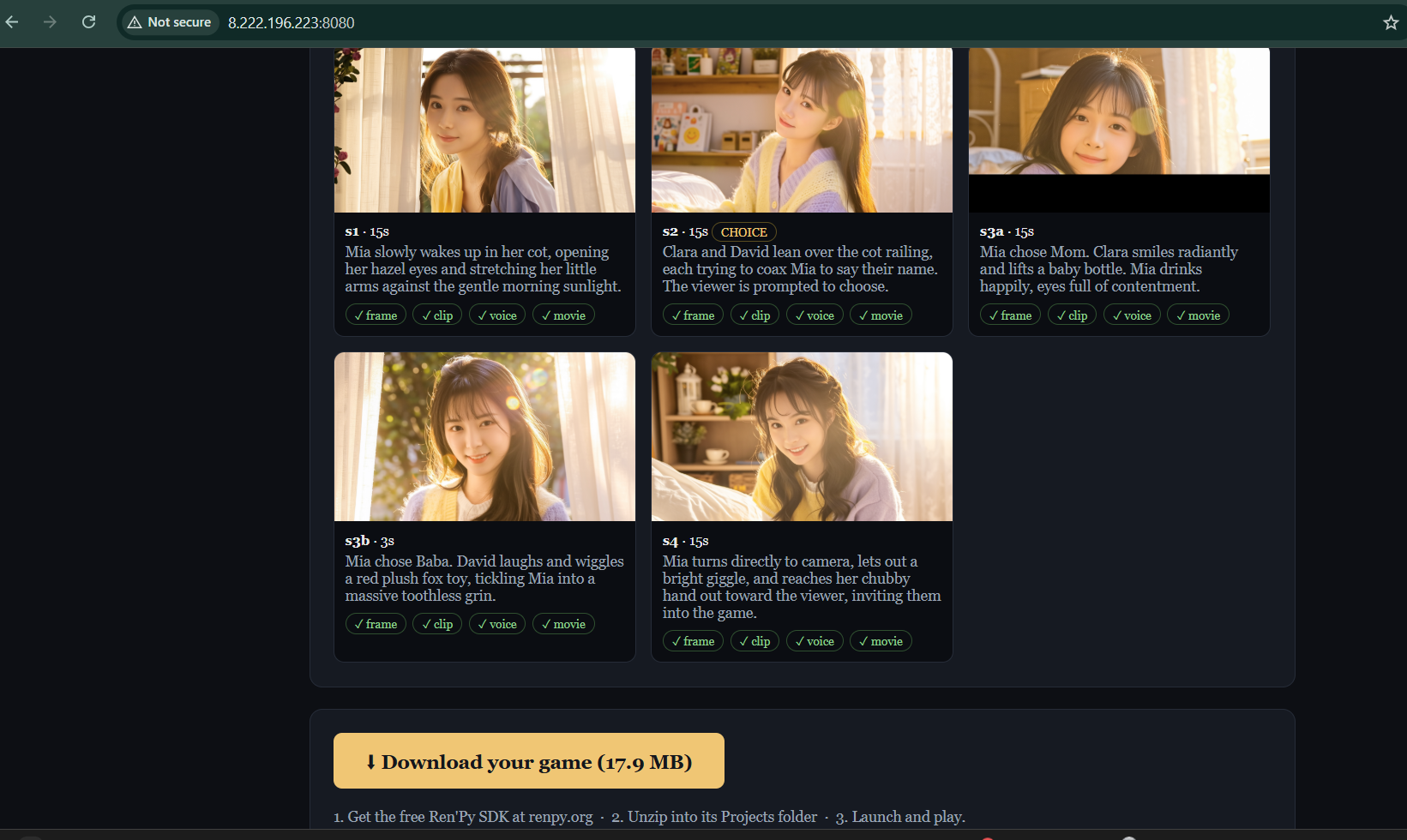
- compiles it into a branching scene graph — real choices that fork into different scene chains and rejoin — validated for reachability and fitted to a runtime budget,
- pitches it back to you with an estimated media budget (the agent asks before spending),
- then shoots it: a style-locked keyframe per scene (wan2.6-t2i, stable seeds + embedded character appearance for consistency), a video clip per scene (happyhorse-1.1-i2v), the protagonist's inner monologue voiced by cosyvoice with subtitles burned in sync, and a narrator intro,
- and finally assembles, lints and zips a complete Ren'Py game.
How I built it. An 8-stage resumable pipeline behind a FastAPI web app on Alibaba Cloud. Every stage leaves artifacts on disk, so the live UI derives per-scene progress purely from the filesystem, jobs are resumable after quota errors, and each job runs in an isolated directory. Model access goes through fallback chains (e.g. happyhorse → wan-flash) so per-model quota exhaustion hops models instead of failing the job.
Challenges. TTS audio with corrupt RIFF headers (transcode to ogg), i2v models that emit no audio stream (mux detection), muted voice channels in Ren'Py (voice is mixed into the video instead), subtitle/voice drift from stale artifacts (fixed by per-job isolation), and free-tier quotas mid-shoot (fallback chains + resume).
What's next. Multi-character dialogue with per-character voices, scene-to-scene continuity via last-frame chaining, longer formats, and music.


Log in or sign up for Devpost to join the conversation.