Inspiration
Honestly, I’ve always been fascinated by how invisible math—like gravity, strange attractors, and quantum fields—secretly governs how beautiful the universe looks and moves. I wanted to build a digital playground where you don't just look at generative art on a screen, but actually touch it, hear it, and feel it react—turning pure equations into something living, breathing, and emotional that couldn't exist on a traditional physical canvas.
What it does
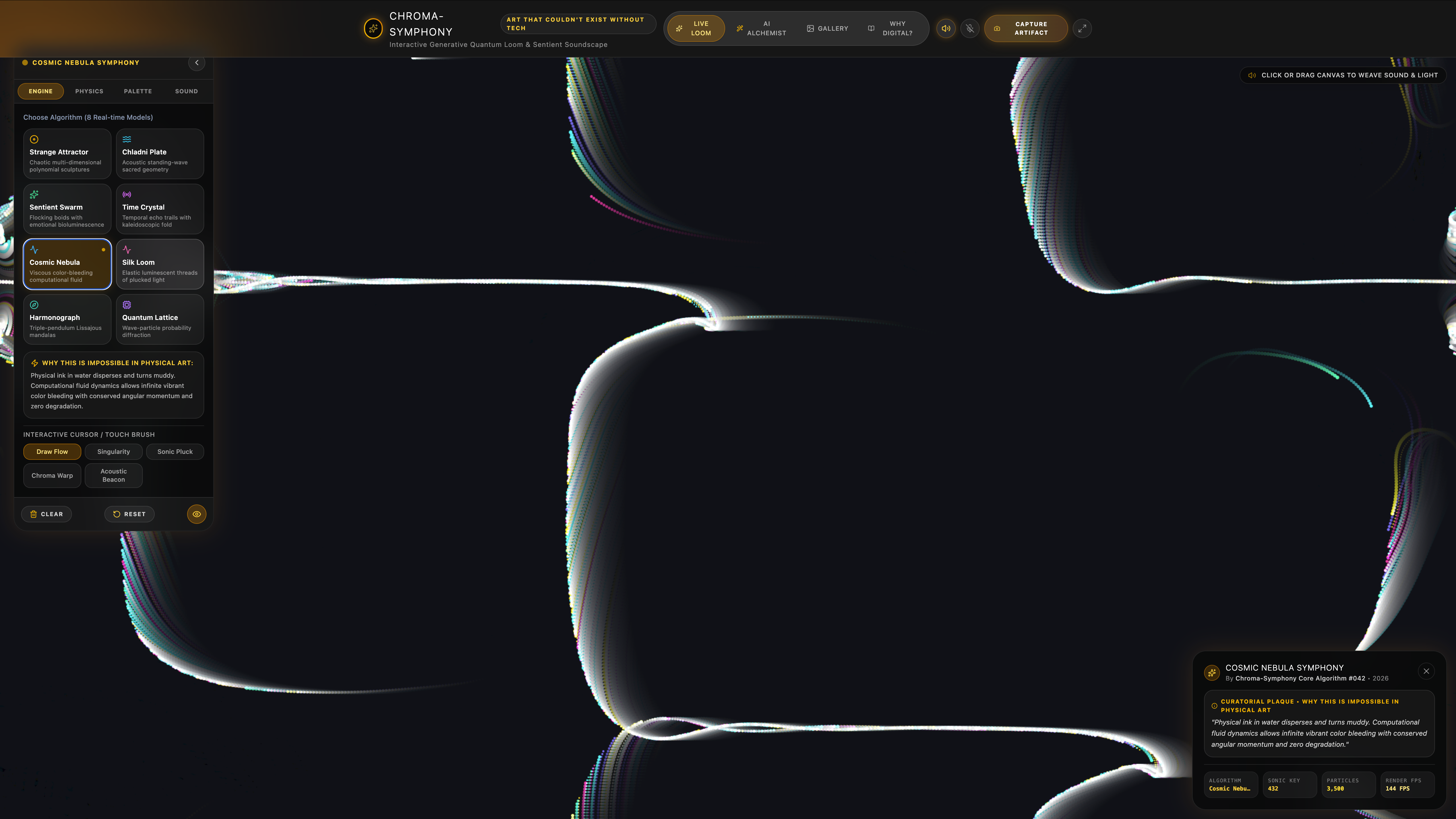
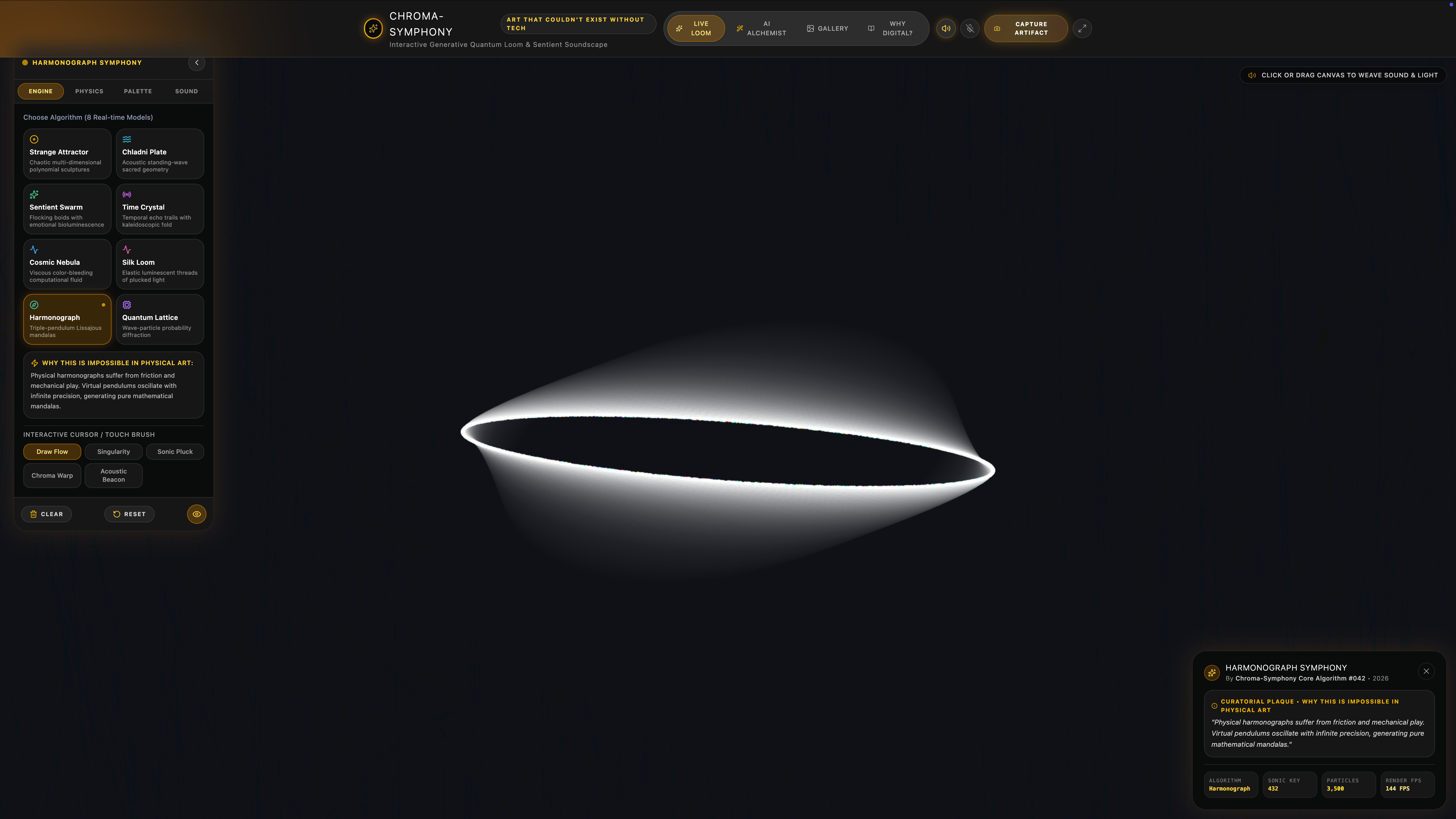
At its heart, Chroma-Symphony is an interactive digital playground where math equations turn into living art and sound. Instead of painting with static brushes, you're guiding thousands of flowing particles that swirl, collide, and chime musical notes as you drag across the screen. You can let the particles dance to your microphone, tweak the physical rules like gravity and speed in real time, or ask the AI Alchemist to turn a mood or memory into a unique visual and harmonic seed—letting you create audiovisual art that could never exist on a traditional canvas.
How we built it
This application is built with TypeScript and React for the user interface, styled using Tailwind CSS, and powered by native HTML5 web APIs for performance and media interactivity. The interactive generative artwork is rendered at 60 frames per second using the HTML5 Canvas 2D API with custom mathematical physics algorithms, while real-time sound synthesis and acoustic microphone analysis are handled by the browser's Web Audio API (AudioContext and AnalyserNode)
Challenges we ran into
Building this app came down to a few tricky balancing acts: first, keeping the visuals buttery smooth at 60 FPS while rendering thousands of math-heavy particles on an HTML5 Canvas without burning up the CPU; second, taming chaotic equations—like Clifford attractors and fluid dynamics—so they move with an organic, meditative flow rather than looking jittery or random; and finally, syncing those generative visuals to real-time audio input without input lag while keeping the museum-style UI clean and unobtrusive.
Accomplishments that we're proud of
I’m most proud of bringing complex mathematical strange attractors to life as fluid, interactive art that anyone can play with—turning abstract equations like Clifford and Lorenz attractors into living, breathing sculptures. Another big win was nailing the audiovisual harmony, where every brush stroke, particle trail, and color shift generates ambient music in real time so you can literally hear what you paint. Finally, I love how the whole experience feels like an elegant interactive gallery, combining smooth 60 FPS performance with deep studio controls that make experimental generative art feel both intuitive and deeply satisfying.
What we learned
Building this experience taught me how much artistic emotion lives inside raw mathematics. I learned that strange attractors and chaotic equations don't have to look rigid or clinical—when you pair them with organic color palettes, fluid motion trails, and subtle audio-reactive pulsing, raw calculus turns into something living and expressive. It also reinforced a great lesson in technical restraint: keeping thousands of particles moving smoothly at sixty frames per second requires disciplined engineering, and the most immersive, meditative experiences come from balancing complex physics with clean, simple visual harmony.
What's next for Interactive Computational Art Studio
Looking ahead, the next step for the Interactive Computational Art Studio is turning it into an even more expressive instrument for live performance and creative collaboration. We're excited about adding MIDI and hardware controller support so artists can map physical knobs and faders directly to chaotic attractor variables in real time, along with high-resolution video and shader export to make sharing artwork in production quality effortless. Further down the line, we'd love to introduce multiplayer collaborative rooms where several people can sculpt particle fields together across the web, as well as WebXR and VR support so you can literally step inside the swirling mathematical sculptures you create.
Built With
- html5
- react
- tailwindcss
- typescript
- webaudioapi


Log in or sign up for Devpost to join the conversation.