Intentra — Understand Before You Pay
An AI-powered payment intelligence companion that turns transaction data into explainable, personalized guidance.
Inspiration
Every payment begins with an intention: who we want to pay, how much we want to send, and why.
Yet most payment experiences focus primarily on executing transactions. When a payment is unusually large, involves an unfamiliar recipient, or raises concerns about available funds, consumers may not have enough context to make a confident decision.
I started Intentra with a simple question:
What if payment technology could help people understand their transactions before sending money, rather than only responding when something goes wrong?
The name Intentra comes from the word intent. It reflects the project's central philosophy: understanding and protecting the intention behind every payment.
During the initial research and planning stages, conversations with fintech professionals helped me recognize that an effective payment intelligence system must balance security, compliance, transparency, and user experience.
This led to Intentra's guiding principle:
Inform and verify, rather than automatically block.
Instead of building another standalone fraud classifier, I wanted to create an accessible payment intelligence companion combining traditional financial risk logic, machine learning, and conversational AI.
What it does
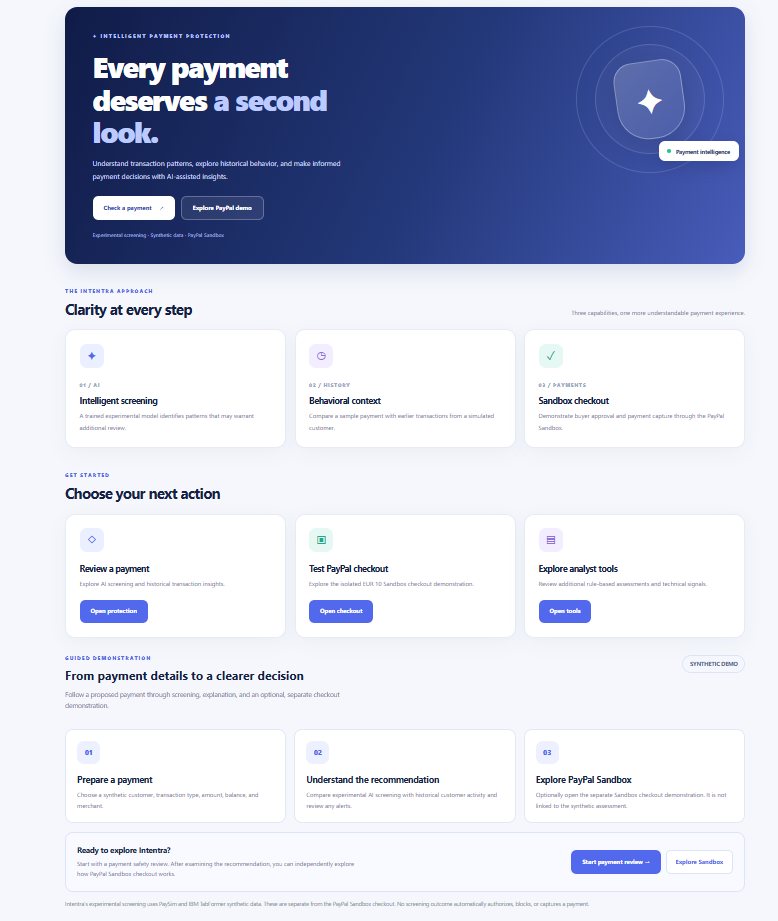
Intentra is a consumer-focused payment intelligence prototype that helps users evaluate proposed transactions and understand when additional verification may be appropriate.
The application brings together six capabilities:
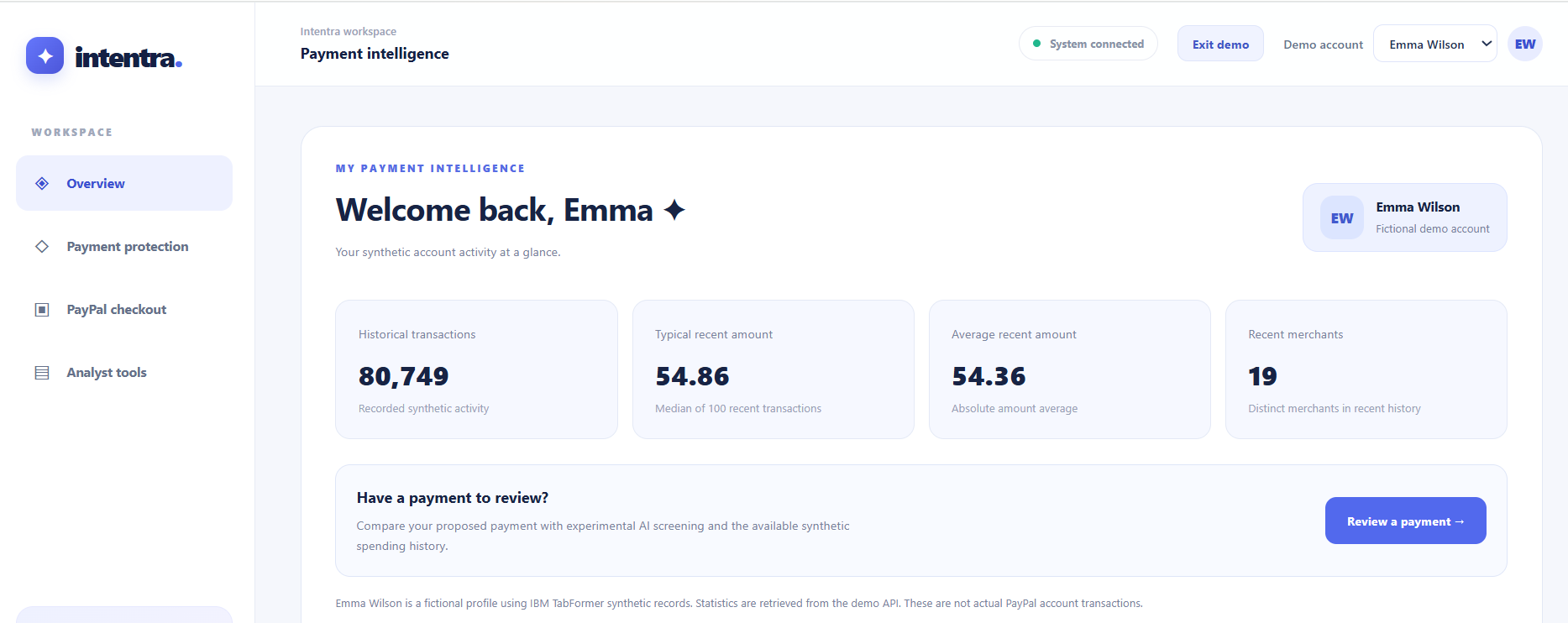
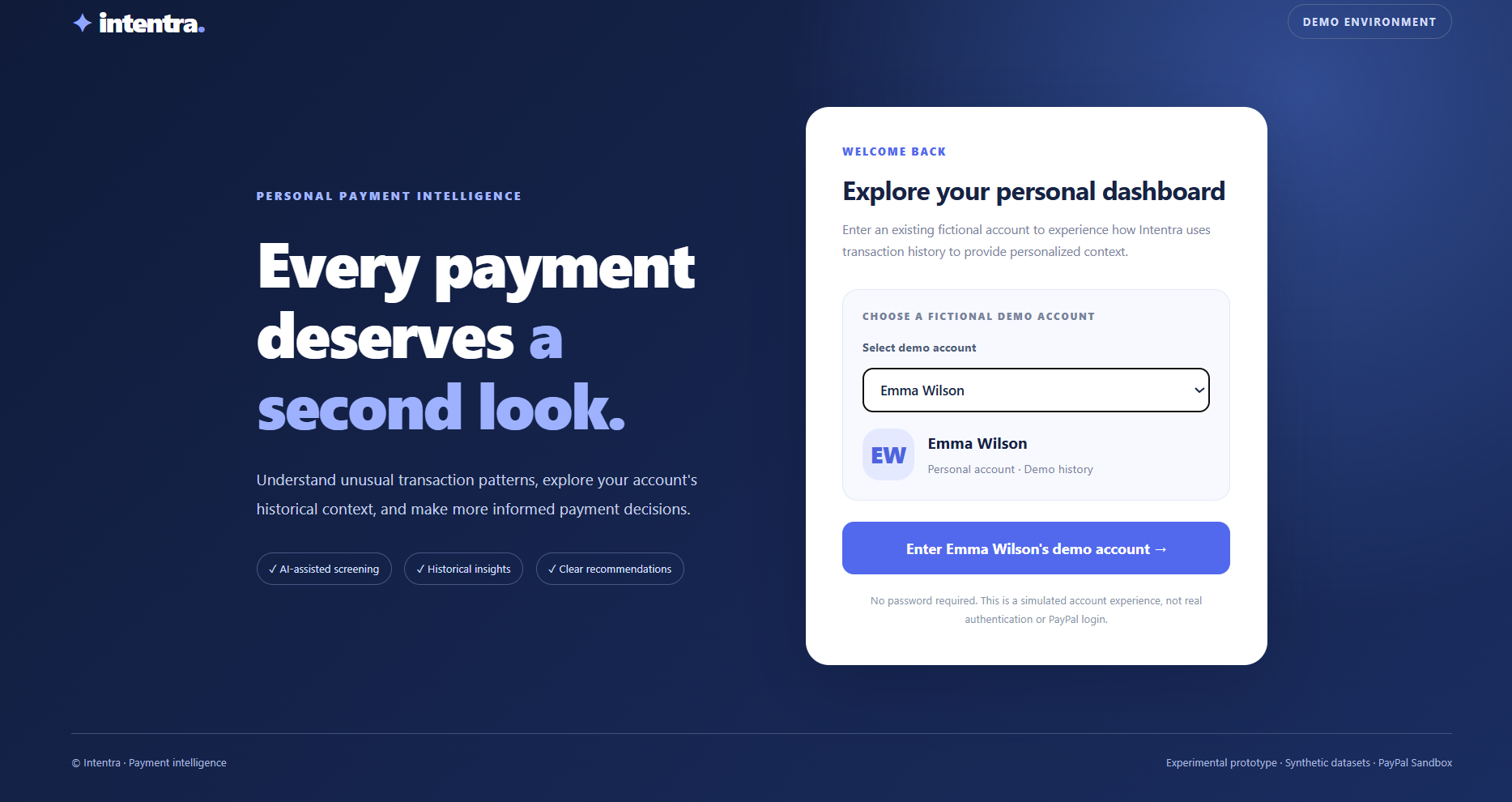
1. Personalized consumer dashboard
Users can explore a personalized dashboard built from synthetic transaction history, including spending summaries and recent financial activity.
The current demonstration uses fictional customer profiles rather than connections to real bank accounts.
2. Behavioral payment analysis
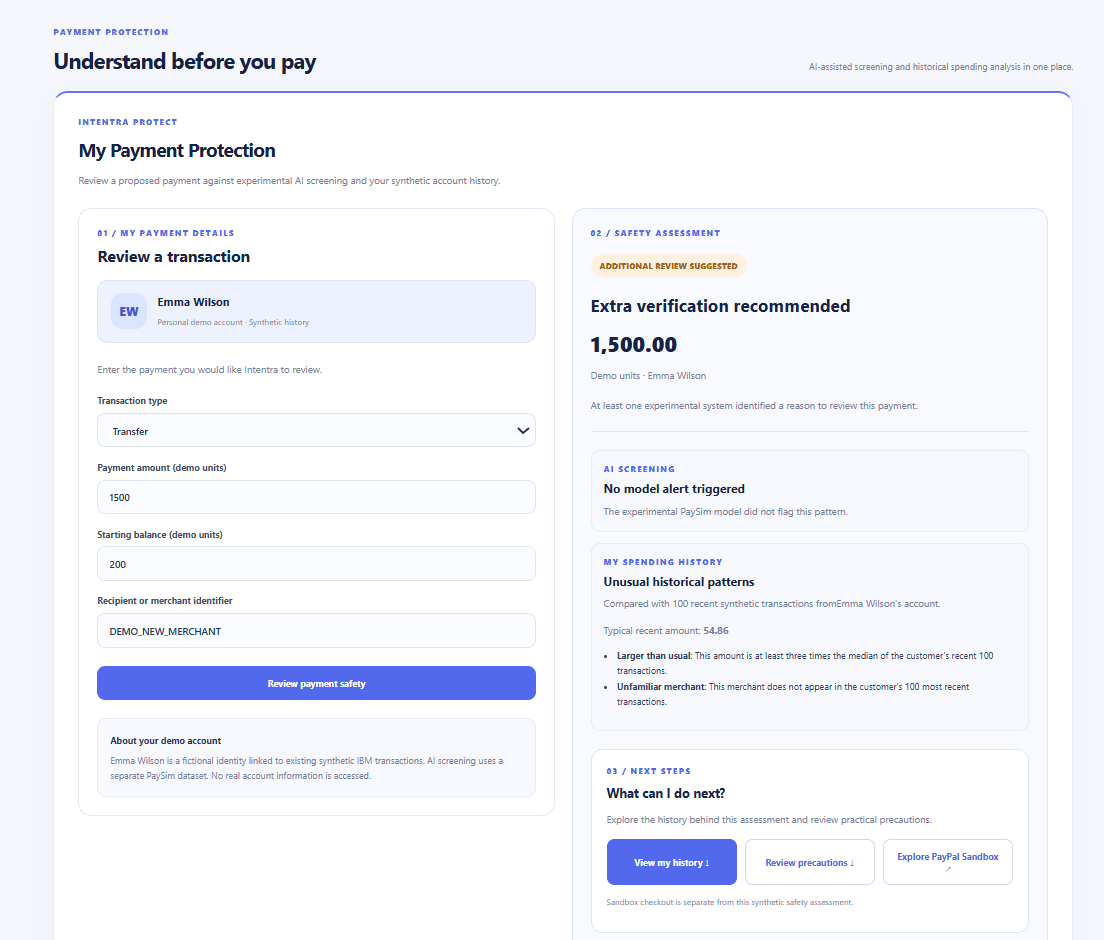
Before making a proposed payment, users can enter transaction details, including the amount, starting balance, transaction type, and recipient.
Intentra evaluates behavioral signals such as unusually large transactions, unfamiliar merchants, and payment amounts relative to available balances and historical spending patterns.
3. Experimental machine learning screening
An experimental HistGradientBoostingClassifier trained on synthetic PaySim transactions provides an additional screening signal.
Importantly, the ML output is not treated as a calibrated real-world fraud probability or as the sole basis for a payment decision.
4. Explainable recommendations
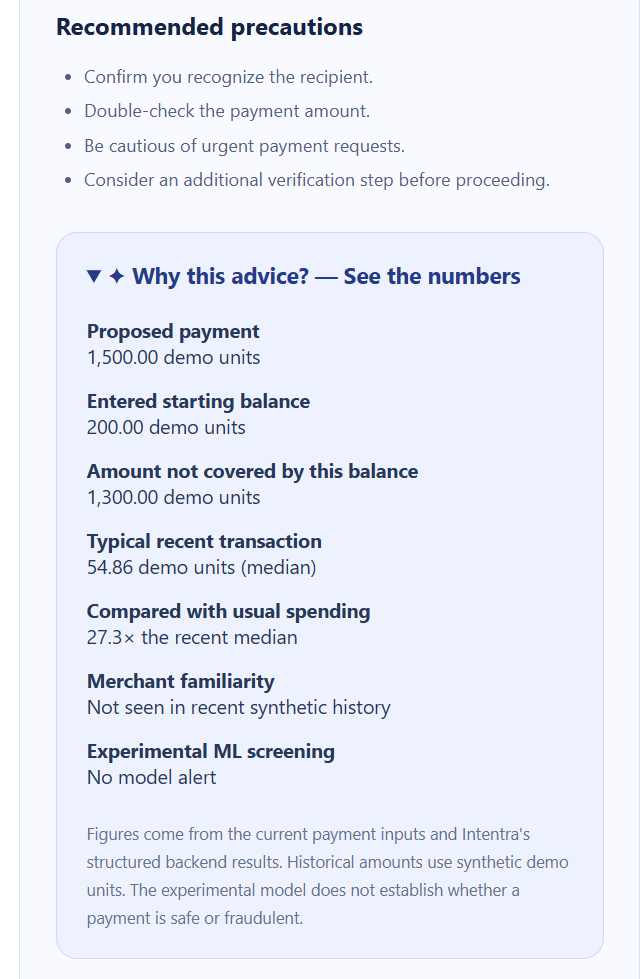
Intentra's "Why this advice? See the numbers" panel presents the supporting evidence behind its recommendations.
Users can examine transaction amounts, balance comparisons, historical spending patterns, and the distinction between behavioral alerts and experimental ML results.
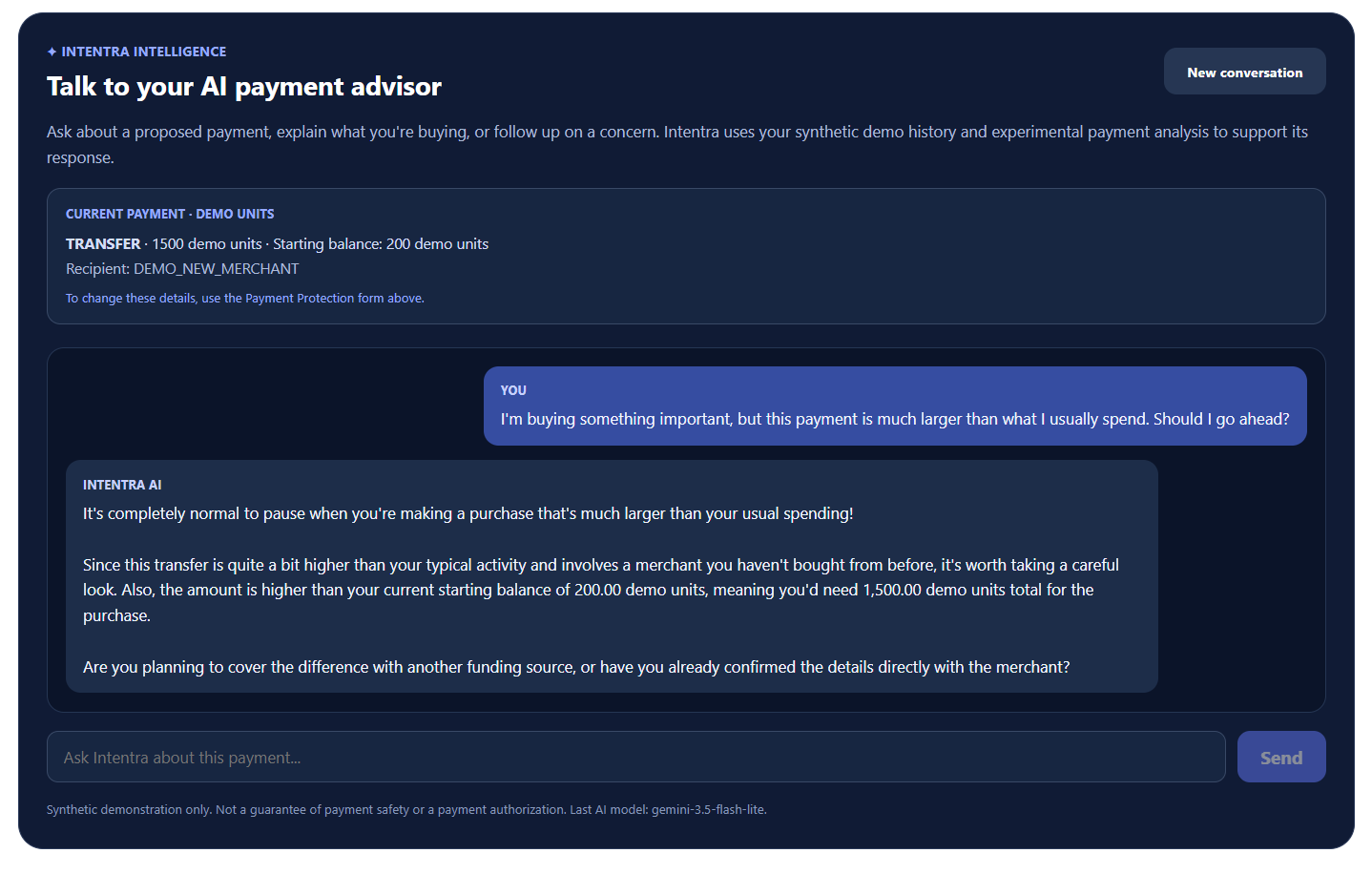
5. Gemini-powered conversational advisor
Users can ask natural-language questions about proposed payments.
The advisor uses structured transaction evidence and demo customer context to explain concerns, consider additional information, and suggest practical verification steps.
For example, someone purchasing a laptop from a new seller can ask what to check before paying, then provide more context and ask follow-up questions.
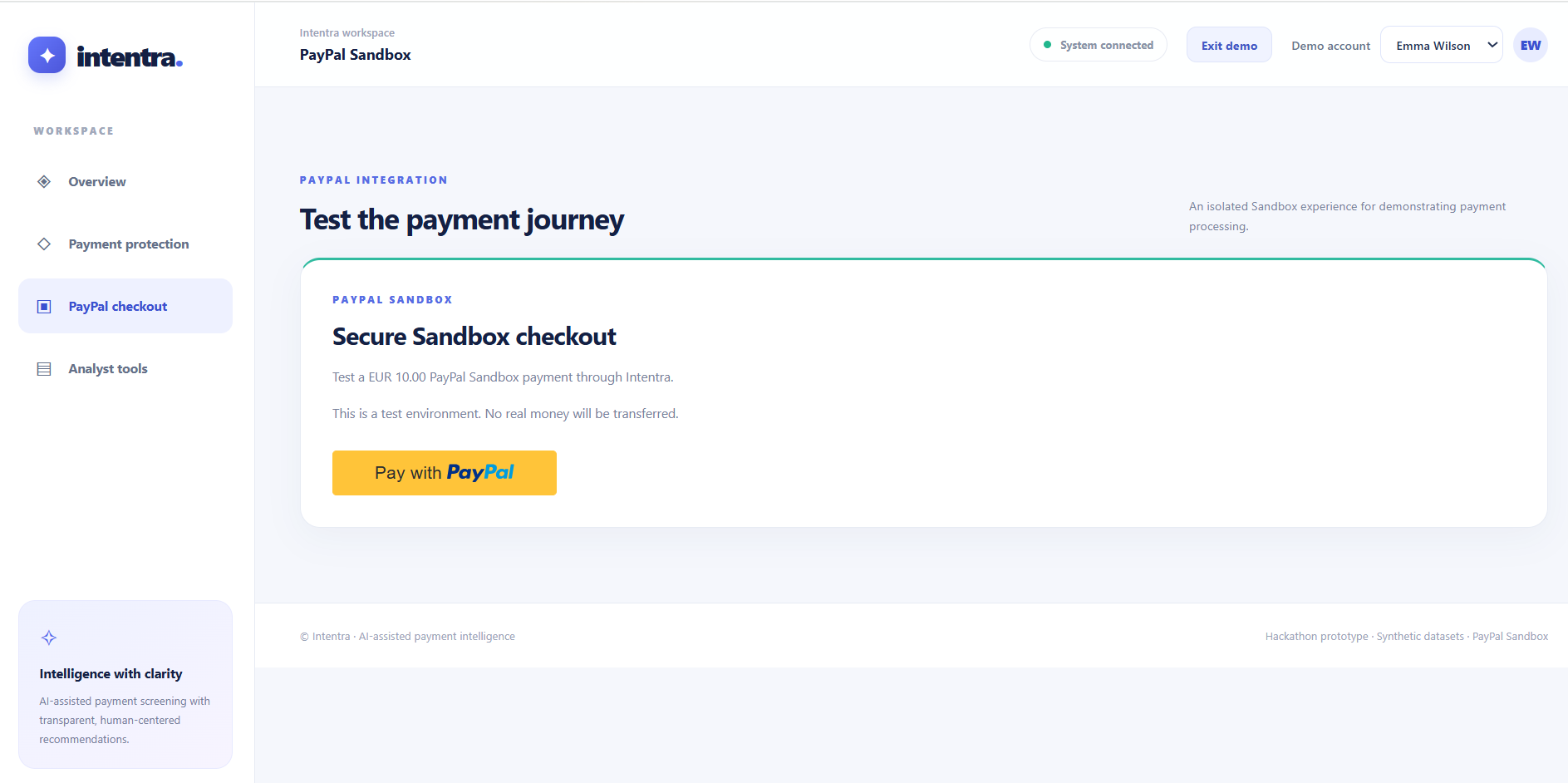
6. PayPal Sandbox and analyst tools
Intentra includes a separate PayPal Sandbox checkout demonstration with payment-status verification logic.
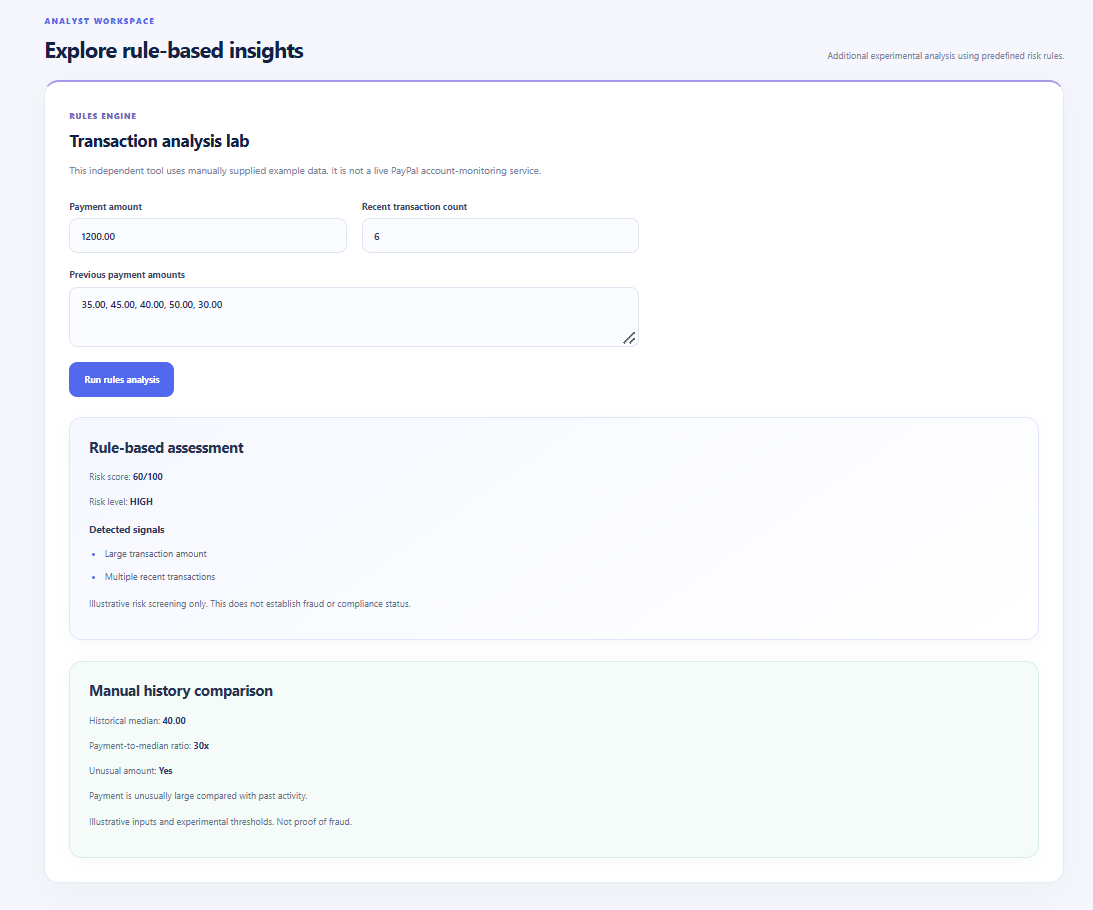
Analyst Tools also provide independent rule-based assessments and manual transaction-history comparisons.
The current preferred-currency selector supports EUR, USD, GBP, AED, and LBP as a display preference. It does not perform currency conversion or connect to actual bank accounts.
How I built it
I developed Intentra independently as a solo participant, combining a full-stack web application with rule-based analysis, experimental machine learning, and conversational AI.
Frontend — React, TypeScript, and Vite
The interface includes a consumer dashboard, payment review workflow, explainable analysis panels, AI advisor, PayPal Sandbox demonstration, and analyst tools.
A shared payment context keeps transaction details consistent across relevant frontend components.
Backend — Python and FastAPI
The backend coordinates transaction analysis, structured evidence, customer history, AI advisor requests, and PayPal Sandbox operations.
Behavioral rules provide interpretable signals independently of the machine learning model.
Machine learning — scikit-learn
I trained and evaluated a HistGradientBoostingClassifier on synthetic PaySim transaction data.
The pipeline uses chronological training, validation, and test periods. Model selection and threshold selection use validation data, followed by evaluation on the held-out test period.
The deployed V3 model achieved:
- Average precision: 0.985912
- ROC AUC: 0.999955
- Precision: approximately 96.88%
- Recall: approximately 84.14%
These results describe performance on the synthetic PaySim test period only. They do not establish equivalent performance on real payment networks.
Conversational AI — Google Gemini
Google Gemini powers the natural-language advisor.
Rather than using the language model as an autonomous payment blocker, Intentra supplies structured payment evidence and transaction context to support understandable, actionable explanations.
The AI assists the consumer's decision-making process without independently executing or suspending payments.
PayPal integration
Intentra uses PayPal's Sandbox environment to demonstrate a separate test checkout flow.
Backend verification logic examines payment details and status, including amount and currency consistency.
The recorded demonstration does not establish a confirmed successful capture, and the application does not process real funds.
Data and evaluation
Intentra uses synthetic IBM transaction-history data for the consumer experience and synthetic PaySim data for experimental ML screening.
This allows the application to demonstrate personalized financial intelligence without exposing actual customers' financial records.
Challenges I ran into
1. Balancing machine learning accuracy with explainability
One of the most interesting challenges involved investigating the behavior of the experimental fraud-screening model.
Although V3 performed strongly on the synthetic test period, targeted testing revealed a sharp score discontinuity around full-balance transfers.
A transfer close to the entire starting balance could receive a dramatically different screening score from a nearly identical transfer.
I investigated the feature engineering and trained a V4 experiment without the explicit full-balance-transfer indicator.
However, V4 performed worse on held-out synthetic data, so I retained V3 while documenting its limitations.
This reinforced an important lesson: strong aggregate evaluation metrics do not eliminate the need for targeted behavioral testing.
2. Separating ML screening from behavioral recommendations
The ML model and rule-based engine do not always agree.
Rather than hiding these differences, I redesigned the interface to communicate them explicitly.
For example, Intentra may display "No ML pattern flagged" while still recommending additional verification based on behavioral evidence.
3. Creating trustworthy conversational AI
The Gemini advisor needed to provide genuinely contextual guidance rather than generic fraud warnings.
I focused on grounding its responses in available transaction evidence, supporting follow-up questions, and avoiding unsupported claims about real-world fraud probabilities.
4. Building a responsible PayPal Sandbox workflow
The payment demonstration required separating the user's proposed payment analysis from the actual Sandbox checkout.
Verifying payment status and distinguishing successful capture from incomplete verification were important implementation considerations.
5. Delivering a complete application independently
Building the frontend, backend, ML experiments, AI integration, tests, documentation, and demonstration required careful prioritization.
I focused on preserving a working application and making the prototype's limitations transparent rather than adding features that could not be implemented reliably within the hackathon timeline.
Accomplishments that I'm proud of
- Building a complete, interactive full-stack fintech prototype independently.
- Combining explainable rule-based intelligence with experimental machine learning rather than relying on a single opaque score.
- Training, evaluating, and investigating the ML model using chronological data splits and targeted edge-case experiments.
- Developing a Gemini-powered conversational advisor that considers structured payment context and supports follow-up questions.
- Building an evidence panel that makes recommendations understandable to consumers.
- Integrating a separate PayPal Sandbox checkout and payment-status verification workflow.
- Creating analyst tools and a polished consumer-facing application.
- Establishing a backend testing workflow with 81 previously passing tests and successfully building the production frontend.
Most importantly, I'm proud that Intentra communicates uncertainty and supports human judgment rather than presenting AI as an unquestionable authority.
What I learned
This project taught me that building responsible financial AI requires more than training an accurate classifier.
I learned the importance of combining deterministic business rules with experimental ML, investigating unexpected model behavior, validating payment states, and designing explanations that real users can understand.
I also gained practical experience integrating React and TypeScript with FastAPI, working with synthetic financial datasets, using Gemini for grounded conversational assistance, and developing PayPal Sandbox workflows.
Beyond the technical work, discussions with fintech professionals helped me appreciate the importance of commercial feasibility, compliance, consumer protection, and the cost of introducing unnecessary friction into payment experiences.
The biggest lesson was that a useful AI system should help users make better decisions, not simply make decisions for them.
What's next for Intentra
The long-term vision is to develop Intentra into a secure, personalized payment intelligence layer that could integrate with existing wallets, banking applications, and payment providers.
Multi-bank and wallet intelligence
With appropriate user authorization and supported integrations, users could securely connect multiple financial accounts and access a unified view of balances and activity.
Intelligent payment-source recommendations
Intentra could compare available funds, applicable transfer fees, payment limits, and transaction context to help users choose a suitable funding source.
Personalized behavioral modeling
Future models could learn from consented, appropriately protected transaction histories and provide more relevant recommendations.
Real-world model validation
Further work would involve evaluating the ML approach on representative datasets, measuring false positives, examining calibration, and testing robustness across user populations.
Compliance and governance
Additional development would include privacy controls, auditability, regulatory review, and secure account integrations.
Integrated payment experiences
Rather than requiring users to open a separate application for every payment, Intentra could eventually provide contextual guidance within existing financial products.
These are future directions, not capabilities implemented in the current prototype.
Acknowledgments
I would like to express my sincere gratitude to Mr. Alex Axiotiadis and Mr. David Norman, founders of JUNO, for generously sharing their time, experience, and valuable perspectives on the fintech industry.
Their guidance on combining traditional rule-based systems with artificial intelligence, establishing sound business logic before introducing advanced AI, considering regulatory and commercial realities, and maintaining a positive consumer experience played an important role in shaping my approach to Intentra.
I am particularly grateful for their encouragement to approach financial technology not only as an engineering challenge but also as a real-world business problem requiring practical, responsible, and user-centered solutions.
I would also like to acknowledge their work in the fintech sector through JUNO and JunoSolutions CY Enterprises Ltd, whose focus on digital wallets, financial infrastructure, and scalable financial solutions provided valuable industry context.
Their contributions were advisory; Intentra was independently designed and developed by me and is not an official product of, or endorsed by, their company.
I sincerely appreciate their encouragement, insights, and willingness to share their expertise throughout this journey.
Intentra — Understand before you pay.
Built With
- fastapi
- git
- github
- google-gemini
- machine-learning
- paypal-rest-api
- paypal-sandbox
- paysim
- python
- react
- scikit-learn
- sqlite
- typescript
- vite
