-
-
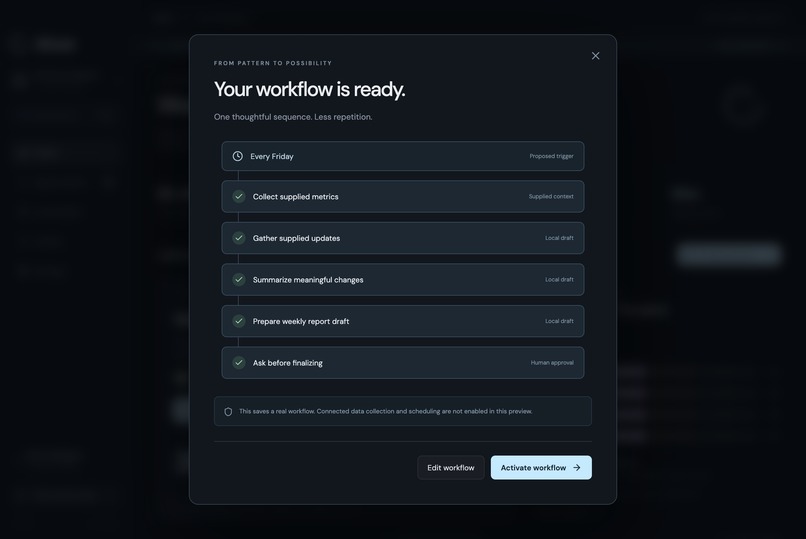
Workflow
-
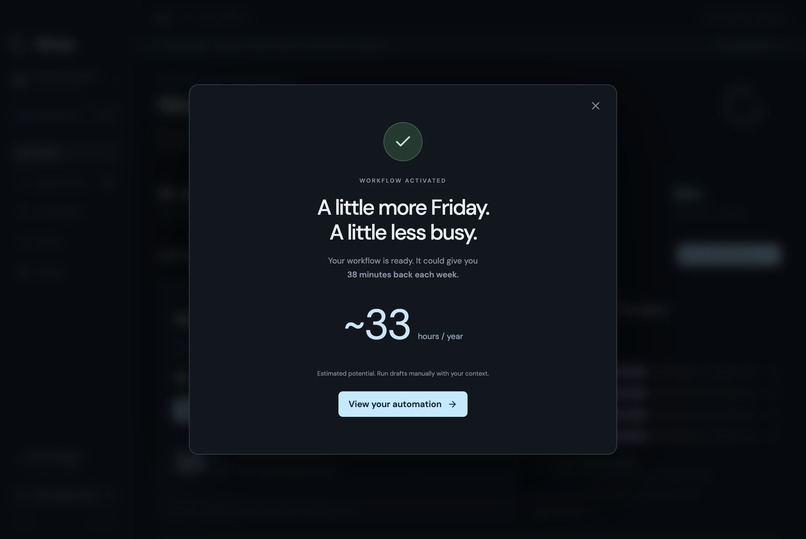
How much time is saved
-
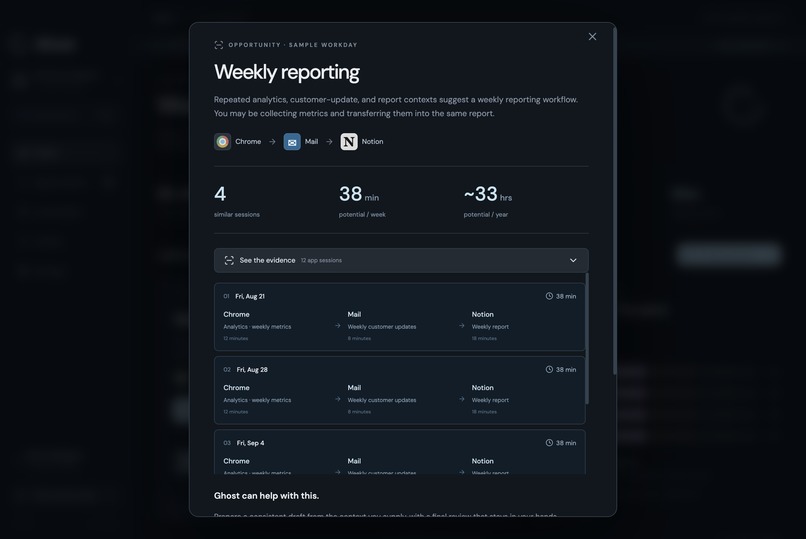
Report
-
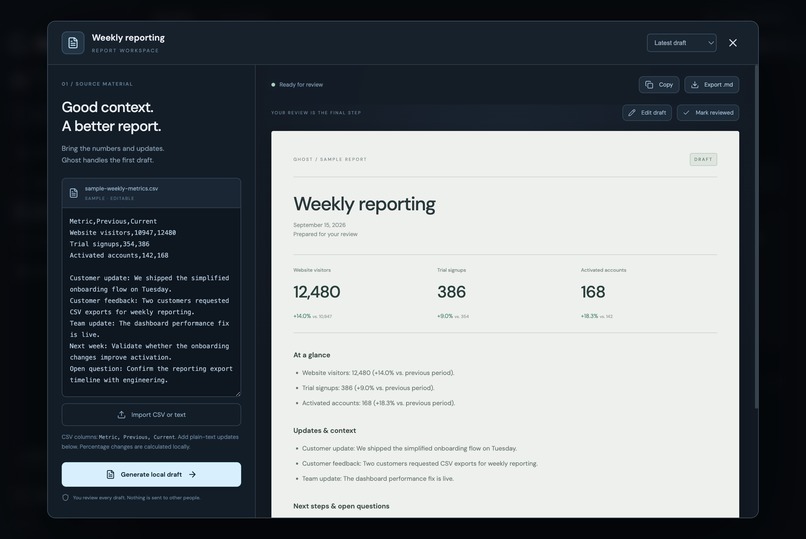
Results
-
Process
-
Home
Inspiration
AI is incredibly good at helping when you ask it a question.
But most of the time, the hardest part isn't getting an answer. It's noticing the repetitive work you shouldn't have been doing in the first place.
Every day, we jump between emails, documents, browser tabs, meetings, messages, spreadsheets, and dozens of small tasks. We copy information from one place to another, repeatedly perform the same workflows, search for context we've already seen, and spend hours on work that could have been automated.
The problem is that existing AI tools usually wait for us to tell them what to do.
Ghost does the opposite.
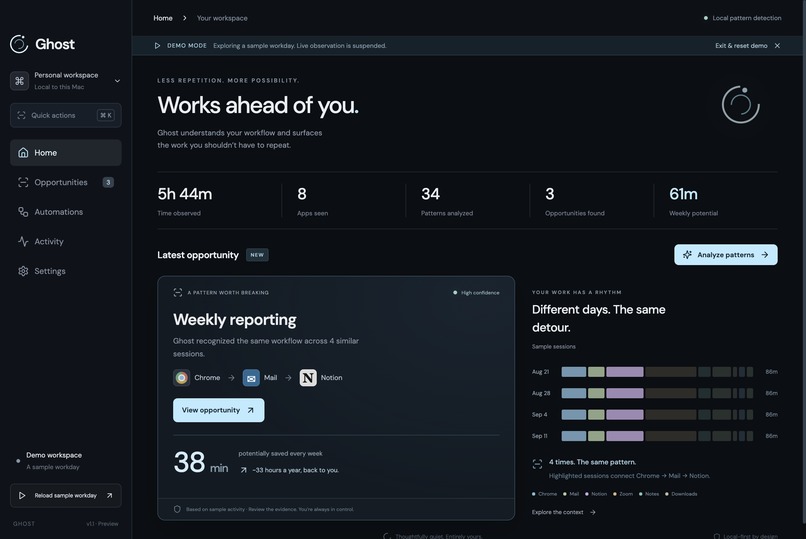
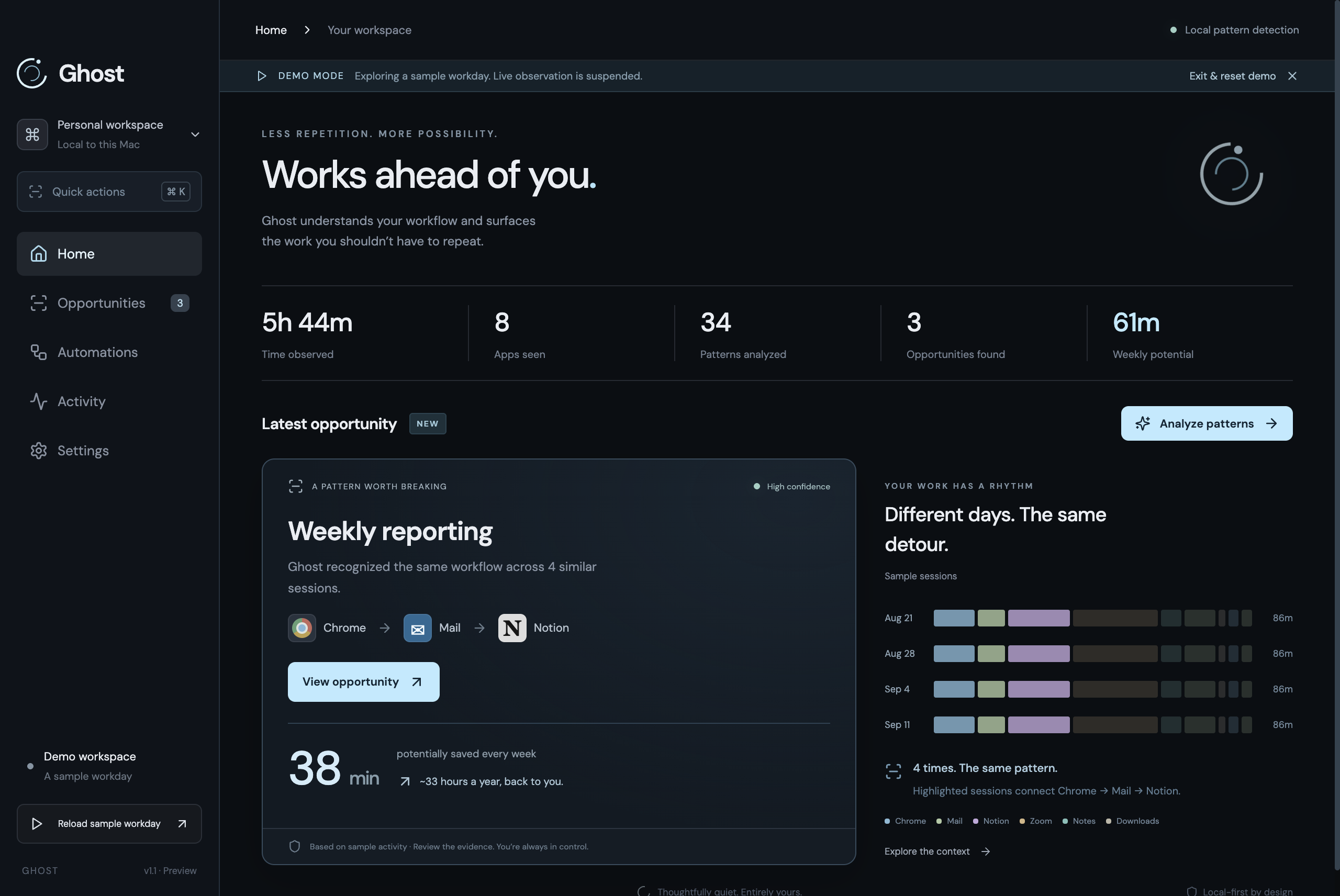
Ghost quietly understands how you work, identifies repetitive patterns and opportunities for improvement, and turns them into useful suggestions and automations.
Instead of asking:
"What can AI do for me?"
Ghost asks:
"What should you never have to do again?"
What it does
Ghost is an ambient AI layer for your computer that learns from your workflow and helps you work more intelligently.
It follows a simple loop:
Observe → Understand → Detect → Suggest → Automate
Ghost can identify patterns such as:
- Repetitive actions you perform every day
- Information constantly copied between tools
- Tasks that could be automated
- Workflows that unnecessarily consume time
- Important context scattered across applications
- Opportunities to summarize, organize, or act on information
- Processes that could become reusable workflows
Instead of forcing users to build complicated automations themselves, Ghost discovers those opportunities automatically.
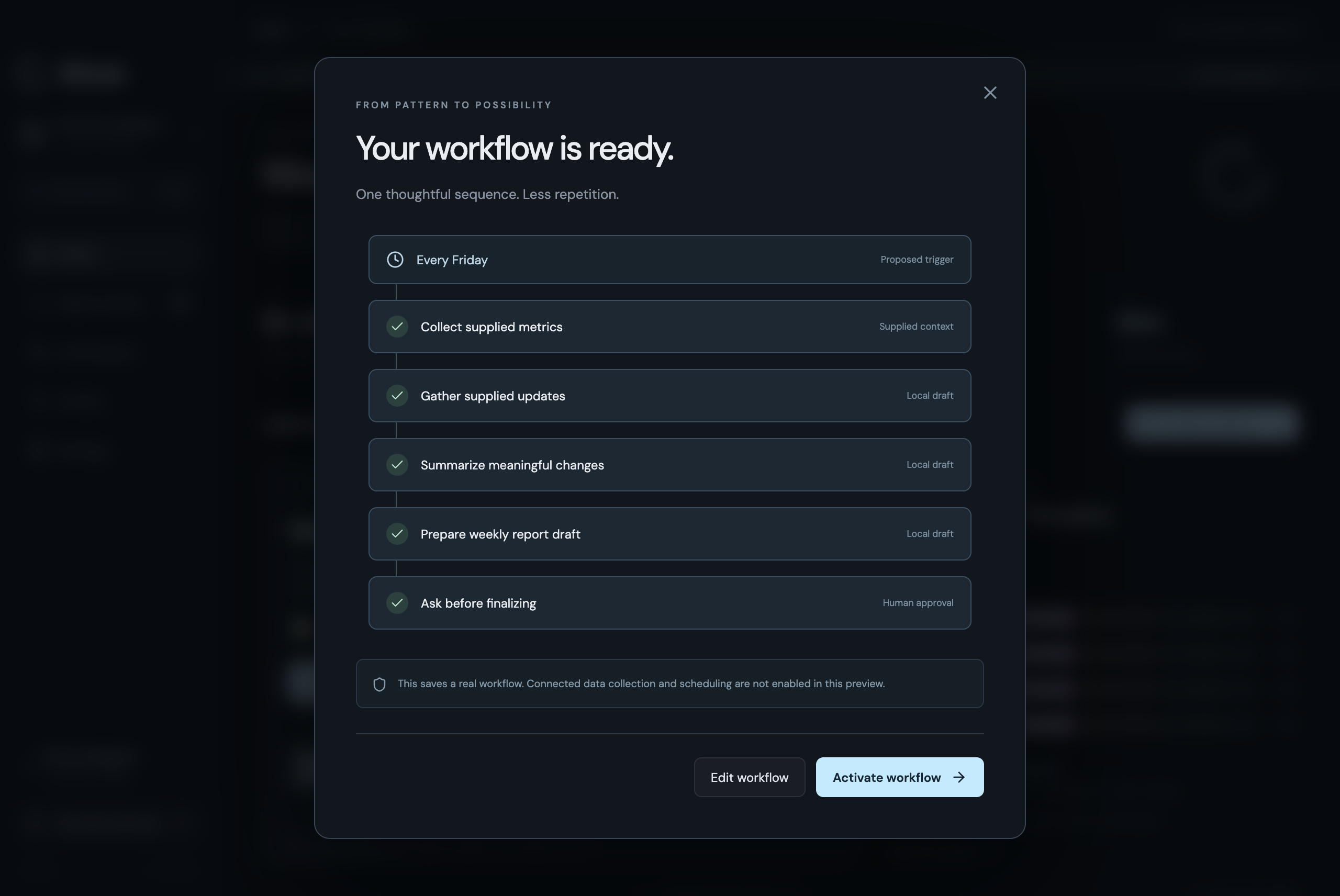
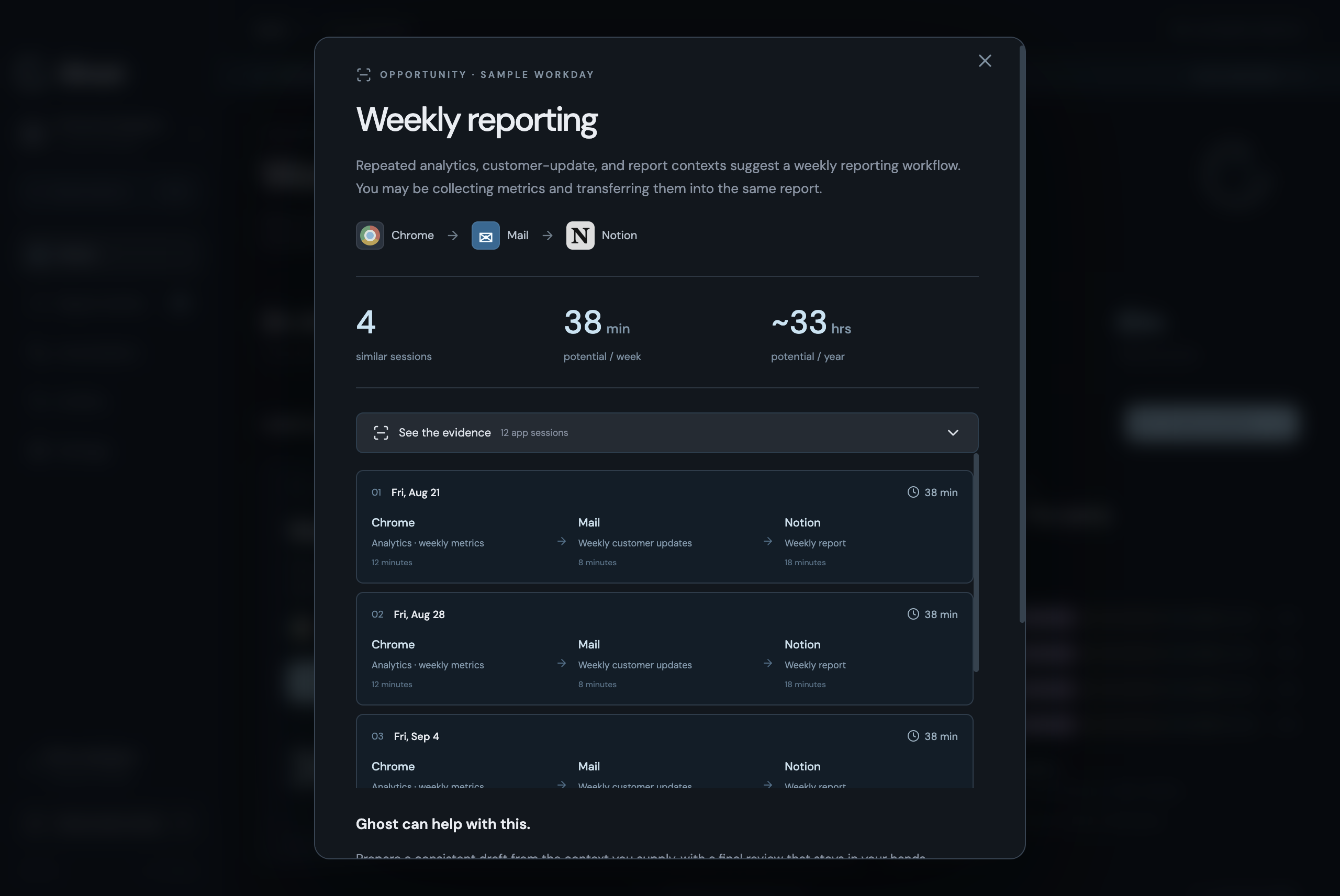
For example, Ghost might notice that every Friday you collect information from several sources, organize it, and write a report.
Rather than waiting for you to create that automation manually, Ghost can recognize the pattern and suggest:
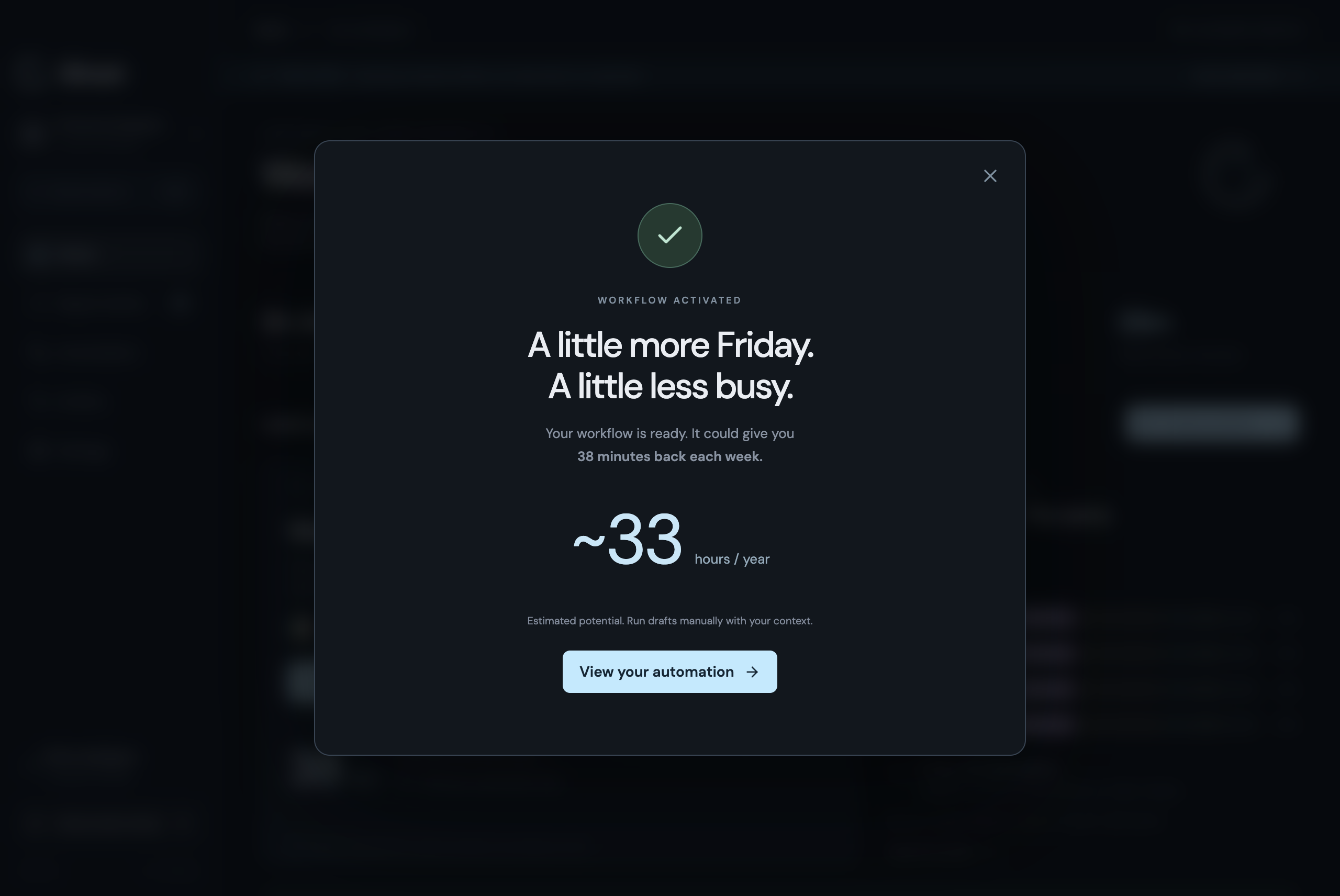
"You spend approximately 35 minutes every Friday creating this report. I can automate it. Would you like me to?"
The user remains in control. Ghost identifies the opportunity; the human decides what happens next.
Why Ghost is different
Most AI products are reactive.
You open a chatbot, explain your problem, provide context, and ask it to perform a task.
Ghost is designed to be proactive.
Because it understands the context surrounding your work, it can identify problems and opportunities you may never think to ask an AI about.
That changes the relationship between humans and AI.
The goal isn't to create another assistant you have to manage.
The goal is to create an intelligence layer that works quietly in the background and surfaces itself only when it can genuinely help.
Less prompting. Less repetitive work. More meaningful work.
How we built it
We designed Ghost around a context-first architecture.
Rather than treating every interaction as an isolated prompt, Ghost builds an understanding of the user's ongoing activity and searches for meaningful patterns across that activity.
The system is organized around several core components:
1. Context capture
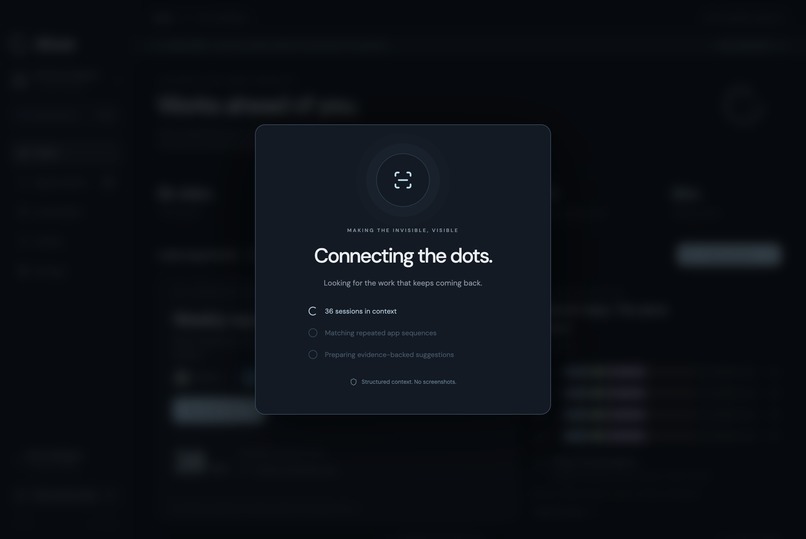
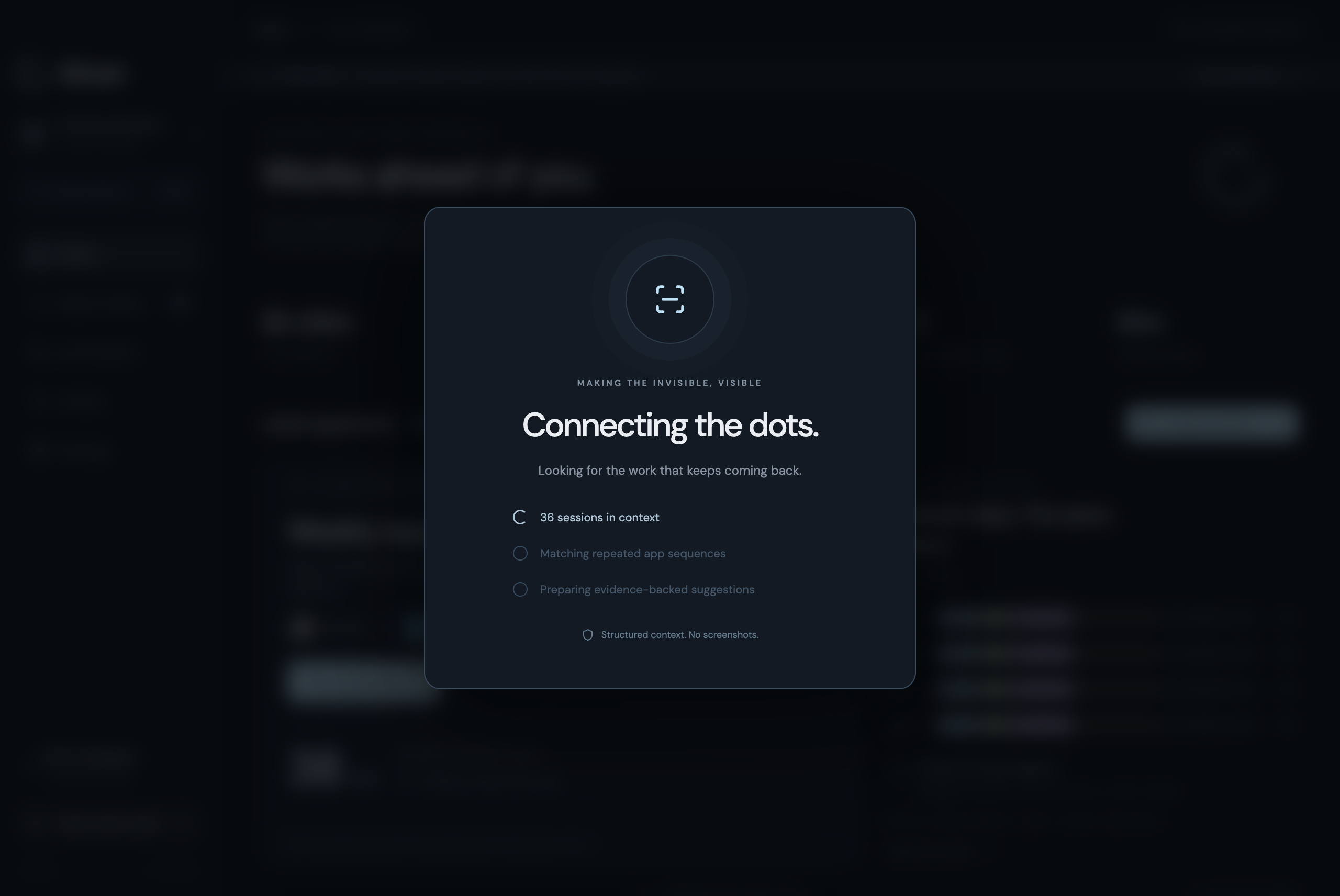
Ghost observes relevant work activity and converts raw interactions into structured events that the system can reason about.
2. Context understanding
Individual actions are connected into higher-level tasks and workflows so Ghost can understand not only what happened, but what the user was actually trying to accomplish.
3. Pattern detection
Ghost looks for repeated sequences, unnecessary manual steps, recurring tasks, and other signals that indicate an opportunity for automation or assistance.
4. AI reasoning
An AI layer evaluates those patterns and determines whether Ghost has found something useful enough to surface to the user.
5. Opportunity generation
Instead of overwhelming the user with information, Ghost translates its findings into simple, actionable suggestions such as:
- Automate this workflow
- Summarize this activity
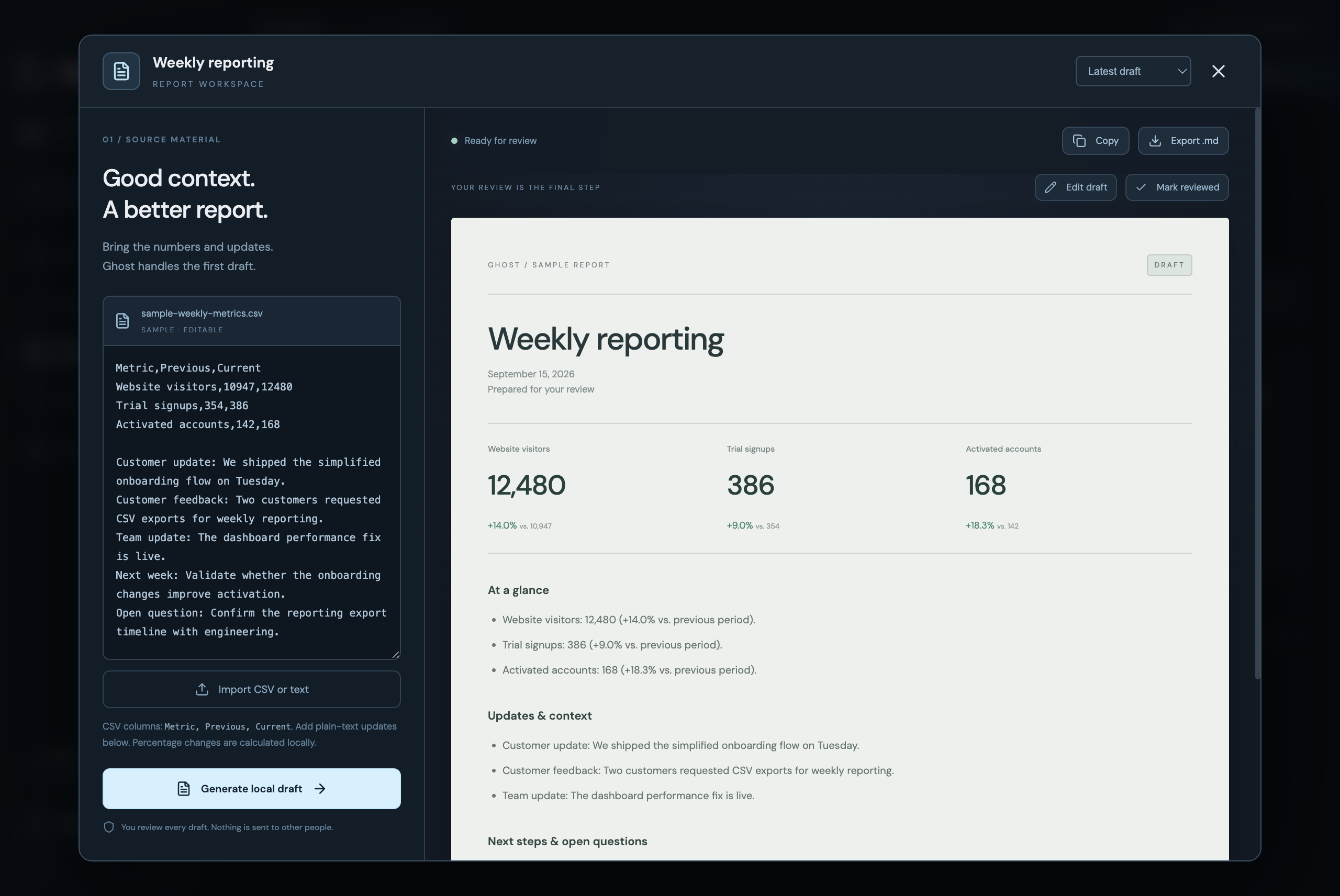
- Create this report automatically
- Organize these files
- Remember this for later
- Turn this repeated process into a reusable workflow
6. Human-controlled execution
Ghost is designed around suggestion before execution.
Potential automations are presented clearly to the user before actions are taken, keeping the system useful without making it unpredictable.
The biggest challenge
The hardest part of building Ghost wasn't making an AI capable of automating something.
It was deciding when AI should intervene at all.
A proactive assistant can easily become annoying if it constantly interrupts the user.
That forced us to think carefully about a much more interesting problem:
How do you make AI proactive without making it intrusive?
Ghost therefore tries to optimize for significance rather than activity.
It shouldn't surface everything it notices.
It should surface the few things that actually matter.
Another major challenge was turning low-level computer activity into meaningful context. Clicking three buttons doesn't necessarily represent three independent actions—it might represent one larger objective.
Understanding that distinction is essential if Ghost is going to discover useful workflows rather than simply recording behavior.
Finally, privacy and control were fundamental considerations. An assistant that understands your work needs clear boundaries, transparency, and user approval before performing consequential actions.
What we learned
Building Ghost changed the way we thought about AI assistants.
The next generation of AI products may not require users to constantly open a chatbot and explain what they need.
The most powerful AI may instead understand enough context to recognize when it can help.
We also learned that automation itself is becoming increasingly easy.
Discovering what should be automated is the harder problem.
People often don't know which parts of their workflow can be improved because inefficient processes gradually become normal.
An intelligent system that can identify those invisible inefficiencies could therefore be significantly more useful than another tool for manually building workflows.
What we're proud of
We're especially proud that Ghost isn't built around adding another interface to someone's day.
It's built around removing unnecessary work from it.
The vision is simple:
Your computer should understand how you work well enough to help improve the way you work.
Ghost represents a shift from AI that waits for instructions to AI that understands context, identifies opportunities, and works ahead of you.
What's next
Ghost can eventually evolve from detecting individual repeated tasks into understanding entire workflows across tools.
Future versions could:
- Measure exactly where users spend unnecessary time
- Build automations from observed workflows
- Connect actions across multiple applications
- Learn which suggestions individual users value
- Create reusable personal workflows automatically
- Provide a dashboard showing hours saved
- Discover increasingly complex opportunities over time
- Allow teams to identify inefficient processes across an organization
Ultimately, we want Ghost to become something you barely have to interact with.
Not another application demanding your attention.
An invisible intelligence layer that gives some of that attention back.
Ghost
Sees the work. Finds the opportunity. Does the boring stuff.
Works ahead of you.
Built With
- ai
- automation
- desktop-app
- electron
- javascript
- llms
- machine
- node.js
- openai-api
- python
- react
- sqlite
- supabase
- tailwind-css
- typescript
- vercel

Log in or sign up for Devpost to join the conversation.