-
-
workflow 1
-
workflow 2
-
-
-
-
Inspiration
Every developer has been dropped into a codebase where nobody can say what anything is for. Legacy systems are the extreme case: business logic buried under years of patches, and the people who understood it are gone. Feeding that code straight into an LLM doesn't fix it. Context degrades, the model guesses, and nothing tells you which guesses are true. We wanted a tool that treats a codebase's intent as something you can map, query, and prove.
What it does
Intent turns any codebase, legacy or actively developed, into a test-verified map of what it's for.
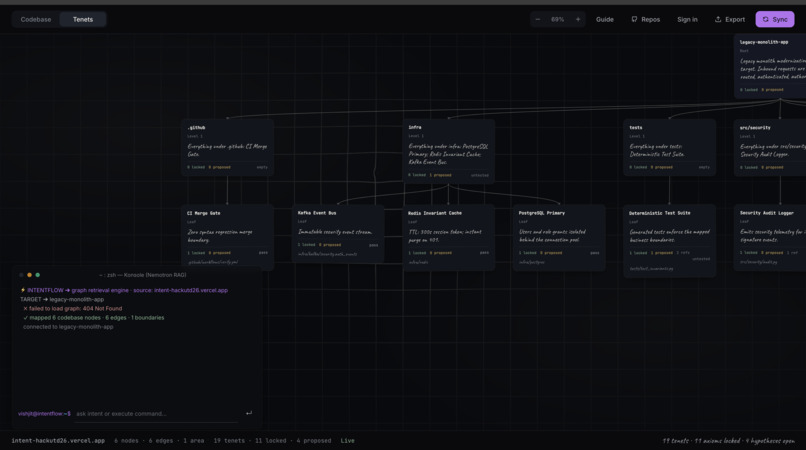
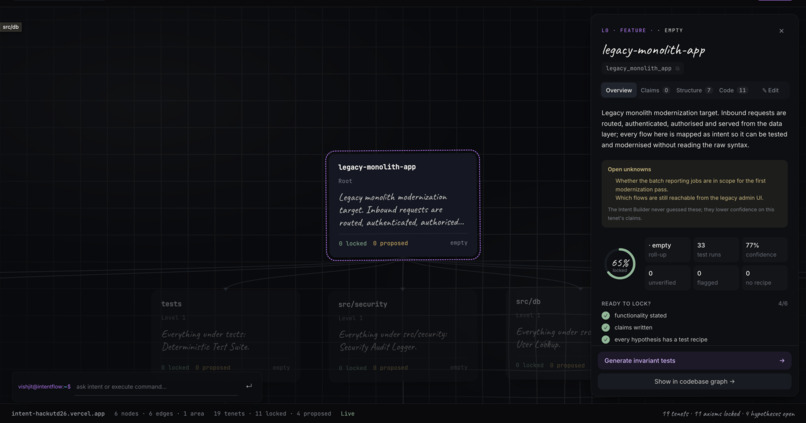
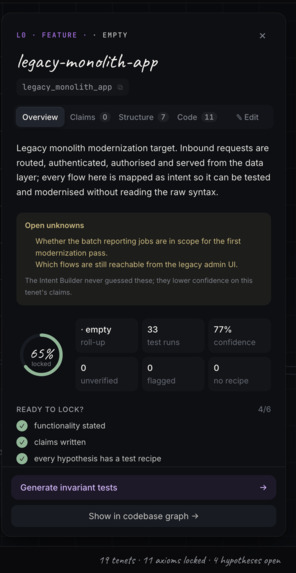
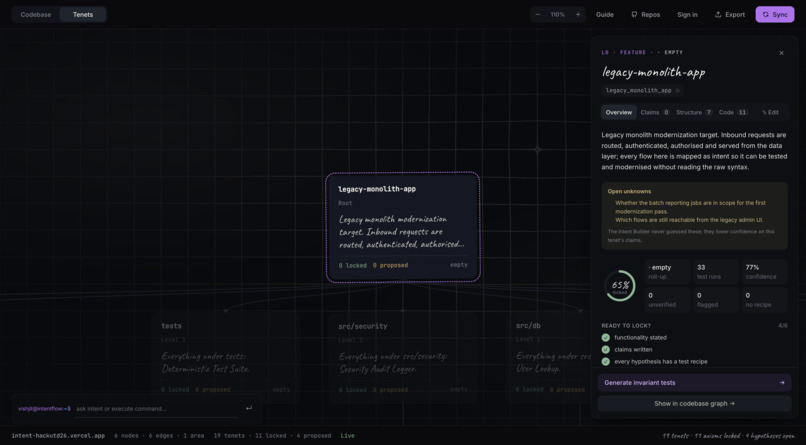
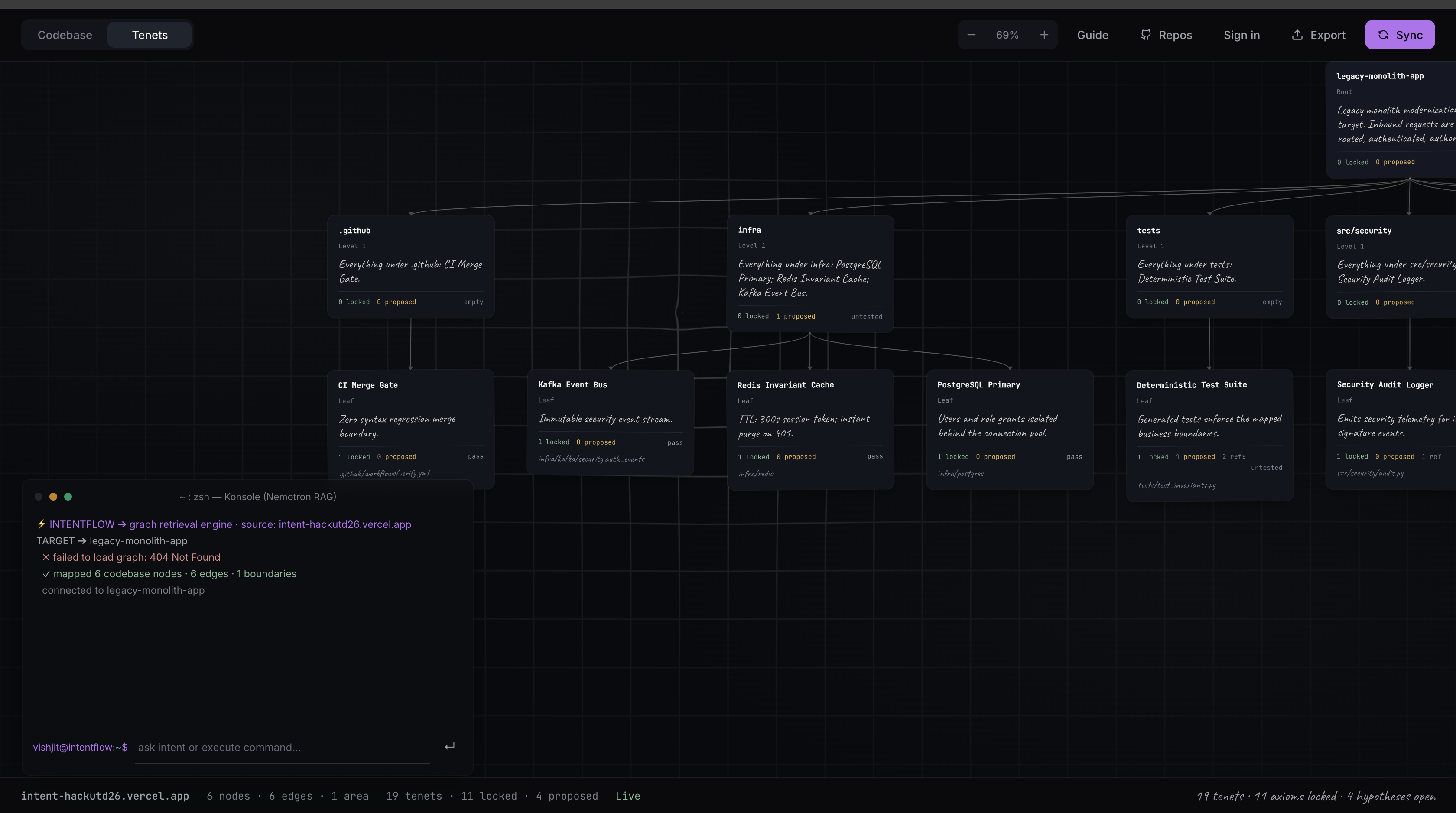
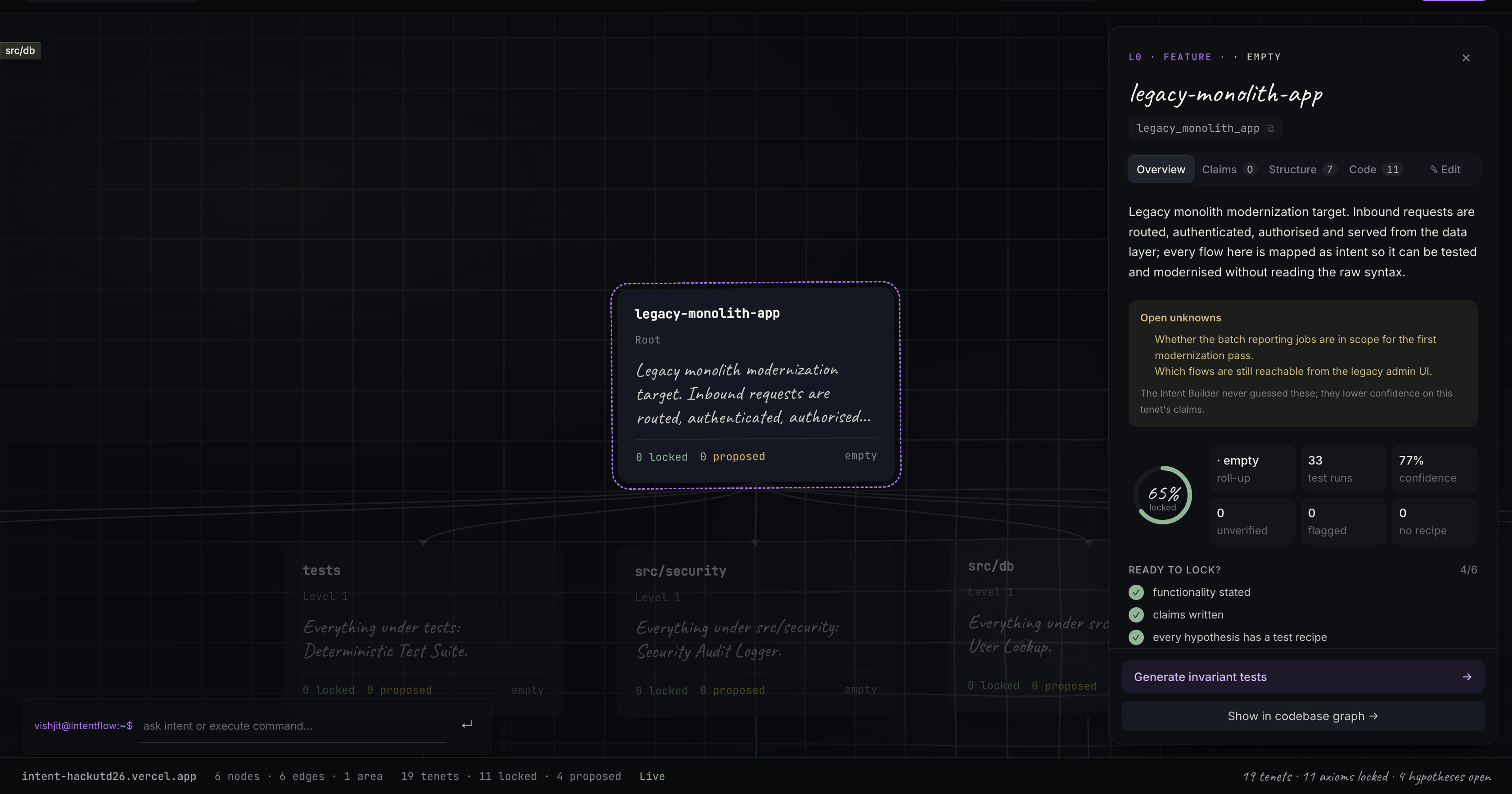
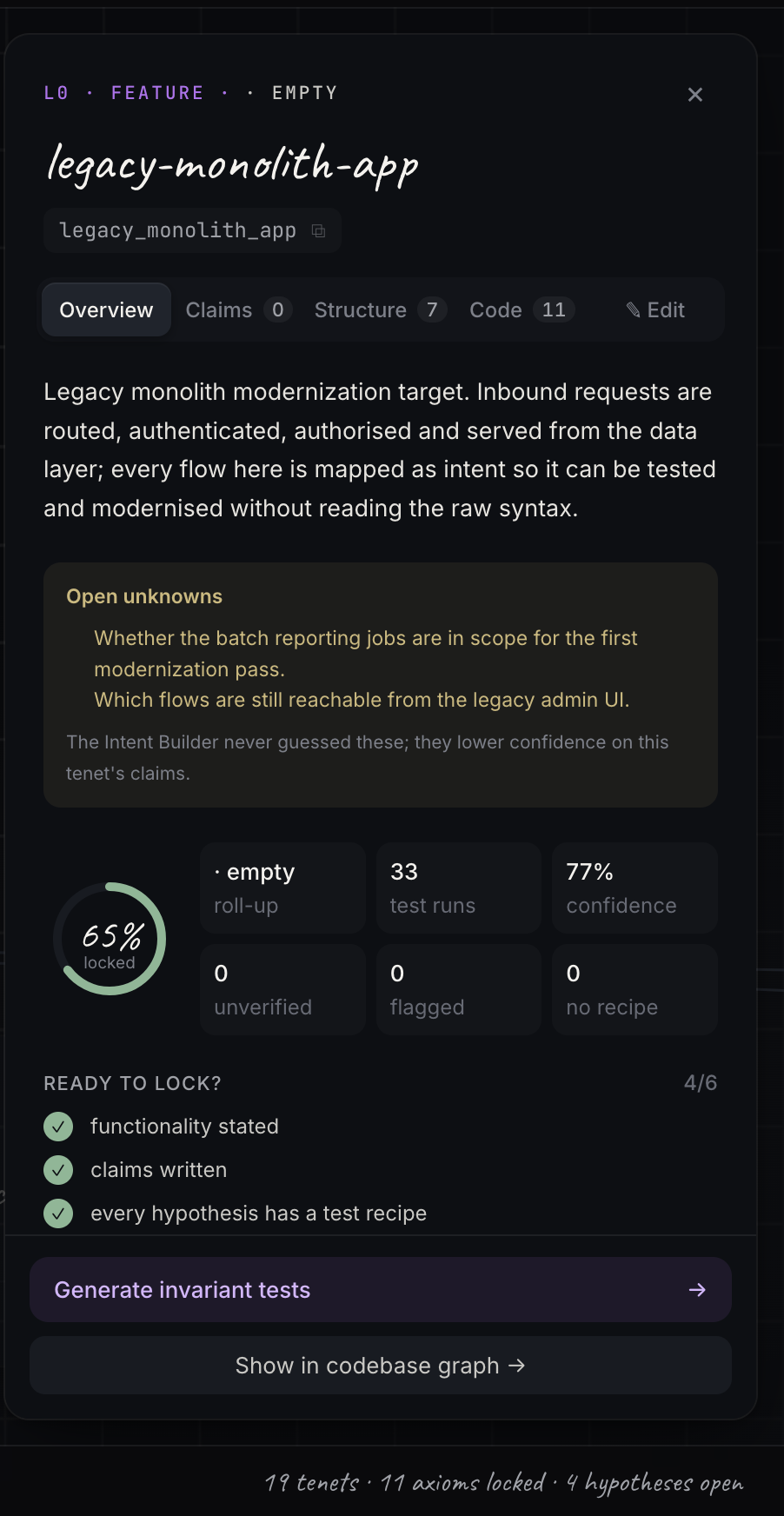
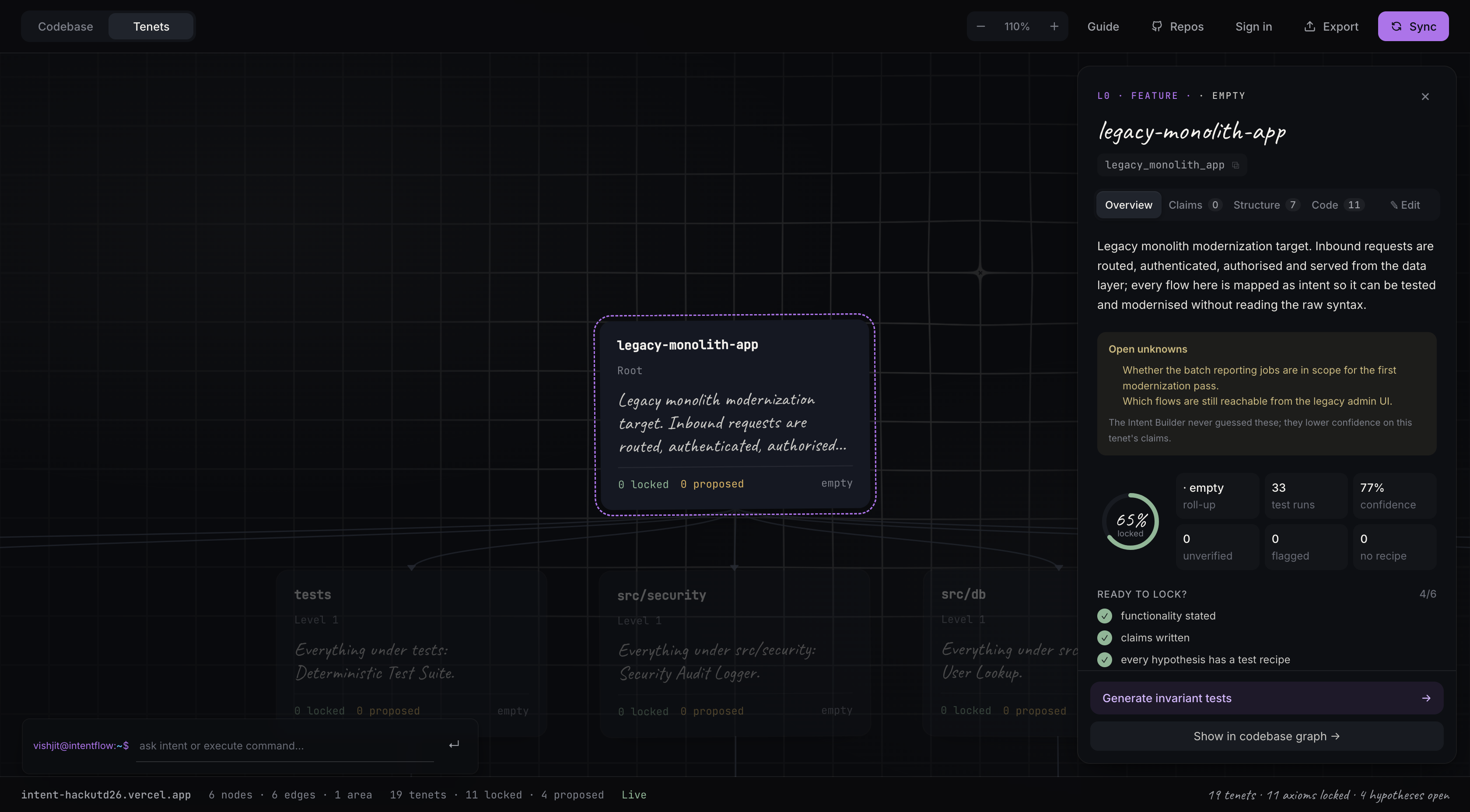
- Intent tree: functionality is organized into a hierarchy of Tenets. The root is the system's purpose, features sit beneath it, and leaves are individual behaviors linked directly to the code that implements them.
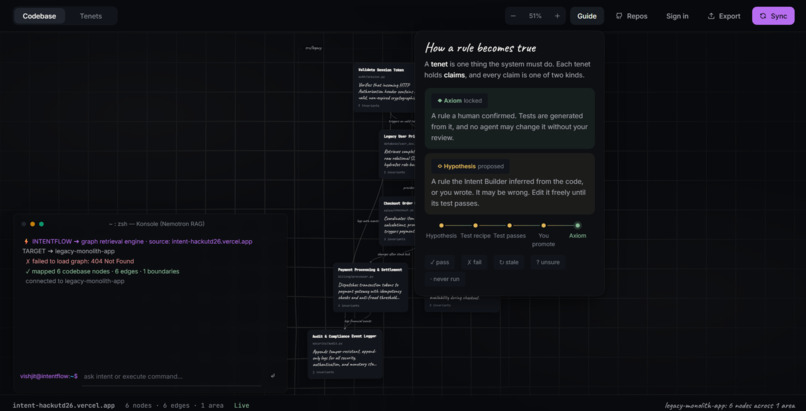
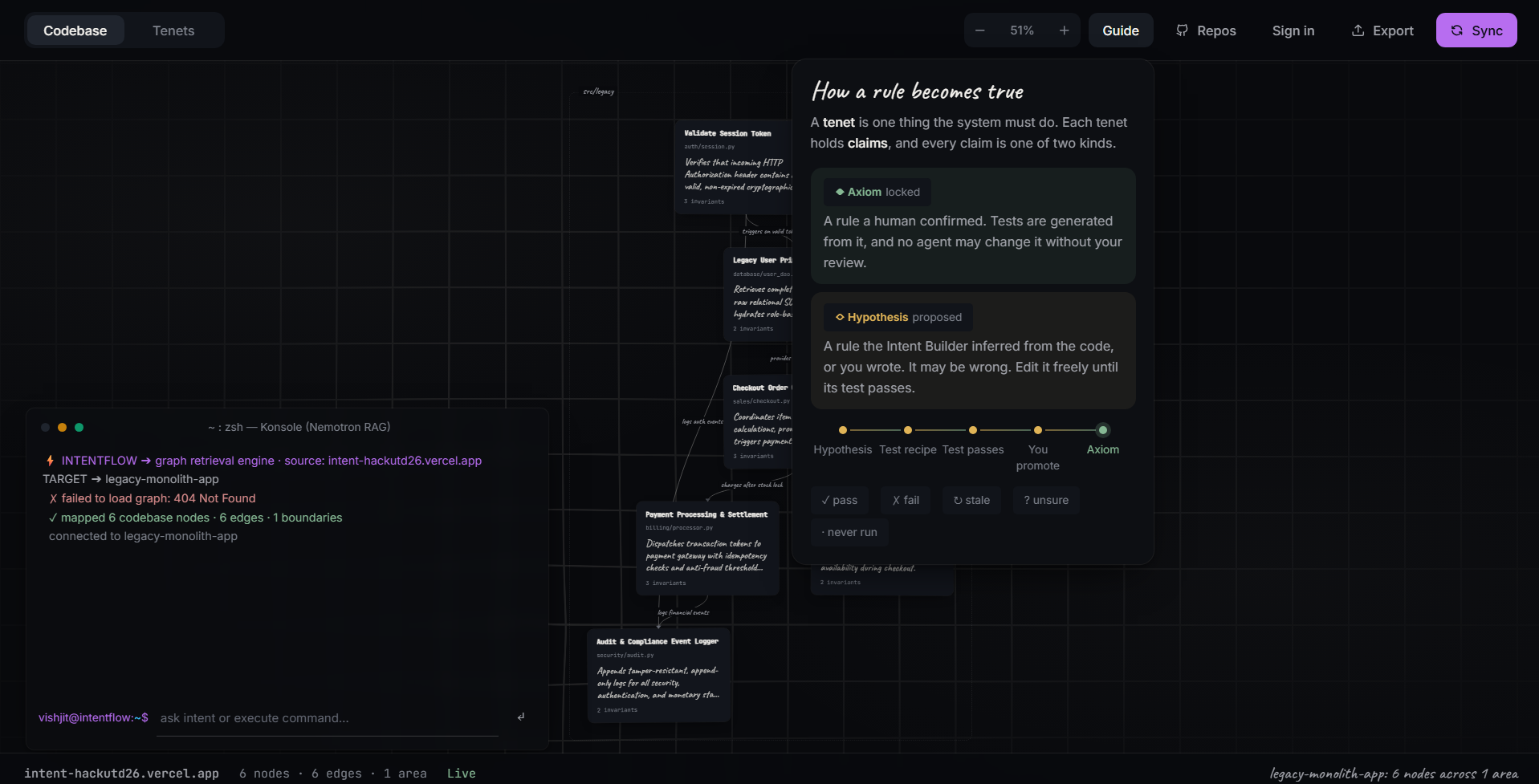
- Codebase view: a live graph of the repo's folders, files, and import edges, bridged to the intent tree. Select a Tenet to see its files; select a file to see which intent it serves.
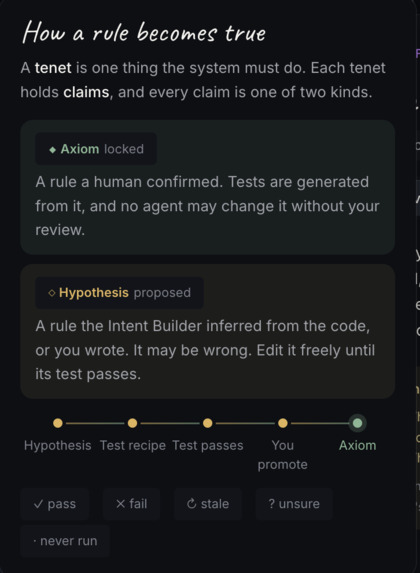
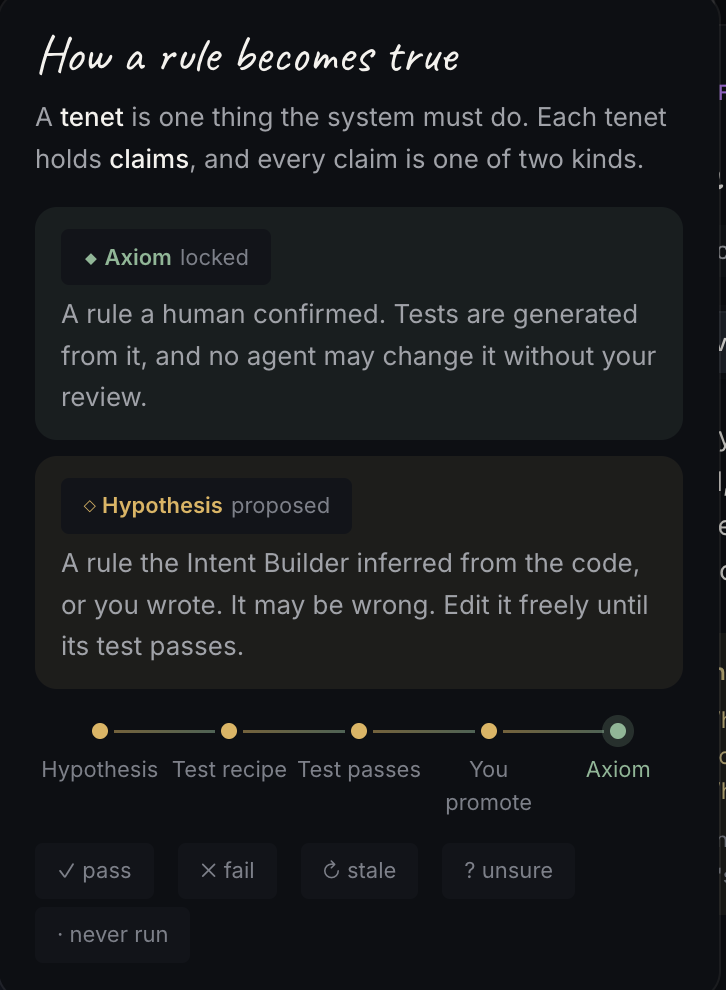
- Hypotheses → Axioms: every claim about a Tenet starts as a Hypothesis with a generated test, run against the original code. Only when the test passes and the user approves does it lock into an Axiom: verified intent that no AI agent can edit, enforced by backend permissions rather than prompts. Verification runs bottom-up: behaviors first, then the features built on them.
- Self-correcting: when a feature-level test fails, Intent localizes the fault (a wrong child behavior vs. a wrong integration) and scraps and remakes only that piece, remembering rejected interpretations so it can't repeat them.
- Stays in sync: on every push, Jev, our type-safe commit classifier, decides whether the change is harmless, updates existing intent, adds a new feature branch, or conflicts with an Axiom. Conflicts raise a flag instead of silently rewriting anything, and every demotion shows its full ripple effect first.
- Query it: ask what any part of the system is for. Answers come from the intent graph first, dipping into raw files only when needed, so context stays small and grounded.
- Regenerate: verified Axioms compile into a requirements spec that can drive a rewrite, and the same tests validate the new code.
How we built it
- GitHub sync & infrastructure (Ayaan): GitHub OAuth, push webhooks with debouncing, import-edge extraction by pattern matching, permission enforcement, and REST/WebSocket pipelines to the frontend.
- Annotation & change review (Indra): a two-pass LLM annotation pipeline (file summary, then chunk-level comments keyed to content hashes so they go stale correctly), Jev, the scoring behind scrap-and-remake, and the spec compiler.
- Graph views & retrieval (Vishjit): the Intent and Codebase views in Next.js and React Flow with auto layout, the Tenet-to-file bridge, impact-summary UI, and the graph retrieval engine (weighted text scoring for seeds plus k-hop expansion through the graph under a context budget).
- Nemotron agents & chat (Aadi): NVIDIA Nemotron powers the agents that interview the user to build the tree, author tests, run them independently of the author, and remake wrong hypotheses, plus the chat panel and token counter.
Challenges we ran into
- Making "locked" actually mean locked: Axiom immutability had to live in backend permissions, not prompt instructions, so no agent has a write path to a verified claim.
- Blaming the right level: When an integration test fails, the obvious move is to rewrite the leaves. We had to run composed children first to tell a broken behavior apart from a broken integration.
- Annotations that survive edits: line numbers shift constantly, so annotations and results are keyed to content hashes and marked stale the moment their code or claim changes.
- Trusting a classifier: Jev's output is constrained to a fixed schema and validated against real tree ids; low-confidence verdicts go to a review inbox instead of passing silently.
Accomplishments that we're proud of
- The Hypothesis → Axiom model: AI proposes, tests verify, humans approve, and nothing verified can be silently overwritten.
- Watching tests flip from red to green on the graph, then locking a feature bottom-up.
- Failure localization that remakes only the piece that was wrong.
- A tool that's as useful on your team's active repo as on a decade-old monolith.
What we learned
- LLMs reason far better about a codebase when they're anchored to verified structure instead of raw files.
- The hard part of understanding code isn't what it does but why, and that "why" needs provenance and evidence to be trusted.
- A conflict between verified intent and new code isn't an error; it's exactly the signal teams need.
What's next for Intent
- More languages beyond Python and TypeScript.
- Multi-branch tracking, so feature branches get their own intent overlays.
- Human-reviewed PRs: proposing refactors as pull requests once intent changes are approved.
- Bring your own model: plugging other LLMs into the agent pipeline.


