-
-
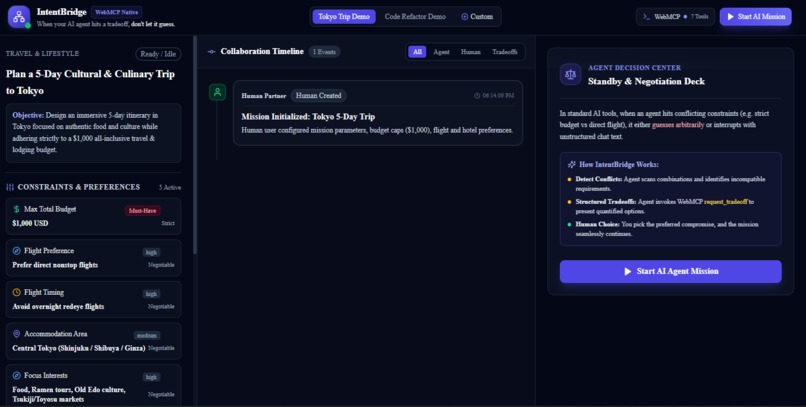
THE OPENING PAGE
-
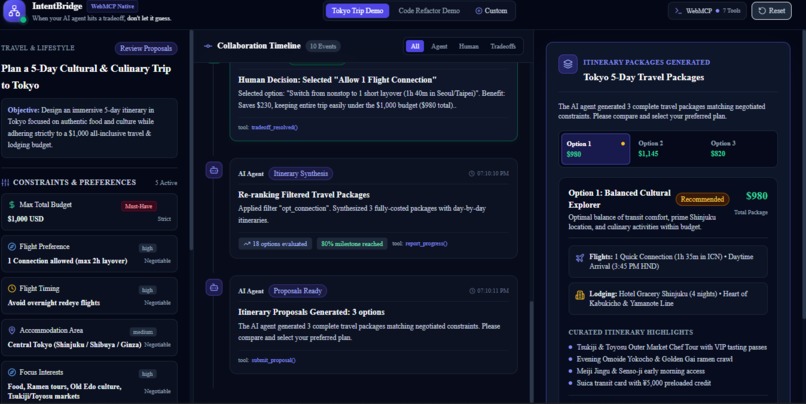
THE NEGOTIATION OF THE DECISION
-
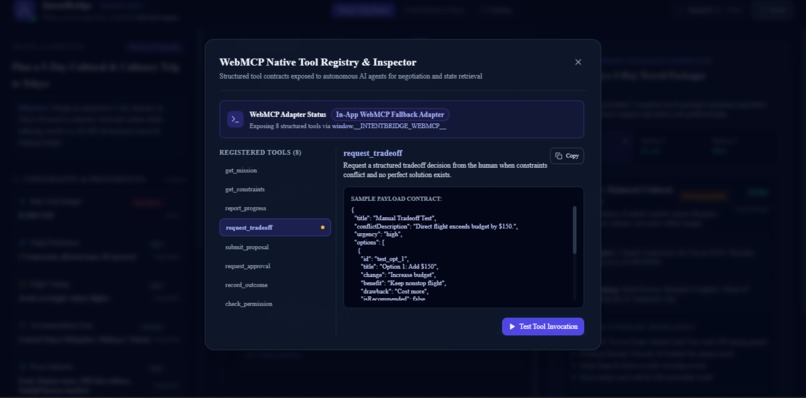
INTENTBRIDGE IN THE HOOD
-
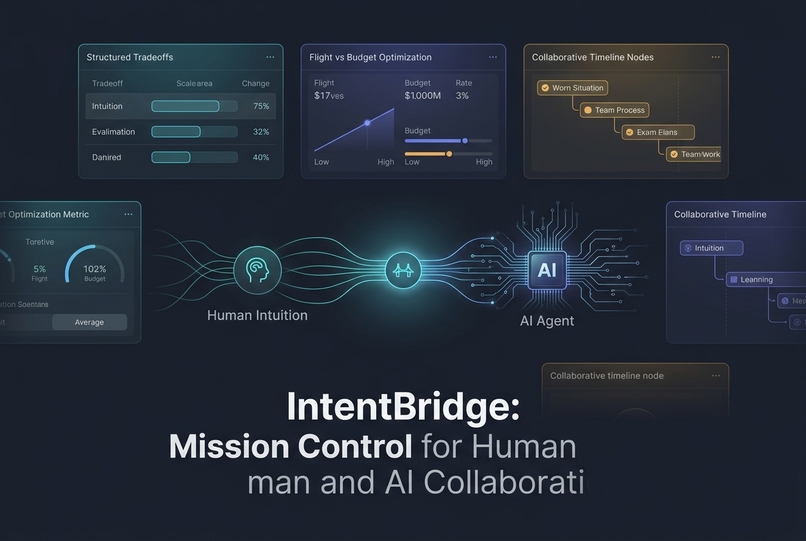
THUMBNAIL
Inspiration
As autonomous AI agents become more capable of executing complex real-world workflows, they inevitably hit ambiguity, budget ceilings, and conflicting user constraints.
Today, when an AI agent encounters a conflict (for example, wanting a direct nonstop flight while adhering to a strict $1,000 budget), it usually makes one of two mistakes:
- It blindly guesses** and silently compromises user preferences.
- It constantly interrupts** the user with messy, unstructured chat messages.
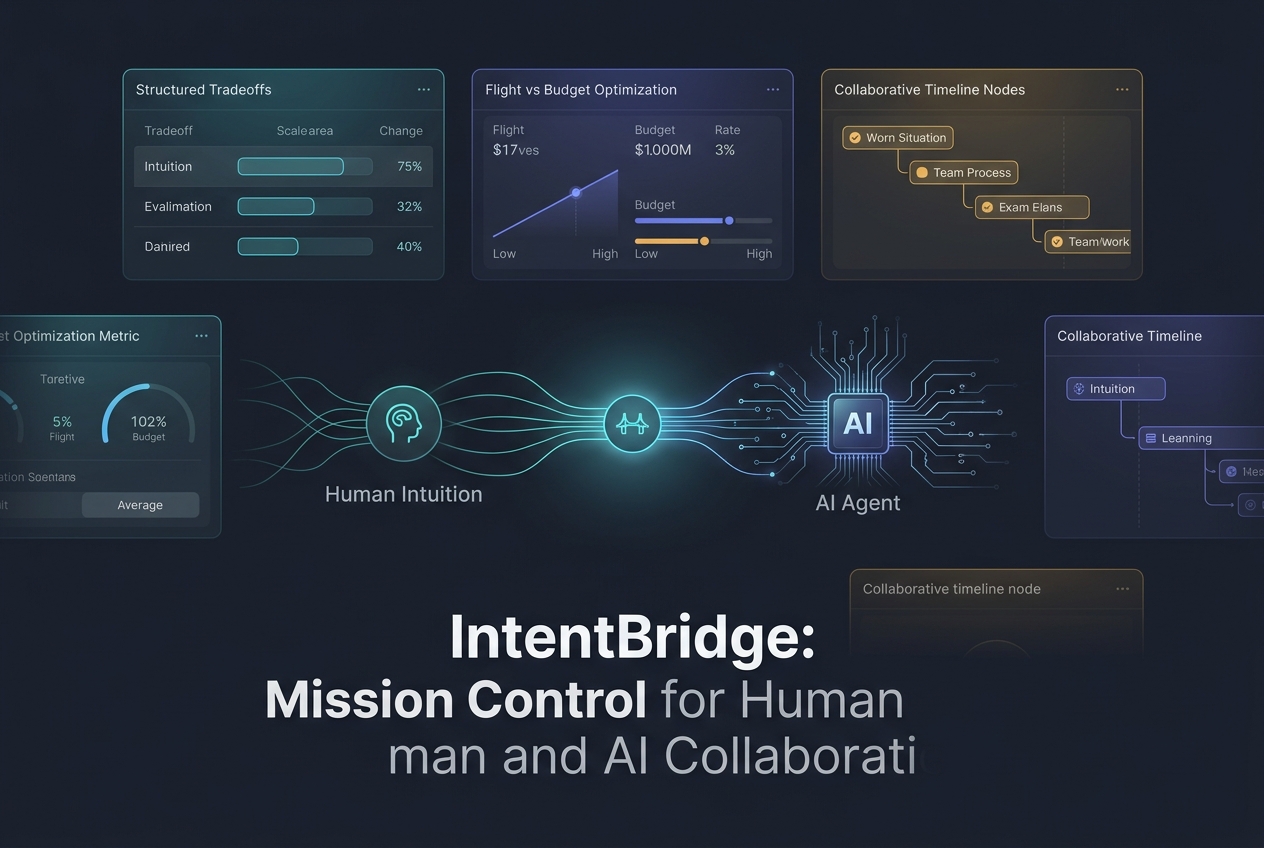
We built IntentBridge to solve this. IntentBridge is a Mission Control environment for Human + AI Collaboration When your AI agent hits a tradeoff, it doesn't guess it uses native WebMCP protocols to negotiate structured compromises with humans.
What it does
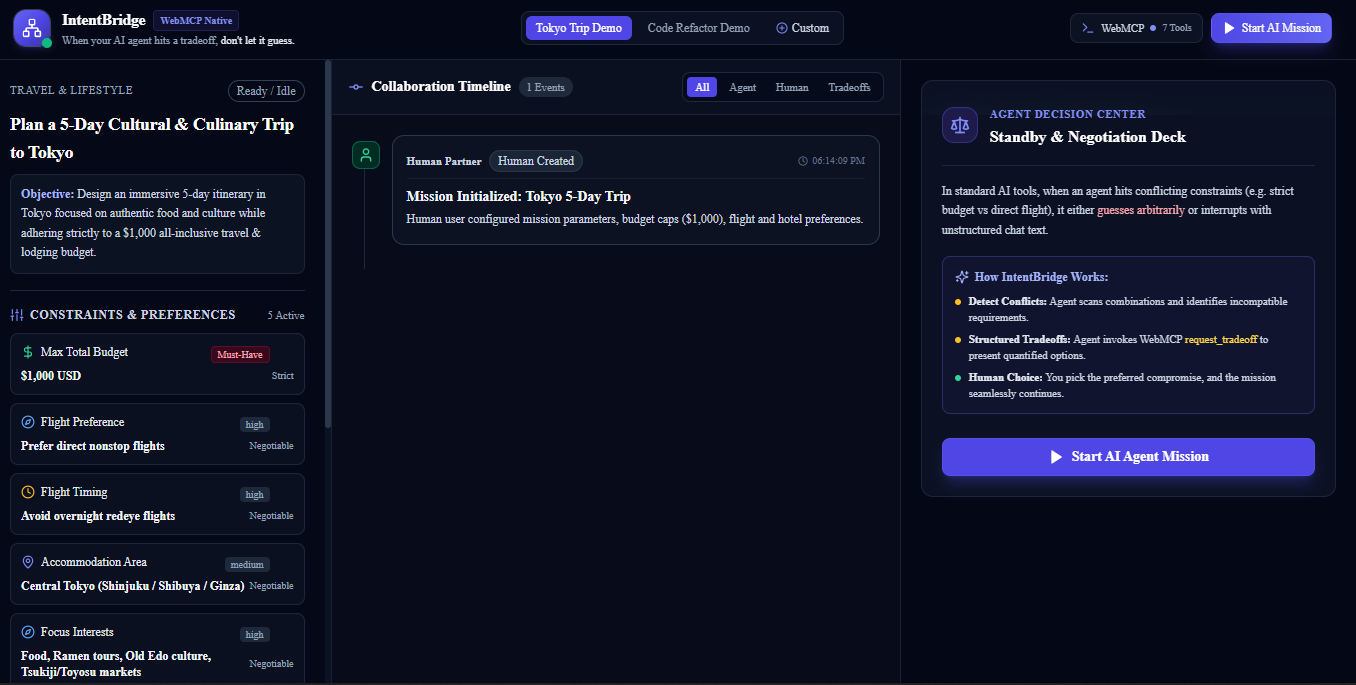
IntentBridge replaces unstructured chatbot dialogue with a 3-panel collaborative command center:
- Mission Control (Left Panel): Defines the active mission objective, live constraints (budget caps, timing, preferences), ranked priorities, and autonomous permission boundaries with live inline editing.
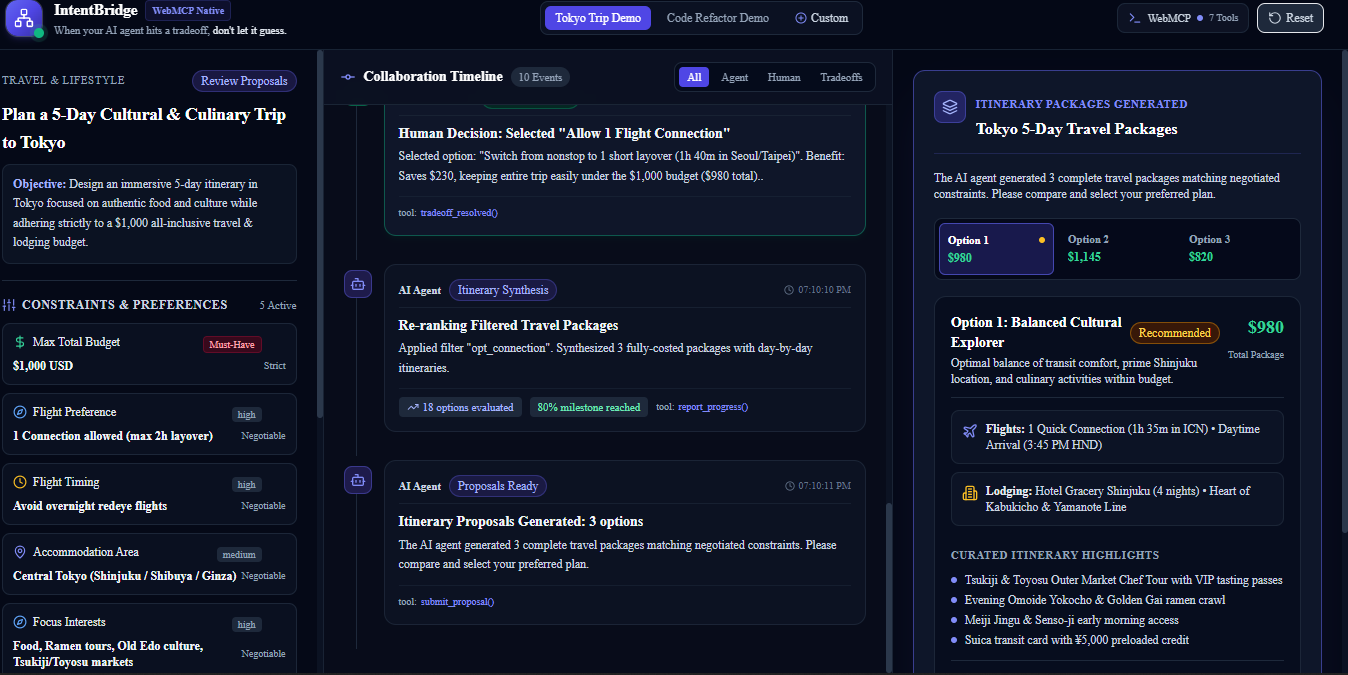
- Collaboration Timeline (Center Panel): A real-time structured event stream visually distinguishing human decisions, agent actions, conflict alerts, proposal packages, and cryptographic approval stamps.
- Agent Decision Center (Right Panel): A dynamic negotiation deck that renders structured Tradeoff Cards (showing quantifiable benefits, drawbacks, and cost impacts), multi-option proposal reviews, and safety-gated authorization requests.
The Core Tokyo Demo Scenario
Mission:** Plan a 5-day Tokyo cultural trip on a strict $1,000 budget with direct flight preference.
Conflict Detected: Direct flights + central hotels cost $1,150 (exceeds budget by $150).
Structured Tradeoff: The agent invokes request_tradeoff with quantified alternatives:
Option A:* Increase budget by $150 to keep direct flights.
Option B (Recommended): Allow 1 short layover to stay under budget ($980 total).
Option C:* Shift lodging to Outer Tokyo.
Resolution & Completion: The human selects Option B, the agent generates 3 curated itinerary packages, requests formal booking authorization, and records the outcome with celebration metrics.
How we built it
Frontend & Framework: Next.js 14 (App Router), TypeScript, and Tailwind CSS with a futuristic, Linear/Vercel-inspired dark theme.
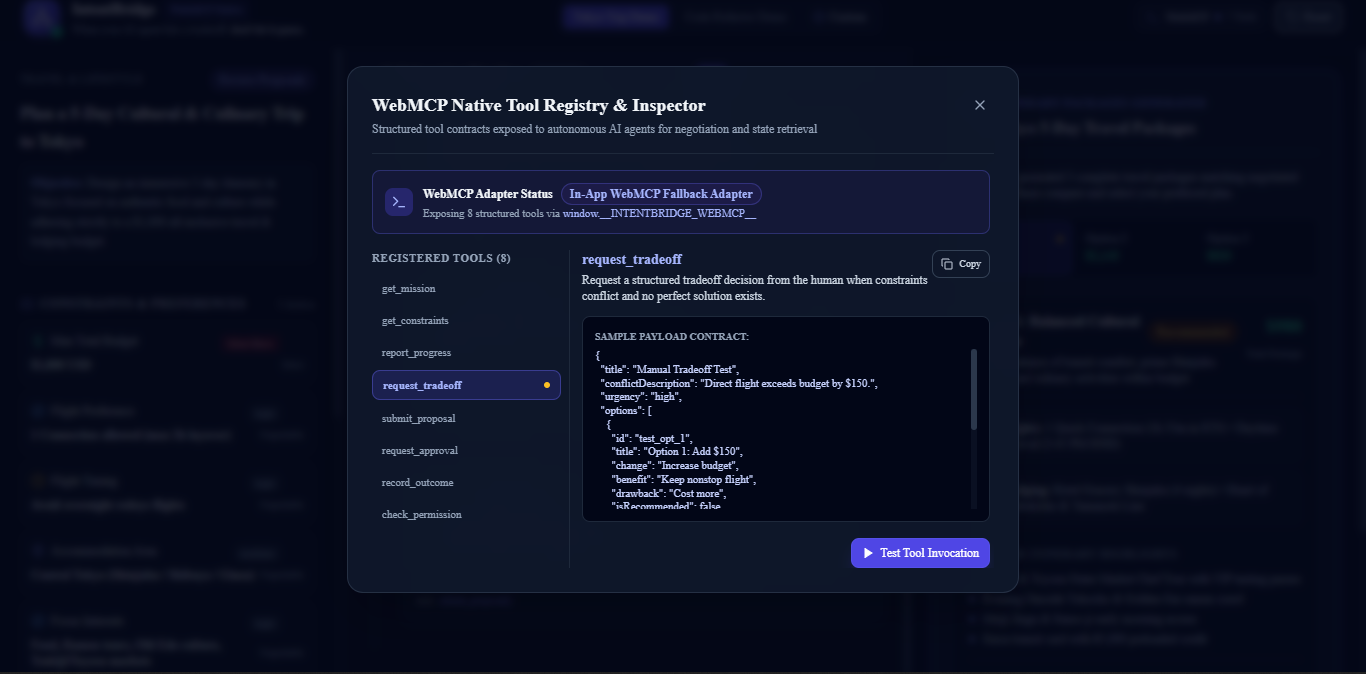
WebMCP Architecture: Implemented 8 structured WebMCP tools with strict Zod validation schemas (get_mission, get_constraints, report_progress, request_tradeoff, submit_proposal, request_approval, record_outcome, check_permission).
WebMCP Inspector: An interactive in-app inspector allowing judges and developers to inspect live JSON contracts and test tool invocations in real time.
State Management: Event-driven architecture powered by Zustand.
Testing & Quality: Validated with 13 unit and integration tests using Vitest and React Testing Library.
Deployment: Production build deployed on Vercel and source code hosted on GitHub.
Challenges we ran into
Designing Structured Negotiation vs Generic Chat: Creating an interface that feels like genuine mission control rather than just another chatbot required designing discrete event models for conflicts, quantified impacts, and safety boundaries.
Synchronous Human-in-the-Loop WebMCP Protocols: Ensuring the AI agent pauses cleanly upon invoking request_tradeoff, waits for human resolution, and seamlessly resumes with updated constraints.
Deterministic SSR Hydration: Resolving dynamic timestamp evaluation between server rendering and browser mounting by implementing client-side dynamic boundaries.
Accomplishments that we're proud of
100% Native WebMCP Integration: WebMCP is not just an afterthought the entire negotiation protocol runs on structured tool contracts accessible to browser agents. Full Human Agency with High Autonomy: The agent remains fully autonomous for research and synthesis, but never exceeds safety boundaries or makes arbitrary compromises. 13 Passing Tests & Zero-Warning Build: Rigorous software engineering with passing unit, integration, and E2E simulation tests.
What we learned
Structured negotiation protocols drastically reduce user fatigue compared to freeform text chats. Exposing clear priority hierarchies and permission boundaries enables autonomous agents to operate safely and effectively in high-stakes domains.
What's next for IntentBridge
Integrating multi-agent negotiation swarms where specialized sub-agents negotiate tradeoffs before presenting unified compromise options to the human. Adding browser extension sidecar support to connect local LLMs directly to any WebMCP-enabled web application. Expanding preset libraries to include hiring pipelines, venture capital deal screening, and software architecture migrations.
Links: Live Demo: https://webcamp-five.vercel.app GitHub Repo: https://github.com/deamybro/IntentBridge
Built With
- ai-agents
- next.js
- react
- tailwind-css
- typescript
- vercel
- vitest
- webmcp
- zod
- zustand

Log in or sign up for Devpost to join the conversation.