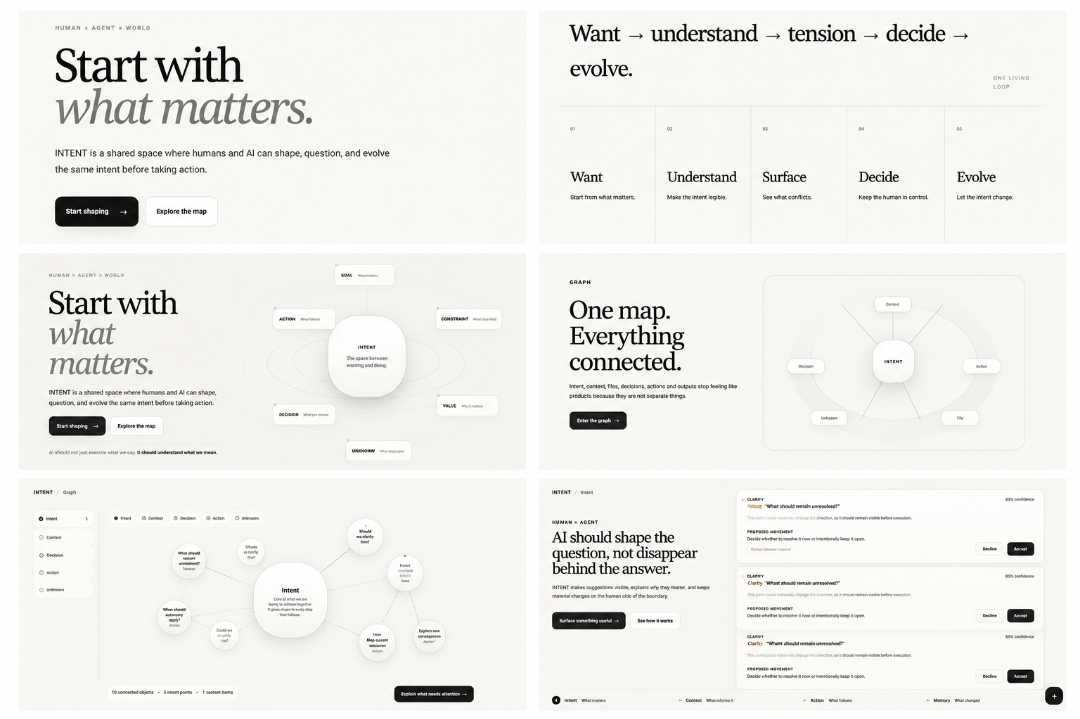
Why I Built INTENT
I kept coming back to a simple problem: when we use AI, we usually start with a prompt and immediately ask it to do something. But sometimes the hardest part is figuring out what we actually want to do in the first place.
That became the idea behind INTENT — a workspace where the human and the AI can work on the intent itself before jumping into execution.
How I Built It
I built INTENT as a Next.js web app with a structured workspace for an evolving intent. Instead of keeping everything inside a chat, the application keeps track of things like intent nodes, decisions, actions, and open questions.
The interesting part for this challenge was connecting that workspace to AI agents through WebMCP.
I exposed six tools that let an agent work with the actual application state:
- "inspect_intent"
- "add_intent_node"
- "focus_attention"
- "surface_contradiction"
- "propose_intent_evolution"
- "fork_intent"
These aren't just functions that return text. They are connected to the workspace, so when an agent uses them, the changes can be reflected in the UI.
What I Learned
The biggest thing I learned was that agent interaction feels different when the agent can actually interact with the application instead of only generating a response.
Designing the tools also made me think carefully about what an agent should be allowed to do. I wanted the human to remain in control while still giving the agent enough access to be genuinely useful.
I also learned a lot about the practical side of WebMCP — especially tool registration, connecting tools to application state, and testing the experience in the browser.
Challenges
The main challenge was getting the WebMCP integration working with the current API. My initial implementation used an older registration pattern, which caused the tools to fail during registration.
I had to update the implementation to the current "ModelContext" API and make sure the tools were registered correctly without causing repeated registrations during React development and refreshes.
Another challenge was making the tools useful enough to represent real actions in the workspace rather than just creating a collection of demo functions.
What's Next
INTENT is still an early version, but the direction I find interesting is giving agents more meaningful ways to participate in applications while keeping the human in control.
For me, WebMCP makes that interaction feel much more direct: the agent doesn't just talk about the workspace — it can actually work with it.
Built With
- agentic
- agents
- ai
- apis
- generative
- human-ai
- javascript
- next.js
- react
- typescript
- web
- webmcp

Log in or sign up for Devpost to join the conversation.