-
-
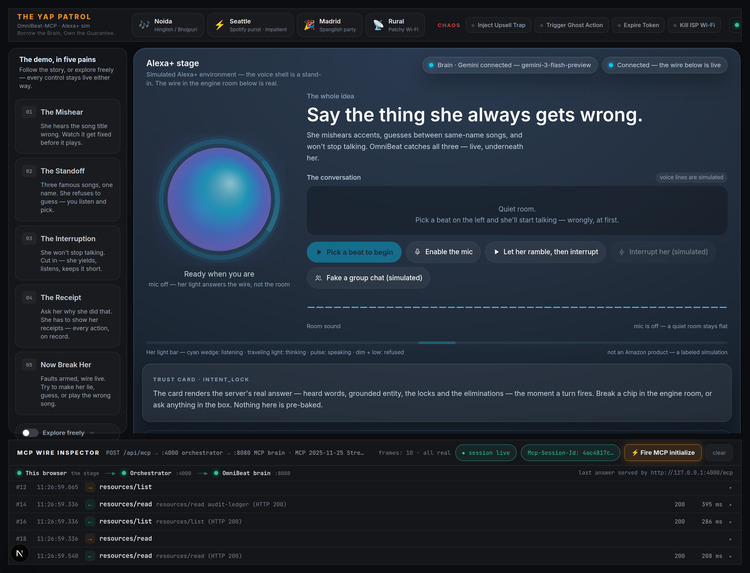
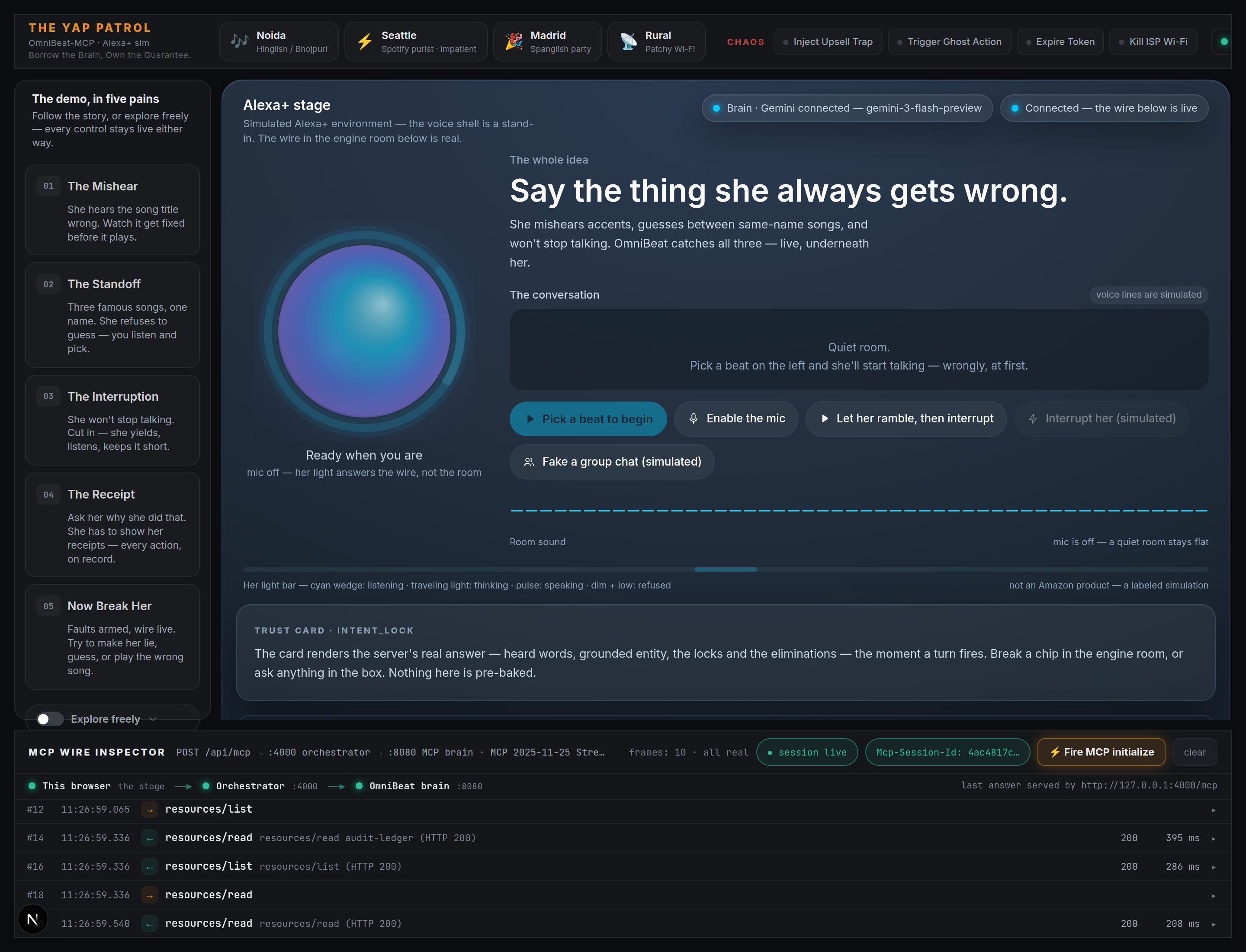
MAIN TESTING INTERFACE WITH GEMINI SIMULATIN AS AI BRAIN OF ALEXA+ AND MAKING REAL TOOL CALLS.
-
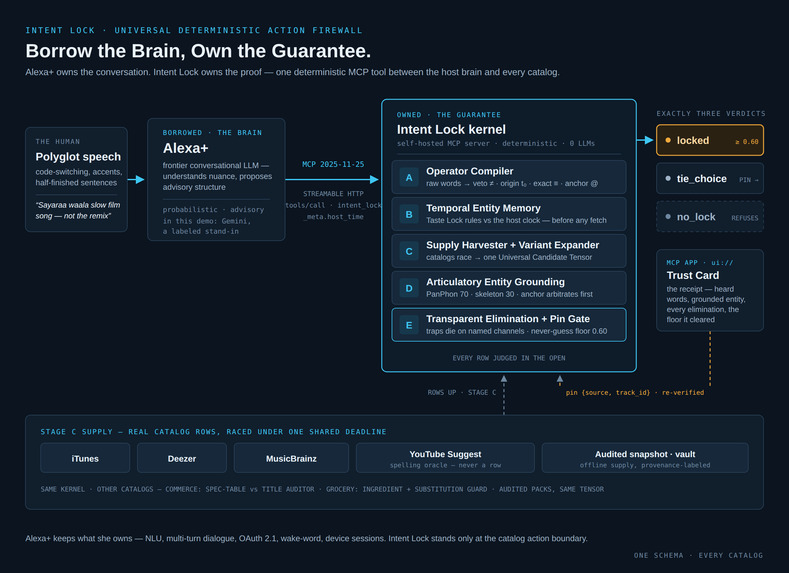
architecture
-
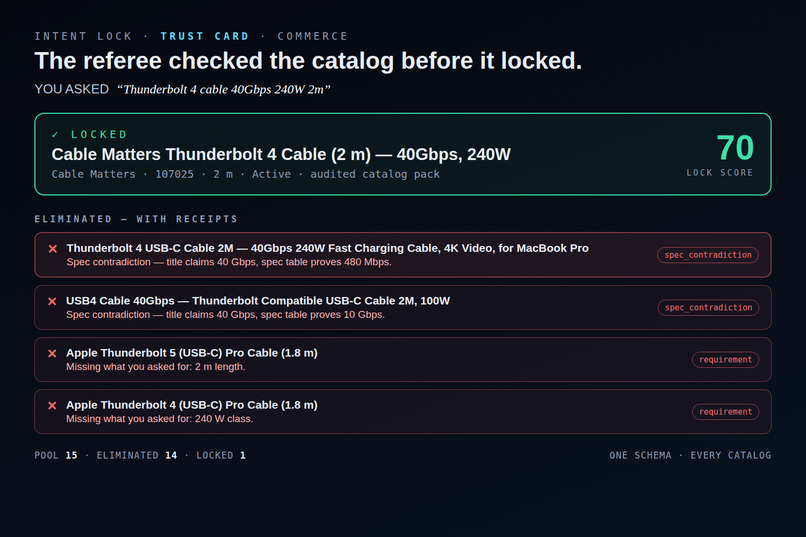
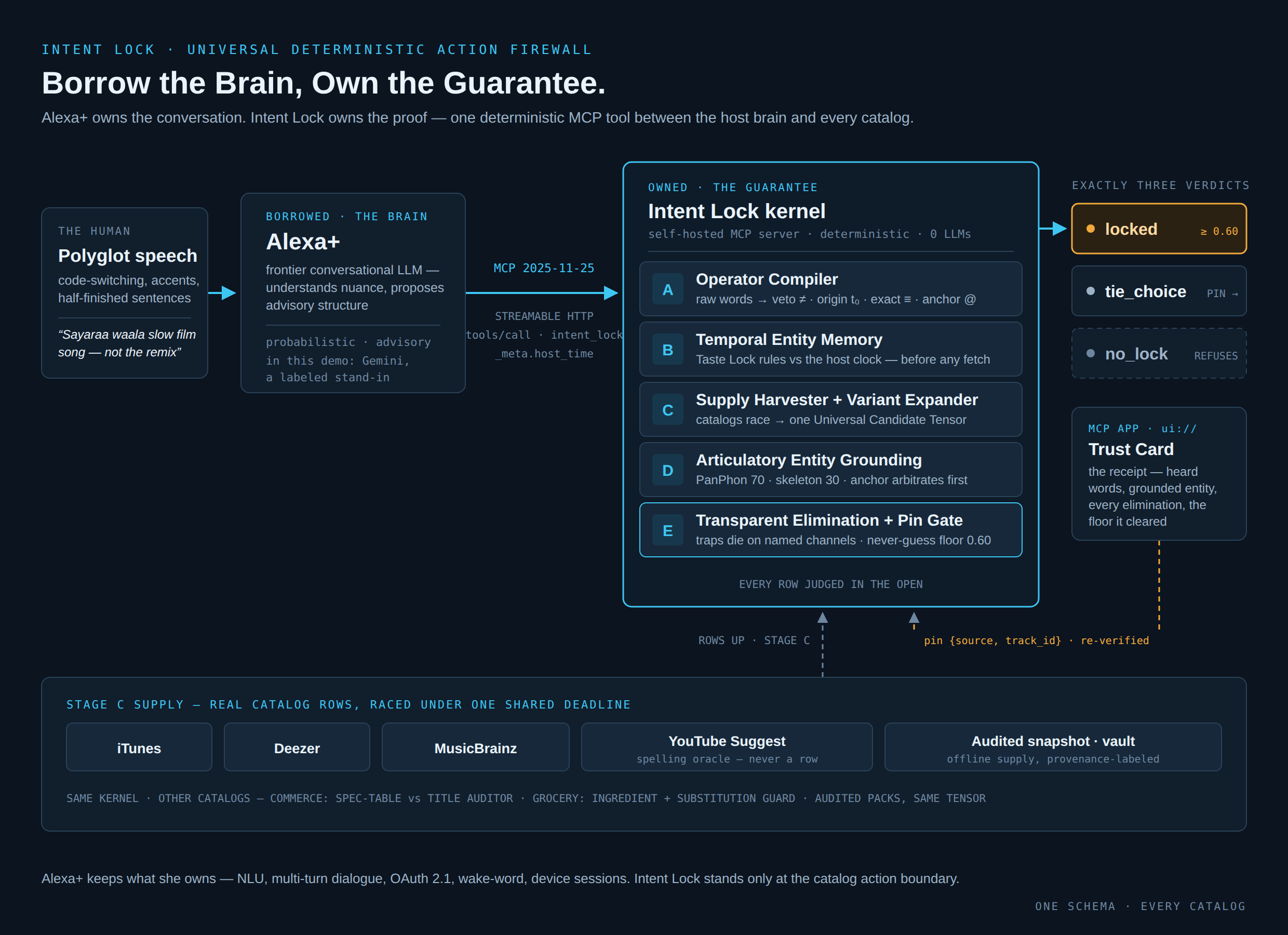
ALEXA HAS GOT WAY INTELLIGENT BUT WITH THESE MCP IT WOULD ALMOST MAKE NO MISTAKES.
-
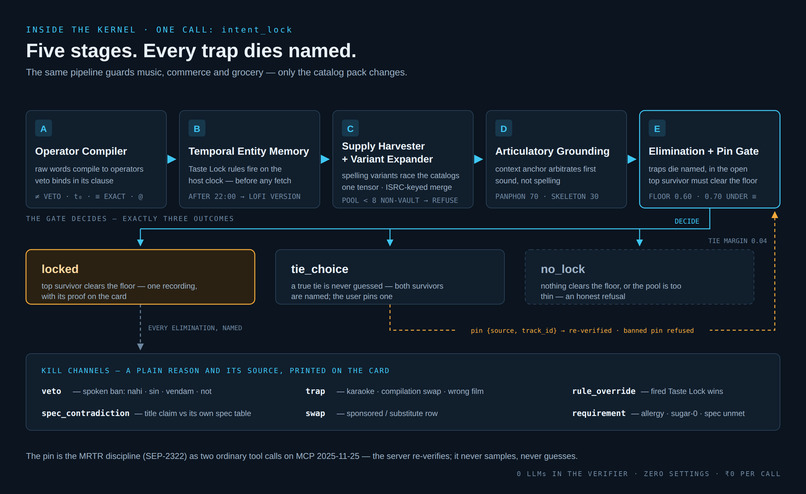
MCP-PIPELINE
Inspiration
Everybody knows this moment. You ask for the original song — and she plays a remix. You ask for the version from the film you love — and she plays some stranger with the same name. You say "not that one" — and it plays anyway.
Alexa+ is not the problem. She hears you fine, and she is brilliant at conversation. The problem is what happens in the final millimeter between understanding your voice and executing the action: she has to pick one item out of a messy real-world catalog, and catalogs are full of traps:
- Remixes and karaoke versions dressed up to look like originals.
- Live recordings and same-name strangers riding popularity algorithms.
- Cheap cables that lie about their fast-charging specs in the title.
- Grocery swaps that quietly ignore "no added sugar" or a household allergy.
A brilliant talker still needs a stubborn checker. We built the missing referee.
What it does
Intent Lock is one small, deterministic referee (built as an MCP server) that stands directly between Alexa+ and every catalog — not just songs.
1. One Referee Across Every Catalog
- Music: Tells the original apart from the remix, the karaoke track, the live recording, the sped-up edit, and the same-name stranger.
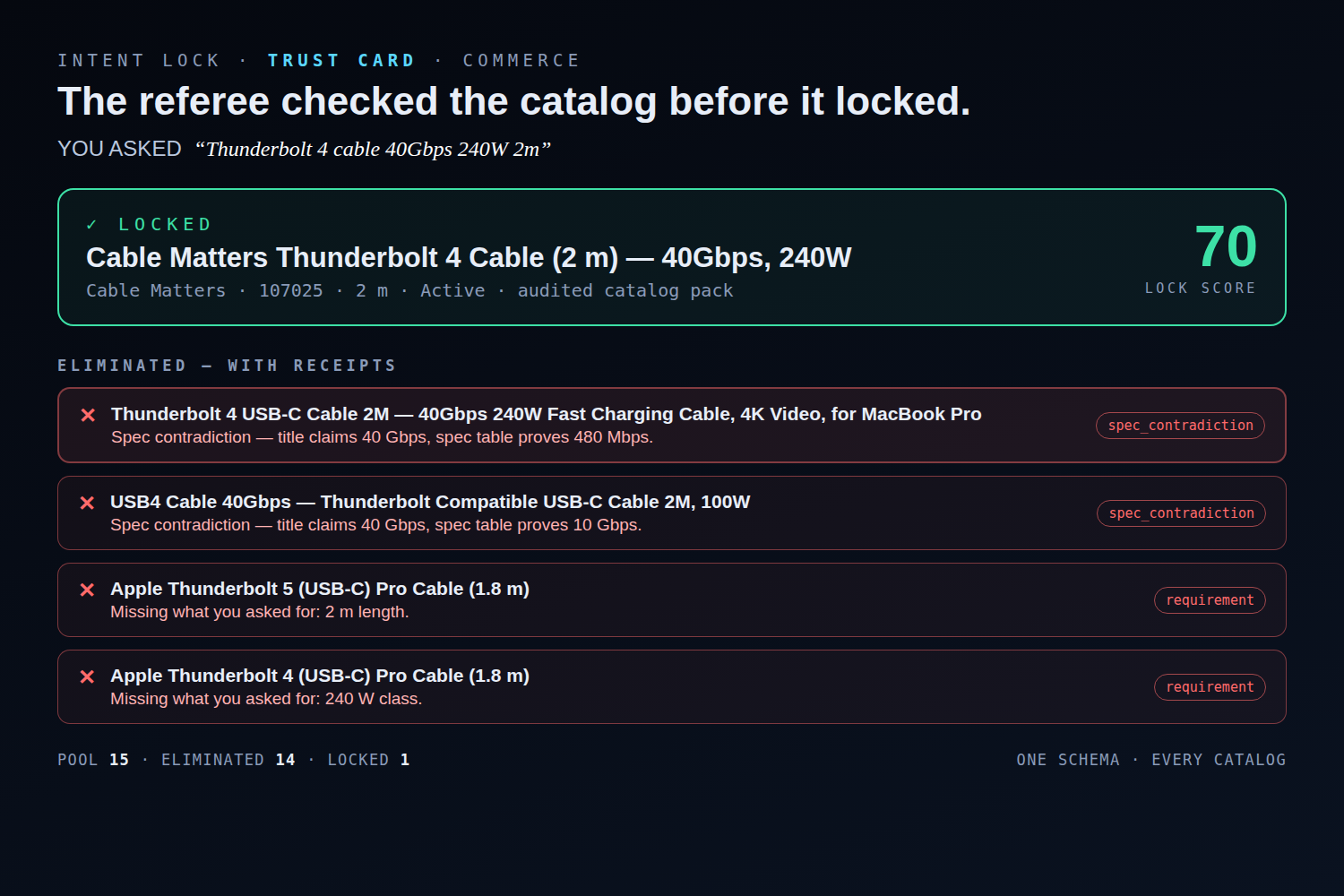
- Cables & Gadgets: Catches the cheap cable that claims to be fast-charging in the title but fails in the actual specs, and blocks sponsored look-alikes swapped in at checkout.
- Groceries: Blocks the substitute that ignores "no added sugar" or sneaks in the one ingredient someone in the house is allergic to.
2. Three Honest Answers (Zero Silent Guessing)
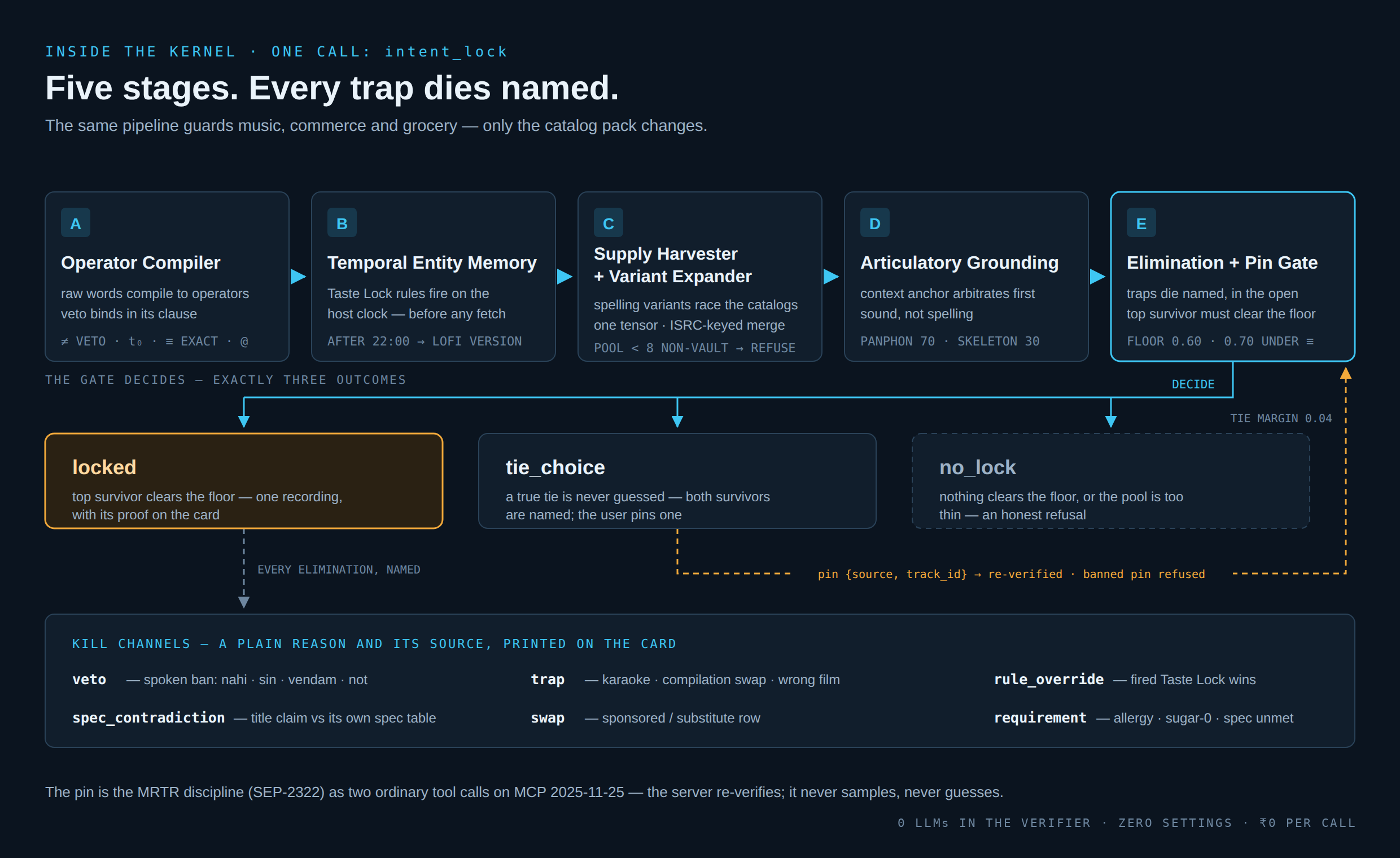
For every single request, Intent Lock gives one of three verifiable outcomes:
- Locked: "Checked against the real catalog — this is the exact one."
- An Honest Tie: Two candidates are genuinely equal against your rules, so it shows you both by name and lets you tap the one you want. It never guesses silently.
- An Honest Refusal: "I cannot prove any pick is right, so I will not pick." Better silence than playing the wrong song or shipping the wrong item.
3. Remembers Your Standing Rules & Speaks Your Language
Tell it once — "after 10 PM, only lo-fi" — and it enforces your rule automatically using your local clock before anything plays. And it understands how real people actually talk across Hindi, Hinglish, Tamil, Spanish, and plain English — treating small, high-stakes words like "nahi" (not this one) as hard orders, not background noise.
How we built it
Alexa+ does the talking — that part is hers and she is great at it. Our referee does only the checking:
- Live Catalog Lookup: It takes your natural-language ask and queries real, live catalogs (music, shopping, and grocery sources).
- Full-Candidate Lineup: Instead of lazily trusting the #1 search result, it lines up every candidate the catalogs return.
- Rule-by-Rule Elimination (With Receipts): It crosses out every candidate that violates your explicit words or standing rules, one by one, and shows its working on a visual proof card — displaying exactly who was rejected and why.
- Phonetic Sound-Matching: Using
PanPhon, it matches by sound, not just spelling, so accents, transliterations, and mixed-language asks still lock onto the right item. - Survival of the Proven: Whatever survives elimination is locked in. If two survive honestly equal (\rightarrow) you choose. If none survive (\rightarrow) it refuses.
Because Intent Lock is built as a standard Model Context Protocol (MCP) server, it plugs cleanly in front of Alexa+ and can guard any catalog without changing how the assistant talks.
Challenges we ran into
- Every catalog lies differently: A remix in music is a spec-lying cable in shopping is an allergy swap in groceries. The traps change clothes across industries; we had to architect the referee to verify the pick's attributes against user constraints, rather than hardcoding for one store.
- Small words, massive meaning: "Nahi", "not the live one", "the original" — one small word completely flips the right answer. We had to make the parser treat negation and qualifier words as strict mathematical filters, not conversational decoration.
- Whose clock is it? Standing rules like "after 10 PM, only lo-fi" only make sense in the user's local timezone. We had to ensure the referee queries the host's clock rather than trusting server time.
- Popularity beats correctness: Search APIs are built to push the most famous or trending version, not the asked-for one. We watched the famous-but-wrong pick win again and again until we stripped popularity out of the decision and forced strict rule-elimination first.
- Proof broke silently, twice: Early in testing, the visual card showing the referee's working failed quietly — nothing looked broken on screen while nothing was actually being checked underneath. We rebuilt our pipeline so that every verification failure is loud and visible.
Accomplishments that we're proud of
- We mapped 38 real-world traps first: Before writing demo code, we cataloged 38 everyday traps real people actually hit — the remix, the karaoke track, the same-name stranger, the live-version trap, "nahi", the spec-lying cable, the sponsored substitute, the allergy swap — and engineered the referee against real human frustration, not staged demos.
- We fought a 165-ask war (and fixed 36/36 failures): We attacked our own system like an enemy, throwing 165 messy, real-world asks at it across wrong spellings, mixed languages, and multi-catalog traps. Standard baseline picking chose the wrong item 36 times. Intent Lock fixed all 36.
- The "Saiyaara" Hero Moment works live: Ask for the original Saiyaara from Ek Tha Tiger and it locks the real 2012 original — cleanly crossing out the 2025 remake and same-name strangers.
- The 10:05 PM Standing Rule works live: Say "after 10 PM, only lo-fi" at 10:05 PM, ask for a track, and it automatically locks the lo-fi version without being reminded.
- It never lies to look smart: When it cannot prove a pick, it refuses and shows why. That honesty is the product.
What we learned
A smart talker still needs a stubborn checker. The final step — selecting the actual SKU or track from a messy catalog — is where voice assistants quietly fail people every single day, in every language, in every store. Checking is a small job, but it has to be done by something deterministic that never guesses.
What's next for INTENT-LOCK
More catalogs behind the exact same referee — pharmacies, ticketing, hardware parts, and local services — anywhere a wrong pick costs money, time, safety, or trust. One referee, every catalog.
Built With
- ai
- alexa
- amazon-alexa
- css3
- deezer
- docker
- docker-compose
- fastapi
- github
- google-gemini
- html5
- itunes-api
- javascript
- json
- mcp
- model-context-protocol
- muse
- musicbrainz
- next.js
- node.js
- python
- react
- rest-api
- typescript
- youtube


Log in or sign up for Devpost to join the conversation.