-
-
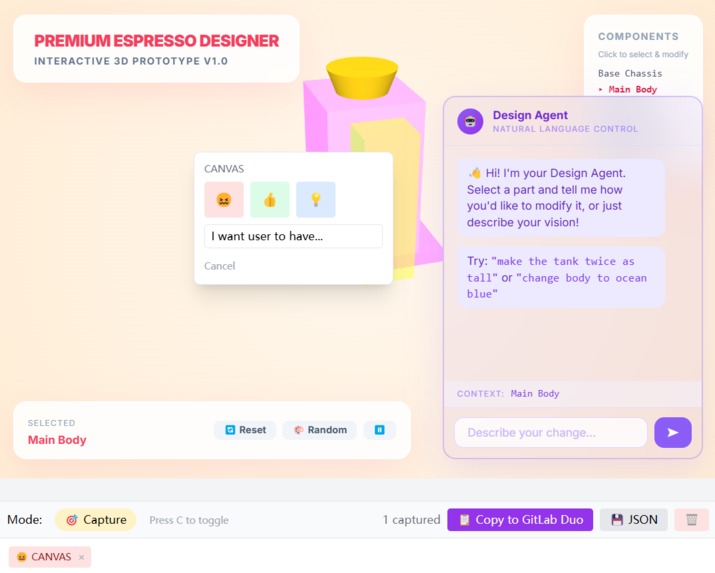
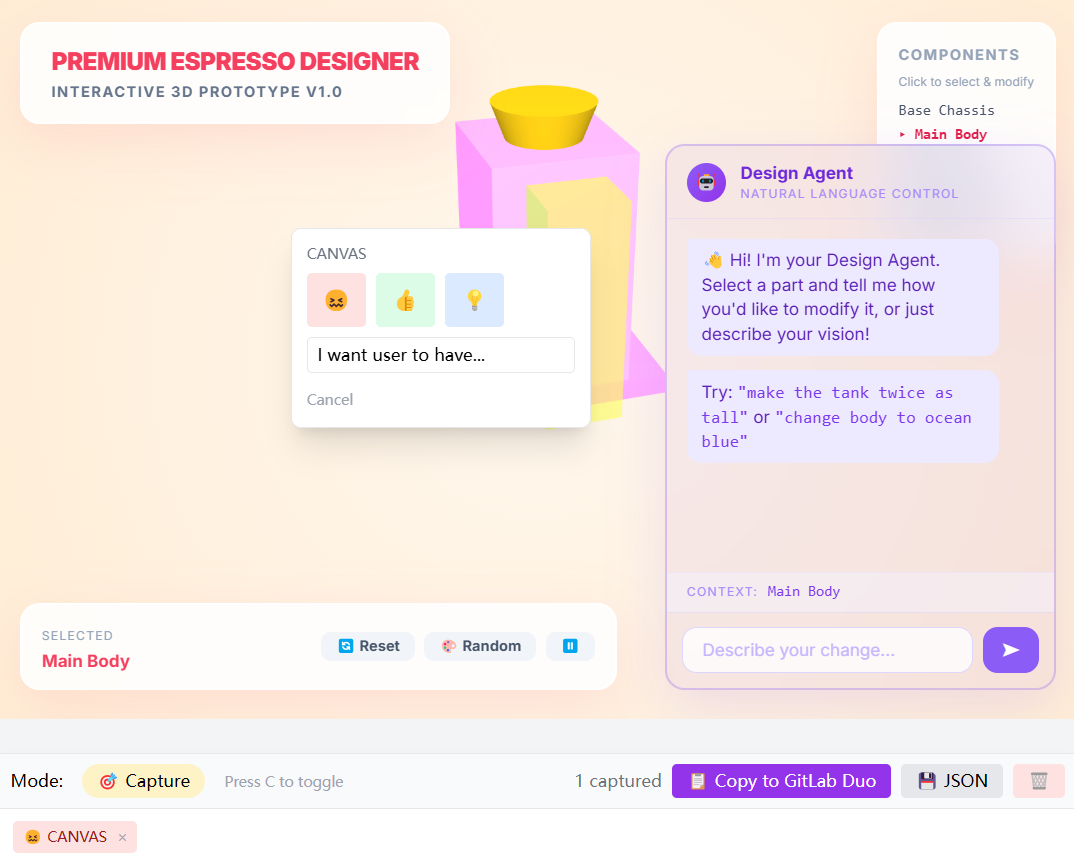
For the future software, it shall be agentified. And to prototype these software, we neet to collect intents .
Intent-Driven Surgical Pipeline — Technical Design
Version: 1.3 Status: Active
Last Updated: 2026-03-25
Table of Contents
- Executive Summary
- Problem Statement
- Core Concepts & Terminology
- System Architecture Overview
- Agent Catalog
- Flow Orchestration
- Data Contracts
- Token Economy Model
- Human-in-the-Loop: The Wake-Up Protocol
- Comparison with Traditional Approaches
- Limitations & Future Work
1. Executive Summary
The Intent-Driven Surgical Pipeline is an orchestrated multi-agent system built on GitLab Duo that transforms how software is analyzed, designed, budgeted, and implemented. Instead of treating AI as a chat-based code generator, it introduces a staged pipeline of specialized agents, each with a narrow mandate, strict data contracts, and a shared token budget.
The key innovation is shifting the unit of work from code to intent. Humans express what and why; agents negotiate how within bounded resource envelopes.
Stage 0 (Surgeon) → Stage 1 (Prototyper) → Stage 2 (Distributed Architects) → Stage 3 (Token Auditor) → Stage 4 (Distributed Programmers)
Each stage produces a well-defined artifact that the next stage consumes. No agent reads the entire codebase; each reads only its contracted inputs.
Agent-Native Software produced by this pipeline is:
- Built by agents — the entire pipeline from intent extraction to implementation is autonomous.
- Usable by agents — the output includes an Agent Interface Layer (AIL) for programmatic interaction.
- Observable by agents — structured logs and intent tracking enable agent-driven operations.
2. Problem Statement
2.1 The AI-Coding Paradox
| Problem | Description | Root Cause |
|---|---|---|
| Long-Context Loss | AI loses track of the original goal when context grows beyond a few thousand lines. | Flat, unpartitioned context windows with no priority hierarchy. |
| Hallucination Friction | AI produces plausible but incorrect implementations. | No architectural contract constraining what the AI is allowed to assume. |
| Boring HITL | Human-in-the-loop review degenerates into line-by-line proofreading. | No intent-level abstraction; humans review code instead of outcomes. |
2.2 The Deeper Cause
These are failures of software architecture, not AI capability. Current codebases were designed for human developers who hold context in their heads. When AI agents enter this environment, they must read more files than their context window can hold, guess at implicit coupling, and interrupt humans for trivial clarifications.
The solution is not a better chatbot. It is a better architecture — one designed for agents.
2.3 The Post-UI World
Software is entering a paradigm shift toward agent-orchestrated workflows with minimal UI:
- Traditional: UI for humans, manuals for documentation, REST APIs for integration.
- Agentified: Agent Interface Layer (AIL) as primary interface, minimal human UI for oversight, agents handle 95% of routine tasks.
Every surviving software system needs Agentification Surgery: Extract Intent → Rebuild Architecture → Construct Agent Interface Layer.
3. Core Concepts & Terminology
3.1 Intent
A human desire expressed at the business level, divorced from implementation.
- ✅ "Customers should be able to see real-time order status."
- ❌ "Add a WebSocket listener on
/api/orders/:id/stream."
Intents are first-class objects: captured, serialized, routed, and tracked.
3.2 Intent Partition (Zone)
A bounded scope within which a single agent is authorized to make autonomous decisions, defined by: a set of files/modules, a token budget, and a contract (input/output schema).
3.3 Surgical Pipeline
The end-to-end flow transforming a legacy codebase (or new idea) into agent-native software via five stages.
3.4 Token Budget
A pre-allocated resource envelope: Read budget (ingesting context), Write budget (generating output), Reserve (error recovery).
3.5 Wake-Up Protocol
The rule set governing when an agent must interrupt the human. Replaces "ask before every step" with batch interruptions triggered only by high-impact events.
3.6 Surgery Report
Stage 0 output mapping a legacy codebase into Rigid Nodes (tightly coupled), Fluid Nodes (loosely coupled), and an Intent Map.
3.7 Software Architecture Document (SAD)
Stage 2 output defining data schemas, intent routing tables, Module Context Index, infrastructure blueprints, observability hooks, and AIL specification.
3.8 Agent Interface Layer (AIL)
A machine-readable API for agent-to-agent interaction, distinct from the human UI.
| Human Interface | Agent Interface Layer (AIL) |
|---|---|
| Fill cart → Click "Proceed" → Fill payment → Click "Submit" | POST /intent/order {cart_id, payment_method} → {order_id, status} |
| Navigate dashboard, scan for anomalies | GET /intent/anomalies?severity=high → [{anomaly_id, context}] |
| Read manual to understand capabilities | GET /ail/capabilities → machine-readable OpenAPI spec |
AIL Design Principles:
- Declarative over Imperative: Agents declare what they want, not how.
- Strict Schemas: Every endpoint has versioned, validated JSON schemas.
- Intent IDs as First-Class Citizens: Every call returns an
intent_idfor tracking. - Observable Execution: Structured logs queryable by humans and agents.
- Versioned Contracts: Semantic versioning; old agents can call old versions.
Software without AIL will be un-composable, forcing agents to resort to screen scraping (fragile and expensive).
3.9 Module Context Index
A pre-built dependency tree in the SAD enabling efficient context navigation.
Example:
handler.py (8KB, 250 lines)
├── models/order.py (4KB, 120 lines)
├── clients/payment_gateway.py (6KB, 180 lines)
│   └── utils/retry.py (2KB, 60 lines)
└── validation/order_rules.py (5KB, 150 lines)
Total Token Estimate: 23,500
This enables Programmer Instances to read only relevant files, Code Integrator to validate cross-task compatibility, and Token Auditor to calculate precise estimates. Built by the Integration Architect (Stage 2C).
4. System Architecture Overview
4.1 High-Level Pipeline
flowchart LR
    subgraph "Human Input"
        H[("👤 Human<br/>Intent + Legacy Code")]
    end

    subgraph "Stage 0"
        S0["🔬 Surgeon Agent<br/>Legacy Intent Extraction"]
    end

    subgraph "Stage 1"
        S1["🎨 UX Prototyper Agent<br/>Intent-Driven Interface"]
    end

    subgraph "Stage 2: Distributed Architecture"
        S2A["📋 Meta-Architect<br/>Module Boundaries"]
        S2B["📐 Contract Architects<br/>(N parallel agents)"]
        S2C["🔗 Integration Architect<br/>SAD Assembly"]

        S2A --> S2B
        S2B --> S2C
    end

    subgraph "Stage 3"
        S3["💰 Token Auditor Agent<br/>Resource Budgeting"]
    end

    subgraph "Stage 4: Distributed Implementation"
        S4A["📋 Task Dispatcher<br/>Dynamic Partitioning"]
        S4B["⚡ Programmer Instances<br/>(N parallel agents)"]
        S4C["🔗 Code Integrator<br/>Merge & Validate"]

        S4A --> S4B
        S4B --> S4C
    end

    H -->|legacy repo + new ideas| S0
    S0 -->|surgery_report.md| S1
    S1 -->|prototype code + intent_fragments.json| S2A
    S2C -->|SAD.md + GitLab Issues| S3
    S3 -->|token_plan.md| S4A
    S4C -->|merged code + MRs| H
4.2 Key Design Principles
- Contract Isolation: Each agent reads only its contracted inputs, never the full codebase.
- Unidirectional Data Flow: Artifacts flow forward; backward dependencies are prohibited.
- Token-Aware Execution: Every stage has a pre-approved token budget.
- Asynchronous Human Review: Agents log assumptions and batch-notify at checkpoints.
- Dynamic Parallelism: Stages 2B and 4B are designed for N parallel agents. Current reality: sequential due to GitLab Duo Flow limitations.
- Hierarchical Decomposition: Complex stages use Decomposer → Parallel Workers → Integrator.
4.3 Entry Points
| Mode | Starting Stage | Description |
|---|---|---|
| Legacy Modernization | Stage 0 (Surgeon) | Existing codebase analyzed first. |
| Greenfield Project | Stage 1 (Prototyper) | No legacy code; starts from ideas. |
4.4 Long-Context Problem Resolution
| Sub-Stage | Agent | How Long-Context is Avoided |
|---|---|---|
| 2A | Meta-Architect | Reads compressed intent summaries, NOT full prototype code |
| 2B | Contract Architects (N) | Each reads <20% of prototype, bounded by module partition |
| 2C | Integration Architect | Reads N partial SADs, NOT prototype code |
No single agent reads >20% of any artifact.
5. Agent Catalog
5.1 Stage 0 — Surgeon Agent
| Attribute | Value |
|---|---|
| Name | legacy-software-surgeon |
| Input | Repository path or directory |
| Output | surgery_report.md (Intent Map, Interaction Schema, Rigid/Fluid classification) |
| Token Profile | Read-heavy, light write |
Scans entry points, routers, controllers; maps UI actions to business logic; classifies modules as Rigid or Fluid. Does NOT modify code or make architectural recommendations.
5.2 Stage 1 — UX Prototyper Agent
| Attribute | Value |
|---|---|
| Name | ux-prototyper |
| Input | surgery_report.md (optional) + human feature descriptions |
| Output | Prototype code + prototype_summary.md + intent_fragments.json + MR |
| Token Profile | Balanced read/write |
Generates a dual-layer prototype:
- Layer 01 — Experience Sandbox: Interactive UI for humans.
- Layer 02 — Agent Interface Kernel: Hidden intent-capture mechanism + AIL prototype endpoints.
Enforces modularity (no file >150 lines), creates feature branch + MR. Does NOT define backend architecture or infrastructure.
5.3 Stage 2 — Distributed Architecture System
5.3.1 Meta-Architect (Stage 2A)
| Attribute | Value |
|---|---|
| Name | meta-architect |
| Input | prototype_summary.md + file tree (paths and sizes only) |
| Output | module_partition_plan.json — N modules with assigned intents and file scopes |
Performs high-level decomposition, domain tagging (frontend/backend/infrastructure/etl/database), file scope assignment, token budget estimation. Does NOT read full prototype code.
5.3.2 Contract Architect (Stage 2B)
| Attribute | Value |
|---|---|
| Name | contract-architect |
| Cardinality | N modules (1 per module). Design: parallel. Current: sequential. |
| Input | 1 module entry from partition plan + assigned prototype files |
| Output | SAD_{module_id}.md — detailed architecture for this module |
Each instance reads ONLY its assigned files. Designs data schemas, intent routing, AIL endpoints, Module Context Index, infrastructure, observability. Defines cross-module contracts (exports/imports). Creates GitLab Issues.
Key Innovation: Single agent definition spawning N runtime instances with different module_partition injections.
5.3.3 Integration Architect (Stage 2C)
| Attribute | Value |
|---|---|
| Name | integration-architect |
| Input | N partial SADs + module_partition_plan.json |
| Output | Final SAD.md + cross-module validation report + GitLab Issues |
Merges partial SADs, generates master Module Context Index, validates cross-module interfaces (no circular dependencies, all intents assigned), resolves minor conflicts automatically (major conflicts invoke Wake-Up Protocol).
5.4 Stage 3 — Token Resource Auditor
| Attribute | Value |
|---|---|
| Name | token-resource-auditor |
| Input | SAD.md + project scope |
| Output | token_plan.md + resource advisory notes |
Uses Module Context Index for precise complexity audit. Allocates budgets (development/maintenance/reserve), identifies Token Death Spiral risks, recommends optimizations. Surgical Threshold Enforcement: if any module requires >20% of total repo, audit FAILS and routes back to Stage 2A.
5.5 Stage 4 — Distributed Programmer System
5.5.1 Task Dispatcher (Stage 4A)
| Attribute | Value |
|---|---|
| Name | task-dispatcher |
| Input | SAD.md + token_plan.md |
| Output | task_manifest.json + GitLab Issues (one per task) |
Recognizes domains, estimates tokens via Module Context Index, decomposes tasks (split if >20% threshold). Assigns each task a context_partition:
"file_scope": {
  "entry_point": "src/services/order/handler.py",
  "dependencies": [
    "models/order.py",
    "clients/payment_gateway.py",
    "utils/retry.py",
    "validation/order_rules.py"
  ]
}
5.5.2 Programmer Agent (Stage 4B)
| Attribute | Value |
|---|---|
| Name | async-programmer |
| Cardinality | N tasks (1 per task). Design: parallel. Current: sequential. |
| Input | 1 entry from task_manifest.json + assigned GitLab Issue |
| Output | Code in feature/{task_id} branch + pending_confirmation_log.md + MR |
Reads ONLY assigned SAD sections + Module Context Index entry + dependency tree files. Executes asynchronously (assume, log, continue). Enforces modularity (no file >150 lines). Batch HITL sync every 3-5 assumptions.
Key Innovation: Single agent definition spawning N instances with different context_partition injections.
5.5.3 Code Integrator (Stage 4C)
| Attribute | Value |
|---|---|
| Name | code-integrator |
| Input | N feature branches + task_manifest.json + confirmation logs + Module Context Index |
| Output | Merged integration branch + integration_report.md + MR to main |
Merges N branches, validates cross-task contracts via Module Context Index, runs integration tests, consolidates assumptions. Minor conflicts auto-resolved; major conflicts invoke Wake-Up Protocol.
6. Flow Orchestration
6.1 Pipeline Flow Definition
flowchart TD
    START(["🚀 Entry Point"])

    START --> MODE_CHECK{"Legacy code<br/>exists?"}

    MODE_CHECK -->|Yes| S0["Stage 0: Surgeon"]
    MODE_CHECK -->|No| S1["Stage 1: Prototyper"]

    S0 --> REVIEW_0{"Human reviews<br/>Surgery Report"}
    REVIEW_0 -->|Approved| S1
    REVIEW_0 -->|Rejected| S0

    S1 --> REVIEW_1{"Human reviews<br/>Prototype MR"}
    REVIEW_1 -->|Approved| S2A["Stage 2A: Meta-Architect"]
    REVIEW_1 -->|Rejected| S1

    S2A --> S2B["Stage 2B: Contract Architects<br/>(N parallel agents)"]

    S2B --> S2C["Stage 2C: Integration Architect"]

    S2C --> S3["Stage 3: Token Auditor"]

    S3 --> AUDIT_CHECK{"Budget<br/>feasible?"}
    AUDIT_CHECK -->|Pass| S4A["Stage 4A: Task Dispatcher"]
    AUDIT_CHECK -->|Fail: re-partition| S2A

    S4A --> S4B["Stage 4B: Programmer Instances<br/>(N parallel agents)"]

    S4B --> S4C["Stage 4C: Code Integrator"]

    S4C --> REVIEW_4{"Human reviews<br/>Integration MR + Assumption Log"}
    REVIEW_4 -->|Approved| DONE(["✅ Merge & Deploy"])
    REVIEW_4 -->|Needs changes| S4B
6.2 Human Review Gates
| Gate | Location | Purpose | Blocking? |
|---|---|---|---|
| Surgery Review | After Stage 0 | Validate intent map captures legacy system's purpose | Yes |
| Prototype Review | After Stage 1 | Validate UX direction and captured intents via MR | Yes |
| Budget Feasibility | After Stage 3 | Auto-gate: if audit fails, routes back to Stage 2A | Automatic |
| Implementation Review | After Stage 4C | Review integration MR + assumption log | Yes |
6.3 Skip Logic
- Greenfield projects: Skip Stage 0.
- Architecture-only changes: Skip Stages 0 and 1, enter at Stage 2A.
- Bug fixes: Skip Stages 0-2, enter at Stage 4 with pre-existing SAD reference.
6.4 Stage 2 Dynamic Execution
- Meta-Architect reads
intent_fragments.json+ file tree → generatesmodule_partition_plan.jsonwith N modules. - Flow orchestrator invokes
contract-architectfor each module (sequential currently). - Integration Architect merges N partial SADs into final
SAD.mdwith Module Context Index.
6.5 Stage 4 Dynamic Execution
- Task Dispatcher reads
SAD.md+token_plan.md→ generatestask_manifest.jsonwith N tasks + N GitLab Issues. - Flow orchestrator invokes
async-programmerfor each task (sequential currently). - Code Integrator merges all N feature branches.
7. Data Contracts
7.1 Artifact Flow
surgery_report.md ──→ intent_fragments.json ──→ module_partition_plan.json ──→ N × SAD_MOD-XXX.md ──→ SAD.md ──→ token_plan.md ──→ task_manifest.json ──→ code + MRs
    (Stage 0)            (Stage 1)                  (Stage 2A)                    (Stage 2B)          (Stage 2C)    (Stage 3)          (Stage 4A)           (Stage 4B/4C)
7.2 Contract Summary
| Contract | Producer | Consumer | Key Contents |
|---|---|---|---|
| Surgery Report | Surgeon (S0) | Prototyper (S1) | Intent map, interaction schema, rigid/fluid classification |
| Prototype Summary | Prototyper (S1) | Meta-Architect (S2A) | Project name, prototype branch, AIL endpoints, intent fragments |
| Intent Fragments | Prototyper (S1) | Meta-Architect (S2A), Contract Architects (S2B) | Fragment IDs, source intents, user actions, feedback, priorities |
| Module Partition Plan | Meta-Architect (S2A) | Contract Architects (S2B) | N module definitions with IDs, domain tags, intents, file scopes |
| Partial SAD | Contract Architect (S2B) | Integration Architect (S2C) | Per-module architecture, schemas, AIL endpoints, context index |
| SAD (Final) | Integration Architect (S2C) | Token Auditor (S3), Dispatcher (S4A), Programmers (S4B) | Complete system architecture with all modules merged |
| Token Plan | Token Auditor (S3) | Task Dispatcher (S4A) | Budget per module, risk analysis, threshold checks |
| Task Manifest | Task Dispatcher (S4A) | Programmers (S4B), Code Integrator (S4C) | N task definitions with context partitions and dependencies |
8. Token Economy Model
8.1 Why Token Management Matters
In an agent-native world, tokens are labor. Without budgeting, agents read entire repositories for one function, error recovery loops consume unbounded context ("Token Death Spiral"), and costs are invisible.
8.2 The 20% Surgical Threshold
Rule: If a single task requires reading >20% of the repository, the architecture must be re-partitioned.
Modern LLM accuracy degrades sharply beyond ~30% context utilization. The 20% threshold keeps agents in the "high accuracy" zone. The Module Context Index provides exact file sizes for precise threshold checks.
8.3 Budget Categories
| Category | Description | Typical Ratio |
|---|---|---|
| Read Budget | Tokens for ingesting code, specs, context | 40% |
| Write Budget | Tokens for generating code, docs, artifacts | 40% |
| Reserve | Buffer for error recovery, clarification loops | 20% |
8.4 Token Death Spiral
Occurs when a bug in a tightly coupled module requires increasing context to understand, the fix introduces side effects requiring even more context, and each iteration consumes more tokens until budget exhaustion.
Prevention: Design modules with clear boundaries. The Module Context Index makes boundaries explicit.
9. Human-in-the-Loop: The Wake-Up Protocol
9.1 Philosophy
Agents execute autonomously by default and only interrupt humans for high-impact events.
9.2 Wake-Up Triggers
| Trigger | Description | Severity |
|---|---|---|
| Intent Shift | Implementation contradicts a captured intent | 🔴 Critical |
| Business Logic Pivot | Requires changing fundamental business model | 🔴 Critical |
| Context Partition Violation | Agent accessed files outside its scope | 🔴 Critical |
| Module Contract Breach | Implementation violates declared interface | 🔴 Critical |
| Token Overrun | Predicted to exceed budget by >10% | 🟡 Warning |
| External Dependency Failure | Required API/service unavailable | 🟡 Warning |
| Assumption Batch | 3-5 unconfirmed assumptions accumulated | 🟢 Advisory |
9.3 Notification Mechanism
- Critical: Post Issue Note, block execution until human responds.
- Warning: Post Issue Note, continue but flag output as provisional.
- Advisory: Log in
pending_confirmation_log.md, batch-notify via MR note.
9.4 What Agents Do NOT Interrupt For
Choosing between equivalent approaches, formatting decisions, test case design within SAD scope, routine error handling within budget.
10. Comparison with Traditional Approaches
| Dimension | Traditional AI Coding | Surgical Pipeline |
|---|---|---|
| Unit of Work | Code (lines, files) | Intent (business goals) |
| Context Strategy | Dump entire codebase | Partitioned: each agent <20% via Module Context Index |
| Human Role | Line-by-line reviewer | Intent validator; reviews outcomes |
| Error Handling | Stop and ask for every ambiguity | Assume, log, batch-notify; block only for critical shifts |
| Resource Management | Unlimited/untracked tokens | Pre-budgeted with audit gates |
| Architecture Awareness | None; treats code as flat text | Deep: contracts, routing, Module Context Index, AIL |
| Legacy Code Strategy | "Explain this code" → manual rewrite | Automated surgery → re-architecture → implement |
| Scalability | Degrades with codebase size | Stable: hierarchical decomposition keeps tasks bounded |
| Agent Interoperability | None; output is human-centric | AIL enables agent-to-agent workflows |
| Parallelism | Single-threaded | N-way parallel at Stages 2 and 4 |
| Long-Context Problem | Unsolved | ✅ Solved: no agent reads >20% |
11. Limitations & Future Work
11.1 Current Limitations
- Module Boundary Detection: Meta-Architect's decomposition may fail for complex cross-cutting concerns.
- Token Estimation Accuracy: Relies on "1 line ≈ 4 tokens" approximation.
- No Learning Loop: No feedback from Stage 4 outcomes back into earlier stages.
- Human Gate Bottlenecks: Review gates can slow high-velocity environments.
- Integration Conflict Resolution: Major conflicts require human review; no AI-powered semantic resolution yet.
- Cross-Cutting Concerns: Auth, logging, error handling not explicitly modeled in Module Context Index.
- Sequential Execution: GitLab Duo Flow lacks dynamic parallel spawning; Stages 2B/4B run sequentially.
- IDE-Only Tools: Some tools only work in IDE context, not Web UI.
- No Native Token Counter: Agents estimate using line-count heuristics.
11.2 Future Work
- Feedback Loop: Compare predicted vs. actual token consumption; improve partitioning and estimation.
- Adaptive Threshold: Dynamic 15-25% threshold based on project complexity and historical accuracy.
- Cross-Pipeline Orchestration: Multiple pipelines on same repo with shared Module Context Index.
- Intent Versioning & Drift Detection: Track intent evolution, alert on implementation drift.
- Hierarchical Task Decomposition: Recursive decomposition maintaining <20% at each level.
- AIL Code Generation: Auto-generate AIL boilerplate from SAD specification.
- Agent Composition Registry: Global registry of AIL-enabled systems for cross-system workflows.
- Cross-Cutting Concerns Module: Special module type for aspects (auth, logging, error handling).
- AI-Powered Conflict Resolution: Semantic merge conflict resolution with confidence thresholds.
- Module Context Index Evolution: Add runtime performance data and compute budget thresholds.
Appendix A: Glossary
| Term | Definition |
|---|---|
| Intent | Business-level goal independent of implementation |
| Intent Partition | Bounded scope (files + token budget) for an agent |
| Surgical Pipeline | 5-stage orchestration: Surgeon → Prototyper → Architects → Auditor → Programmers |
| Token Budget | Pre-allocated resource envelope (read + write + reserve) |
| Wake-Up Protocol | Rules for when agents must interrupt humans |
| Surgery Report | Stage 0 output: intent map + node classification |
| SAD | Stage 2C output: complete architecture document |
| Token Plan | Stage 3 output: budget allocation and risk analysis |
| Task Manifest | Stage 4A output: task decomposition with context partitions |
| AIL | Machine-readable API for agent-to-agent interaction |
| Module Context Index | Dependency tree per module for efficient navigation |
| Token Death Spiral | Runaway context growth during error recovery |
| Rigid Node | Tightly coupled legacy module |
| Fluid Node | Loosely coupled, agent-ready module |
| Post-UI World | Future paradigm where agents handle 95% of operations |
Appendix B: File & Artifact Map
Agent-Definition Project (this repo):
agent-definition-project/
├── TECHNICAL_DESIGN.md
├── Technical_design_middle_size.md          ← This document
├── README.md
├── agents/                                  ← 9 agent YAML definitions
│   ├── surgeon.agent.yml
│   ├── prototyper.agent.yml
│   ├── meta_architect.agent.yml
│   ├── contract_architect.agent.yml
│   ├── integration_architect.agent.yml
│   ├── token_auditor.agent.yml
│   ├── task_dispatcher.agent.yml
│   ├── async_programmer.agent.yml
│   └── code_integrator.agent.yml
├── contracts/                               ← Contract schemas
│   ├── surgery_report.schema.md
│   ├── prototype_summary.schema.md
│   ├── intent_fragments.schema.json
│   ├── module_partition_plan.schema.json
│   ├── partial_sad.schema.md
│   ├── sad.schema.md
│   ├── token_plan.schema.md
│   └── task_manifest.schema.json
├── flows/                                   ← Flow orchestration
│   ├── surgical_pipeline.flow.yml
│   └── greenfield.flow.yml
└── example/
User's Target Project (runtime artifacts):
user-project/
├── analysis/surgery_report.md               ← Stage 0
├── prototype/                               ← Stage 1
│   ├── src/sandbox/                         ← Experience Sandbox
│   ├── src/kernel/                          ← Agent Interface Kernel
│   └── prototype_summary.md
├── architecture/
│   ├── module_partition_plan.json           ← Stage 2A
│   ├── SAD_MOD-*.md                         ← Stage 2B
│   ├── SAD.md                               ← Stage 2C
│   ├── token_plan.md                        ← Stage 3
│   └── task_manifest.json                   ← Stage 4A
├── src/                                     ← Stage 4B: Implementation
├── infra/                                   ← Stage 4B: Infrastructure
├── tests/                                   ← Stage 4B: Tests
├── logs/pending_confirmation_log_T*.md      ← Stage 4B
└── integration_report.md                    ← Stage 4C
Branch Structure During Stage 4:
main
├── integration/20260324-140000                ← Code Integrator (Stage 4C)
│   ├── feature/T001                           ← Programmer instance 1
│   ├── feature/T002                           ← Programmer instance 2
│   ├── feature/T003                           ← Programmer instance 3
│   ├── feature/T004                           ← Programmer instance 4
│   └── feature/T005                           ← Programmer instance 5
Appendix C: Agent Count Summary
| Stage | Agent | Runtime Instances | Parallelism |
|---|---|---|---|
| 0 | Surgeon | 1 | No |
| 1 | Prototyper | 1 | No |
| 2A | Meta-Architect | 1 | No |
| 2B | Contract Architect | N (1 per module) | Design: Yes, Current: Sequential |
| 2C | Integration Architect | 1 | No |
| 3 | Token Auditor | 1 | No |
| 4A | Task Dispatcher | 1 | No |
| 4B | Async Programmer | N (1 per task) | Design: Yes, Current: Sequential |
| 4C | Code Integrator | 1 | No |
| Total | 9 definitions | 1 to 2N+5 instances | Stages 2B & 4B |
Key Insight: Dynamic instantiation achieves N-way parallelism with only 9 agent YAML definitions.
Built With
- cloud-run
- gitlab
- terraform

Log in or sign up for Devpost to join the conversation.