-
-
Meeting to actions
Inspiration
This project was inspired by a common issue I observed during team meetings and group discussions. Many meetings end after long conversations, but there is no clear record of what decisions were made, who is responsible, or what the deadlines are. Because of this, important tasks are often forgotten, misunderstood, or delayed simply because they were never documented properly.
I wanted to build a simple AI-powered system that could automatically convert unstructured meeting notes or chat messages into clear, actionable tasks — similar to a virtual assistant that listens carefully and organizes the outcomes.
What It Does
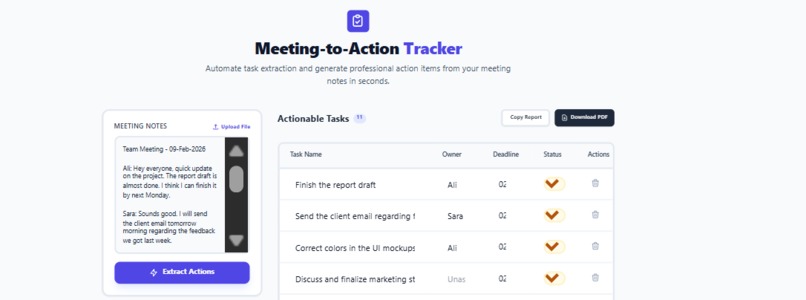
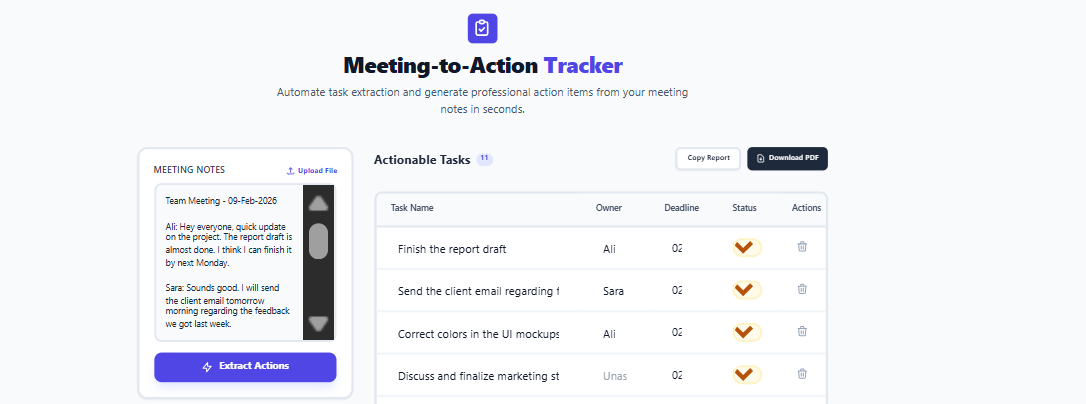
The Meeting-to-Action Tracker takes raw meeting notes or chat transcripts and transforms them into a structured list of actionable tasks. It automatically:
- Identifies tasks
- Assigns owners when mentioned
- Detects deadlines
- Organizes everything into a clear, editable format
This helps teams quickly understand what needs to be done after a meeting, without manually going through long discussions.
How We Built It
The project is developed as a web application with a simple and clean workflow:
- The user pastes meeting notes or chat transcripts into the application.
- These notes are sent to a backend service where the Gemini API analyzes the text.
- The AI extracts actionable tasks and converts them into structured JSON data, including:
- Task description
- Assigned owner (if mentioned)
- Deadline (if available)
Status (defaulted to pending)
- The frontend displays the extracted tasks in an editable table where users can:
Modify task details
Add new tasks manually
Delete incorrect or unnecessary tasks
The system also generates a concise summary report showing the total number of tasks and responsibilities per person.
All processing is done in memory, and no database is used, keeping the system lightweight and easy to test.
Challenges We Ran Into
One major challenge was dealing with unstructured and noisy input text. Meeting notes often contain informal language, spelling mistakes, and discussions that are not actionable. Teaching the AI to distinguish between casual conversation and real tasks required careful prompt engineering.
Another challenge was handling ambiguous deadlines, such as phrases like “next week” or “by Friday”. These required logical assumptions and consistent interpretation to ensure accurate task extraction.
Accomplishments That We’re Proud Of
- Successfully extracting meaningful tasks from messy, real-world meeting notes
- Designing an AI system that works without a database, relying only on in-memory processing
- Creating a clean and editable task interface that keeps human control over AI-generated results
- Building a practical tool that improves productivity in real team environments
What We Learned
While building this project, I learned that AI is most powerful when used for understanding and structuring information, not just for conversation. I gained hands-on experience with:
- Prompt engineering for extracting structured data from unorganized text
- Using AI to identify tasks, owners, and deadlines from natural language
- Designing systems without a database using in-memory processing
- Handling edge cases such as missing owners, unclear deadlines, and non-actionable text
I also learned how to clearly separate AI responsibilities from traditional programming logic, making the system more reliable and easier to maintain.
What’s Next for Meeting-to-Action
In the future, this project can be enhanced by adding features such as:
- File upload support for meeting transcripts
- Exporting reports in PDF or Markdown format
- Calendar integration for automatic deadline reminders
- Real-time collaboration for team-based task management
These improvements would make the system even more valuable for professional and academic teams.

Log in or sign up for Devpost to join the conversation.