Here is a draft for your hackathon submission. I have written this assuming you used Generative AI (LLMs) to generate the questions, as that is the standard approach for "automating" content creation today.
You can copy and paste these sections, but please replace the bracketed text [like this] with your specific technology stack (e.g., React, Python, AWS, OpenAI, etc.).
Inspiration We’ve all been there: you need to collect feedback for a project, a club event, or product research, but you stare at a blank screen wondering what questions to ask. Writing good survey questions that aren't biased or confusing is actually a difficult skill. We realized that while there are plenty of tools to host forms, there weren't enough tools to help you design them. We wanted to bridge the gap between having an idea ("I want to know why customers like our coffee") and having a deployable, professional survey instantly.
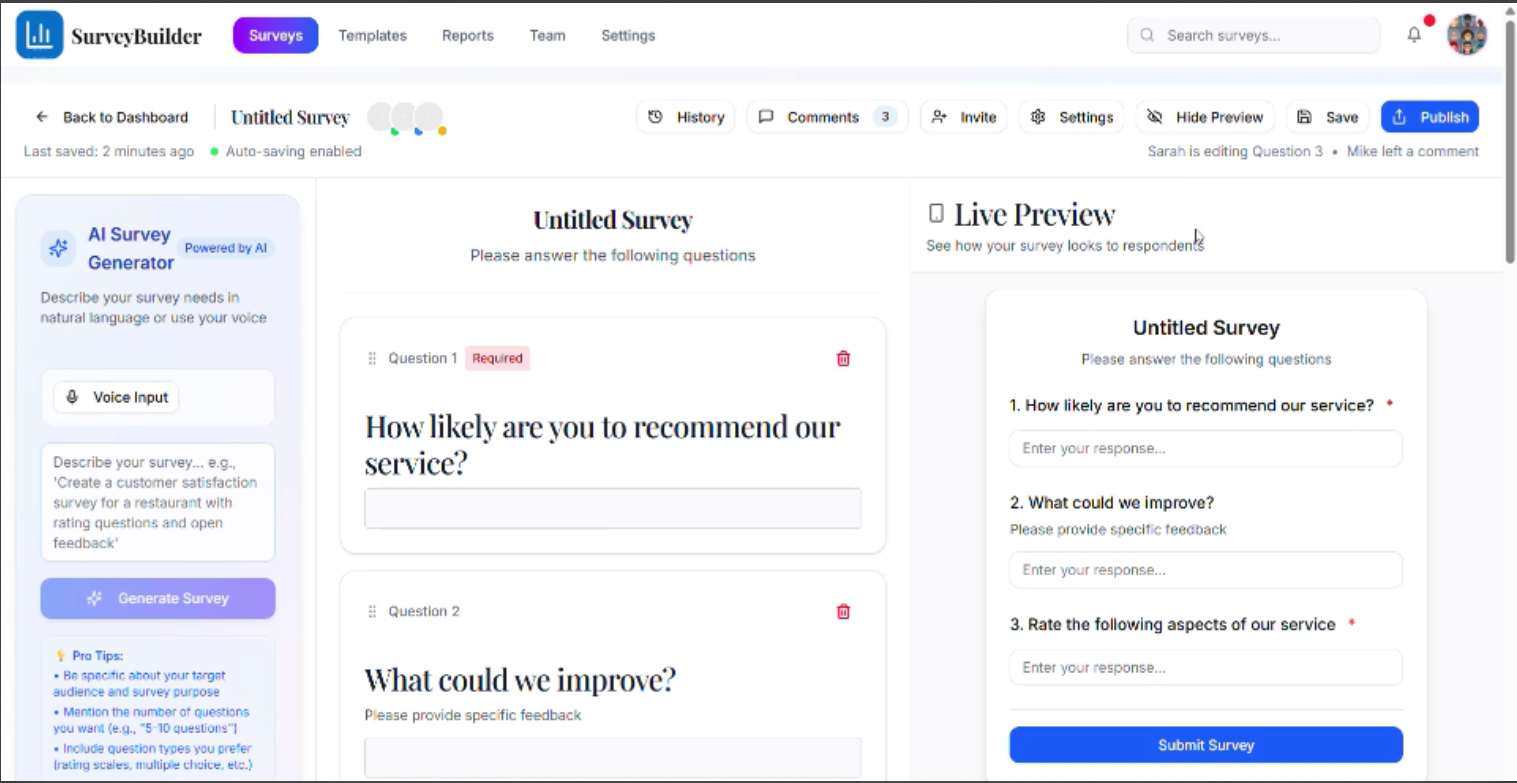
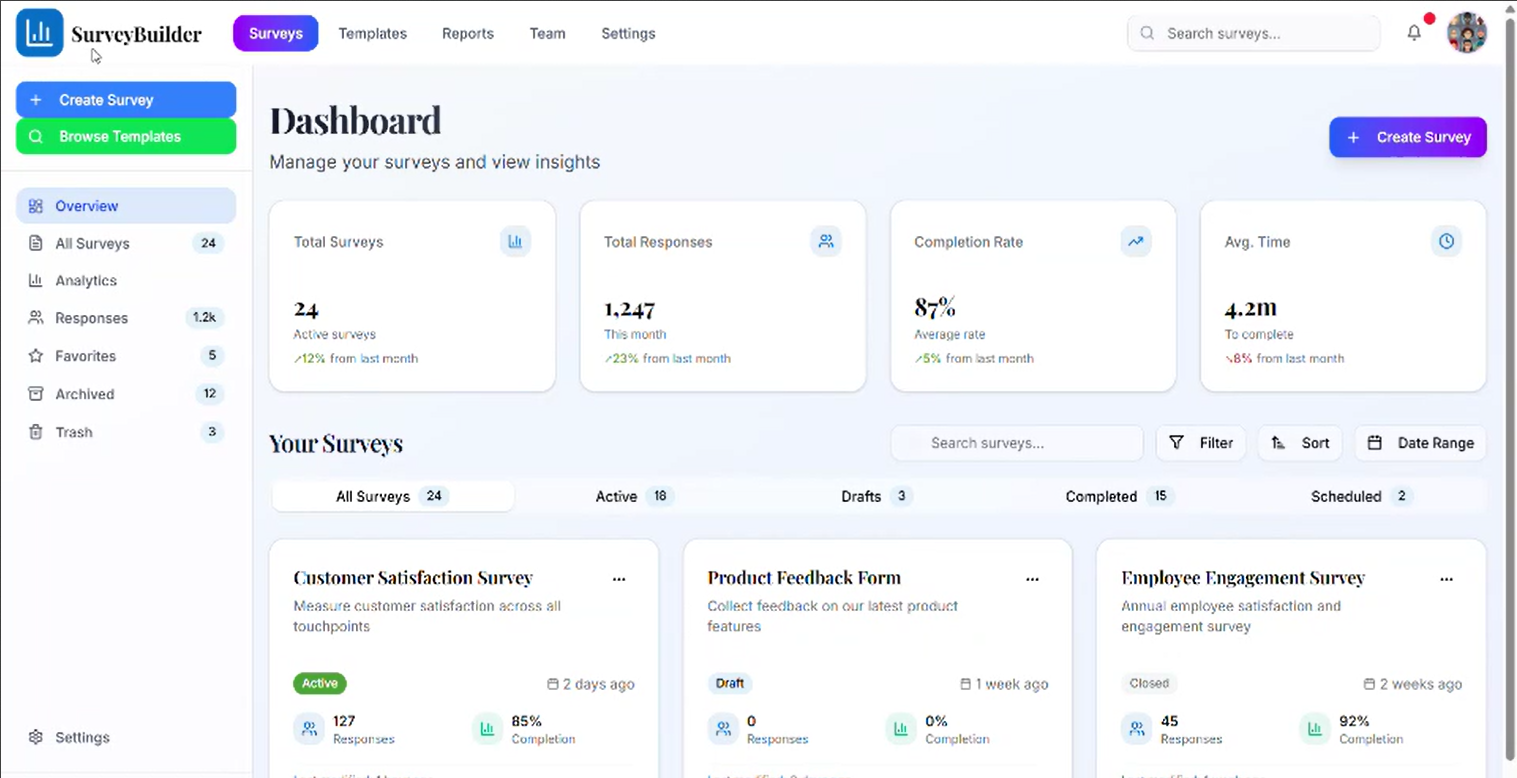
What it does Intelligent Survey-as-a-Service is an AI-powered platform that transforms a simple text prompt into a fully functional survey in seconds.
Prompt-to-Form: The user simply types a goal (e.g., "Create a feedback form for a college hackathon participant").
Smart Generation: The system uses AI to generate relevant, unbiased, and chemically diverse questions (Multiple choice, text, ratings).
Instant Deployment: It automatically renders the UI for the form and generates a unique shareable link.
Data Collection: It captures user responses in real-time and stores them securely.
How we built it We built the frontend using [Frontend Tech, e.g., React/Next.js/Flutter] for a responsive and clean user interface.
The Brains: We utilized [LLM Tech, e.g., OpenAI GPT-4 / Gemini / Claude / AWS Bedrock] to handle the logic. We engineered specific prompts to ensure the AI outputs the questions in a strict JSON format.
The Backend: We used [Backend Tech, e.g., Python Flask / FastAPI / Node.js] to handle API requests and parse the AI's output.
Database: For storing the generated forms and the incoming responses, we used [Database, e.g., MongoDB / PostgreSQL / Firebase].
Hosting: The application is deployed on [Cloud Provider, e.g., Vercel / AWS / Heroku].
Challenges we ran into Structured Output: The biggest challenge was getting the AI to consistently output valid JSON data that our frontend could render. Early versions would often break because the AI added conversational text (like "Here is your survey") mixed with the code. We solved this by using [mention a fix, e.g., strict prompt engineering / Zod schema validation / instructor library].
State Management: Handling the dynamic nature of the form—where the number of questions changes every time—was tricky on the frontend.
Context Window: Ensuring the AI understood the specific context of niche topics required fine-tuning our system prompts.
Accomplishments that we're proud of Zero-to-One Flow: We successfully built a pipeline where a user inputs a single sentence and gets a working URL in under 30 seconds.
Dynamic Rendering: We are proud of our dynamic form component that can render any type of question (rating, dropdown, text) on the fly without hardcoding.
User Interface: We managed to keep the design clean and intuitive, focusing on the user experience rather than just the underlying complexity.
What we learned Prompt Engineering is Key: We learned that the quality of the output depends almost entirely on how specific and structured the input prompt is.
Handling Unstructured Data: We gained a lot of experience in converting unstructured text (AI ideas) into structured database entries.
The Power of Simplicity: Users don't want a thousand buttons; they want a magic wand. Keeping the input simple was a major design lesson.
What's next for Intelligent Survey-as-a-Service AI Analytics: We plan to add an "Analysis" tab that uses AI to summarize the responses (e.g., sentiment analysis of open-ended answers).
Multi-Language Support: Allowing users to generate surveys in their local language instantly.
Platform Integration: Building plugins for Slack or Discord so teams can generate internal polls without leaving their chat apps.
Editability: Giving users the ability to manually tweak the AI-generated questions before publishing.
Built With
- amazon-web-services
- aws-bedrock
- flask
- langchain
- mongodb
- openai
- python
- react
- tailwind-css


Log in or sign up for Devpost to join the conversation.