-
AI copilot
Inspiration
The inspiration to develop an intelligent sales assistant arose from the need to enhance efficiency and customer experience in the sales process. We observed that customers often require quick and accurate responses about products and services, prompting us to create a solution capable of providing detailed information instantly.
What it does
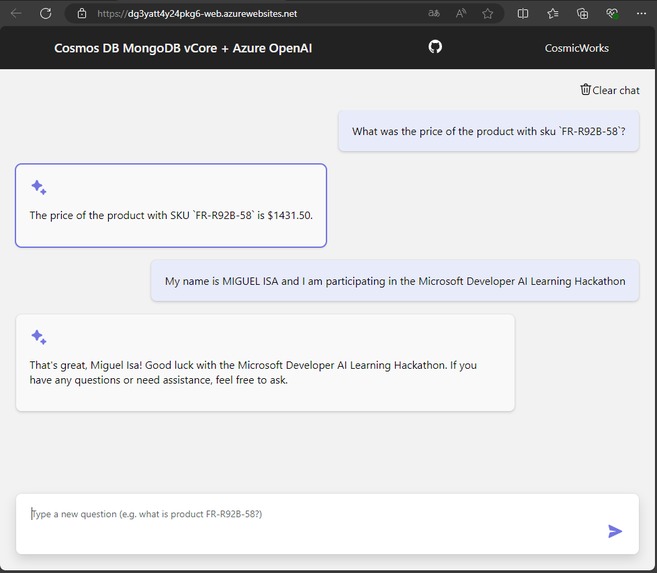
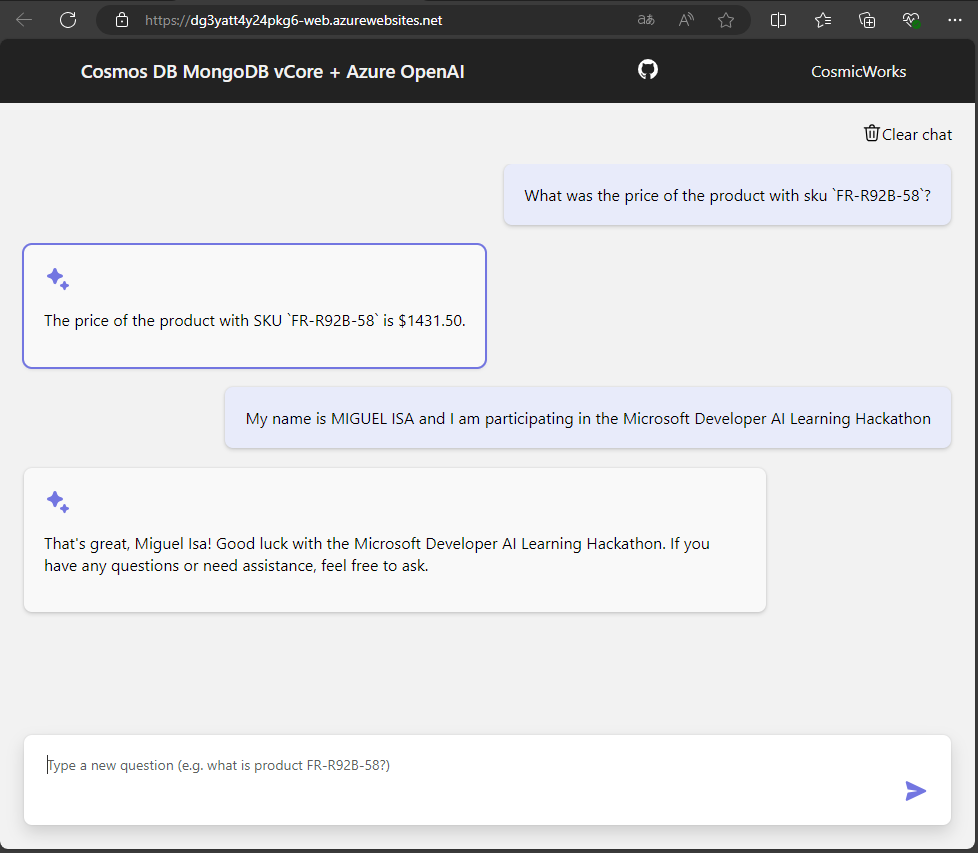
The intelligent sales assistant enhances the sales process by: Answering Queries: Providing quick and accurate responses to customer inquiries about products, services, and sales processes. Personalizing Interactions: Tailoring responses based on customer preferences, purchase history, and demographic information. Recommendations: Offering product recommendations and upsell opportunities based on customer needs and behavior. Data Integration: Seamlessly integrating databases (such as Cosmos DB) to access real-time customer data and transaction histories. Automation: Streamlining routine tasks such as order processing, appointment scheduling, and follow-up communications.
How we built it
We utilized a combination of cutting-edge technologies to create a robust and efficient intelligent sales assistant:
Azure OpenAI Models: Leveraged Azure's OpenAI models, including Large Language Models (LLMs) and Retrieval-Augmented Generation (RAG), to understand and generate contextually relevant responses to customer queries.
FastAPI: Implemented FastAPI, a modern Python web framework, to develop the backend API services. FastAPI's asynchronous capabilities ensured high performance and responsiveness for handling concurrent user requests.
Docker: Containerized the application components using Docker to ensure portability and consistency across different environments. Docker containers facilitated easy deployment and scaling of the application.
LangChain: Integrated LangChain, a library for handling natural language processing tasks, to enhance the assistant's ability to interpret and respond to complex customer queries effectively.
Cosmos DB: Used Cosmos DB as the backend database to store and manage structured and unstructured data efficiently. Cosmos DB's global distribution and scalability capabilities ensured real-time data access and seamless integration with other services.
SPA Frontend: Developed a Single Page Application (SPA) frontend using modern web technologies such as React.js or Angular, providing a responsive and intuitive user interface for customers and sales teams to interact with the assistant.
Challenges we ran into
While developing the intelligent sales assistant, we encountered several challenges, particularly with Docker, which was a new technology for our team:
Learning Curve: Docker's containerization concept and its ecosystem were unfamiliar to us initially. We had to invest time in learning Docker's fundamentals, including container creation, Dockerfiles, and Docker Compose for orchestrating multiple containers.
Integration Complexity: Integrating Docker into our development workflow posed challenges in terms of ensuring compatibility with existing tools and environments. We had to troubleshoot compatibility issues and refine our Docker configurations to align with project requirements.
Performance Optimization: Achieving optimal performance and resource management within Docker containers required fine-tuning. We had to optimize container sizes, manage dependencies efficiently, and configure resource allocation to maintain application responsiveness.
Deployment and Scaling: Setting up Docker for deployment and scaling across different environments (development, testing, production) required careful planning and configuration. We faced challenges in automating deployment pipelines and ensuring consistent performance across deployments.
Accomplishments that we're proud of
We successfully achieved a fully functional and efficient intelligent sales assistant that meets our initial goals and exceeds expectations in several key areas:
Reliable Functionality: Through diligent development and testing, we ensured that the intelligent sales assistant operates reliably, providing accurate and timely responses to customer queries.
Integration Success: We seamlessly integrated Azure OpenAI models, FastAPI backend services, Docker containerization, LangChain for NLP tasks, and Cosmos DB as the backend database. This integration enabled smooth data flow and efficient processing within the application.
User Experience: Our SPA frontend offers a user-friendly interface that enhances the interaction between customers and the assistant. It provides intuitive navigation and responsive design, contributing to a positive user experience.
What we learned
During the project, we delved into advanced AI techniques such as Large Language Model (LLM) models and Retrieval-Augmented Generation (RAG). These models proved instrumental in understanding complex customer queries and generating contextually relevant responses by leveraging vast amounts of textual data.
Additionally, we explored vector search methodologies to enhance the efficiency of information retrieval. Implementing vector search allowed us to quickly retrieve and rank relevant information from large datasets, improving the speed and accuracy of our intelligent sales assistant's responses.
Furthermore, we gained valuable insights into database management by utilizing Cosmos DB. Integrating Cosmos DB enabled us to store and access structured and unstructured data efficiently, ensuring real-time updates and seamless scalability for our application.
What's next for Intelligent Sales Copilot
Moving forward, our focus is on integrating the Intelligent Sales Copilot more deeply into our sales and post-sales processes to further enhance its utility and impact:
Sales Process Integration: Integrate the assistant seamlessly into our existing CRM systems and sales workflows. This integration will enable automatic updating of customer records, lead management, and real-time sales analytics based on interactions handled by the assistant.
Enhanced Personalization: Implement advanced personalization features using AI insights gathered from customer interactions. Tailor product recommendations, pricing strategies, and promotional offers based on individual customer preferences and behaviors identified by the assistant.
Automation of Post-Sales Activities: Extend the assistant's capabilities to automate post-sales activities such as order tracking, customer support ticket management, and proactive follow-up communications. This will streamline customer service operations and improve overall customer satisfaction.
Analytics and Reporting: Develop comprehensive analytics and reporting capabilities within the assistant to provide actionable insights into sales trends, customer behavior patterns, and performance metrics. This data-driven approach will support informed decision-making and strategy formulation.
Continuous Improvement: Continuously refine the assistant's AI models and NLP capabilities to enhance accuracy, language understanding, and response generation. Implement feedback mechanisms to gather insights from users and iteratively improve the assistant's performance.

Log in or sign up for Devpost to join the conversation.