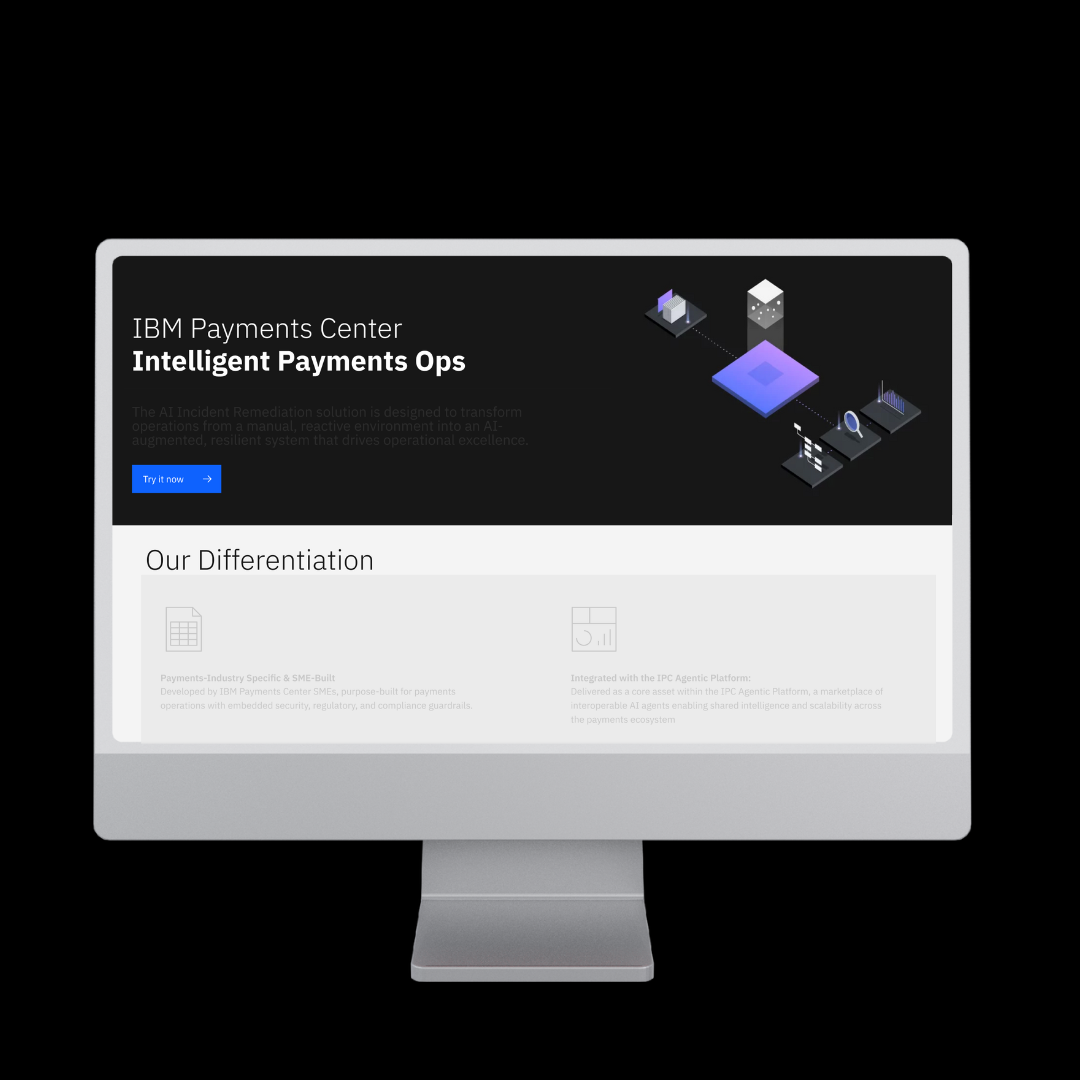
Product Overview
Intelligent Payment Operations is an AI-powered incident-resolution system designed to help payment operations teams identify issues faster, reduce manual workload, and improve operational reliability. It provides automated playbooks, guided decision support, and a unified knowledge hub that streamlines how operators respond to high-volume, time-sensitive payment incidents.
The platform transforms scattered documentation, inconsistent remediation steps, and reactive operations into a predictable, data-driven workflow that improves clarity, speed, and operational accuracy.
Problem Space
Payment operations teams manage thousands of daily transactions, yet incident handling is often fragmented and manual. Across multiple discovery sessions, several challenges emerged:
- Operators relied on tribal knowledge instead of standardized guidance.
- Existing documentation was outdated, hard to search, and inconsistent across teams.
- Incident resolution steps varied widely, creating unpredictable outcomes.
- High cognitive load and context switching slowed execution and increased MTTR.
Impact Stats:
- ≈ 45 percent of incidents required manual searching for steps or historical context.
- Operators reported losing up to 20–30 minutes per incident due to unclear guidance.
- MTTR variance across teams exceeded 40 percent, highlighting inconsistent remediation.
Teams needed a system that could surface the right steps, reduce errors, and shorten the time to resolve incidents without requiring deep domain expertise.
Outcomes
The Intelligent Payment Operations system delivered measurable improvements:
- 30–50 percent faster access to remediation steps due to structured, centralized guidance.
- Reduced knowledge gaps across junior and senior operators, improving consistency.
- Clearer, standardized operational playbooks that removed ambiguity during high-pressure incidents.
- Improved operator confidence and accuracy, especially for less familiar incident types.
The project became the foundation for a broader operational-resilience initiative and validated the use of AI-augmented decision support in payment operations.
My Role
Product Ownership
- Defined vision, problem statement, and success metrics for the initial pilot.
- Facilitated discovery interviews with operations teams to map workflows and pain points.
- Created personas, use cases, and a decision hierarchy for automated and human-assisted steps.
- Authored the operational playbook taxonomy and structured the knowledge framework.
Execution
- Translated incident workflows into modular, step-based playbooks that AI could surface contextually.
- Designed low-fidelity and high-fidelity user flows for operators, reviewers, and managers.
- Collaborated with engineering to align feasibility, system boundaries, and data requirements.
- Set up feedback loops and live validation exercises with operations teams.
Leadership
- Presented strategy, risks, and operational value to senior engineering and operations leadership.
- Coordinated cross-functional teams (ops, engineering, knowledge management) to ensure alignment.
- Built operator trust by incorporating their input into each iteration and showcasing improvements.
Product Lifecycle
4. Discovery
- Conducted workflow shadowing to understand how operators triage incidents end-to-end.
- Benchmarked industry practices in automated ops workflows to define the target experience.
- Mapped all incident types into a structured decision tree to identify where automation should support operators.
- Documented friction points such as unclear steps, knowledge fragmentation, and inconsistent escalation paths.
- Synthesized insights into a unified operational model to inform feature prioritization.
5. Solution
Core Features & Deliverables
- A centralized knowledge hub containing standardized remediation steps, templates, and operational rules.
- AI-powered guided workflows that provide step-by-step support based on incident context.
- Automated recommendations for next actions, validation checks, and escalation triggers.
- Operator-friendly UI flows designed to minimize cognitive load and reduce friction.
- Review & improvement loops allowing teams to refine operational guidance over time.
Workflow Simplification
- Consolidated dozens of inconsistent playbooks into a single structured remediation model.
- Reduced operator decision fatigue with simple, intuitive, context-aware workflows.
- Enabled adaptive workflows based on incident type, severity, and historical behavior.
Decision Logic
- Automated workflows only where clarity and consistency were required.
- Preserved human oversight for judgment-heavy or high-risk decisions.
- Ensured the system complemented, not replaced, operator expertise.
6. System / Architecture View
(High-level, non-confidential)
Components Worked With
- Knowledge repository storing validated remediation steps and operational guidance.
- Workflow engine that surfaces the right instructions based on incident context.
- User interface for operators to take action, review guidance, and record outcomes.
- Analytics layer to measure time savings, adherence, and process quality.
My Role Across Components
- Defined requirements for knowledge structure, metadata, tagging, and retrieval.
- Created interaction models for automated and human-assisted workflows.
- Ensured usability by designing clear, minimal, and intuitive operator experiences.
- Worked with engineering to validate data sources, system dependencies, and guardrails.
Content Planning & Workflow Design
- Developed operational scenarios across common incident categories.
- Designed flow diagrams to map how operators progress from detection → action → resolution.
- Documented every remediation step with clarity, expected outcomes, and fallback logic.
7. Execution & Delivery
- Delivered complete documentation: workflows, UX flows, decision models, and operational taxonomy.
- Ran a 3-week internal pilot with operations teams to validate usability and accuracy.
- Implemented feedback cycles to refine unclear steps and improve discoverability.
- Guided engineering on prioritizing core features for MVP and future enhancements.
- Facilitated alignment meetings to ensure leadership buy-in and operational readiness.
9. What I Learned
- How to translate highly complex operational workflows into simple, AI-supported experiences.
- How to balance automation with human oversight in high-risk, time-critical environments.
- How to conduct discovery in a domain with fragmented knowledge and inconsistent processes.
- How to build trust and adoption among operations teams who depend on precision and reliability.
- How to validate an AI-assisted experience when ground truth is partially undocumented.
Built With
- a2a
- amazon-web-services
- claude-4.5
- dyanmodb
- figma
- langgraph
- node.js
- opensearch
- redis

Log in or sign up for Devpost to join the conversation.