-
-
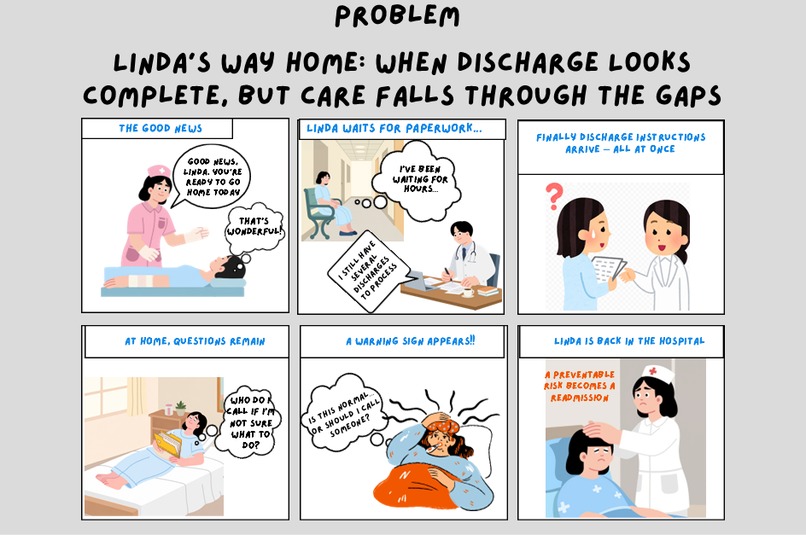
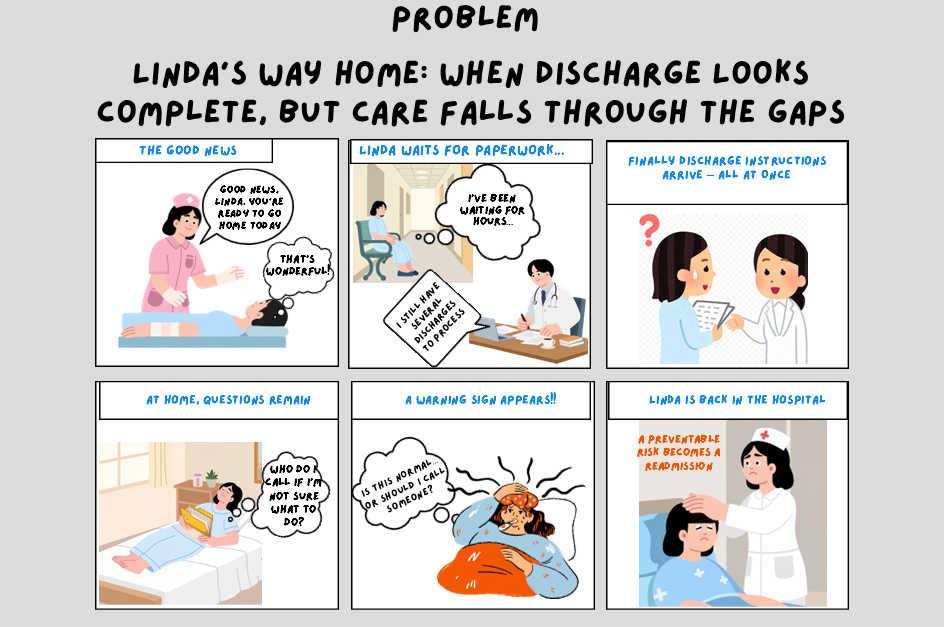
Comic Strip Describing the Current Problem
-
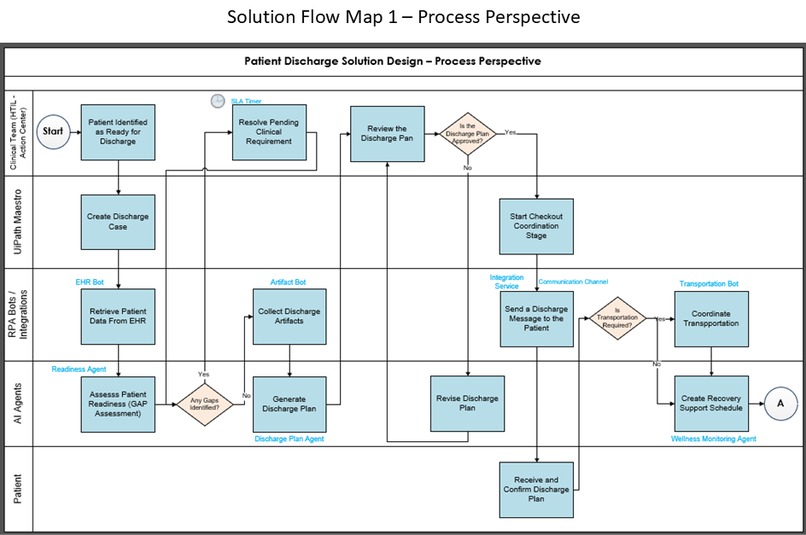
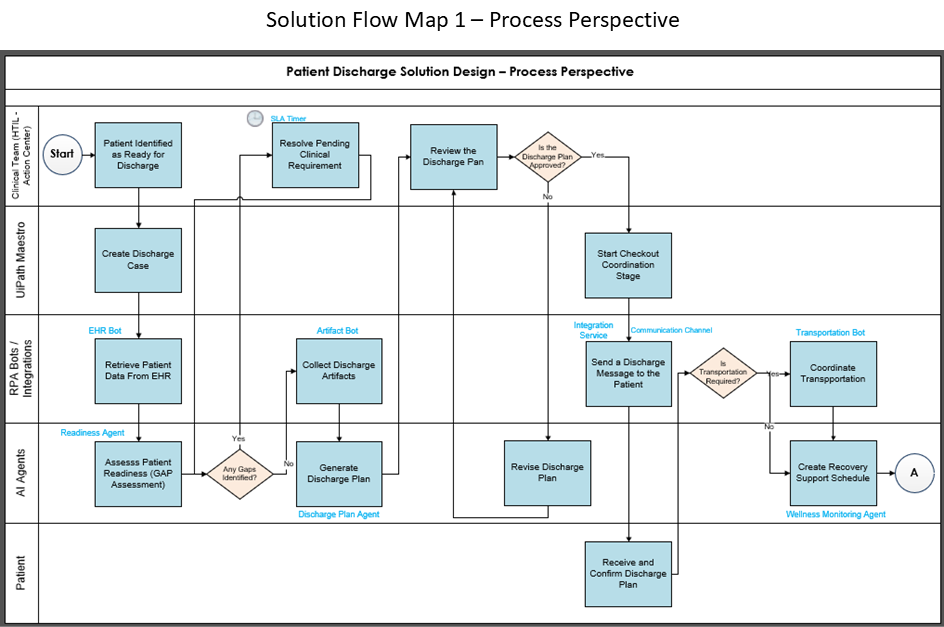
Solution Flow Map Process Perspective Slide 1
-
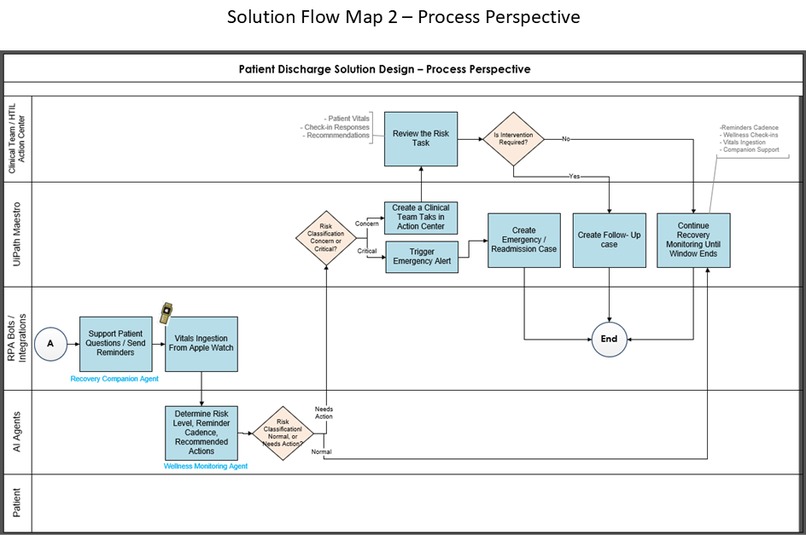
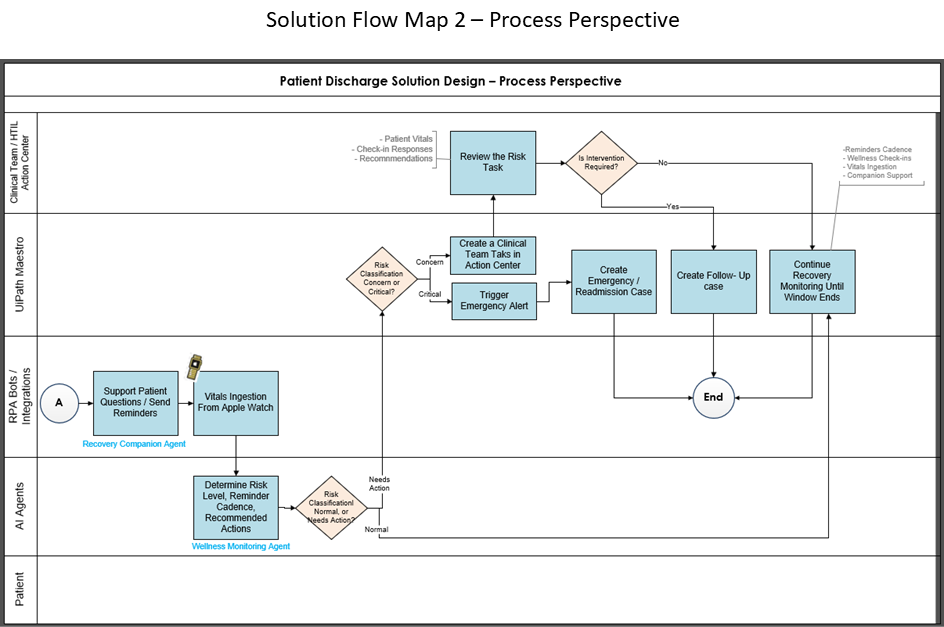
Solution Flow Map Process Perspective Slide 2
-
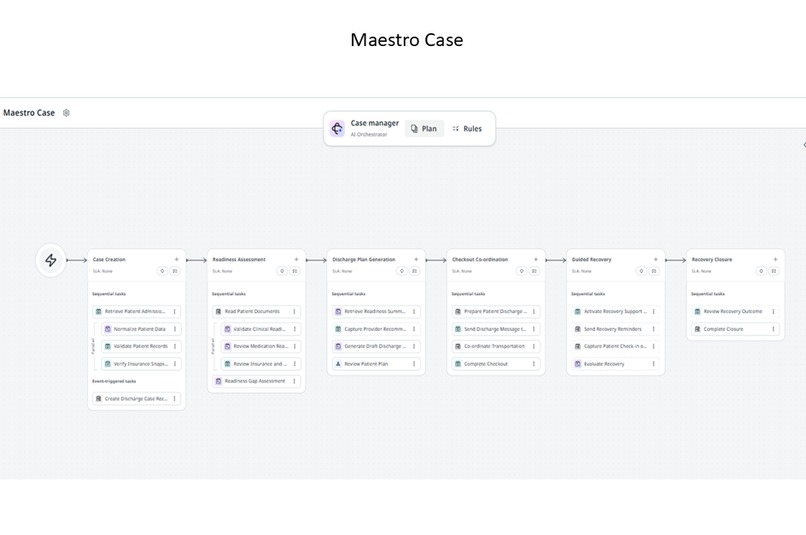
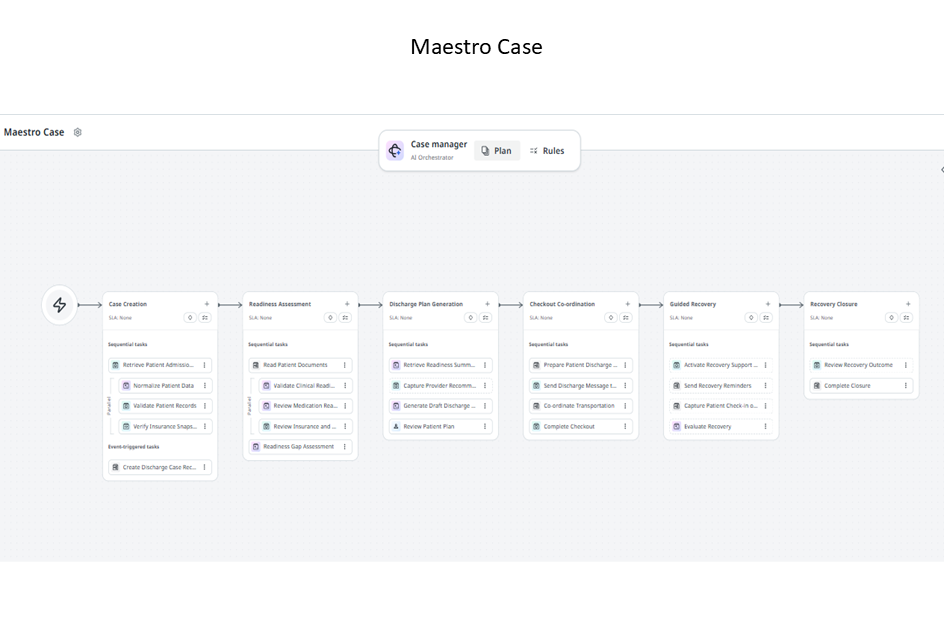
Maestro Case
-
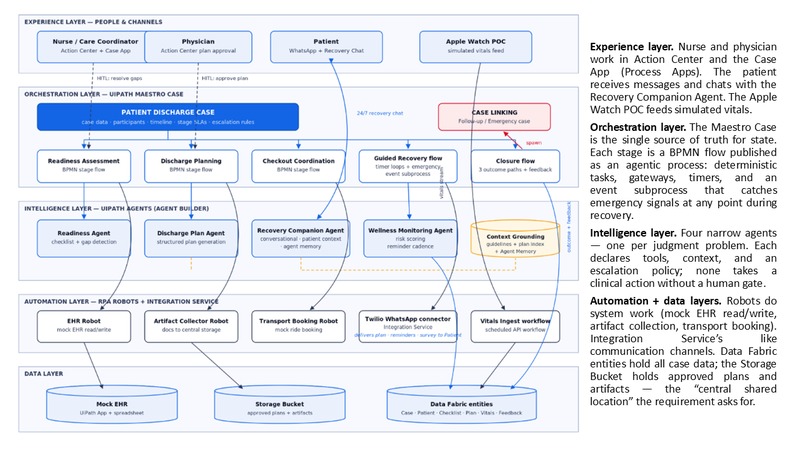
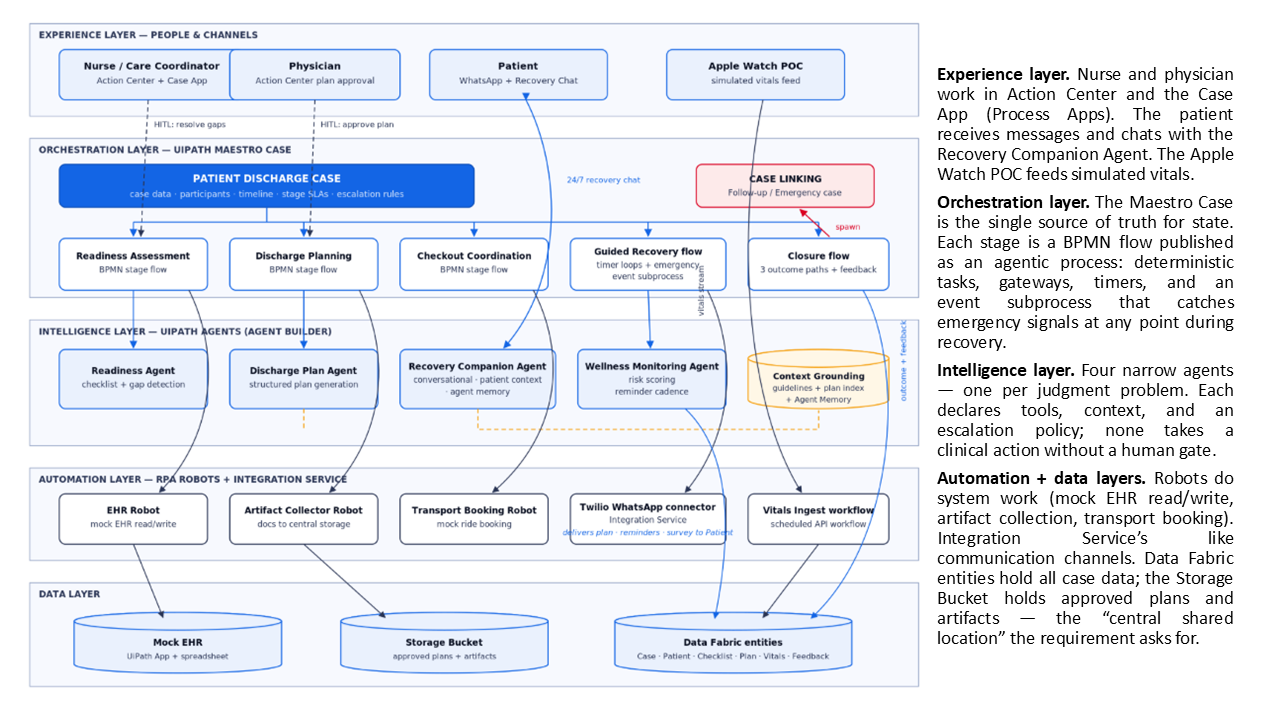
Solution Architecture
## Inspiration

Hospital discharge is one of the most vulnerable moments in the patient journey. A patient may be medically cleared to go home, but that does not always mean the transition is truly safe, coordinated, or understood.

We were inspired by a simple but powerful question: **What happens after the discharge order is given?**

In many hospitals, discharge still depends on fragmented manual coordination across nurses, physicians, care coordinators, patients, documentation, follow-up tasks, transportation, and post-discharge monitoring. When those handoffs are disconnected, patients can leave the hospital with unclear instructions, unresolved questions, pending follow-ups, medication confusion, or missed warning signs.

Our project, **Intelligent Patient Discharge Case System**, was built to transform discharge from a manual administrative handoff into a connected, intelligent, and compassionate care journey.

## What it does

The solution manages the patient discharge journey through a governed **UiPath Maestro Case**. It coordinates discharge readiness, discharge plan generation, physician approval, patient communication, guided recovery, wellness monitoring, escalation, and case closure.

The system supports multiple users across the journey:

- **Patients** receive timely discharge instructions, recovery reminders, and access to a recovery companion for post-discharge support.
- **Nurses and care coordinators** receive structured tasks for readiness gaps, follow-ups, and recovery escalations.
- **Physicians** review and approve AI-generated discharge plans before they are finalized.

The solution also monitors simulated post-discharge vitals, classifies recovery risk, and creates follow-up or emergency cases when intervention is needed.

For the hackathon, we used **synthetic / mocked patient data** and a **mock EHR** to safely demonstrate the concept without using real patient PHI.

## How we built it

We built the solution using a hybrid orchestration model that combines UiPath case management, deterministic process automation, AI agents, RPA bots, integrations, and human-in-the-loop review.

The core components include:

- **UiPath Maestro Case** to govern the patient discharge lifecycle and provide a single source of truth for case state.
- **BPMN Flows** to orchestrate deterministic stages such as readiness assessment, discharge planning, checkout coordination, guided recovery, and closure.
- **Agent Builder** to support judgment-based work, including readiness assessment, discharge plan generation, patient companion support, and wellness monitoring.
- **Action Center** to keep nurses and physicians in control of clinical review, approvals, readiness gaps, and escalations.
- **RPA Robots** to perform system tasks such as mock EHR read/write, artifact collection, transportation coordination, and vitals ingestion.
- **Data Fabric** to store case, patient, checklist, plan, vitals, and feedback data.
- **Storage Bucket** to store approved discharge plans and related artifacts.
- **Integration Service and a communication channel** to send patient notifications and discharge messages.
- **Simulated Apple Watch CSV data** to provide recovery vitals for monitoring.
- **Clinical guidelines and discharge plan templates** to ground the Discharge Plan Agent.

The architecture is organized into four layers:

- **Experience layer:** nurses and physicians work through Action Center and the Case App, while the patient receives messages and interacts with the Recovery Companion Agent through a communication channel.
- **Orchestration layer:** Maestro governs the long-running case, while BPMN flows coordinate tasks, gateways, timers, and emergency event handling.
- **Intelligence layer:** narrow agents support specific judgment problems, each with defined context, tools, and escalation policies.
- **Automation and data layer:** robots, integrations, Data Fabric, and Storage Bucket handle system execution and structured case data.

What makes the solution unique is that it does not automate isolated tasks. It creates an auditable, long-running healthcare case where agents assist with complex work, robots execute system actions, and humans remain responsible for clinical decisions.

## Challenges we ran into

One of our main challenges was designing a healthcare workflow that was intelligent while still keeping clinicians safely in control. Because the solution supports discharge readiness, plan generation, patient communication, recovery monitoring, and escalation, we had to carefully define where agents could assist and where human review was required.

We addressed this by using narrow, purpose-specific agents and placing clinical decisions behind Action Center approvals and escalation gates.

Another challenge was modeling discharge as more than a simple linear workflow. The patient journey continues after the hospital discharge event, so we used UiPath Maestro Case as the single source of truth and BPMN flows to manage readiness checks, approvals, reminders, monitoring loops, risk decisions, emergency signals, and case closure.

We also had to make several scope and architecture decisions. For the hackathon, we focused on a demo-safe implementation using UiPath Automation Cloud, synthetic patient data, a mock EHR, simulated vitals, and a communication-channel integration. This allowed us to demonstrate the value of the concept without requiring real PHI, a live EHR, a signed BAA, or production healthcare infrastructure.

We also identified several real-world technical considerations that would matter in an enterprise rollout:

- Wearable data should not stream raw vitals directly into Maestro. A production version would use middleware to evaluate thresholds and send only meaningful events into Maestro.
- Long-term patient context should live in Data Fabric or an external system of record, rather than relying only on conversational memory.
- Patient messaging integrations require explicit routing to connect inbound patient replies back to the correct case context.
- A real deployment would need stronger compliance review around PHI, HIPAA, BAA scope, LLM endpoints, and EHR connectivity.
- Recovery cases may need to be split from discharge cases in production because recovery can last weeks while discharge may only last hours.

We also faced a technical blocking issue during implementation when Studio Web / Solutions failed during the packaging step before debug or publish could run. The issue was later confirmed as a known UiPath platform packaging issue caused by a version mismatch between internal packaging components. While the issue temporarily blocked our ability to debug and publish, we worked around it by isolating workflows, reducing the solution scope for testing, trying different project combinations, and coordinating with UiPath support until the platform fix was deployed.

This experience reinforced the importance of designing modular solutions that can be tested in smaller parts and validated incrementally, especially when building with multiple components such as Maestro, BPMN flows, agents, RPA projects, integrations, and shared data layers.

## Accomplishments that we're proud of

We are proud of building an end-to-end agentic case management solution instead of a simple task automation. The project demonstrates how UiPath can orchestrate a complex healthcare journey across patients, nurses, physicians, robots, agents, data, and communication channels.

We are especially proud of the hybrid orchestration model:

- **Maestro Case** governs the long-running patient journey.
- **BPMN flows** coordinate deterministic process steps.
- **Agents** support judgment-based work.
- **RPA robots** execute system actions.
- **Action Center** keeps humans in control of clinical decisions.
- **Data Fabric** provides structured case visibility.
- **Integrations** support patient communication and recovery monitoring.

We are also proud that the solution keeps the patient experience at the center. The story of Linda’s discharge journey helped us design around real pain points: delays, confusing instructions, unclear follow-up, lack of support at home, and missed warning signs.

Another accomplishment is that we designed the solution with both demo feasibility and production realism in mind. Even though the hackathon version uses mocked data and simulated integrations, the architecture anticipates real-world concerns such as compliance, EHR integration, wearable data, patient communication channels, long-term recovery monitoring, escalation SLAs, and measurable closure criteria.

## What we learned

We learned that the real value of agentic automation in healthcare is not just speed. It is coordination, visibility, governance, and timely intervention.

A discharge process may look complete on paper, but the patient journey can still break at home. Intelligent orchestration helps close that gap by ensuring that the right information, tasks, approvals, reminders, and escalation paths are connected in one governed case.

We also learned that human-in-the-loop design is essential for healthcare automation. The best use of AI is not to remove clinicians from the process, but to help surface insights, reduce administrative burden, and ensure that clinical teams can focus on the decisions that matter most.

From a technical perspective, we learned that healthcare orchestration requires more than connecting tools. It requires careful decisions about data boundaries, event design, escalation logic, patient context, integration patterns, and what should or should not be handled by an agent.

## What's next for Intelligent Patient Discharge Case System

Next, we would expand the solution from a demo-ready proof of concept into a more complete healthcare orchestration model.

Future enhancements could include:

- Connecting to real EHR systems using healthcare interoperability standards such as FHIR APIs.
- Splitting the process into a short-running **Discharge Case** and a longer-running **Recovery Case** for cleaner lifecycle management.
- Adding a predictive readmission risk score, such as LACE or HOSPITAL, to identify high-risk patients earlier.
- Expanding recovery monitoring with additional vitals, symptoms, patient-reported outcome measures, and caregiver inputs.
- Adding Social Determinants of Health checks, such as transportation, caregiver availability, food access, and housing stability.
- Supporting additional patient communication channels such as SMS, IVR, and human outreach for patients who cannot use digital messaging tools.
- Creating a closed-loop medication reconciliation and prior authorization path.
- Adding hard SLAs for emergency escalation, including human acknowledgment and auto-escalation if no response occurs.
- Building advanced dashboards for care teams to track discharge readiness, bottlenecks, escalations, readmission risk, patient feedback, and process outcomes.
- Using process insights and optimization dashboards to feed real outcomes back into future discharge process improvements.
- Strengthening governance, auditability, security, compliance, and clinical safety controls for enterprise deployment.

Our vision is to make discharge safer, clearer, and more connected — because going home should not mean going unsupported.
Built With
- bpmn-flows
- clinical-guidelines-/-discharge-plan-templates
- communication-channel
- integration
- mock-ehr
- simulated-apple-watch-csv-vitals-data
- synthetic-patient-data
- uipath-action-center
- uipath-agent-builder
- uipath-data-fabric
- uipath-integration-service
- uipath-maestro-case
- uipath-process-apps-/-case-app
- uipath-robots
- uipath-storage-bucket

Log in or sign up for Devpost to join the conversation.