-
-
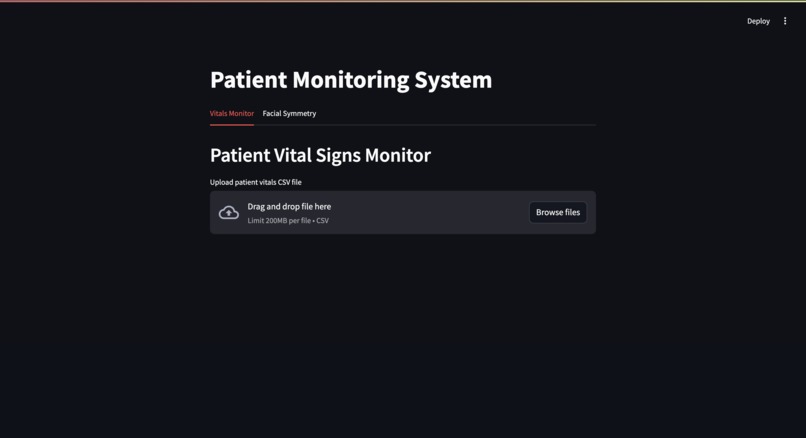
Website Interface
-
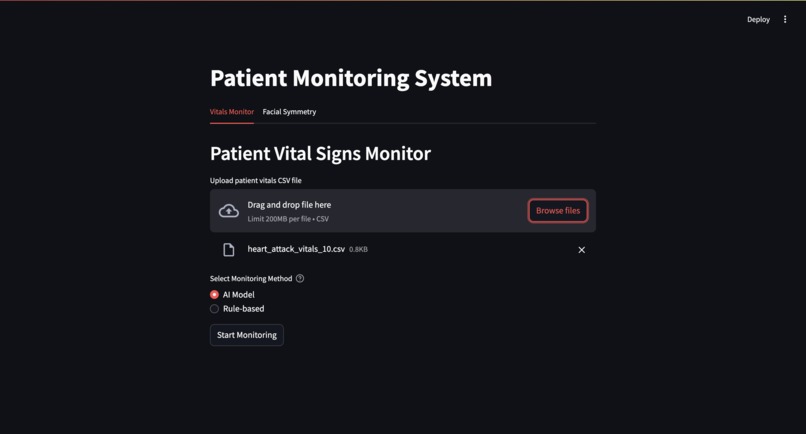
You can choose between either utilizing the AI model or opting for the rule-based method to compare the differences.
-
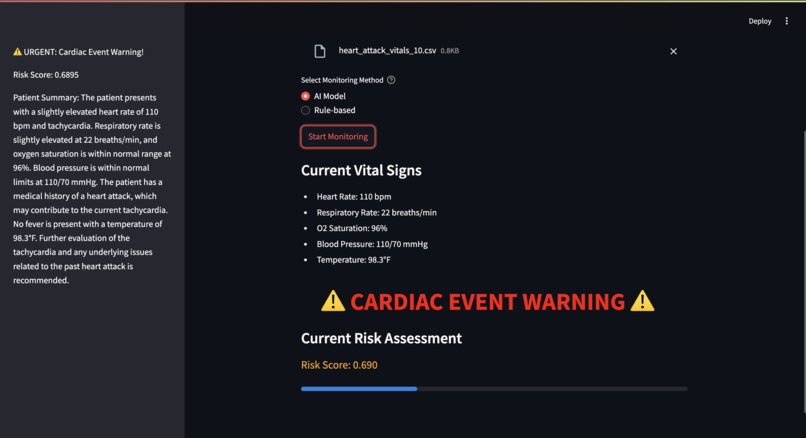
Detection of cardiac arrest with the auto-generated patient summary.
-
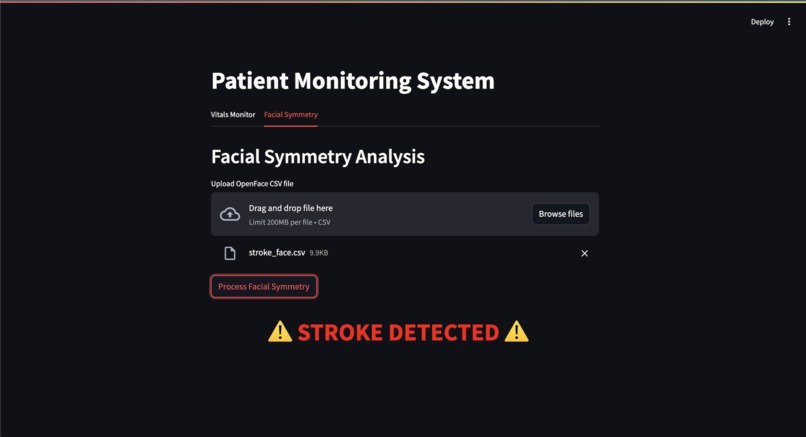
Detection of stroke.


IntelliCare: Predicting Patient Crises Before They Happen
Every second counts in a medical emergency. When a patient experiences a heart attack, stroke, or other life-threatening event, early intervention is critical. However, identifying these crises before they escalate and understanding how to prioritize remains a challenge in hospitals.
Medical data shows:
- Every 40 seconds, someone in the U.S. has a heart attack or stroke.
- One in four hospital deaths are linked to sepsis, which often presents with subtle warning signs before becoming critical.
- AI-driven hospital command centers have reduced patient mortality rates by up to 20% by predicting crises before they occur.
Inspired by this, we built IntelliCare, an AI-powered system that flags high-risk patients based on a combination of real-time vitals, medical history, and AI-generated insights.
IntelliCare detects life-threatening conditions before they happen by analyzing patient vitals and electronic health records (EHR). Our system:
- Flags patients at risk based on a dangerous combination of vitals (e.g., rapidly dropping blood pressure + irregular heart rhythm).
- Generates real-time summaries of a patient’s medical history when a critical alert is raised, making it easier for nurses and doctors to respond quickly with the context needed to treat patients well.
- Incorporates vision-based assessments to detect facial anomalies that may occur related to medical emergencies, such as facial asymmetry (stroke), swelling (anaphylactic shock), and sudden nosebleeds (hypertensive crisis).
Market Size
- Global AI in healthcare market is projected to reach $187.9 billion by 2030
- Predictive analytics in healthcare is rapidly growing as a submarket, projected to exceed $20 billion by 2030 Hospital Costs:
- Sepsis costs hospitals ~$62 billion annually, and AI powered early sepsis detection models like Epic's have shown a $5000+ in patient savings per patient
- Stroke and cardiac treatment cost the US $500 billion annually Total Addressable Market Size:
- Globally, the AI in healthcare market could be $200 billion
- If early intervention solves even 20% of sepsis/cardiac arrest cases, Intellicare could be looking at a $17 billion total market size
How we built it
Data Collection & Processing
- Used publicly available MIMIC-IV-ED vitals data
- Generated synthetic crisis scenarios based on EHR data (e.g., rapid heart rate increase, oxygen drop).
AI-Powered Detection
- Leveraged a gradient-boosted decision tree model to analyze patient history and detect risk patterns.
- Used OpenAI’s API to summarize patient history related to a flagged crisis.
- Utilized Cursor to provide valuable insights into bugs or other useful actionables.
- Leveraged a gradient-boosted decision tree model to analyze patient history and detect risk patterns.
Vision-Based Tracking
- Adopted a vision-language model for detecting crises.
- Incorporated facial analysis for stroke and anaphylaxis detection.
- Adopted a vision-language model for detecting crises.
Challenges we ran into
One major challenge we faced was the lack of publicly accessible medical data, especially video datasets of patients. Given the highly sensitive nature of medical information, there are strict privacy regulations that limit access to patient videos, particularly those depicting symptoms such as facial asymmetry in stroke patients or swelling in anaphylaxis cases. Another challenge was balancing false positives and false negatives. While we wanted to ensure that every critical case was flagged, excessive false alarms could overwhelm healthcare providers and lead to alert fatigue.
What we learned
Through this project, we learned that AI in healthcare requires explainability. Clinicians need to understand why a patient is flagged as high-risk in order to trust and act on AI-generated recommendations. Simply providing a risk score is not enough; clear, interpretable insights are essential.
Additionally, we gained valuable perspectives into the real-world challenges of AI deployment in healthcare. Hospitals have strict compliance and regulatory requirements, making AI integration more complex than initially expected. Understanding these constraints is crucial for developing AI solutions that can be successfully implemented in clinical settings.
Moving forward, we aim to give doctors and nurses a head start in preventing medical crises. Because every second counts.

Log in or sign up for Devpost to join the conversation.