-
-
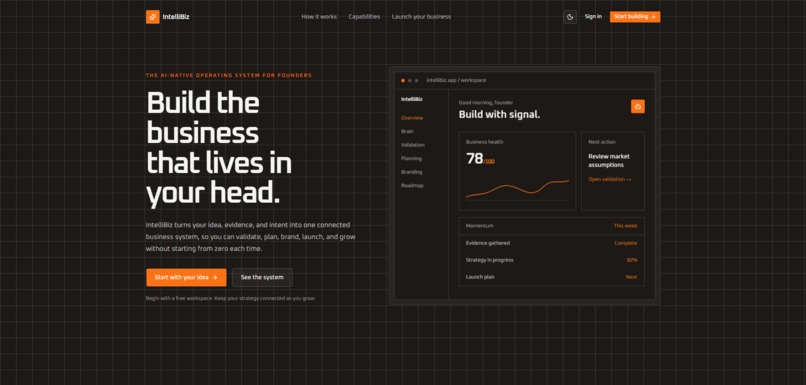
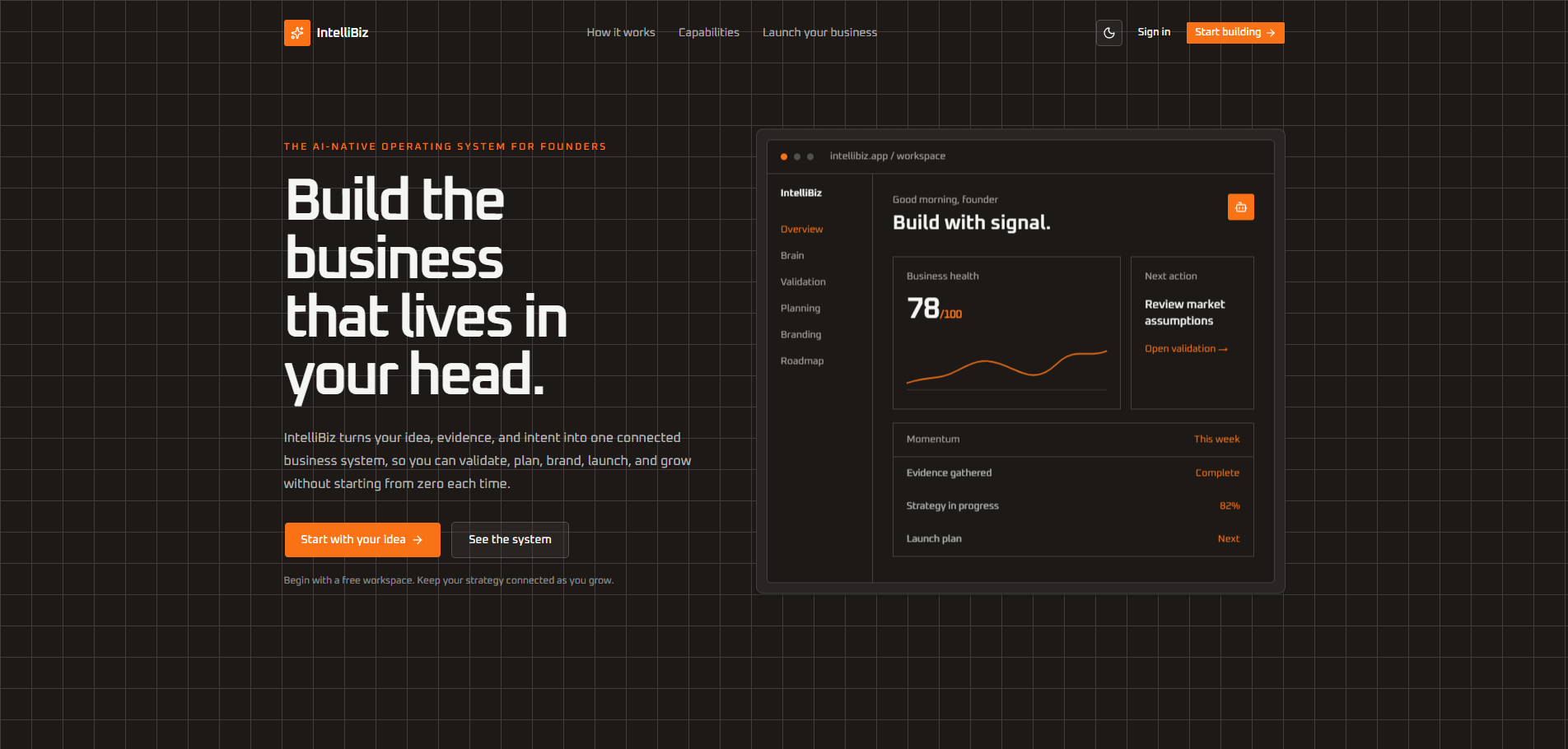
Intellibiz Hero Section
-
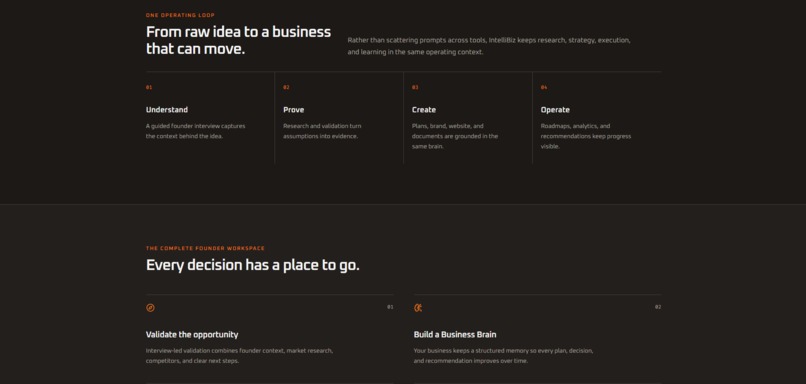
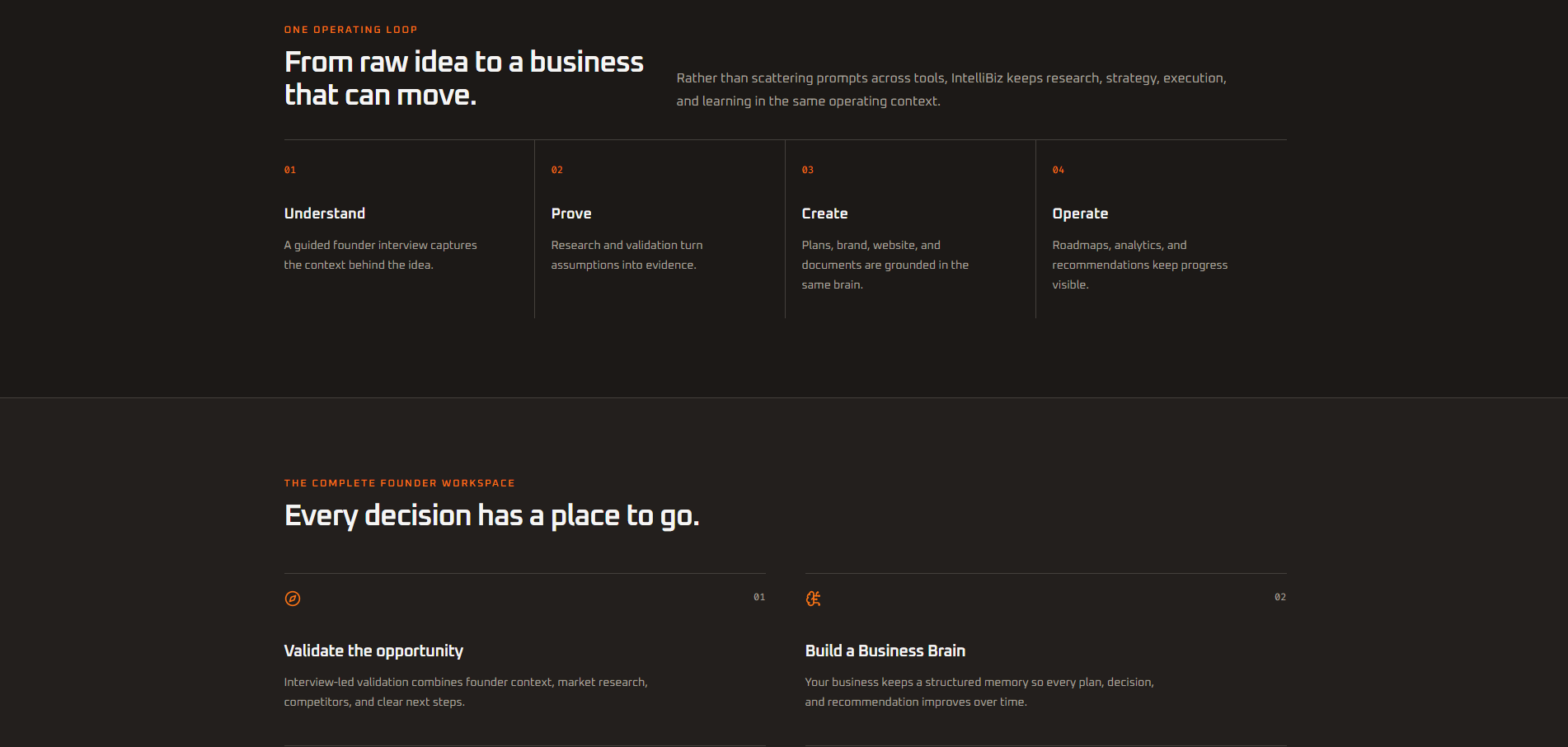
Intellibiz How it Works
-
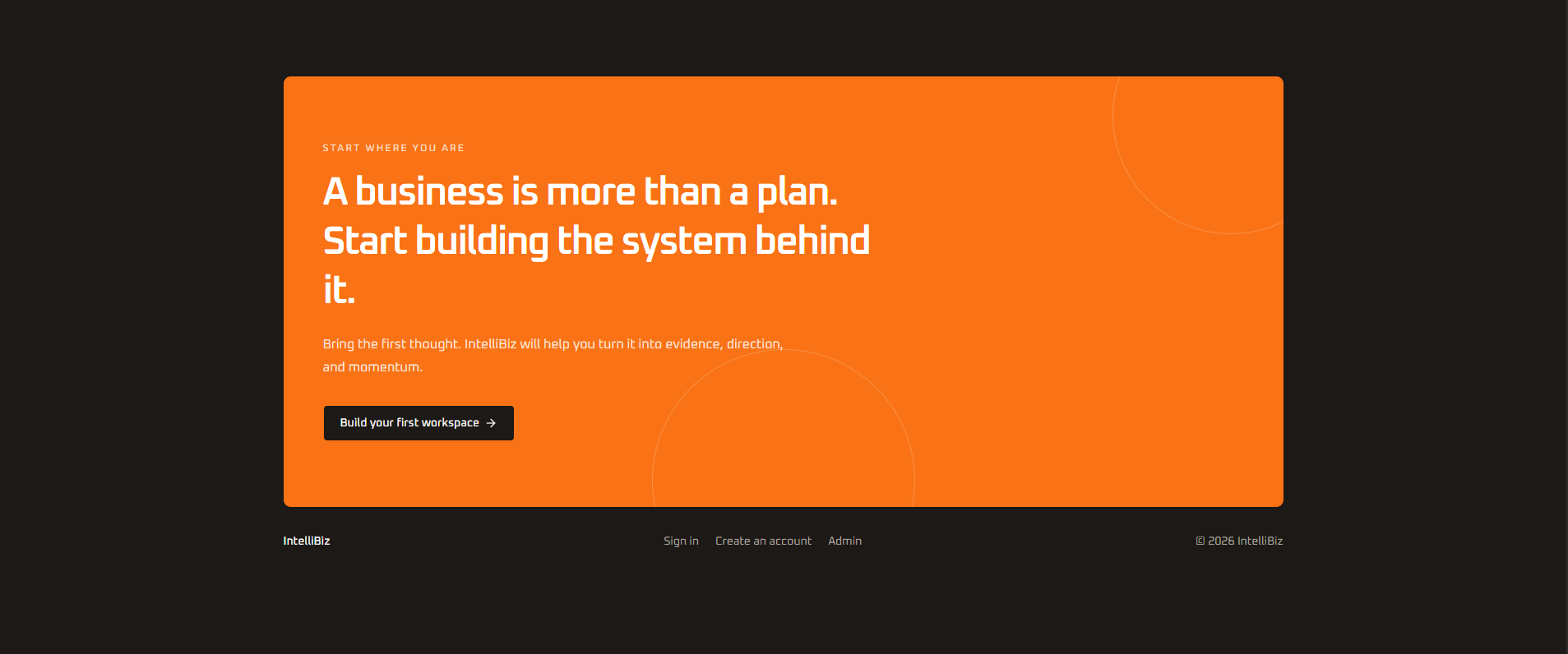
Intellibiz CTA
-
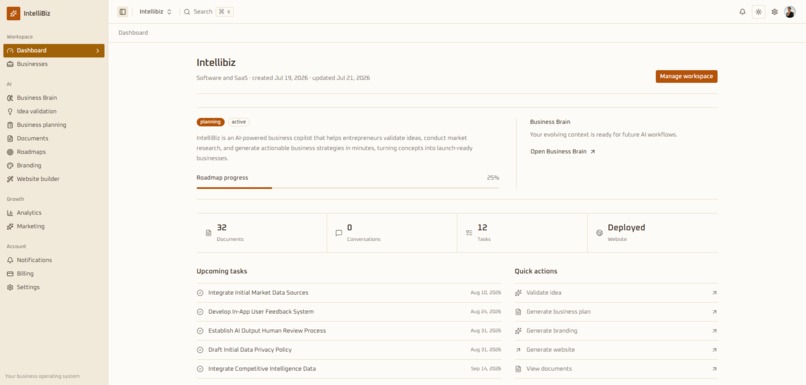
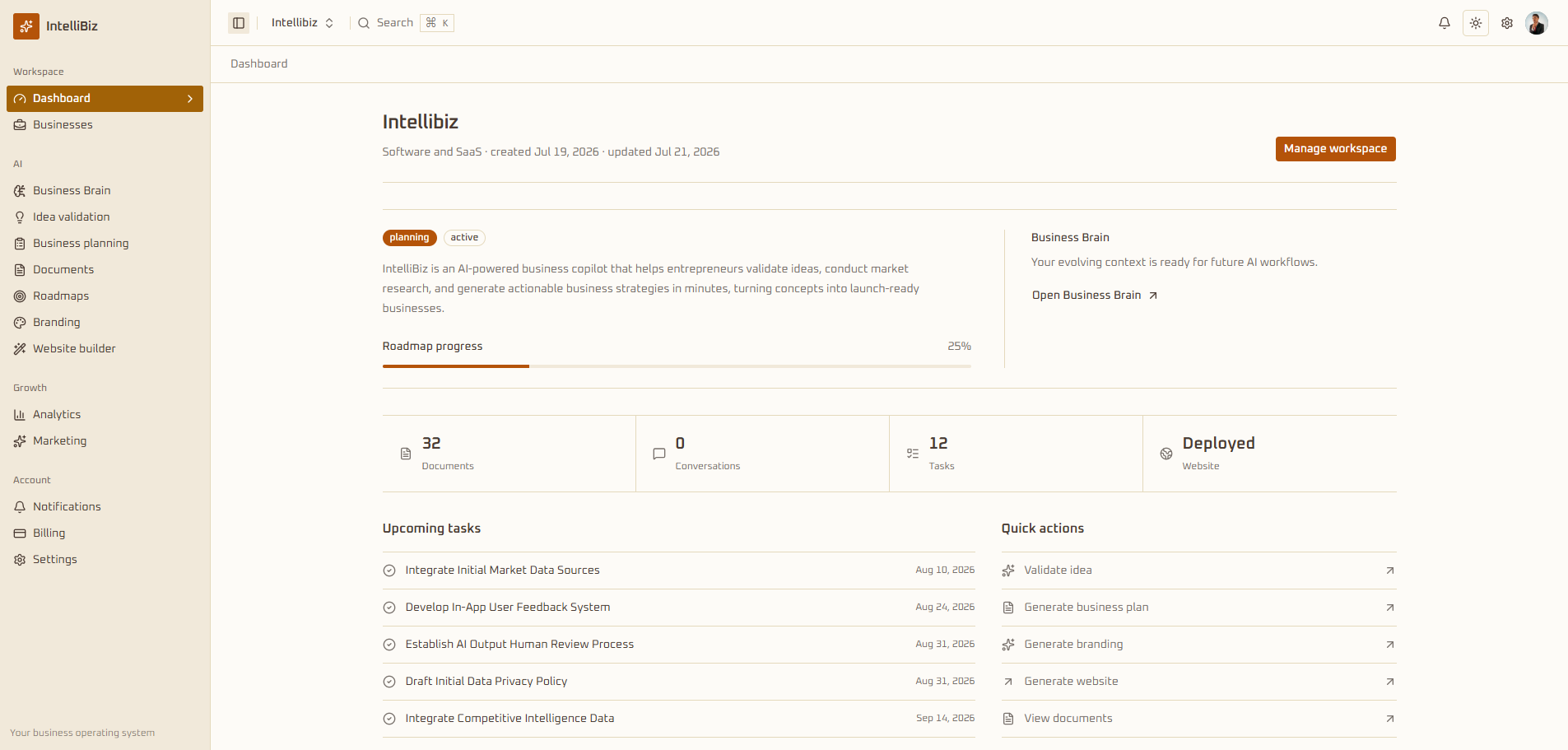
Intellibiz Workspace Dashboard
Inspiration
Building a business still means stitching together too many disconnected tools: research tabs, business-plan templates, branding tools, task lists, website builders, spreadsheets, and AI chats that forget everything from the previous conversation. We wanted to give founders a more coherent starting point.
IntelliBiz is our answer: an AI-native Business Operating System that helps an entrepreneur move from an early idea to a launch-ready business from one connected workspace. Its central idea is the Business Brain which is a persistent, evolving knowledge base for each business. Instead of treating AI as a one-off prompt generator, IntelliBiz lets every workflow build on the research, decisions, strategy, brand, roadmap, and progress that came before it.
What it does
IntelliBiz guides founders through the practical journey of building a business:
- Create and manage one or more business workspaces, each with its own Business Brain and semantic memory.
- Complete a guided founder interview, then receive researched idea validation with market and competitor analysis, opportunities, risks, recommendations, citations, and an opportunity score.
- Turn a validated idea into living strategic artifacts: a Lean Canvas, Business Model, Business Plan, SWOT analysis, Revenue Strategy, and Pricing Strategy.
- Generate a complete brand system with name and slogan options, colour and typography recommendations, voice, logo briefs, and a reusable brand guide.
- Convert strategy into milestones, atomic tasks, timeline windows, weekly goals, and progress tracking through an AI roadmap.
- Generate a responsive, branded marketing website from the accumulated business context, previewed in a live E2B sandbox.
- Produce versioned Investor Memos, 14-slide Pitch Decks, and 90-day Marketing Plans, with Markdown, JSON, and print-to-PDF exports.
- Track revenue, goals, execution, business health, and AI-generated next actions in a decision-oriented analytics workspace.
- Stay informed through a priority-aware notification centre, preference-aware email delivery, and scheduled weekly and monthly business reports.
The platform also includes secure user onboarding and preferences, billing foundations for Stripe and Paystack, and an admin control centre for operating the platform. All long-running AI work is durable, visible to the founder as it progresses, and designed to recover cleanly when a run needs to be retried.
How we built it
IntelliBiz was built through an AI-orchestrated product-development process. We began by turning each feature into a detailed specification with ChatGPT, then used Codex, primarily GPT-5.6 (medium), for roughly 90% of the work, to implement the product incrementally. We tested features end to end at every stage; whenever an issue emerged, Codex GPT-5.6 helped us trace it, fix it, and verify the result.
Technically, IntelliBiz is a Next.js 16 and React 19 application written in TypeScript, with Tailwind CSS and shadcn/ui for the interface. Clerk handles authentication; Prisma and Neon Postgres store the product data; pgvector enables semantic Business Brain retrieval; and Inngest orchestrates durable background workflows. The AI layer uses Vertex AI/Gemini with Zod-validated structured outputs, Tavily for live research, Firecrawl for competitor extraction, and E2B for isolated website builds and previews. We also integrated Google Cloud Storage, Upstash Redis, Nodemailer/Gmail SMTP, Stripe, and Paystack as part of the wider platform foundation.
The most important architectural decision was treating the Business Brain as the shared source of truth. Each completed workflow reads the relevant business context, writes back only its new knowledge, and refreshes semantic memory. That gives a founder continuity across validation, planning, branding, roadmap generation, documents, websites, and analytics rather than a set of unrelated AI outputs.
Challenges we ran into
The largest technical challenge was the Website Builder. Our first E2B sandbox template took too long to build on the sandbox server. We had to step back, research the sandbox constraints, and manually wire a leaner template. With Codex GPT-5.6, we pushed the revised template to E2B and brought the build time down to under three minutes, making the live preview workflow practical for the MVP.
We also hit an Inngest deployment issue on the free tier: the deployed functions failed to sync because of configuration and setup constraints. After surfacing the issue to Codex GPT-5.6, we corrected the configuration almost immediately and made the workflow concurrency compatible with the Hobby plan.
More broadly, reliable AI orchestration required careful guardrails. We learned to validate every model output, make provider-facing schemas compatible, explicitly restate constraints that models can lose during schema conversion, distinguish retryable from deterministic failures, and give founders clear progress and restart paths for durable jobs.
Accomplishments that we're proud of
- We built a connected end-to-end founder journey rather than a collection of isolated AI generators.
- The Business Brain preserves business context across the platform and is enriched by every meaningful workflow.
- Idea validation is research-driven and evidence-based, not just a generic chat response.
- Core outputs are durable and versioned: founders can revisit, export, and regenerate plans, brand systems, roadmaps, websites, and investor-facing documents.
- The website builder produces a branded, responsive Next.js marketing site from strategy and business context, then builds it in an isolated E2B environment.
- We built with production-minded foundations: ownership checks, Zod validation, structured AI outputs, workflow recovery, background orchestration, analytics snapshots, notification preferences, and admin controls.
- We took the product from an initial foundation through sixteen detailed feature specifications, continually testing and refining each stage with GPT-5.6.
What we learned
We learned that AI works best in a product when it has durable context, clear boundaries, and verifiable outputs. A powerful model alone is not enough; the surrounding system, research tools, schemas, memory, retries, workflow state, permissions, and an interface that explains what is happening, is what makes the experience dependable.
We also learned how effective an orchestration-first development loop can be. Detailed specifications gave the work a stable direction, while Codex GPT-5.6 enabled rapid implementation, debugging, and end-to-end iteration. The result was not just faster code generation, but a disciplined way to build a complex system feature by feature.
What's next for Intellibiz
Next, we will complete live billing verification by configuring production Stripe Price IDs, recurring Paystack plan codes, and webhook secrets. We will finish the live admin-login verification after securely configuring the admin secret, then continue hardening deployment and monitoring.
From there, we want to move website previews from temporary E2B sandboxes to durable publishing on business-name.intellibiz.app, add custom domains and editing, and expand the operating system with team collaboration, richer marketing workflows, deeper integrations, and additional notification channels. The long-term goal remains the same: one intelligent workspace that helps founders build, launch, and grow a business without losing context along the way.
Built With
- clerk
- codex
- e2b
- firecrawl
- google-cloud
- gpt-5.6
- inngest
- nextjs
- pgvector
- postgresql
- prisma
- shadcn
- tailwind
- tavily
- typescript
- vetexai


Log in or sign up for Devpost to join the conversation.