-
-
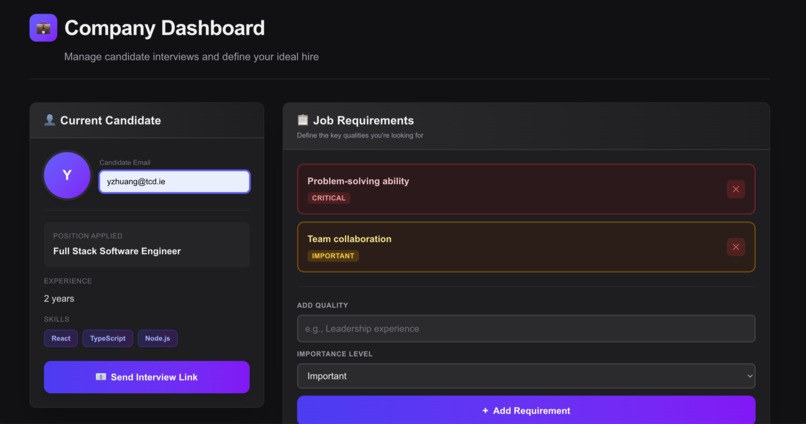
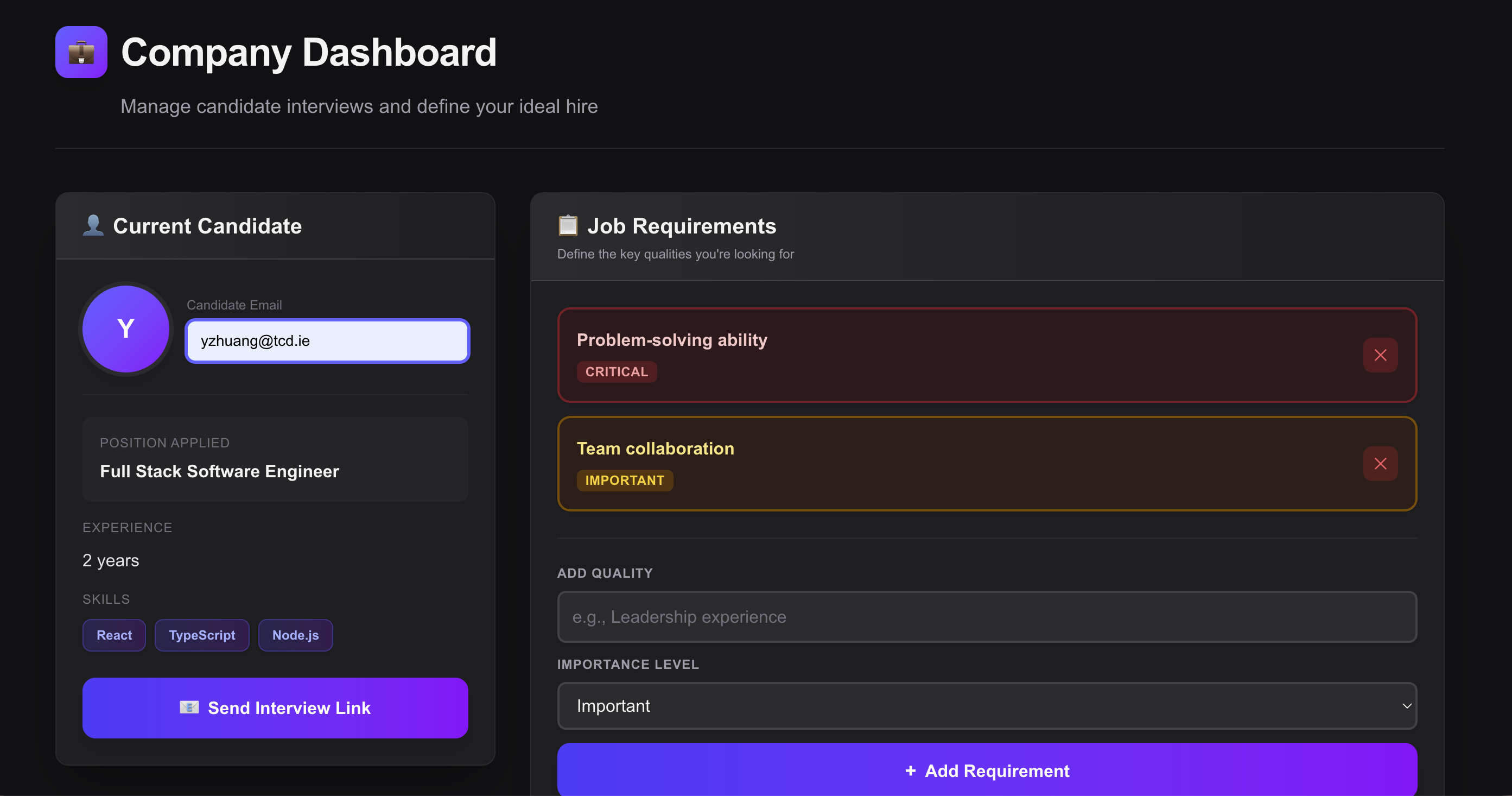
Company Dashboard
-
-
Inspiration
The traditional hiring process is broken. Candidates use AI to write perfect CVs and mass apply to hundreds of roles. Companies use AI to screen those same applications. The result? Candidates wait three months only to receive a generic rejection email with zero feedback on how to improve. We wanted to build something that changes that: an AI-powered interview agent that streamlines the assessment process for companies and gives candidates a fairer, more transparent experience.
What it does
Intelliview is a browser-based AI interview agent that works directly with candidates to assess both their technical competency and interpersonal skills. For software engineering roles, it simulates the real interview pipeline, from online assessments with coding challenges to behavioral questions but with a key difference: the AI engages candidates in conversation, evaluating not just whether they get the right answer, but how they think through problems and communicate their approach. Companies get a dashboard with structured data on each candidate's performance, and candidates get the feedback they've always been missing.
How we built it
We built Intelliview using TypeScript/Next.js as our core framework, structuring the platform into two main interfaces: a company dashboard and a candidate portal.
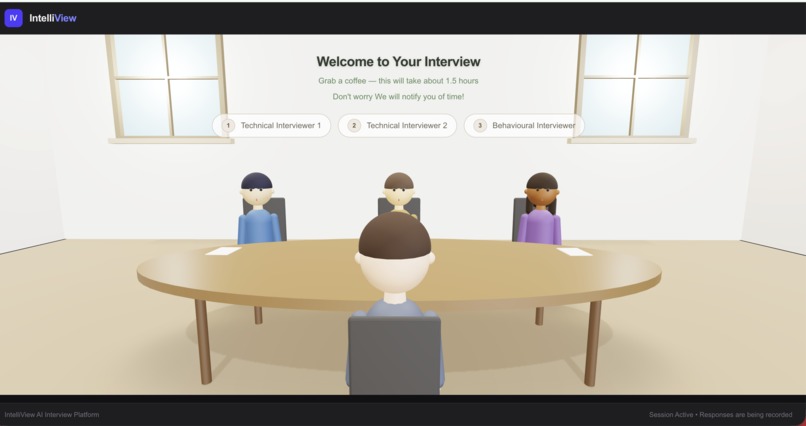
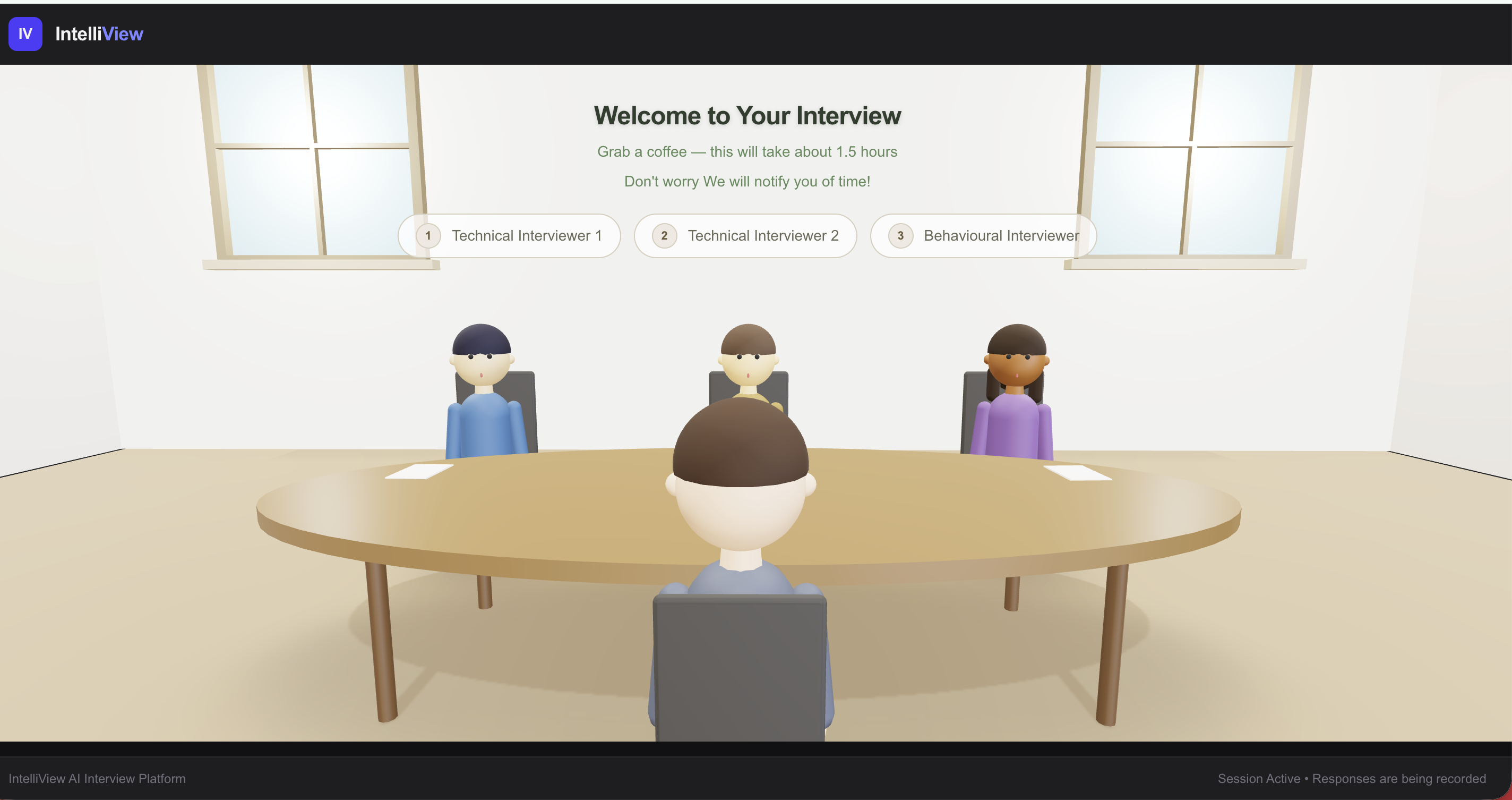
For the candidate experience, we used Three.js to render an immersive 3D conference room environment with three virtual interviewers, striking a balance between professionalism and interactivity. Candidates move through three interview rounds, two technical and one behavioral, with simulation scenarios woven into each stage.
Our AI agents conduct and evaluate interviews in real time, assessing not just technical correctness but also thought process, logical reasoning, and alignment with company culture. All interview conversations are stored in MongoDB, which the agents then analyze to generate scores (Technical /10, Behavioral /10) and an overall average. Once the interview concludes, two API endpoints simultaneously deliver a feedback report and hiring recommendation to both the candidate and the hiring manager's dashboard.
Email invitations to candidates are handled via Nodemailer with a Gmail business account, and the platform was deployed on Vercel.
Challenges we ran into
Email configuration: Setting up Nodemailer with a business Gmail account required navigating app passwords and two-factor authentication, which was more involved than expected. MongoDB team access: Adding a new team member to the database required IP whitelisting and updating environment variables, which caused delays and required thorough testing of data storage and retrieval. 3D UI design: Building a 3D interview environment with Three.js that felt both professional and interactive required significant iteration to get right. Agent design philosophy: Tuning the AI agents to guide candidates toward answers without ever revealing the solution, mirroring how a real interviewer behaves, required careful prompt engineering. Speech integration: We attempted to integrate ElevenLabs for voice capabilities but ran out of time to fully implement it. The groundwork is there, but it remains a stretch goal for future development.
Accomplishments that we're proud of
We're proud of designing a system that addresses a genuine pain point from both sides of the hiring table. The modular pathway approach means Intelliview isn't locked into one role type, it can expand to other domains beyond software engineering.
What we learned
We learned how much of the real-world interview process is opaque and inefficient. Rather than replacing human judgment, AI can add value by structuring and enriching it. We also learned that building an AI hiring tool responsibly means confronting hard questions about data storage, bias, surveillance, and regulation.
What's next for Intelliview
Next, we want to expand beyond the software engineering pathway to cover other roles and industries. Our goal is to deploy an agent that can understand any role's responsibilities and autonomously generate tailored challenges to assess a candidate's skill set. We're exploring how candidate interaction data with proper consent and GDPR compliance, this could potentially be used to train better AI models for assessing talent. We also plan to build out the company dashboard with richer analytics on candidate performance, and refine the AI agent's ability to evaluate interpersonal and communication skills alongside technical ability.
Built With
- claude
- elevenlabs
- mongodb
- nextjs
- typescript
- vercel

Log in or sign up for Devpost to join the conversation.