-
-
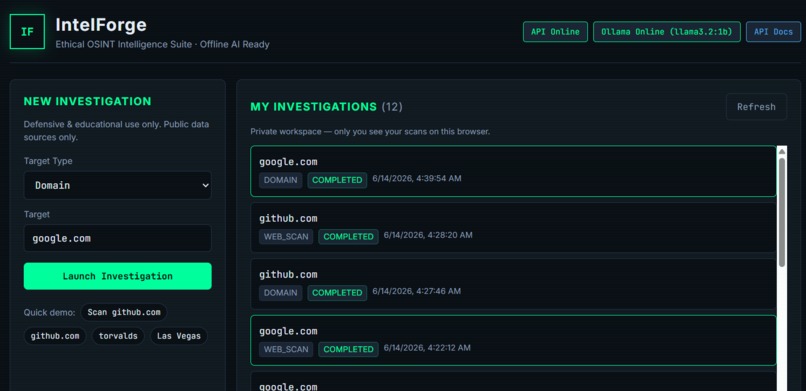
Search
-
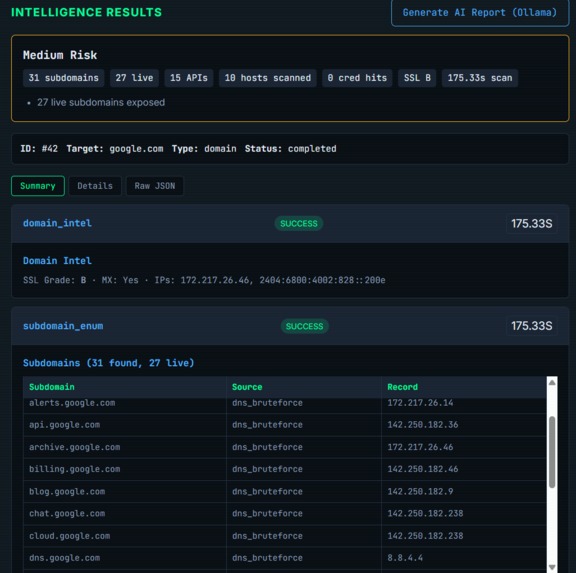
Result
-
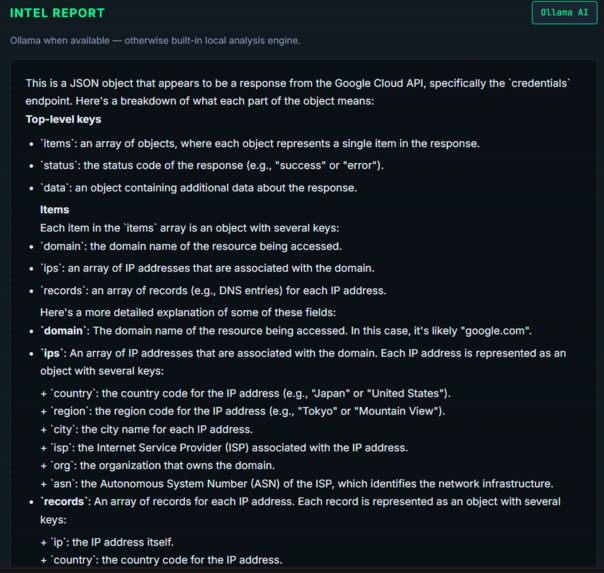
Ollama Report
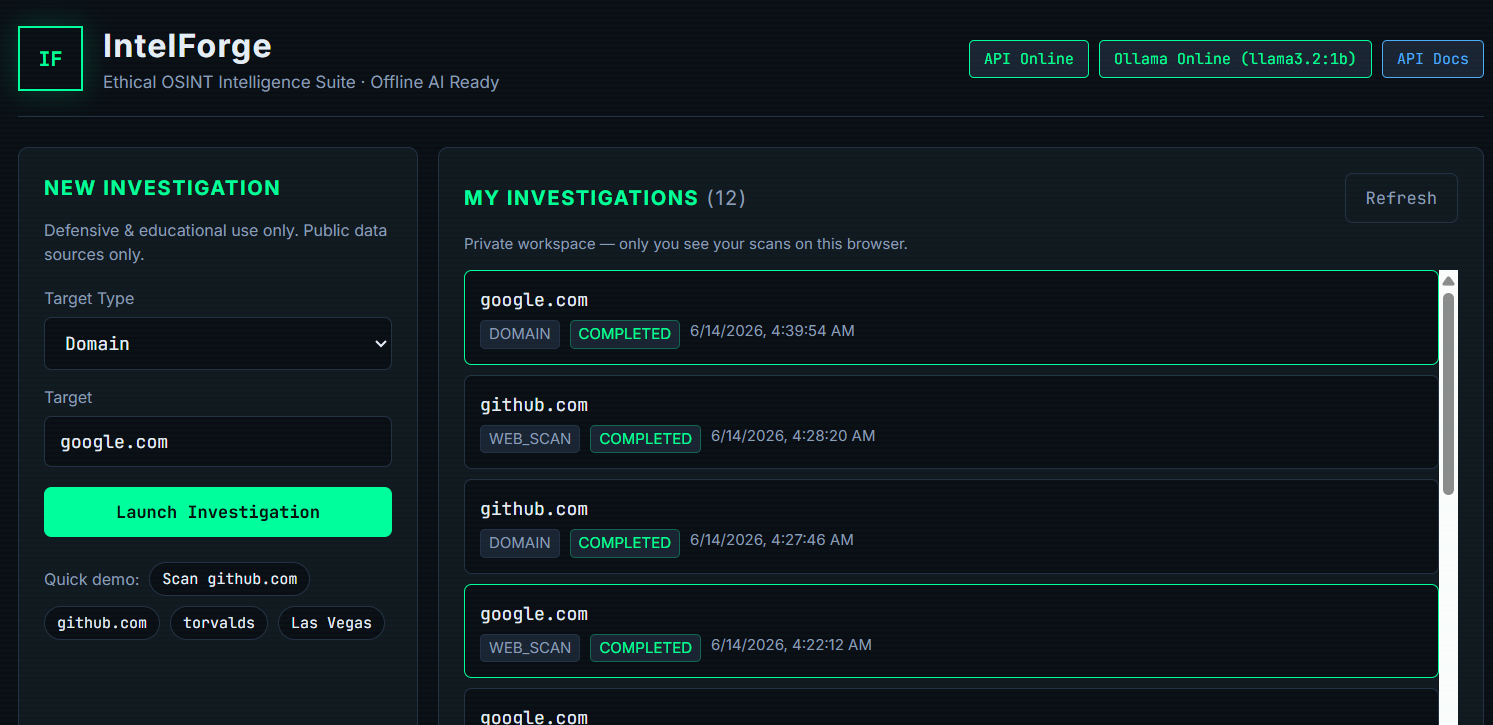
Inspiration
Security teams and researchers need to turn public data into actionable intelligence — without sending sensitive findings to the cloud. We built IntelForge for the Black Hat Zone hackathon to combine OSINT, defensive scanning, and offline AI in one ethical, local-first tool.
What it does
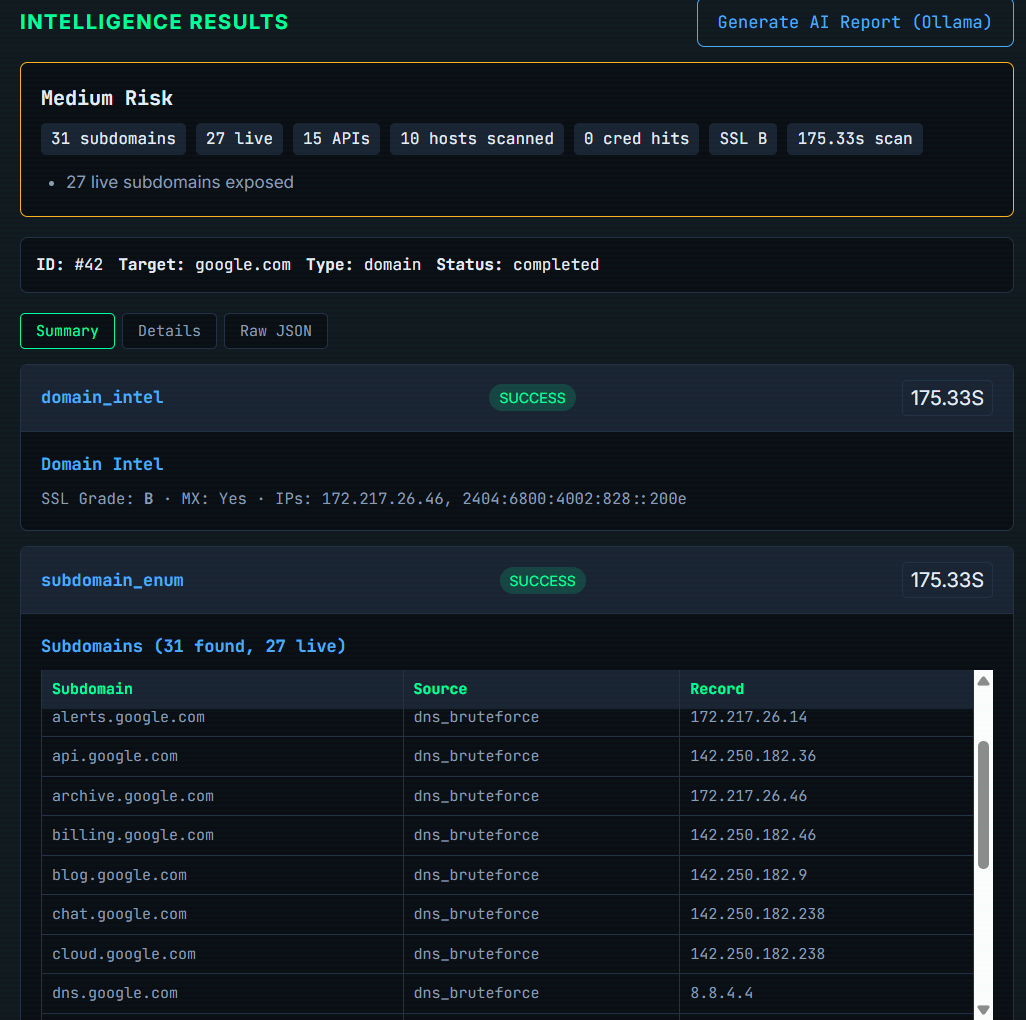
IntelForge is a web-based OSINT suite that runs deep investigations across five target types:
- Web Scanner — subdomain enumeration, API discovery, and hardcoded credential detection (masked output)
- Domain — DNS, WHOIS, SSL grading, exposure scan, and IP/ASN lookup
- Email — MX validation, SPF/DMARC checks, optional breach lookup, and domain exposure scan
- Username — footprint across 35+ public platforms with GitHub deep dive
- Location — multi-source geocoding with reverse lookup and nearby context
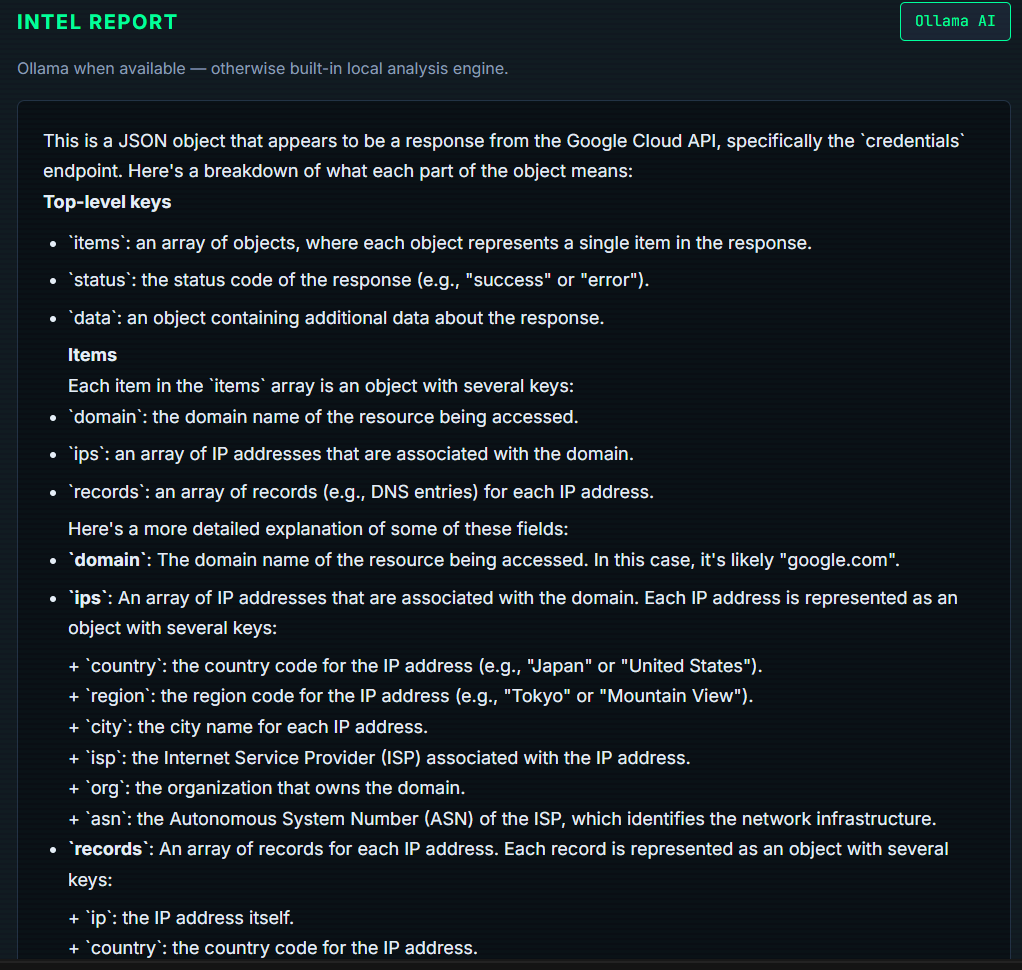
Results feed into a risk summary and optional AI report generated by Ollama locally, with a built-in fallback engine when Ollama is offline.
How we built it
- Backend: Python, FastAPI, SQLite — modular collectors in
backend/collectors/ - OSINT: httpx, dnspython, crt.sh, Nominatim, Open-Meteo, ip-api.com
- Frontend: Dark-themed dashboard (HTML/CSS/Vanilla JS) with per-target scan progress
- AI: Ollama integration + rule-based local report engine
- Architecture: Collectors → orchestration service → SQLite → dashboard → offline report
Each investigation type runs a multi-phase deep scan (typically 3–4 minutes) using real public data sources only.
Challenges we ran into
- Scan reliability on Windows — auto-reload left stale server processes; fixed by disabling reload by default and requiring clean restarts
- Long-running scans — web and domain scans take minutes; balanced UX with progress steps and clear wait messaging
- Platform rate limits — GitHub and other sites block or throttle requests; added batched checks and GET fallbacks
- Geocoding edge cases — vague queries like event names failed; added query expansion across multiple geocoding sources
- Ethical boundaries — designed credential scanning to mask secrets and restrict scans to authorized targets only
Accomplishments that we're proud of
- One tool covering OSINT, cyber defense, and offline AI — all three hackathon tracks
- End-to-end pipeline: investigate → risk summary → AI report → Markdown export
- Deep scans that return real collector data, not placeholder UI
- Fully local AI option — no cloud API keys required for core functionality
- Clean modular codebase ready for demo and review
What we learned
- OSINT tools must balance depth vs. speed — users need honest progress feedback during multi-minute scans
- Passive recon (crt.sh, DNS, public HTTP) is powerful for defensive audits when used ethically
- Offline AI (Ollama) adds strong demo value but needs a fallback for machines without a GPU or LLM installed
- Process management matters on Windows — dev ergonomics directly affects whether scans appear "broken"
What's next for IntelForge
- PDF report export and investigation sharing links
- Scheduled re-scans and change detection for monitored targets
- Optional API keys (HIBP, Shodan) as plug-in collectors
- Faster caching layer for repeat scans on the same target
- Mobile-friendly dashboard layout
Built With
- docker
- fastapi
- javascript
- ollama
- python
- sqlite

Log in or sign up for Devpost to join the conversation.