-
diagram
Inspiration
A NAS is where people keep the files they can't afford to lose: contracts, tax records, legal evidence, family archives. Yet when you ask "has anything in here changed?", the honest answer is usually "I don't know". Ransomware, a bad sync, an accidental save or silent disk corruption (bit rot) can alter a file without anyone noticing, and modification dates prove nothing, because they're trivial to reset. Forensic investigators solve this with cryptographic hashes and a sealed record of them. I wanted to bring that evidence-grade technique to anyone with a UGREEN AI NAS, through a single conversational request.
What it does
Integrity Sentinel has two modes:
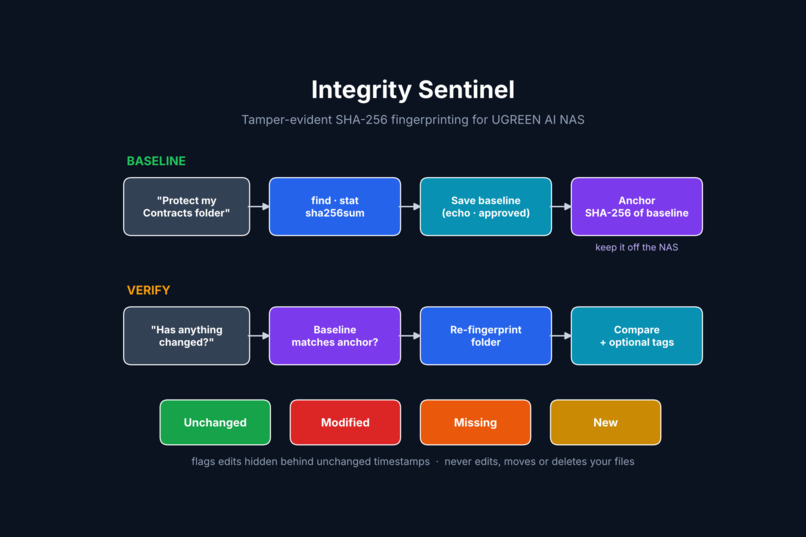
- Baseline: "Protect my Contracts folder." It fingerprints every file with SHA-256 (plus size and modification time), saves the fingerprints to a baseline file you choose, and gives you a 64-character anchor: the SHA-256 of the baseline file itself, which you keep off the NAS.
- Verify: "Has anything in Contracts changed?" It checks the baseline against your anchor, fingerprints the folder again, and classifies every file as unchanged, modified, missing or new. If you opt in, it tags suspicious files
integrity-alertso you can find them in the file manager.
Two details make it more than a checksum list:
- Hidden-edit detection. A file whose hash changed but whose timestamp didn't is flagged explicitly. That's the signature of someone trying to hide a change.
- A tamper-evident record. An attacker who edits files can also rewrite the baseline, but can't match an anchor stored somewhere else. Finding two different files with the same hash would take about \( 2^{128} \) work, so a matching anchor means the baseline is untouched.
The Skill never edits, moves or deletes your files. Its only writes, the baseline file and the optional tags, go through the platform's approval gateway.
How I built it
Integrity Sentinel is an orchestration Skill that follows the Uliya Skill Development Standard:
- Every NAS operation is delegated to
file-agentwith self-contained instructions:find,statandsha256sumto fingerprint,echoto save the baseline, a read to check it, andtag-add/tag-add-filefor alerts. - The Skill itself only compares the real results it gets back and writes the report. It never invents paths or hashes, and if a required value is missing, it stops.
- The baseline uses a versioned plain-text format that both modes parse the same way.
- All five delegation states are handled:
completed,failed,cancelled,waiting_userandwaiting_approval. That includes not retrying a write automatically after a cancellation. - Validated with the official
check-skill.mjs: static-pass, 0 errors, 0 warnings.
Challenges
- No custom code. My first idea was threshold encryption, but Skills can't run their own scripts and the NAS exposes no encryption capability. I redesigned around what the platform does natively, SHA-256, and moved the cleverness into the workflow.
- Trusting the record itself. A list of hashes is only as good as its integrity. The anchor closes that gap at no extra cost.
- Honest edge cases. An empty folder, more than 500 files, a partially fingerprinted folder and a renamed file all needed explicit, truthful handling instead of a silent "all clear".
What I learned
Strong security in an AI-agent world comes less from new algorithms than from disciplined orchestration: bounded scope, explicit approvals, reporting only verified facts, and putting the trust anchor out of the attacker's reach.
What's next
If selected as a finalist:
- Validate on a real NAS: an edit, a deletion and an addition on a 50-file folder, a tampered baseline, and a hidden edit with the timestamp restored.
- Add batched runs for large folders.
- Add rename detection, which matches a missing file to a new file with the same hash.
- Add scheduled re-verification.
Built With
- file-agent
- markdown
- sha-256
- ugos
- ugreen-ai-nas
- uliya-skill-kit
