Inspiration
When an embedded project fails, the bug rarely comes with a clear label. Is it the code, the wiring, the component, or the interaction between them?
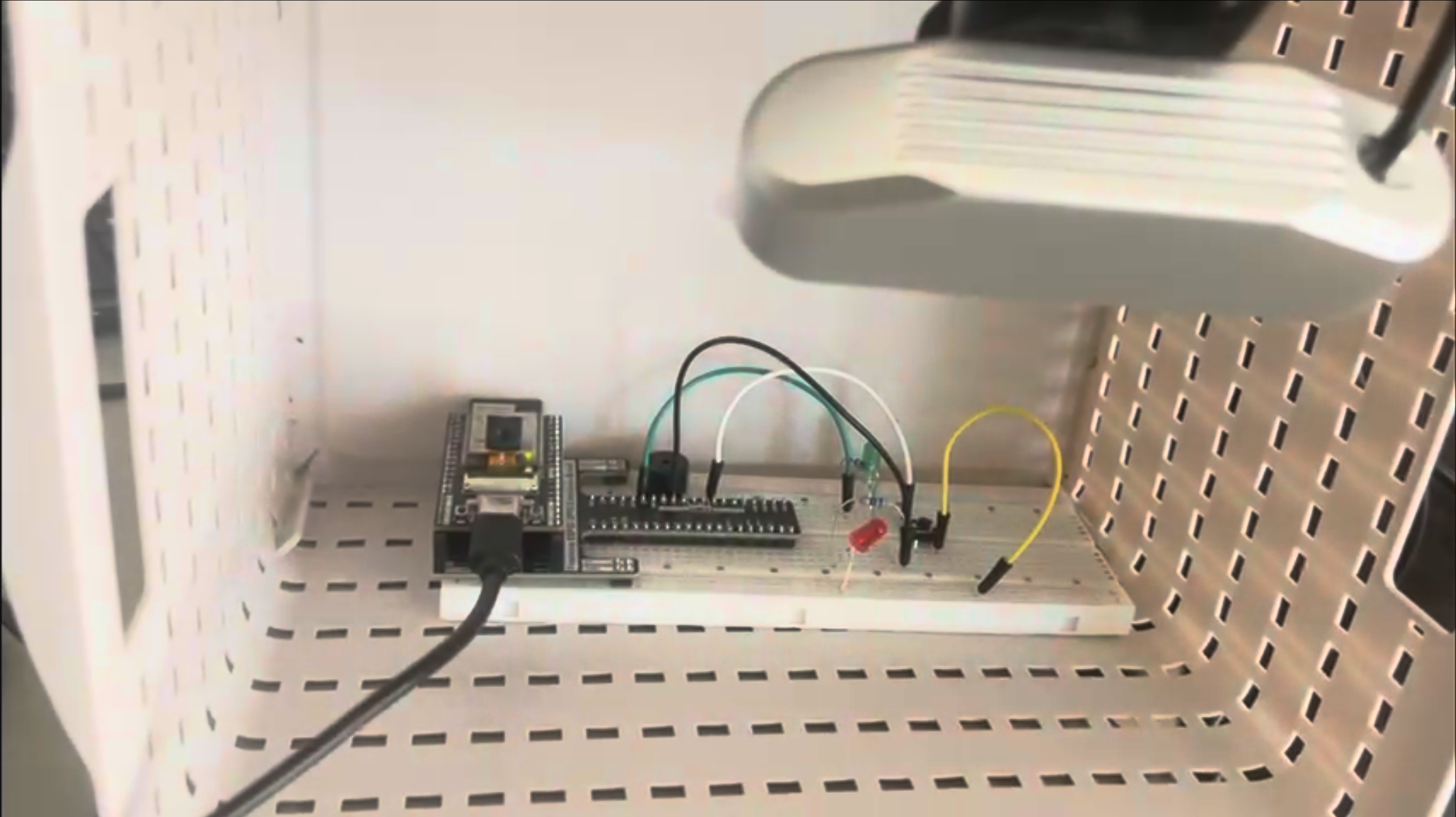
We ran into this while building with an ESP32. Our code editor could show us the firmware, but it couldn't see the breadboard. A camera could see the LEDs, but it couldn't explain which code controlled them. We built inteGREAT to bring that context together and help engineers debug across the hardware/software boundary.
What it does
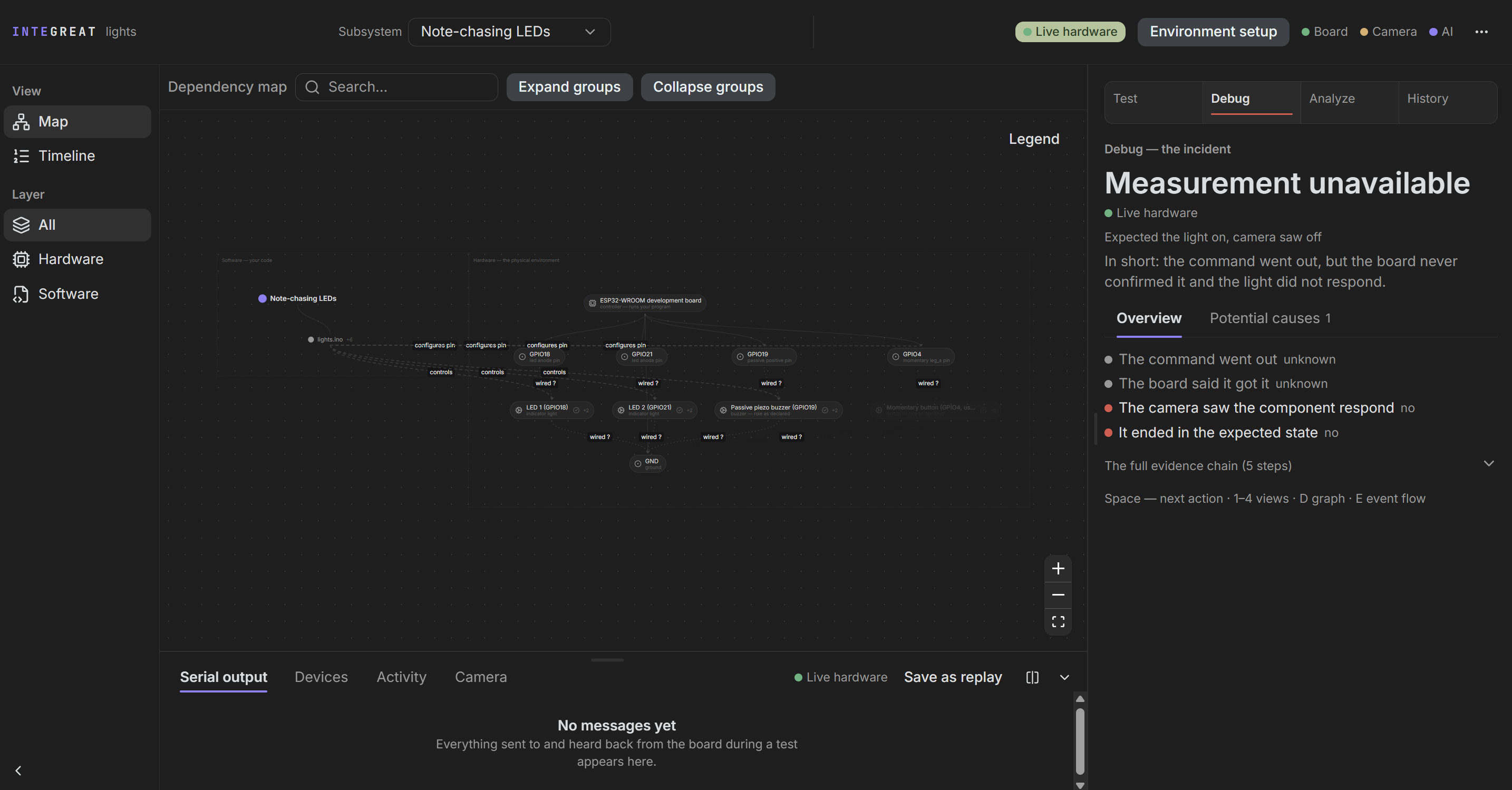
inteGREAT is a graph-first debugging workspace for ESP32 Arduino projects. It connects:
- Source code
- Declared wiring
- Runtime logs
- Camera observations
This lets engineers investigate a failure in one place. With inteGREAT, engineers can:
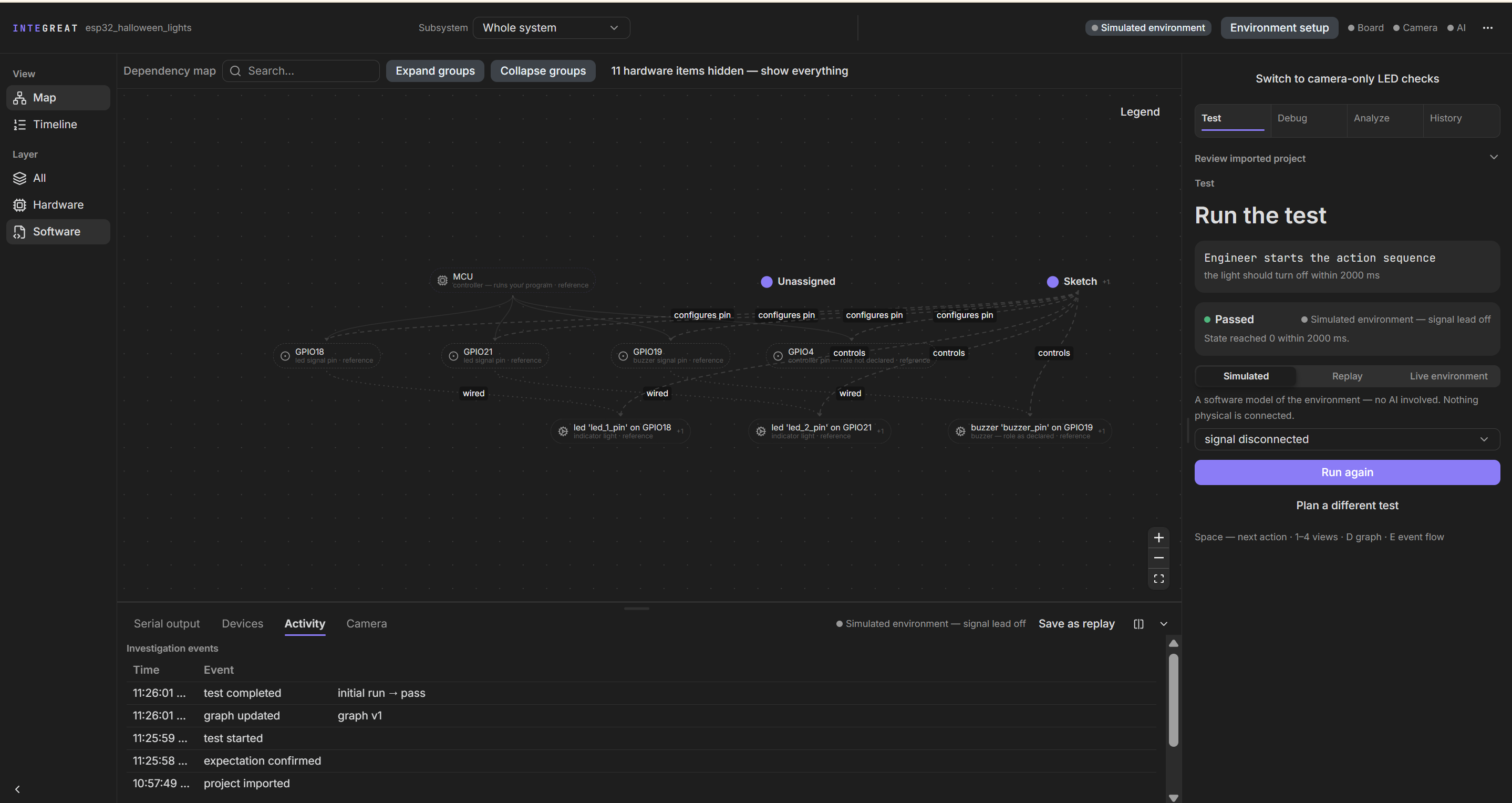
- Inspect dependencies across code and hardware
- Run supported tests
- Review evidence-backed hypotheses
- Choose a diagnostic action
- Rerun the test after a repair to check whether the observed behavior now matches the expectation
How we built it
- Frontend: React + TypeScript, with an interactive dependency graph
- Backend: Python FastAPI service that imports Arduino source and YAML hardware manifests to connect software functions, GPIO pins, and physical components
- Vision: OpenCV powers camera-based observations, including a two-LED visual test workflow
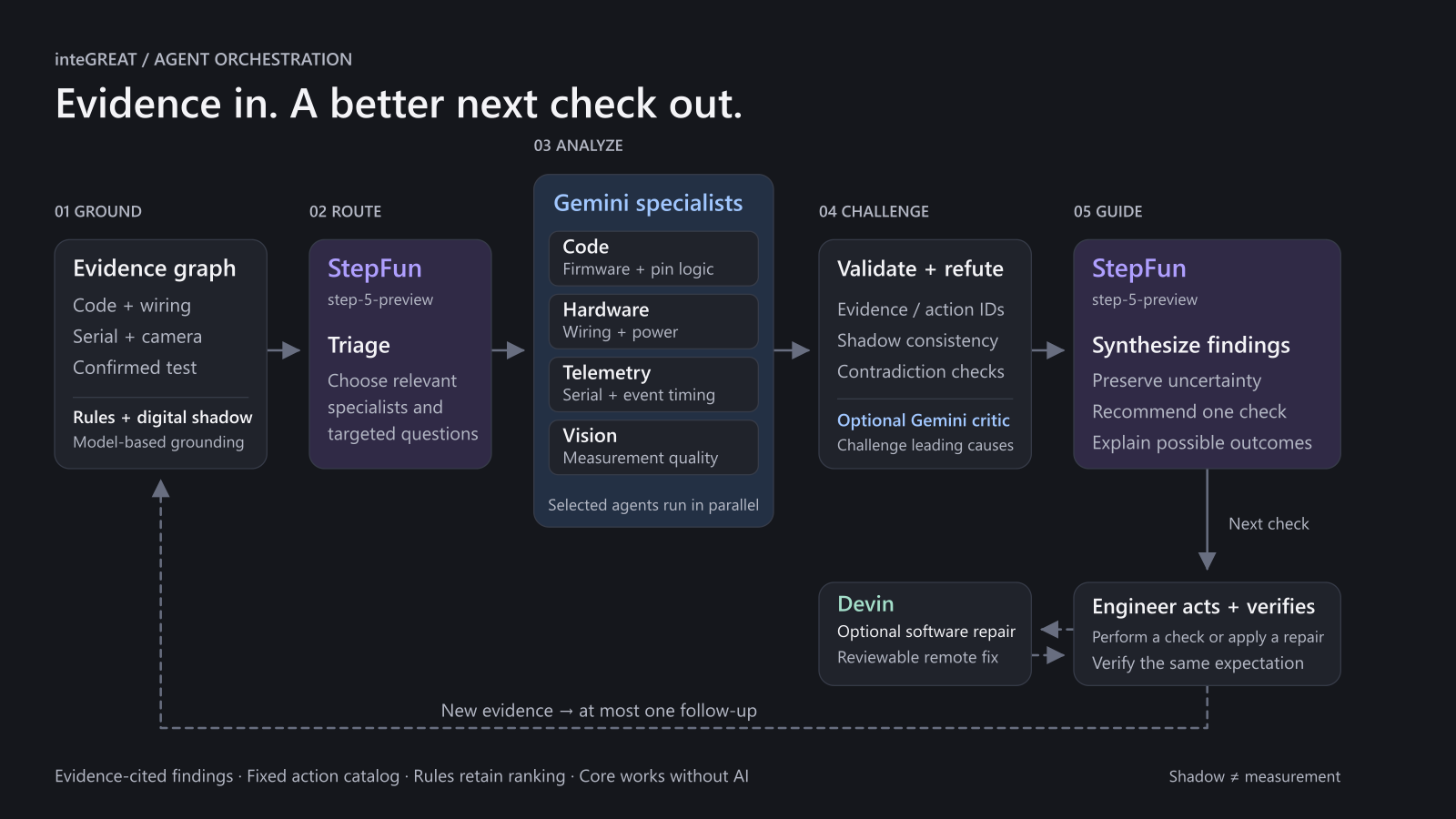
- AI:
- StepFun's Step 5 Preview for investigation coordination and synthesis
- Gemini for specialist analysis
- Devin for engineer-requested, reviewable software repair proposals
- Fallback: Deterministic rules provide a foundation that keeps working when AI services are unavailable
Our ESP32 demo combines alternating LEDs, a passive buzzer, and a button that toggles playback.
Challenges we ran into
The hardest challenge was separating what the system observed from what it could only infer. A dark LED could mean a software issue, a disconnected wire, or an obstructed camera view. We had to preserve that uncertainty instead of treating every unexpected image as a hardware failure.
We also worked through:
- Camera connectivity
- GPIO assignments
- Asynchronous AI responses
- Keeping evidence linked to the correct investigation
Connecting these pieces while keeping the interface understandable was as much a design challenge as an engineering one.
What we learned
Debugging assistance is only as good as its context. A useful explanation needs traceable evidence, clear limits, and a concrete next step.
We also learned that general infrastructure and specialized measurements work well together. The graph and evidence workflow can support many systems, but each physical behavior still needs an appropriate detector and test.
What's next for inteGREAT
- Validate more workflows on real hardware
- Connect the LED visual workflow to the existing AI investigation pipeline
- Expand support to more components and embedded platforms
- Longer term: adapters for logic analyzers, multimeters, and oscilloscopes, so inteGREAT has stronger electrical evidence alongside code and camera observations
Built With
- arduino
- c++
- devin
- esp32
- fastapi
- geminiapi
- github
- opencv
- pydantic
- pytest
- python
- react
- reactflow
- sqlite
- stepfun
- typescript
- vite
- vitest
- websockets
- yaml


Log in or sign up for Devpost to join the conversation.