-
-
Alert Lens - Integration RunBook Copilot
Inspiration
Integration support teams are drowning in alert noise. Every day, on-call engineers receive dozens of monitoring emails from MuleSoft, SnapLogic, and other iPaaS platforms—each containing error codes, timestamps, and stack traces buried in HTML tables. Stitching these alerts into a coherent incident, prioritizing by impact, and deciding what to check first takes valuable time during outages.
We wanted to build an AI copilot that thinks like an L3 integration engineer: reading alerts, reasoning about root causes, calling observability APIs for live context, and generating a step-by-step runbook—all in seconds.
What it does
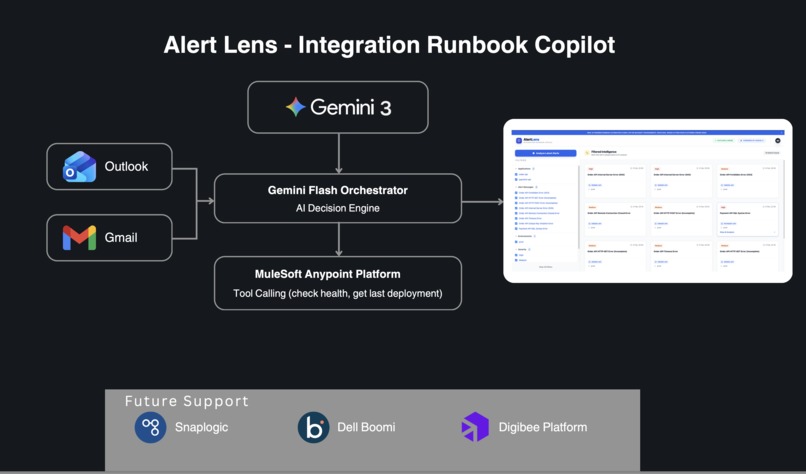
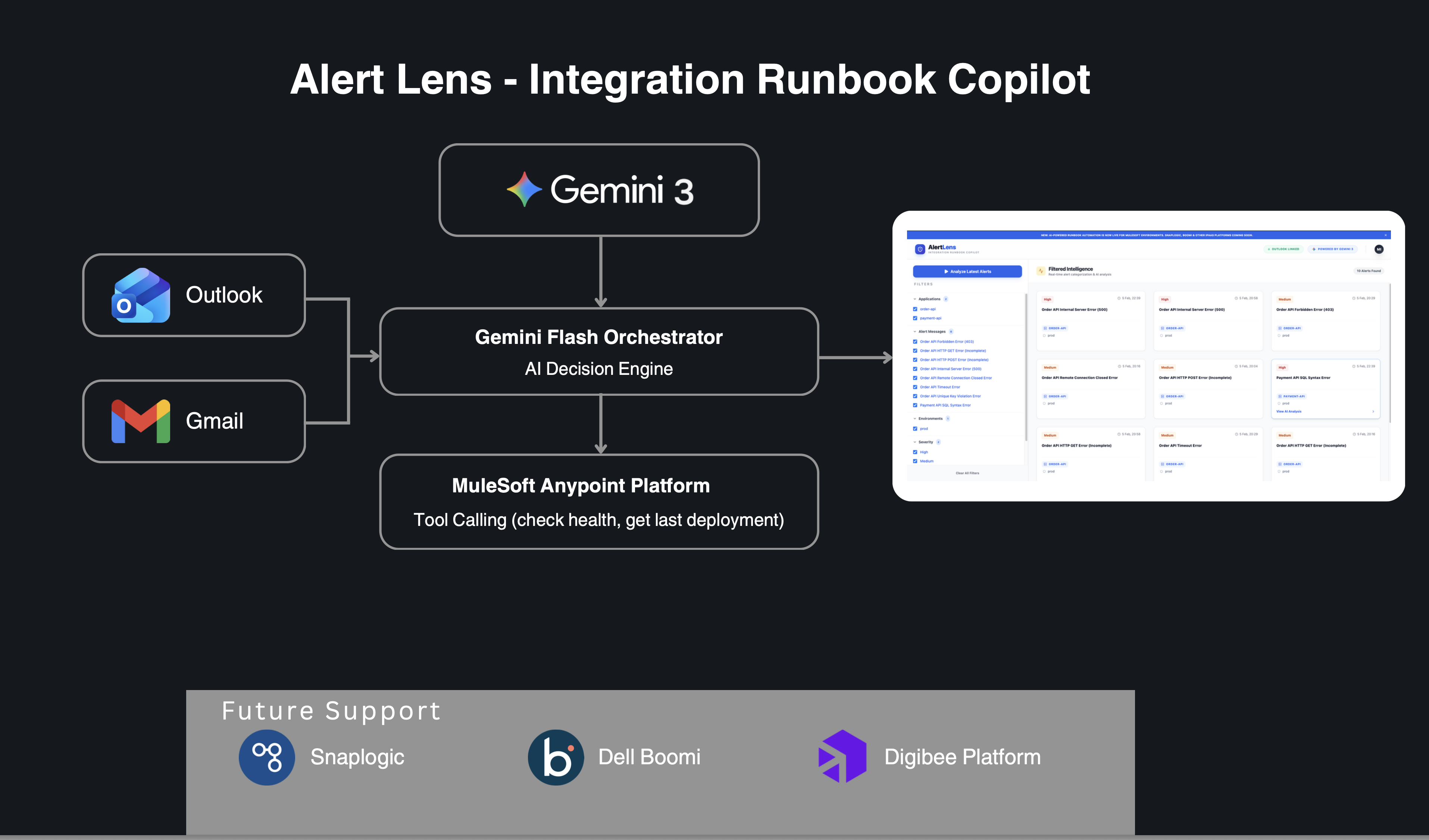
AlertLens (Integration Runbook Copilot) pulls monitoring alert emails from Outlook or Gmail, normalizes them into structured incident data, and sends them to Gemini 3 with a specialized prompt.
Gemini:
- Groups related alerts into incidents by service, environment, and error pattern.
- Prioritizes incidents (prod connectivity failures rank as Critical, QA data issues as High/Medium).
- Calls MuleSoft observability APIs as tools (
get_service_status,get_last_deployment,run_smoke_test) to gather live health data. - Generates a runbook with:
- Incident summary
- Root cause hypotheses with confidence scores
- Step-by-step remediation checklist, annotated with tool results
Engineers can also use agentic search: type "show only prod SAP→Salesforce failures from today" and Gemini filters and re-analyzes on the fly.
How we built it
Architecture:
- Frontend: React SPA built with Lovable/Antigravity, deployed at integration-copilot.lovable.app
- Backend: MuleSoft flows exposed as REST API:
- Alerts ingestion module: Calls Microsoft Graph API to fetch emails from an Outlook alerts folder, normalizes them into
Alert[]using DataWeave. - Gemini orchestrator: Builds Gemini 3 Flash requests with structured output schema (JSON for incidents + runbook), handles tool-calling protocol (execute MuleSoft observability flows, pass results back to Gemini).
- Observability APIs: Internal MuleSoft flows that mock service health, last deployment metadata, and synthetic checks.
- Alerts ingestion module: Calls Microsoft Graph API to fetch emails from an Outlook alerts folder, normalizes them into
- AI: Gemini 3 Flash with:
- Structured output for predictable JSON (incidents, hypotheses, steps).
- Tool calling to query MuleSoft APIs mid-reasoning.
Key flow:
- User clicks "Analyze Latest Alerts" or types an agentic query.
- Backend fetches alert emails from Outlook.
- Gemini groups alerts, identifies top incident, requests tools.
- Backend calls MuleSoft observability flows, returns results to Gemini.
- Gemini finalizes runbook with live data inlined.
- UI renders incidents list + detailed runbook with tool badges.
Challenges we ran into
- Tool-calling in Mule: No official Gemini connector for MuleSoft, so we hand-crafted the HTTP requests and function-calling protocol using DataWeave and flow orchestration.
- Parsing messy alert emails: Real monitoring emails vary wildly in format (HTML tables, plain text, different error codes). We built robust DataWeave transformations with regex to extract service, environment, severity, and error summaries.
- Balancing speed vs. accuracy: We tested Gemini 3 Flash vs. Pro; Flash gave us sub-5-second responses with good-enough hypotheses, which is critical for on-call UX.
- Agentic search UX: Making natural-language queries feel intuitive required careful prompt engineering so Gemini could interpret vague queries like "recent prod errors" into precise filters.
Accomplishments that we're proud of
✅ Full Gemini 3 integration in MuleSoft—proving you can build agentic workflows in iPaaS platforms, not just Node/Python.
✅ Tool calling works end-to-end—Gemini decides when to call get_service_status, and the runbook reflects live MuleSoft health data.
✅ Structured output eliminates parsing—the UI is basically a JSON renderer; no fragile regex on Gemini responses.
✅ Agentic search feels natural—engineers can ask questions instead of fighting filter dropdowns.
✅ Built in 48 hours—from architecture diagram to working demo with real Outlook alerts.
What we learned
- Gemini 3's tool calling is a game-changer for operations AI. Instead of just summarizing, it can actively investigate by calling APIs, then incorporate that context into its reasoning.
- Structured output + JSON Schema = reliable UI integration. We spent zero time debugging "Gemini returned markdown instead of JSON."
- MuleSoft as an AI orchestration layer works well. DataWeave is expressive enough to build Gemini request bodies, and flow-based tool routing is cleaner than spaghetti if/else in code.
- Natural language UX lowers cognitive load. On-call engineers loved typing "prod failures today" instead of selecting 3 dropdowns and a date picker.
What's next for AlertLens
- Multi-platform support: Extend observability tool calling to SnapLogic, Boomi, Digibee, and Workato.
- Ticketing integration: Auto-create Jira/ServiceNow tickets with the runbook pre-filled.
- Feedback loop: Let engineers mark hypotheses as correct/incorrect to fine-tune prompts over time.
- Proactive alerts: Instead of waiting for emails, poll MuleSoft Runtime Manager APIs and trigger runbook generation when anomalies are detected.
- MCP refactor: Expose Outlook and observability as MCP servers so other Gemini agents can reuse them.
Built with: Gemini 3 Flash, MuleSoft Anypoint Platform, Microsoft Graph API (Outlook), React, Lovable
Live demo: https://integration-copilot.lovable.app/
GitHub: [https://github.com/MuleCraft/gemini-alert-copilot]


Log in or sign up for Devpost to join the conversation.