Integrated Smart Waste Management System (ISWMS) An AI-Powered Solution for Sustainable Waste Management, Recycling, Renewable Energy, and Smart City Integration Project Category: Smart City & Environmental Sustainability Prepared By: Innovative Bloomers
Abstract Rapid urbanization and population growth have significantly increased municipal solid waste generation, creating major environmental and public health challenges. Conventional waste management systems primarily rely on manual collection schedules and inefficient segregation methods, resulting in overflowing waste bins, poor recycling rates, increased landfill usage, greenhouse gas emissions, and higher operational costs. The Integrated Smart Waste Management System (ISWMS) is an intelligent, technology-driven solution that integrates Artificial Intelligence (AI), Machine Learning (ML), Internet of Things (IoT), Robotics, Automation, Cloud Computing, and Renewable Energy to modernize the complete waste management lifecycle. The proposed system performs automatic waste identification and segregation, monitors waste levels in real time, detects hazardous conditions, optimizes collection routes, promotes recycling, and converts suitable waste into renewable energy. The system also provides a centralized Smart City Dashboard for municipal authorities, enabling data-driven decision-making and efficient resource management. By integrating advanced technologies with sustainable waste processing, ISWMS contributes to cleaner cities, improved public health, reduced environmental pollution, and progress toward smart and sustainable urban development. Keywords: Artificial Intelligence, Smart Waste Management, Internet of Things, Smart Cities, Recycling, Waste-to-Energy, Robotics, Sustainability.
Introduction Waste management has become one of the most pressing environmental challenges worldwide. According to international environmental studies, rapid urbanization, industrialization, and changing consumption patterns have dramatically increased municipal solid waste generation. Inefficient waste collection and improper disposal contribute to air pollution, water contamination, greenhouse gas emissions, and numerous public health concerns. Traditional waste management systems often depend on fixed collection schedules rather than actual waste levels. Consequently, waste bins overflow before collection, recyclable materials become contaminated with general waste, and municipalities spend excessive resources on transportation and manual labor. Emerging technologies such as Artificial Intelligence, IoT, Robotics, and Automation provide opportunities to transform conventional waste management into an intelligent, efficient, and sustainable process. The Integrated Smart Waste Management System (ISWMS) proposes a fully automated solution that combines smart sensing, intelligent waste classification, robotic segregation, renewable energy generation, and centralized monitoring to improve urban sanitation while supporting Smart City initiatives.
Problem Statement Urban municipalities face several waste management challenges that affect environmental sustainability and public health. The major issues include: Overflowing garbage bins due to fixed collection schedules. Poor segregation of recyclable and biodegradable waste. High dependence on manual waste handling. Increasing landfill accumulation. Air, soil, and water pollution caused by improper disposal. High transportation and operational costs. Limited real-time monitoring of waste collection systems. Inefficient recycling processes. Health risks caused by hazardous and biomedical waste. Lack of integrated digital monitoring for municipal authorities. These challenges highlight the need for an intelligent, automated, and sustainable waste management system capable of optimizing the complete waste lifecycle.
Objectives The primary objectives of the proposed system are: Design an AI-powered automated waste management system. Improve waste segregation accuracy using computer vision. Enable real-time monitoring through IoT sensors. Reduce environmental pollution and landfill dependency. Increase recycling efficiency. Generate renewable energy from suitable waste. Support data-driven municipal waste management. Enhance public sanitation and health. Promote sustainable urban development.
Literature Review Recent advancements in smart city technologies have significantly improved waste management practices. IoT-enabled smart bins monitor waste levels and notify authorities when collection is required, reducing unnecessary transportation costs. Artificial Intelligence and Machine Learning have demonstrated high accuracy in identifying waste categories using image classification techniques. Deep learning models such as Convolutional Neural Networks (CNNs) have shown promising results in automated waste segregation. Robotic waste sorting systems increase recycling efficiency while minimizing human exposure to hazardous waste. Waste-to-Energy (WtE) technologies convert non-recyclable waste into electricity through thermal and biological conversion processes, reducing landfill dependency and recovering useful energy. Despite these developments, many existing systems focus on only one component of waste management. ISWMS integrates all major technologies into one comprehensive solution.
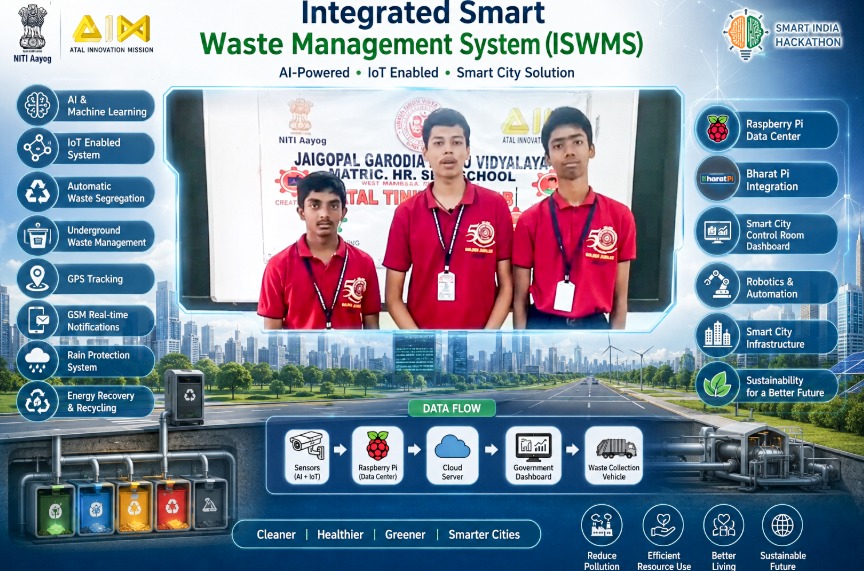
Proposed System The Integrated Smart Waste Management System consists of multiple interconnected subsystems that automate waste collection, segregation, monitoring, recycling, and energy recovery. Citizens dispose of waste through a smart inlet equipped with an AI-powered camera. The camera captures the waste image, and a trained Machine Learning model identifies its category. Robotic mechanisms automatically direct the waste into dedicated underground storage compartments. IoT sensors continuously monitor: Waste level Temperature Humidity Toxic gases Methane concentration Fire risk Flood level When storage approaches capacity, the system automatically notifies municipal authorities through the Smart City Dashboard. Organic waste is processed into compost and biogas. Recyclable waste is transferred to recycling facilities. Suitable non-recyclable waste is processed through Waste-to-Energy plants to generate electricity.
System Architecture The proposed architecture consists of six major layers. Layer 1: User Interaction Smart waste disposal inlet Touchless operation QR-based citizen identification (optional) Layer 2: AI Processing Camera captures waste image. AI identifies waste category. Machine Learning validates classification. Layer 3: Robotic Segregation Automated conveyor system. Servo-controlled sorting gates. Separate underground storage chambers. Layer 4: IoT Monitoring Sensors continuously monitor: Fill level Temperature Humidity Gas leakage Methane concentration Flooding Layer 5: Cloud Platform Data storage Analytics Predictive maintenance Historical reports Layer 6: Smart City Dashboard Municipal authorities receive: Live waste levels Collection alerts Vehicle tracking Waste analytics Energy production reports
Core Technologies The proposed system integrates multiple advanced technologies. Technology Purpose Artificial Intelligence Waste recognition Machine Learning Image classification Computer Vision Waste detection Arduino/ESP32 Hardware control IoT Sensors Environmental monitoring Robotics Automatic segregation Cloud Computing Data storage GPS Vehicle tracking Renewable Energy Electricity generation Smart Dashboard Monitoring and analytics
System Workflow The operational workflow consists of the following steps: Citizen disposes waste. Camera captures image. AI classifies waste. Robotic gates segregate waste. Waste enters underground storage. IoT sensors monitor storage conditions. Cloud platform receives sensor data. Dashboard displays real-time status. Authorities receive collection alerts. Organic waste becomes compost and biogas. Recyclables enter recycling facilities. Non-recyclable waste undergoes Waste-to-Energy processing.
Key Features AI-powered waste identification Automated waste segregation Underground smart storage IoT-based real-time monitoring Hazardous waste detection Fire and gas leakage detection Flood monitoring Smart municipal dashboard Predictive maintenance Autonomous waste collection support Drone inspection Digital waste tracking Waste-to-Energy integration Renewable energy generation Smart recycling marketplace
Waste-to-Energy Integration Waste-to-Energy (WtE) technology enables suitable non-recyclable waste to be converted into useful electrical energy. The generated electricity can supply: Street lighting Traffic management systems Public buildings Electric vehicle charging stations Emergency backup systems Benefits include: Reduced landfill volume Lower greenhouse gas emissions Renewable energy generation Improved resource utilization
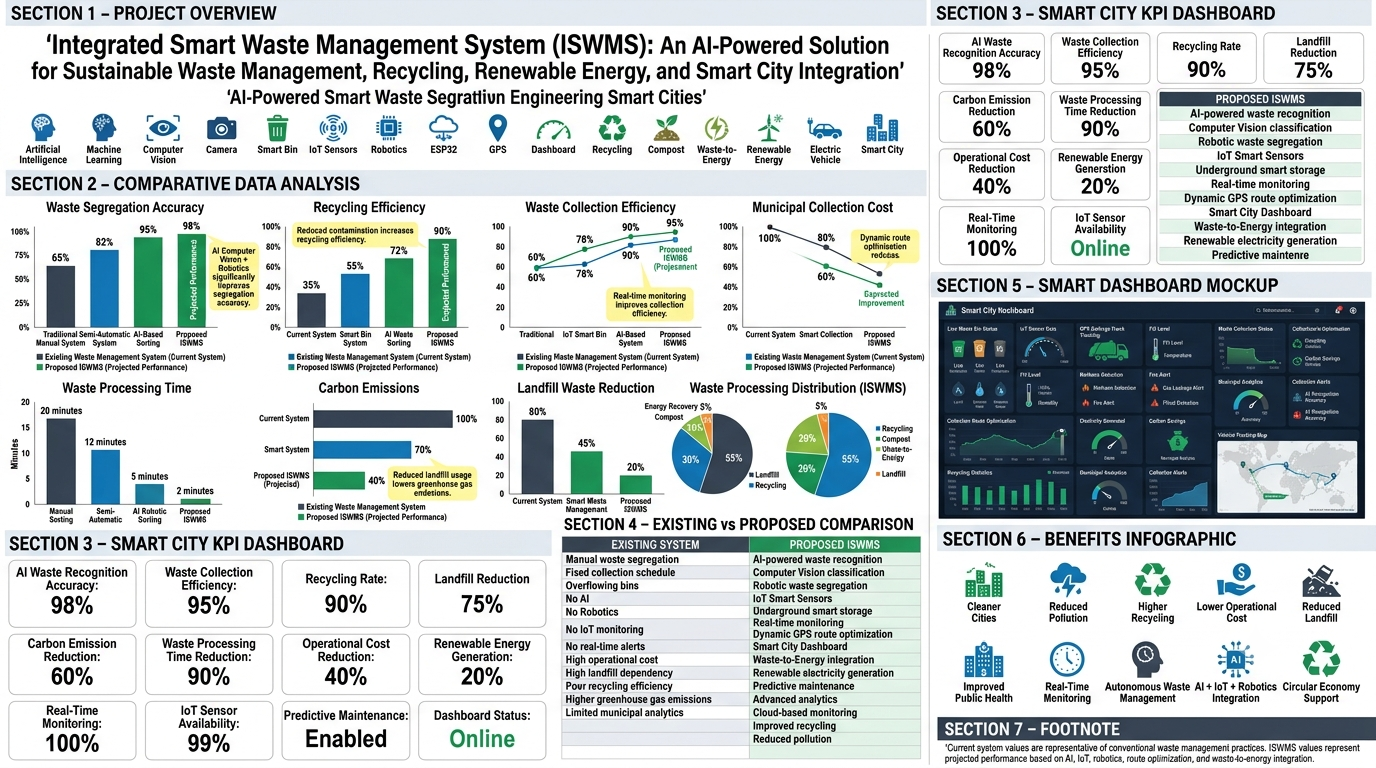
Expected Outcomes The implementation of ISWMS is expected to: Increase waste segregation accuracy. Improve recycling rates. Reduce municipal collection costs. Minimize landfill waste. Improve public hygiene. Lower greenhouse gas emissions. Generate renewable energy. Enable real-time municipal decision-making. Enhance Smart City infrastructure. Promote sustainable environmental management.
Future Scope Future enhancements include: AI-based waste generation prediction Blockchain-enabled waste tracking Digital Twin technology Carbon footprint analysis Smart recycling reward systems Autonomous electric waste collection vehicles National Smart City integration Circular economy implementation AI-powered maintenance prediction Edge AI for faster waste recognition
Advantages Fully automated operation Reduced manual labor Higher recycling efficiency Cleaner urban environments Lower operational costs Improved public health Sustainable energy production Smart City compatibility Real-time monitoring Scalable deployment
Limitations High initial implementation cost Requirement for AI model training and maintenance Dependence on reliable internet connectivity Periodic calibration of sensors Infrastructure modifications for underground storage Need for skilled technical maintenance
Conclusion The Integrated Smart Waste Management System (ISWMS) presents an innovative and comprehensive approach to modern waste management by combining Artificial Intelligence, Machine Learning, IoT, Robotics, Automation, Cloud Computing, and Renewable Energy into a single intelligent platform. The proposed system addresses key challenges associated with conventional waste management by enabling automatic waste segregation, real-time monitoring, optimized collection, recycling, and renewable energy generation. Through centralized monitoring and predictive analytics, municipal authorities can make informed decisions that improve operational efficiency and environmental sustainability. By reducing pollution, minimizing landfill dependency, promoting recycling, and supporting Smart City initiatives, ISWMS contributes to cleaner, healthier, and more sustainable urban environments. With future enhancements such as blockchain, digital twins, and autonomous waste collection, the system has significant potential for large-scale implementation in smart cities worldwide.
References World Bank. What a Waste 2.0: A Global Snapshot of Solid Waste Management to 2050. Washington, DC: World Bank, 2018. United Nations Environment Programme (UNEP). Global Waste Management Outlook. UNEP, 2015. Ministry of Housing and Urban Affairs, Government of India. Swachh Bharat Mission (Urban) Guidelines. IEEE Xplore Digital Library. Research papers on AI-based waste classification and smart waste management systems. Elsevier. Waste Management Journal. Springer. Smart Cities and Sustainable Urban Development. World Health Organization (WHO). Safe Management of Wastes from Health-Care Activities.
Built With
- artificial-intelligence-(ai)
- internet-of-things-(iot)
- machine-learning-(ml)
- robotics
- smart-cities
- smart-waste-management
- sustainability
- waste-to-energy


Log in or sign up for Devpost to join the conversation.