Insurix — AI-Powered Insurance Intelligence
The Problem
Health insurance policies are often lengthy, complicated, and difficult for ordinary people to understand. Important information such as coverage limits, exclusions, waiting periods, deductibles, co-payments, room-rent restrictions, and treatment-specific sub-limits is buried across multiple sections of policy documents.
As a result, people often struggle to answer some of the most important questions:
- Is my treatment covered under my insurance policy?
- Are there any waiting periods or exclusions?
- How much will my insurance actually pay?
- How much will I have to pay from my own pocket?
Understanding whether a treatment is covered is only half the problem. Knowing the potential financial responsibility before undergoing treatment is equally important.
Our Solution
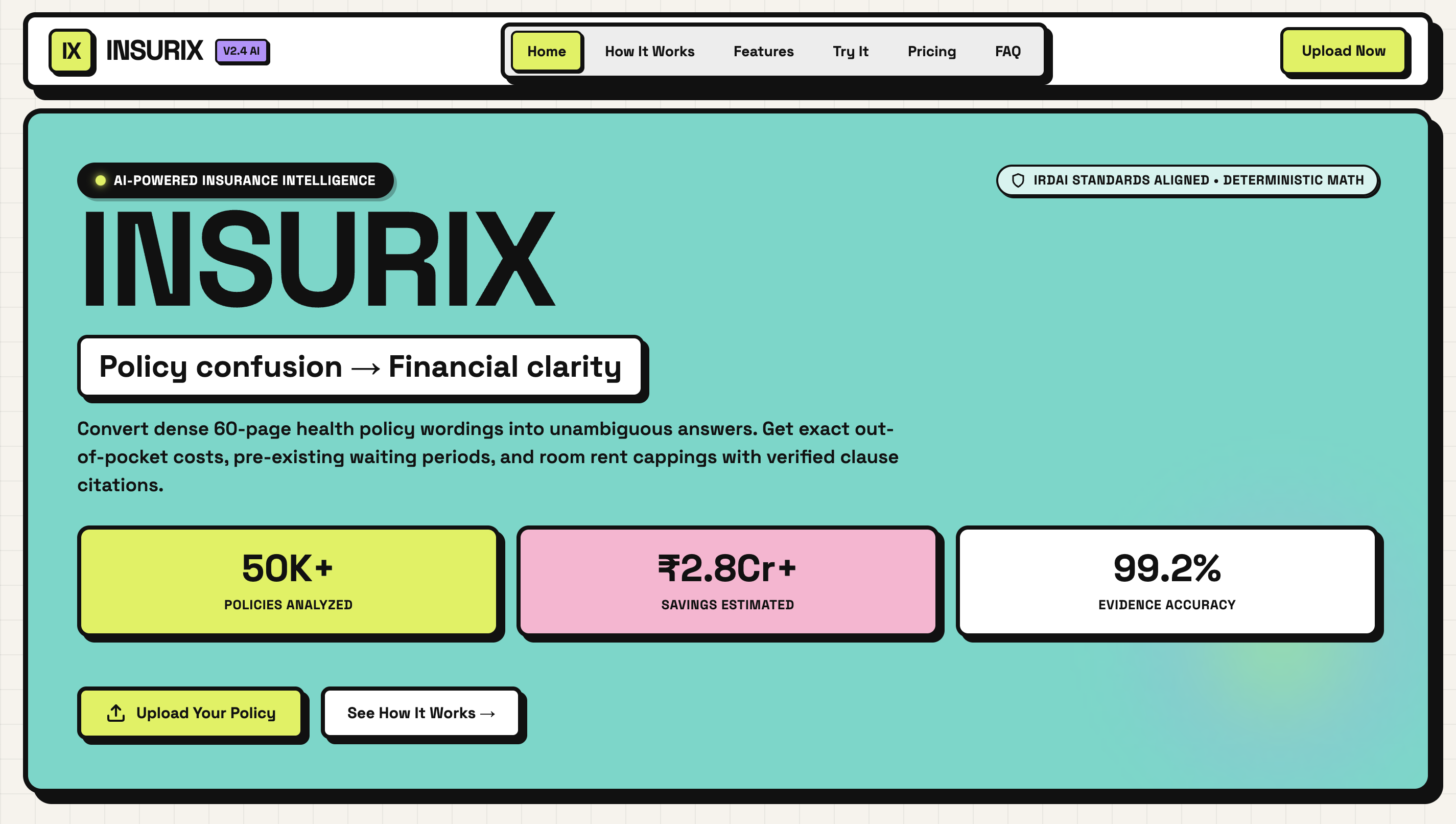
Insurix is an AI-powered Health Insurance Policy Intelligence Assistant that transforms complex insurance documents into understandable, evidence-backed coverage insights and treatment cost estimates.
Instead of manually searching through dozens of pages, users can upload their health insurance policy and interact with it conversationally.
Insurix connects policy information with actual treatment scenarios to help users understand both their insurance benefits and their potential financial liability.
How It Works
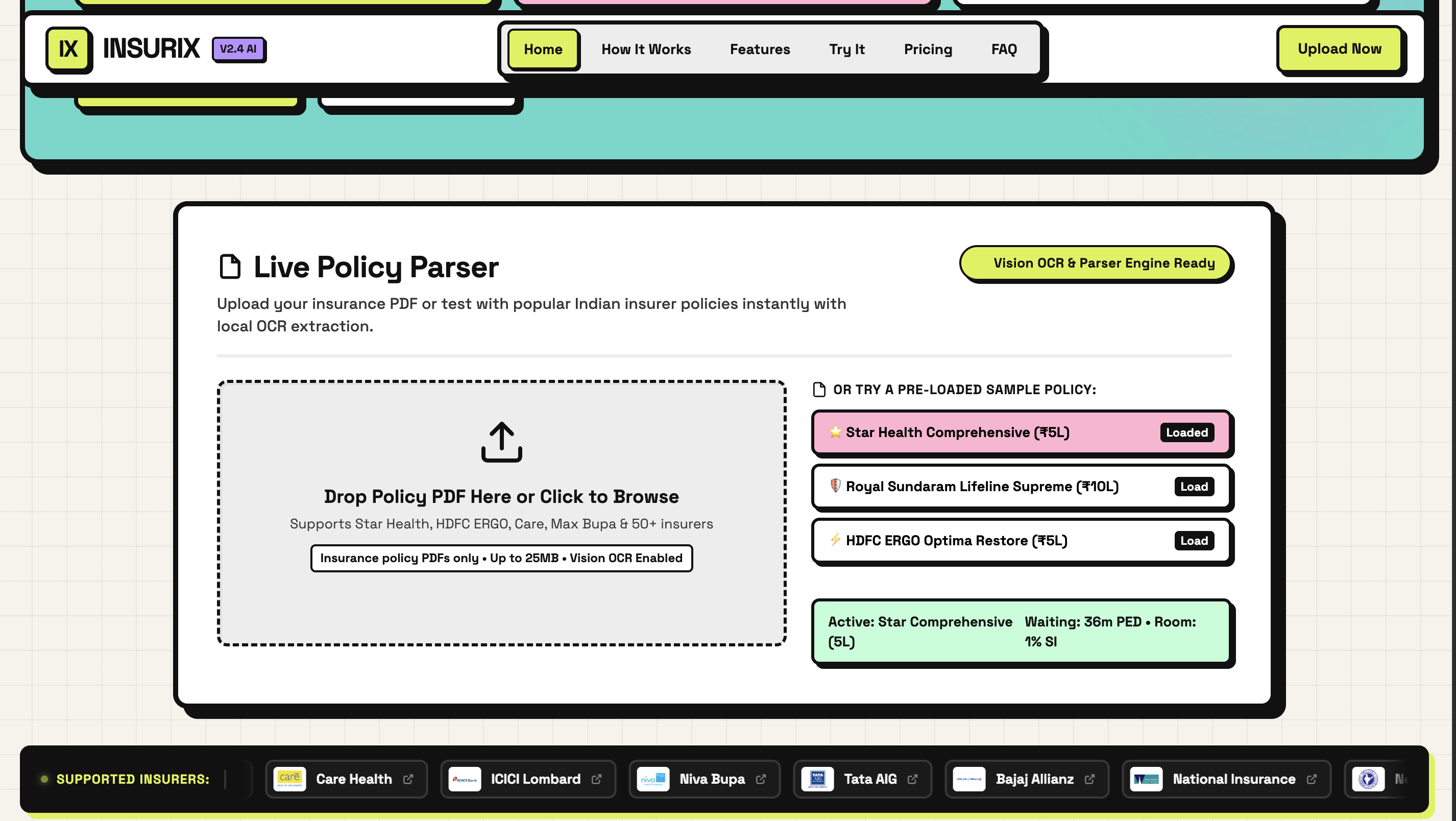
1. Upload Your Policy
Users upload their health insurance policy in PDF format. The system processes the document and extracts relevant information, including coverage clauses, exclusions, waiting periods, deductibles, co-payments, and sub-limits.
2. Intelligent Policy Understanding
Using document processing, structured information extraction, and Retrieval-Augmented Generation (RAG), Insurix builds a searchable knowledge base of the uploaded policy.
3. Conversational Policy Assistant
Users can ask natural-language questions such as:
- Is knee replacement surgery covered?
- What is my room rent limit?
- Does my policy cover pre-existing diseases?
- What are the waiting periods?
- Which treatments are excluded?
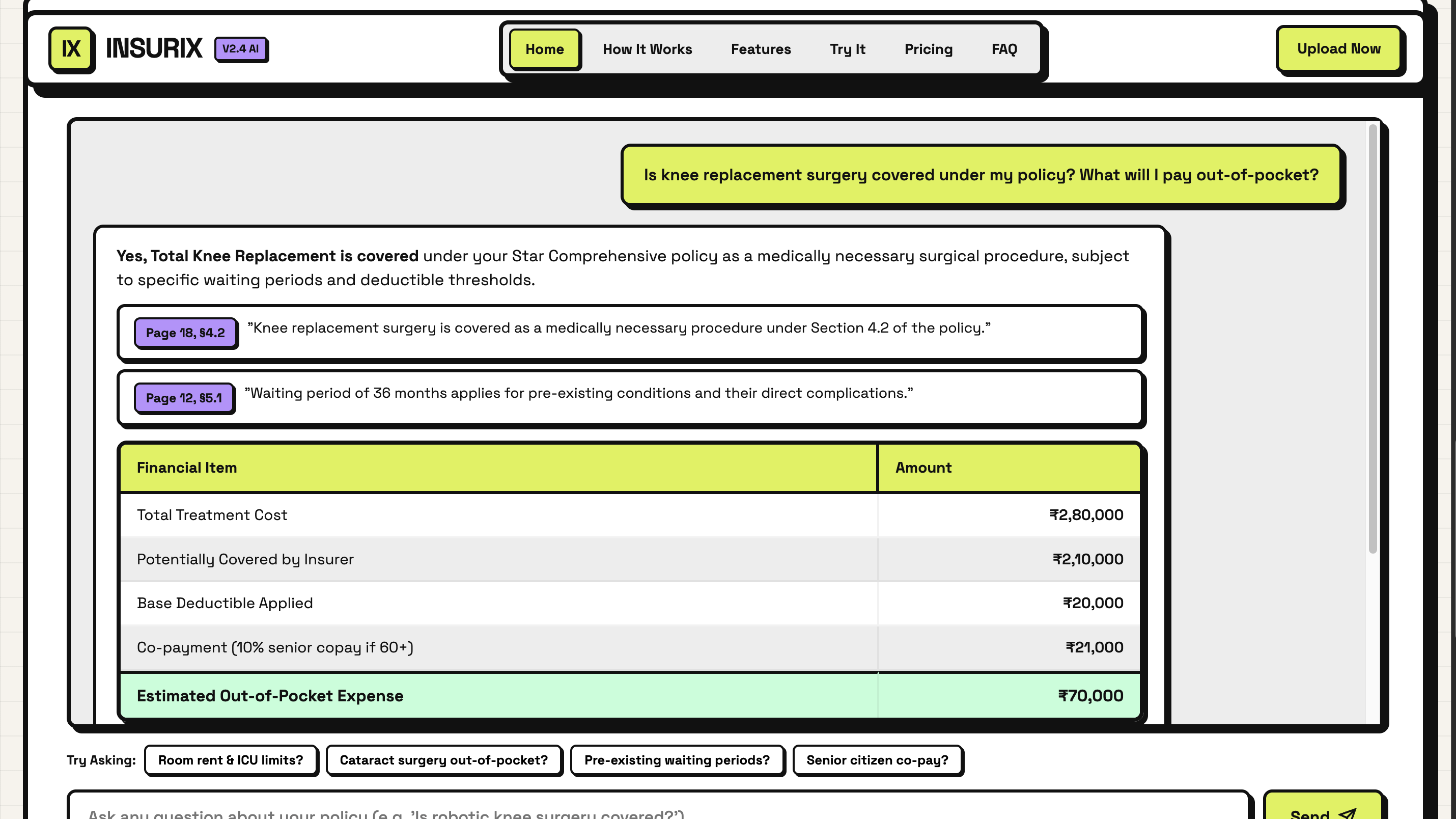
Insurix retrieves relevant policy clauses and generates answers supported by exact page and section references.
4. Treatment Analysis
Users can provide a treatment scenario, including the procedure, estimated hospital bill, patient details, and hospital information.
The system evaluates the treatment against the extracted policy conditions.
5. Cost Estimation
Insurix combines policy rules with a structured treatment-cost dataset to estimate:
- Total expected treatment cost
- Potentially eligible/covered amount
- Applicable deductibles
- Co-payment amounts
- Estimated out-of-pocket expenses
6. Transparent Results and Uncertainty Detection
Every important result includes supporting policy evidence, a transparent calculation breakdown, and a confidence level.
If critical information is missing, ambiguous, or conflicting, Insurix identifies it instead of generating an unreliable estimate.
What Makes Insurix Different?
Insurix goes beyond conventional PDF-based AI chatbots.
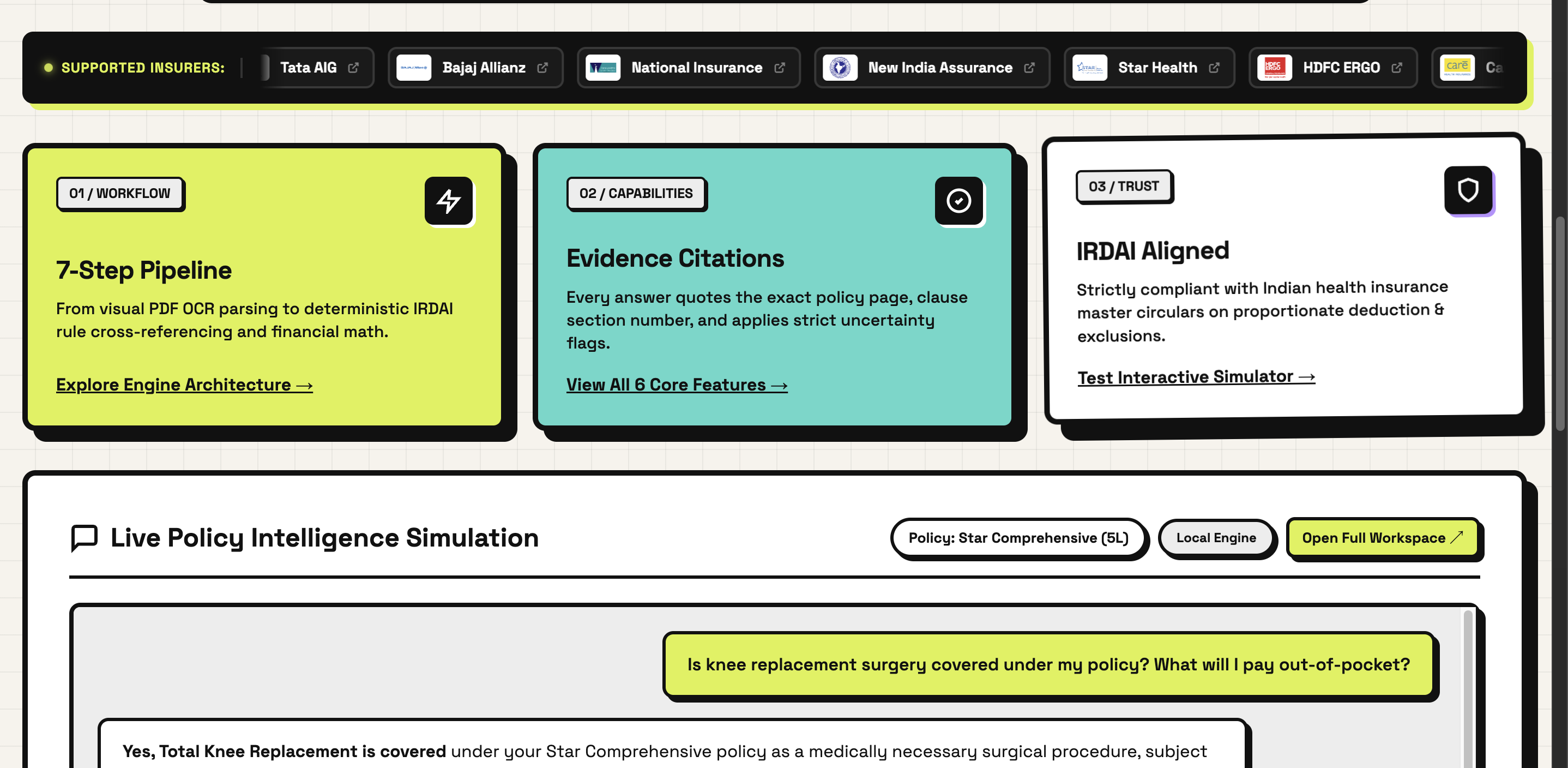
Its core innovation is the integration of three intelligence layers:
1. Evidence-Based Policy Intelligence
Answers are grounded in the user's uploaded policy, with supporting page and section references.
2. Deterministic Coverage and Cost Calculation
A rule-based engine evaluates coverage conditions, waiting periods, exclusions, deductibles, co-payments, and applicable sub-limits. Financial calculations are handled separately from LLM-generated explanations.
3. Uncertainty-Aware Reasoning
The system identifies missing information and ambiguous policy conditions, communicates confidence levels, and explains what additional information is required to improve an estimate.
Technology Stack
Frontend
- React.js
- TypeScript
- Tailwind CSS
Backend
- Python
- FastAPI
AI and Intelligence
- Groq LLM
- Google Gemini
- LangChain
- Retrieval-Augmented Generation (RAG)
- Semantic Search
- Structured Information Extraction
Document Processing
- PyMuPDF
- pdfplumber
- OCR support for scanned documents
Database and Retrieval
- PostgreSQL
- pgvector
- Vector Embeddings
- Hybrid Search
Cost Estimation
- Structured treatment-cost datasets
- Rule-based coverage evaluation
- Deterministic financial calculations
Deployment
- Vercel
- Render
- PostgreSQL Cloud
Challenges and What We Learned
One of the biggest challenges in designing Insurix was understanding that insurance policies cannot be treated like ordinary text documents.
A single treatment may be affected by multiple clauses distributed across different sections. Retrieving one relevant paragraph is not sufficient to determine actual eligibility.
We focused on preserving policy section structures, retrieving related clauses, and maintaining page-level evidence throughout the answering process.
Another important challenge was financial accuracy. We recognized that allowing an LLM to independently calculate insurance payouts could introduce unreliable results. This led us to separate AI-based policy interpretation from deterministic rule-based calculations.
We also explored how to handle missing information and conflicting clauses. Rather than forcing the system to produce a definite answer, we designed an uncertainty-aware approach that makes limitations visible to users.
Through this project, we explored document intelligence, RAG pipelines, semantic retrieval, structured data extraction, explainable AI, and rule-based reasoning.
Future Scope
We envision extending Insurix with:
- Multi-policy comparison
- Insurance claim assistance
- Hospital network integration
- Multilingual and voice-based interaction
- Insurance advisor and hospital integration
Our Vision
We believe understanding health insurance should not require specialized knowledge.
Insurix aims to bridge the gap between complicated insurance documentation and real-world healthcare decisions.
From Policy Confusion to Financial Clarity.
Built by Team CIPHER.
Built With
- artificial-intelligence
- document-intelligence
- fastapi
- generative-ai
- google-gemini
- groq
- healthcare
- insurtech
- langchain
- llm
- machine-learning
- natural-language-processing
- pgvector
- postgresql
- python
- rag
- react
- semantic-search
- typescript
