-
-
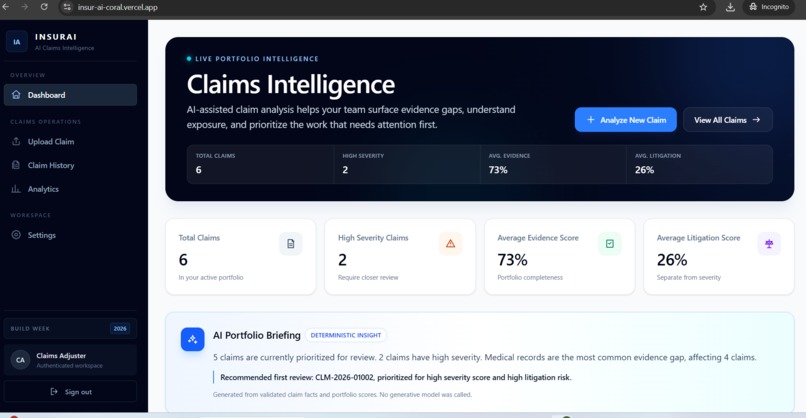
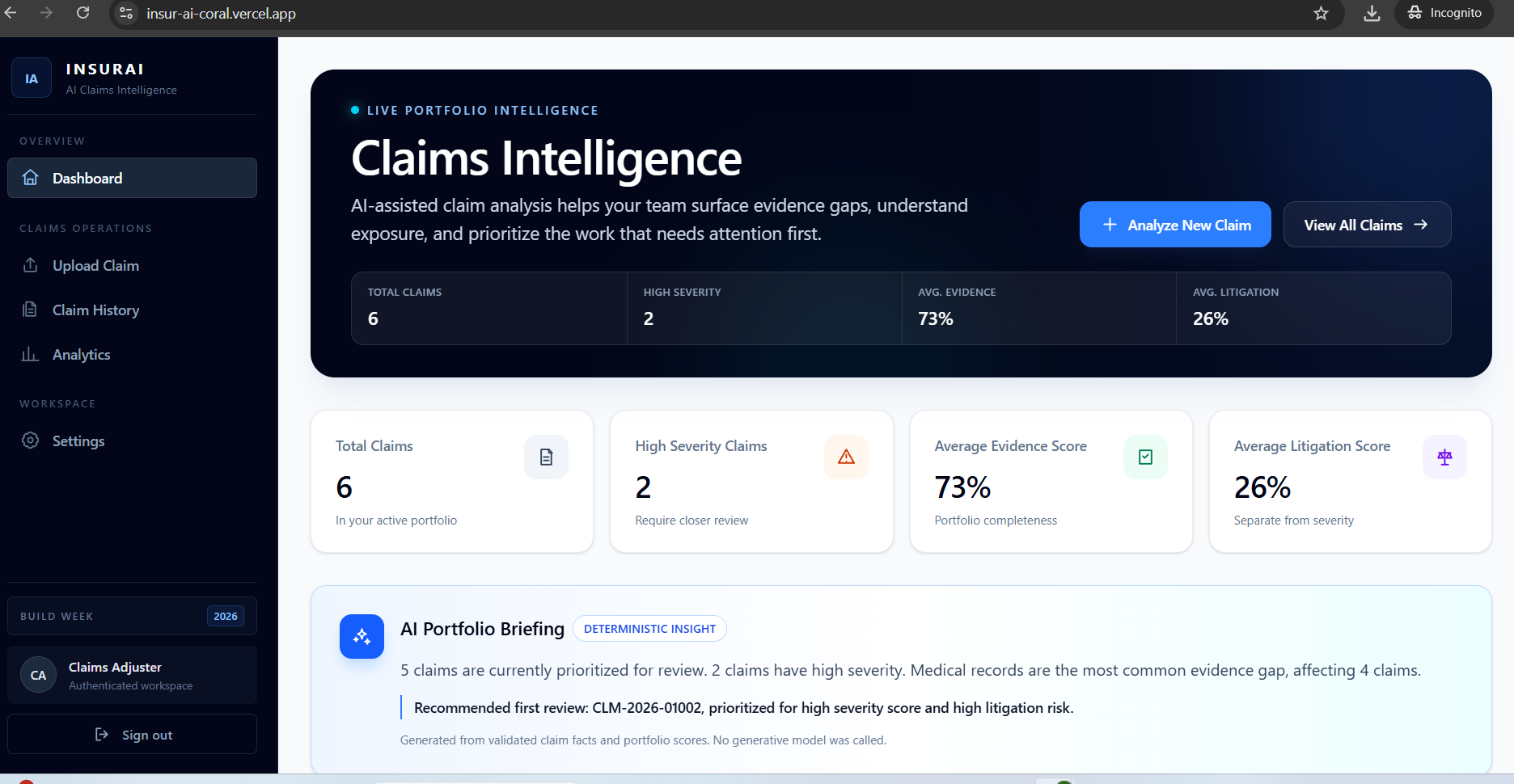
Dashboard
-
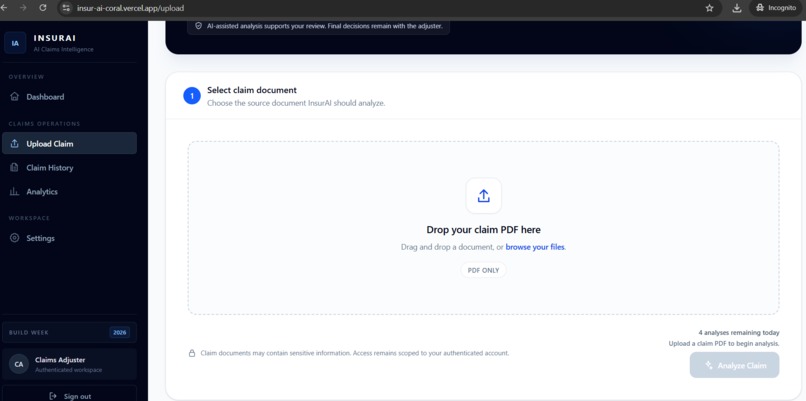
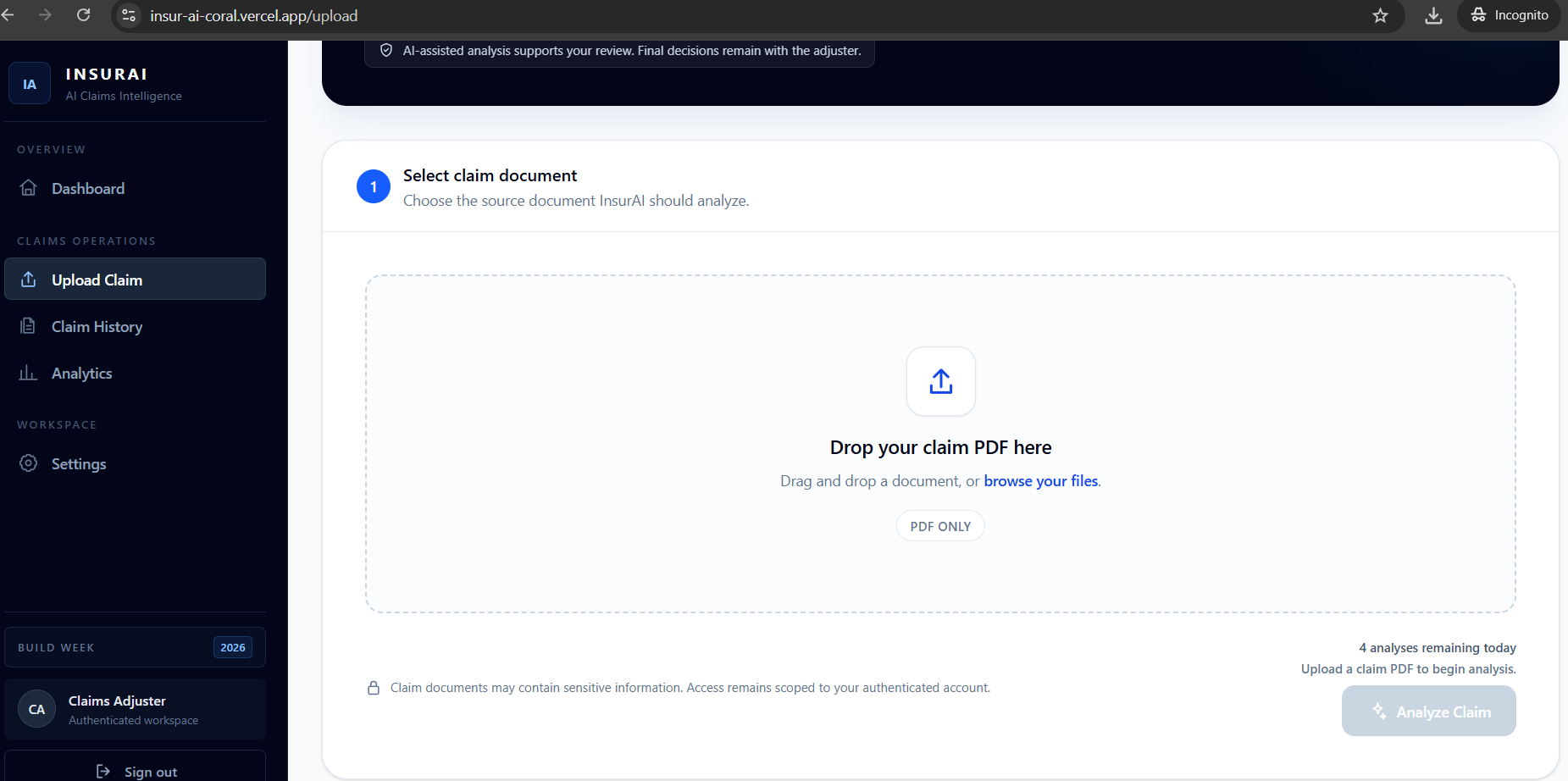
PDF file upload screen
-
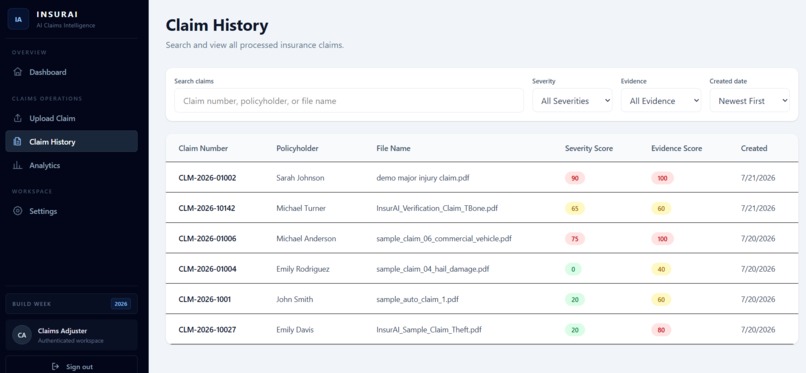
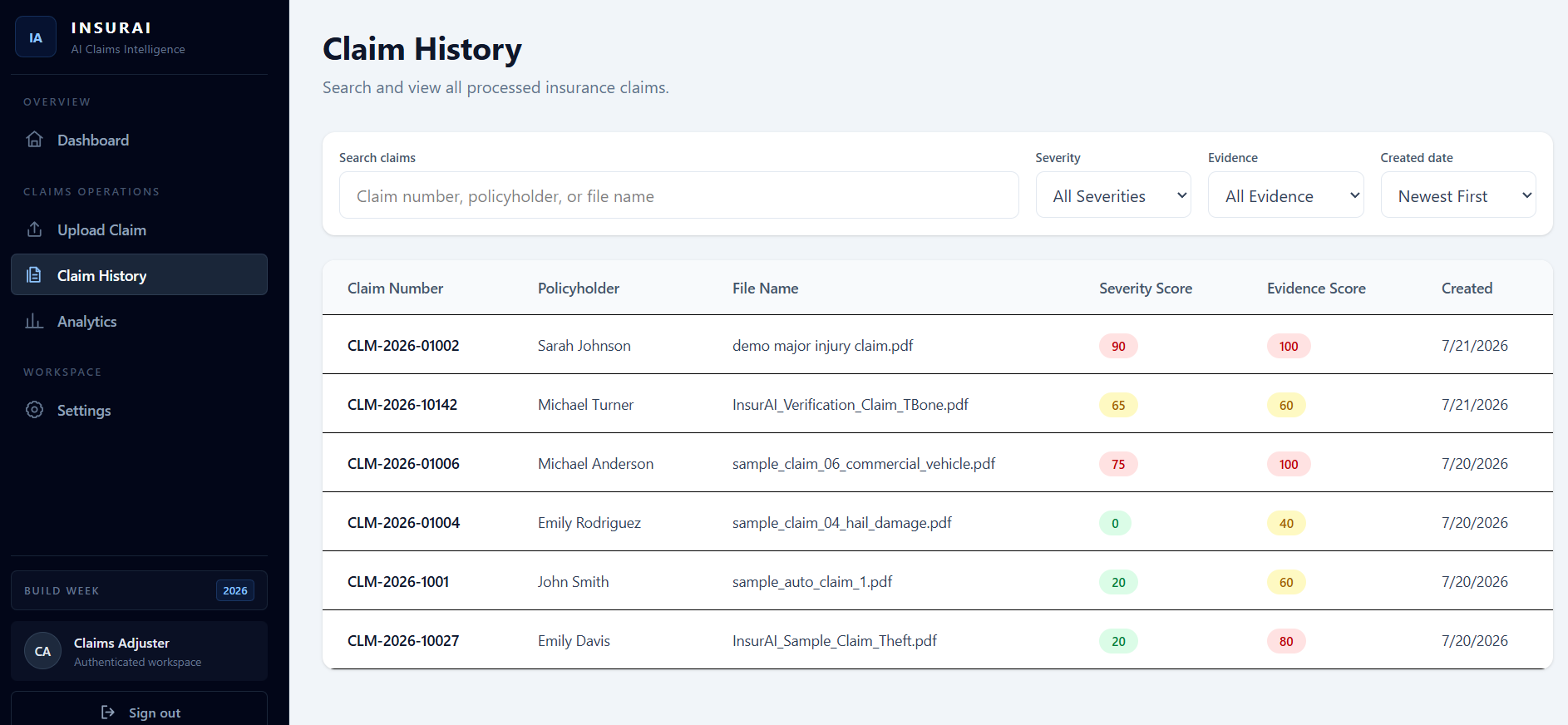
Claims history screen
-
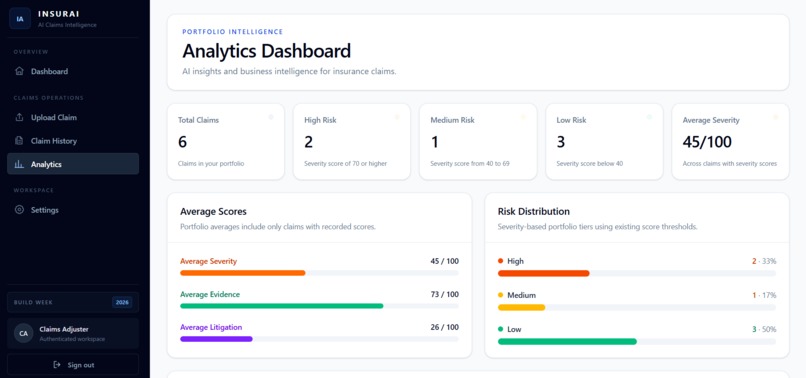
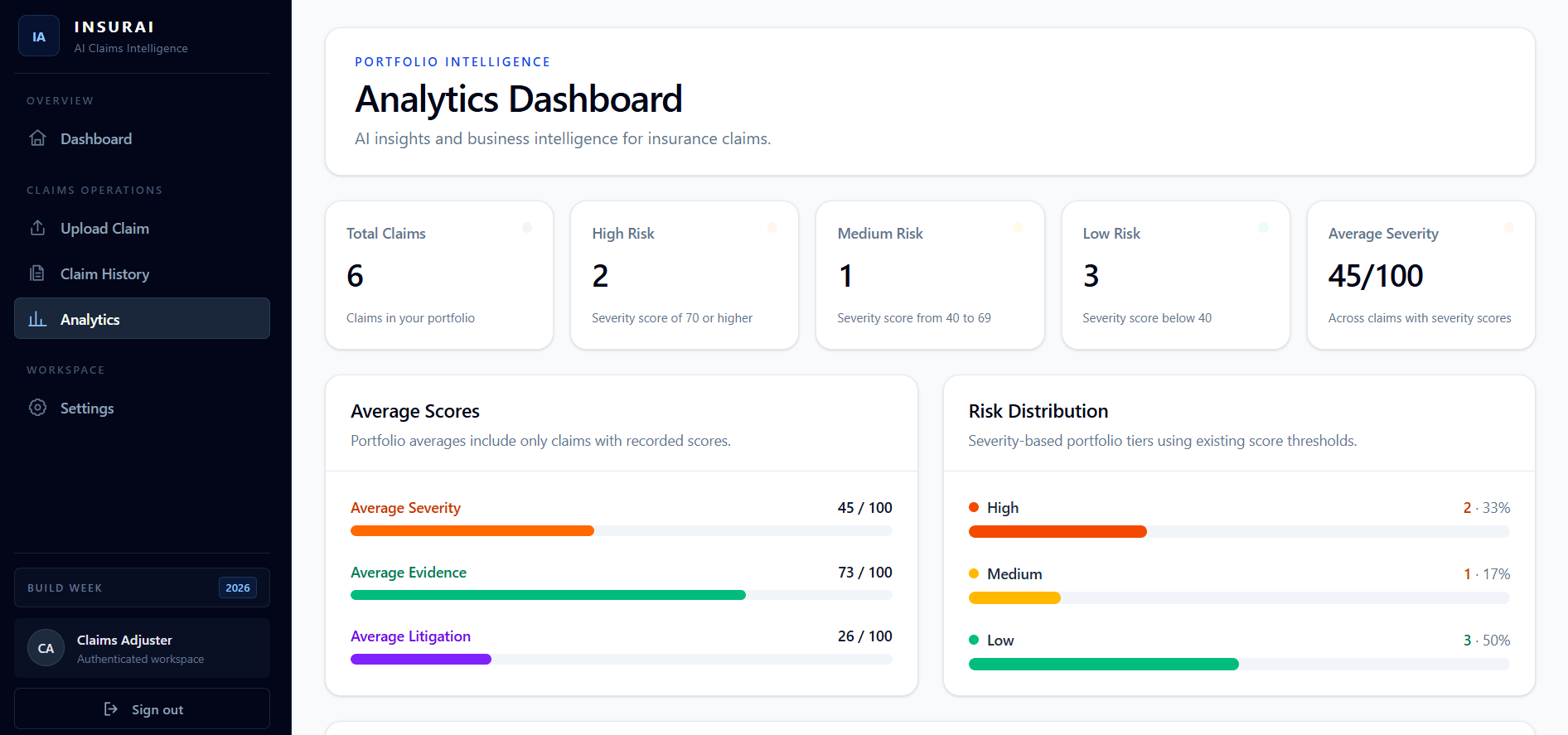
Claim Analytics screen
-
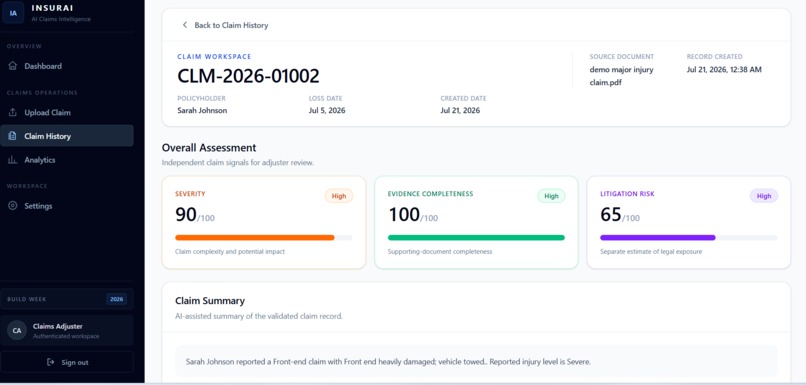
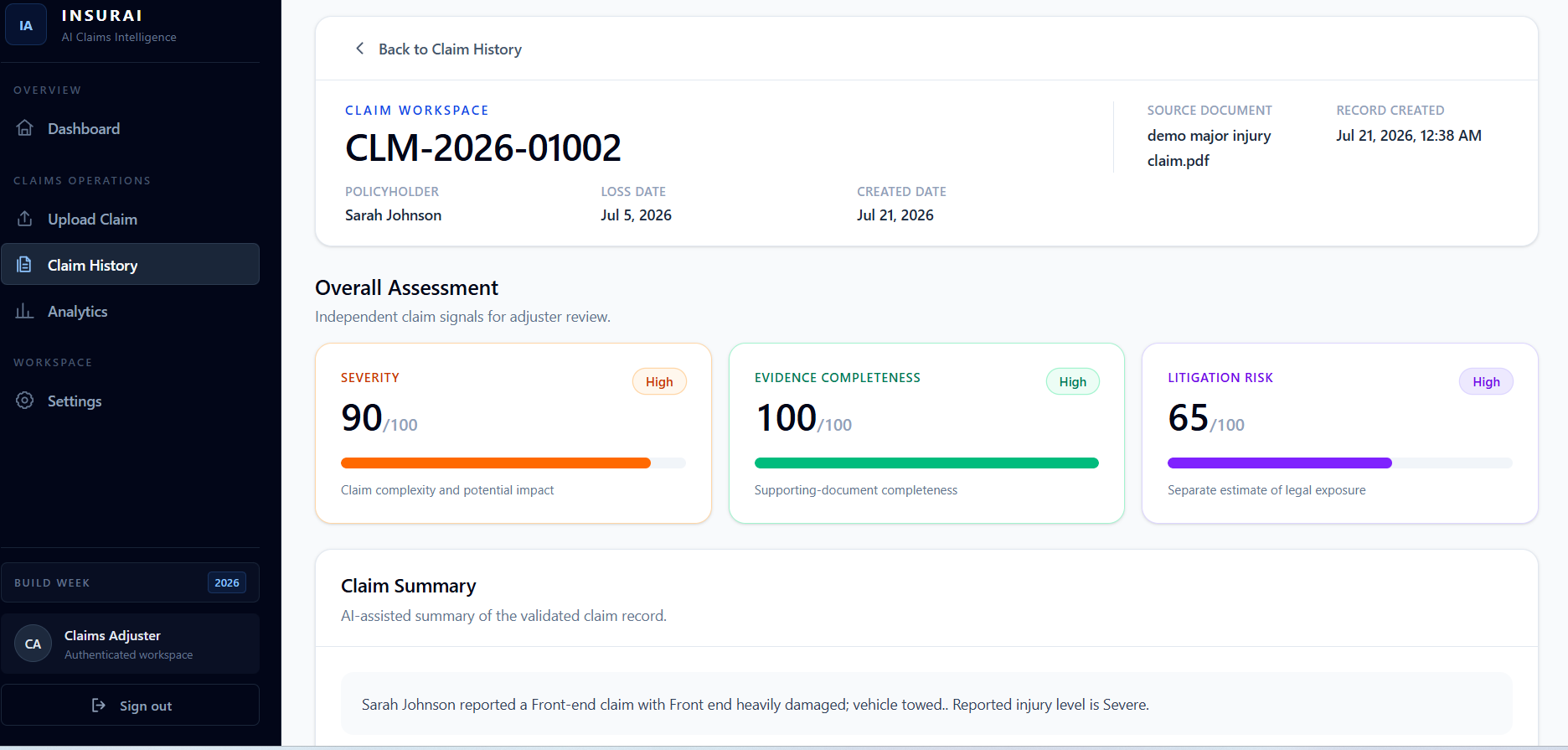
Claim in detail screen
Inspiration
Insurance adjusters spend significant time moving between claim documents, incomplete evidence, exposure signals, and portfolio queues. They need more than a PDF summary—they need to understand what is known, what is missing, which claims require attention, and why.
InsurAI was inspired by this practical workflow and by conversations with former insurance colleagues who have Claim Center experience. We wanted to build an AI Claims Copilot that reduces repetitive document review while keeping adjusters in control of consequential decisions.
What it does
InsurAI is an AI-assisted claims intelligence workspace for insurance adjusters.
An authenticated adjuster uploads a text-based claim PDF. InsurAI extracts and validates structured claim facts and uses deterministic engines to calculate:
- Claim severity
- Evidence completeness
- Litigation risk
- Missing information
- Recommended next actions
Completed analyses appear in owner-scoped claim history, detailed claim review, portfolio dashboards, priority queues, evidence-gap intelligence, and analytics.
The platform also supports invitation-based onboarding, account expiration, usage quotas, bounded PDF uploads, extracted-text limits, failed-attempt controls, and administrator management.
InsurAI provides decision support—not final coverage, liability, legal, or payment decisions. Human adjusters remain in control.
How we built it
The frontend uses React 19 and Vite with React Router, Axios, Tailwind CSS, and conventional CSS. The backend uses FastAPI , Pydantic , SQLAlchemy , Alembic, and signed JWT authentication.
PyMuPDF extracts text from bounded PDF uploads. When OpenAI is selected, the backend uses the OpenAI Responses API structured-parsing workflow to produce a Pydantic ClaimFacts object. A local Ollama provider remains available for development and comparison.
Model output is treated as untrusted and must pass Pydantic validation before entering the analysis pipeline. Deterministic Python engines then calculate severity, evidence completeness, litigation risk, and recommended actions. The model extracts facts; it does not control authorization, ownership, quotas, or consequential scoring rules.
PostgreSQL supports production, SQLite supports local development, and Alembic manages schema migrations.
Codex with GPT-5.6 served as our engineering copilot during Build Week. It helped trace full-stack workflows, review authentication and ownership boundaries, implement and test usage controls, exercise provider failures, verify migrations, improve documentation, and perform the final release audit.
This Codex development usage is separate from InsurAI’s runtime extraction model, which is configured independently through the application’s provider settings.
Challenges we ran into
The biggest challenge was balancing useful AI assistance with the reliability expected in an insurance workflow.
We needed to constrain the model to structured fact extraction, validate malformed or incomplete responses safely, and keep consequential scoring deterministic and explainable.
Additional challenges included:
- Preserving claim ownership across dashboard, history, detail, and analytics queries
- Handling unavailable, refused, malformed, or timed-out provider responses
- Applying quotas correctly when analyses fail
- Bounding uploaded PDFs and extracted prompt text
- Supporting PostgreSQL production alongside SQLite development
- Deploying the frontend, backend, and database as separate services
Accomplishments that we're proud of
- Built and deployed a complete workflow from authenticated PDF upload to saved claim intelligence
- Integrated OpenAI Responses API structured extraction into validated
ClaimFacts - Created deterministic severity, evidence, litigation-risk, and recommendation engines
- Implemented owner-scoped dashboard, history, detail, priority, and analytics experiences
- Added invitation onboarding, administrator controls, account expiration, quotas, upload limits, text bounds, and attempt limits
- Preserved provider-agnostic support for OpenAI and local Ollama
- Added PostgreSQL production support and Alembic migrations
- Verified the production workflow on desktop and mobile
- Completed 102 passing backend tests
- Completed a successful Vite production build and clean ESLint verification
Former insurance colleagues with ClaimCenter experience also responded positively to the product direction and recognized the value of combining document understanding, evidence gaps, risk signals, and next actions in one adjuster workspace.
What we learned
We learned that building a trustworthy vertical AI product requires much more than connecting an application to a capable model.
Structured schemas, validation, deterministic rules, authorization, ownership isolation, usage controls, migrations, failure handling, testing, and a human-review experience are equally important.
We also learned that the model’s best role in this workflow is narrow but valuable: converting variable claim documents into consistent structured facts. Application logic and human adjusters should remain responsible for consequential decisions.
What's next for InsurAI
Near-term improvements include:
- OCR for scanned documents
- Multi-document claim analysis
- Stronger evidence provenance
- Browser-level automated testing
- Durable document storage
- Configurable carrier rules
- Supervisor collaboration and audit trails
Longer term, InsurAI can expand into policy context, litigation intelligence, enterprise portfolio alerts, deeper insurance-core integrations, billing intelligence, and executive decision support while preserving human oversight and explainable deterministic boundaries.
Built With
- alembic
- chatgpt5.6
- codex
- fastapi
- openai
- postgresql
- pydantic
- pymupdf
- python
- react
- render
- sqlalchemy
- vercel
- vite

Log in or sign up for Devpost to join the conversation.