-
-
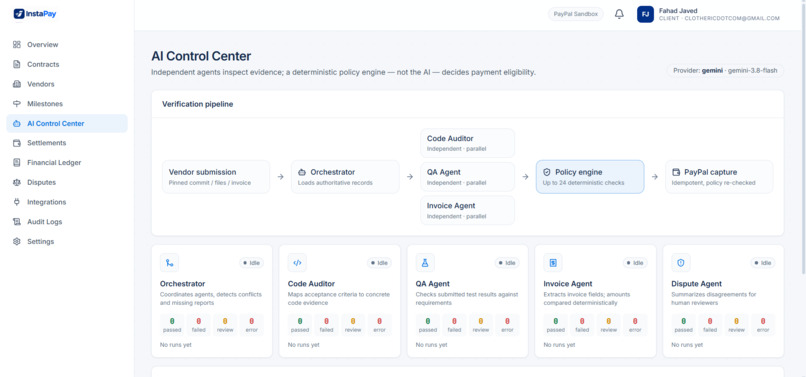
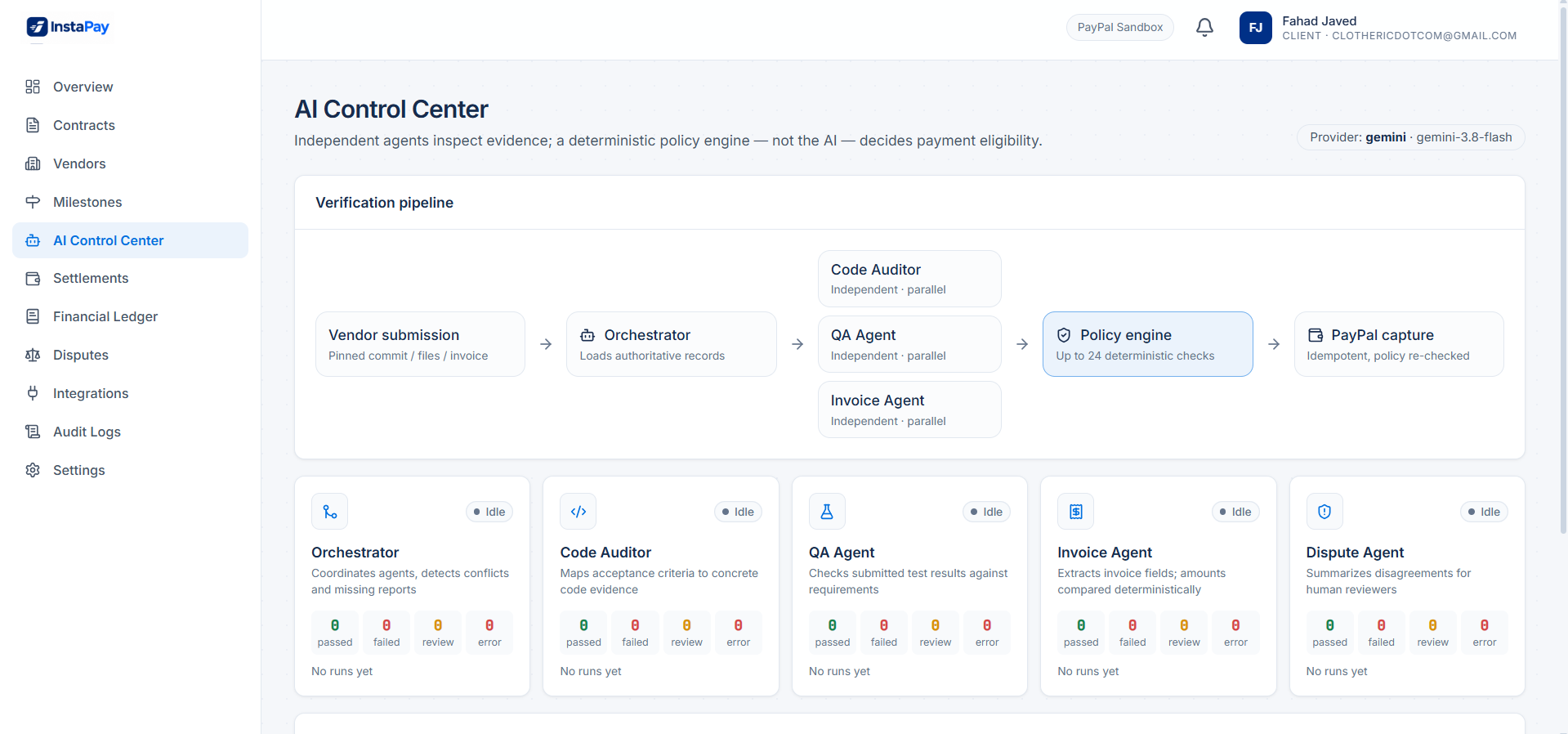
Three specialized AI agent independently assess milestone evidence while a deterministic policy engine makes the final verification decision
About InstaPay
I got the idea for InstaPay while thinking about a problem that freelancers and clients deal with quite often. Imagine a developer finishes a project milestone, but the client isn't satisfied with the work. Or a freelancer completes everything but has to wait and follow up repeatedly to receive payment. These situations can become frustrating for both sides.
I wanted to work on a solution where the requirements are agreed upon before the work starts and the submitted work can be checked before a payment is released. That's how I started building InstaPay.
How it works
InstaPay allows a client to create a project, break it into milestones, and describe what they expect from the vendor. Once the vendor completes a milestone, they can submit their work and attach supporting files as evidence.
For the verification part, I decided to use three separate AI agents instead of depending on just one model. Each agent reviews the submitted evidence, and their results are passed to a policy engine. The policy engine applies predefined rules and determines the final outcome.
I didn't want an AI model making payment decisions on its own. That's why I kept the verification process separate from the actual decision-making logic.
Building the project
I built InstaPay as a full-stack application. A lot of the work went into connecting different parts of the system and making sure they behaved correctly together.
Some of the main features I worked on were project and milestone creation, acceptance criteria, vendor submissions, file handling, AI-based verification, structured response validation, and payment workflow management.
I also worked on the PayPal integration for payment authorization, capture, and webhook-based status updates.
The difficult parts and what I learned
Honestly, getting the different components to work together was one of the biggest challenges. AI responses aren't always perfect. Sometimes an agent may return an unexpected result, the submitted evidence may be incomplete, or an external API may fail. I had to consider these situations while designing the application.
Another challenge was PayPal Sandbox access. I couldn't get authorized Sandbox credentials during development, so I haven't been able to complete an actual end-to-end Sandbox payment test yet. The integration is prepared for the intended payment workflows, but this part still needs proper testing.
Working on this project also changed how I think about using AI in software. It's easy to connect an AI model to an application, but building something reliable around it is a different challenge. I learned a lot about validation, backend logic, handling failures, and keeping important decisions under clearly defined rules.
What's next?
I still have things I want to improve, especially testing the complete PayPal payment flow and making the verification process more reliable.
Building InstaPay has been a valuable experience because it pushed me beyond simply building another web application. I had to think about how people would actually use it, what could go wrong, and how the system should respond when things don't go as planned.
That's the idea behind InstaPay: clients should have confidence in the work, and vendors should have confidence in the payment process.
Accomplishments that we're proud of
One thing we're particularly proud of is bringing the complete idea together into a working platform. We didn't just build a payment interface; we worked on the process that happens before a payment is released.
The three-agent verification system is probably the part we're most proud of. Having multiple agents review submitted evidence and then using a separate policy engine for the final decision was an interesting engineering challenge.
We're also happy that we were able to bring together project management, milestone tracking, file submissions, AI verification, and payment workflow architecture in one application.
What we learned
We learned that building an AI-powered application involves much more than connecting an API to an AI model. Getting consistent outputs, validating responses, handling unexpected situations, and making sure different services communicate properly takes a lot of thought and testing.
We also learned the importance of keeping AI-generated results separate from critical business decisions. An AI model can help analyze information, but important actions should follow clear and predictable rules.
Another valuable lesson was understanding the complexity of payment workflows, especially authorization, capture, webhook events, and handling different payment states. PayPal Sandbox access was a limitation during this project, so completing the actual end-to-end payment tests remains part of our next steps.
What's next for InstaPay?
We want to continue developing InstaPay beyond this initial version. Our immediate priority is to complete authorized PayPal Sandbox testing and verify the payment lifecycle from authorization to capture.
We also plan to improve the AI verification process, make the evaluation results easier to understand, strengthen evidence handling, and add more testing for unusual situations and failed requests.
Ultimately, we'd like to make InstaPay useful for real clients, freelancers, and development agencies that work with milestone-based projects. There's still work to do, but this version gives us a solid foundation to build on.
Built With
- ai
- amazon-web-services
- api
- ec2
- express.js
- gemini
- github
- integration
- javascript
- multi-agent
- node.js
- paypal
- postgresql
- react
- rest
- typescript
- webhooks
