-
-
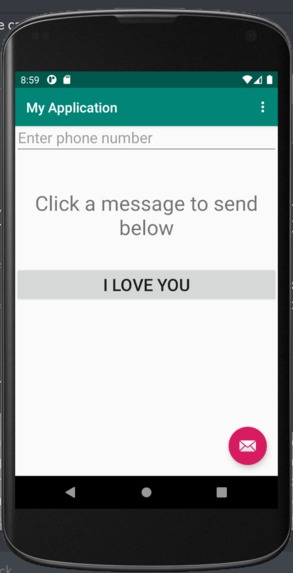
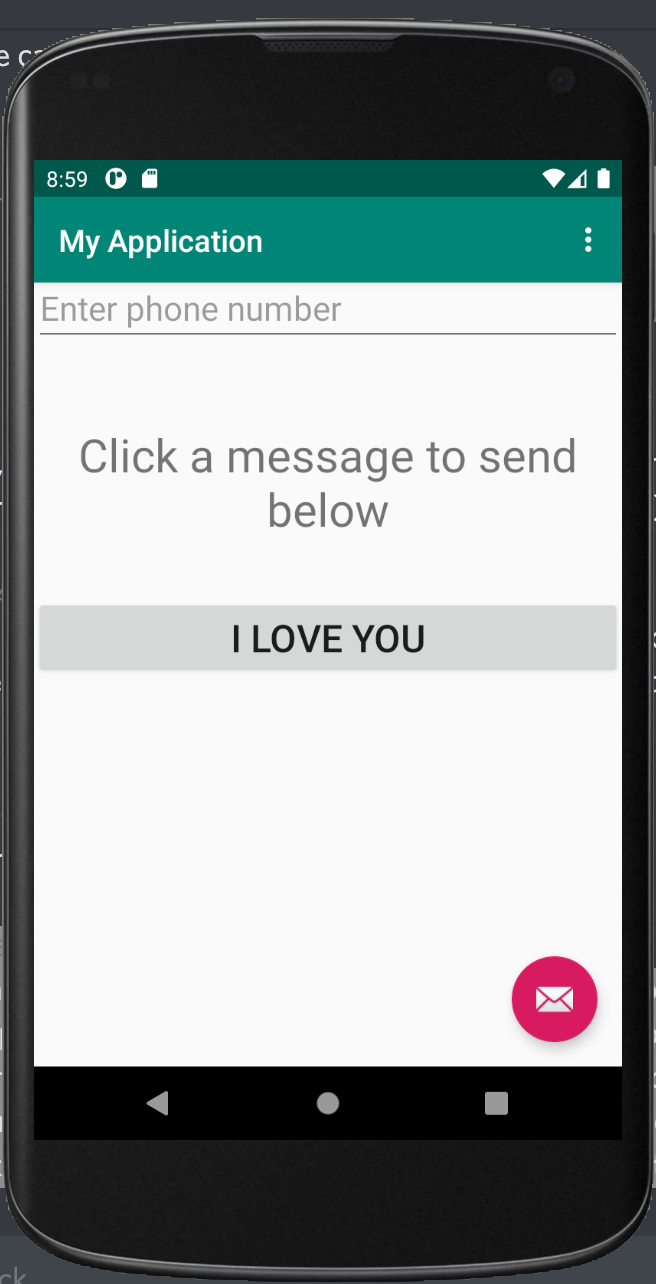
The shortcut to send an SMS message
Inspiration
Inspiration: Our inspiration for this application came from noticing the deficits of virtual care and the negative mental health effects of isolation. For compromised older adults, relying on telemedicine and not being able to see family is a significant challenge. Feelings of loneliness during the COVID-19 pandemic are exacerbated due to increased risk factors including: non-married status, older age, low income, lower educational level, living alone, low quality of social relationships, poor self-reported health, and poor functional status (Cohen-Mansfield et al., 2016).
Our idea was to create a tool to supplement telehealth technology by promoting social connectedness in a simplified, user-friendly format. Many of the barriers involved in transitioning to virtual care reported by elderly adults are related to complicated designs. Often the user interface’s fonts are too small, actions take too many steps to execute, or appearance isn’t adaptive to people with visual deficits. (Foster & Sethares, 2014).
When times are difficult, it may feel daunting to reach out to others, whether it is the depth of feelings that cannot be described or even confusion over how to do so. Our app aims to create an easy way to reach out to others and text them “I love you”. As people age, they may feel like they are drifting away from others, but the importance of social connection doesn’t change. There needs to be easily accessible ways to reach out to others, and we aim to create a simple and effective way to do so.
What it does
InstaGrandma allows people of all demographics (grandma status not required), to instantly and easily text their loved ones “I love you”. The only necessary action is to click on the contact, and you can tell your grandkids you love them. Especially during times like these, it may be hard to reach out to others but an “I love you” can make all the difference for someone, benefiting both the app user and the recipient.
How I built it
Challenges I ran into
The challenges in our workflow centered mostly around our own technical skills. It was the first time building an app for all of us, and many of us lacked the coding experience to fully execute our vision. Other challenges involved working solely in a virtual setting.
The inherent challenges with our idea include finding a way to make the application inclusively accessible. We are aware that many people, especially older adults, don’t have WiFi or a smartphone. Our app relies on cellular service for sending messages, so that function would not be available.
One of our more ambitious functions for the app was beyond what we could accomplish within the given time period and with our preexisting skill sets. We wanted to implement a “synchronize” page in the app, where individuals in isolation could feel connected with family members by “tuning into” a common channel. Whether it’s streaming a video or music, one would be able to listen knowing their loved ones are doing the same thing.
Accomplishments that I'm proud of
Aside from everything we learned, we accomplished creating a basic SMS sender program and a reminder system. We had to keep in mind what our “units of progress” were, and in the case of our first hackathon, we considered this a good first step forward.
What's next for InstaGrandma
The plan for InstaGrandma is to expand its capabilities to meet the increased needs of the aging population. We envision that InstaGrandma will have updates to facilitate a large, connected, and social audience within the app, instead of just facilitating a more streamlined experience with functions already available on a base mobile device. Our first goal would be adding a login feature so that each user’s experience can be tailored to their specific needs. Furthermore, this can allow users of the app to chat and send videos to each other and to find friends with others with similar experiences. Globally, seniors from all over the world can connect with each other over similar interests or become digital penpals. However, there will be a special option to let users find others in the area, letting digital connections become grounded in the real world. We also hope to add additions to make the app more accessible. There will be options to make the app more visually accommodating like a built in magnifying option, a more pared down, larger font layout for users who have a hard time reading the current layout, and a screen reader. We also hope to add the ability for users to tell the app what they want to do-instead of clicking the option to tell their grandkids they love them, users can simply say it. Overall, we want users to have the ability to customize their experiences, from what functions they want displayed to them to the way it’s displayed-from contrast, to font size, to font choice, and even the color palette of the app. Furthermore, we understand that the range of older adults is large. People are all different, and this group is no different. Some aging adults are tech-wizards, and they might even work in IT themselves. However, for some this may be their first technological encounter, and overwhelming them with a variety of options and customizations may turn them away. For that reason, we will group certain functions like QuickText, Local Friend Finder, Chat, MedTimer, MusicSync and other options into widgets that they can add to their main dash. For those who want to just use the app to quickly text their loved ones pre-made messages, they have the option to only have that on their dash. The goal of InstaGrandma is to make sure everyone’s experience is tailored to their interests, and that users can connect with people, whether it be loved ones, local friends to be discovered, or international penpals.
Login messaging/sending videos with other users Add more in app features Increased accessibility features Screen readers More audio engagement Font size adjustments contrasts/color options References
References
Cohen-Mansfield, J., Hazan, H., Lerman, Y., & Shalom, V. (2016). Correlates and predictors of loneliness in older-adults: A review of quantitative results informed by qualitative insights. International Psychogeriatrics, 28(4), 557-576. doi:10.1017/S1041610215001532
FOSTER, MARVA, MSN, RN-BC, SETHARES, KRISTEN & PhD, RN. (2014). Facilitators and Barriers to the Adoption of Telehealth in Older Adults: An Integrative Review. CIN: Computers, Informatics, Nursing, 32, 523-533. https://doi.org/10.1097/CIN.0000000000000105
Built With
- adobe-xd
- android-studio

Log in or sign up for Devpost to join the conversation.