-
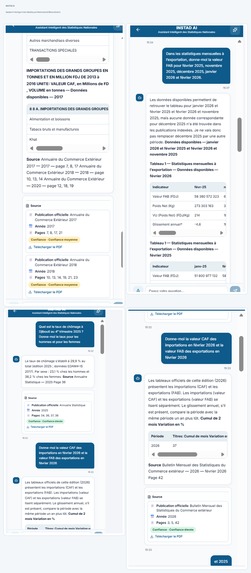
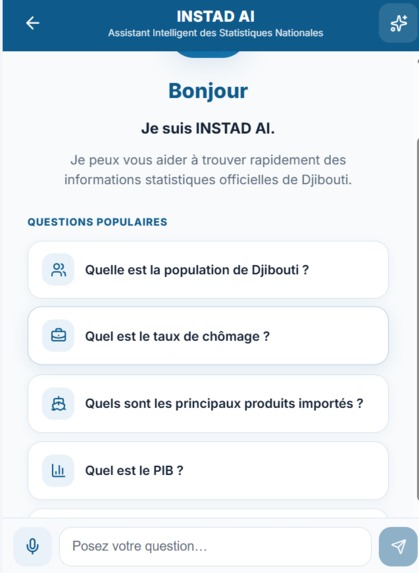
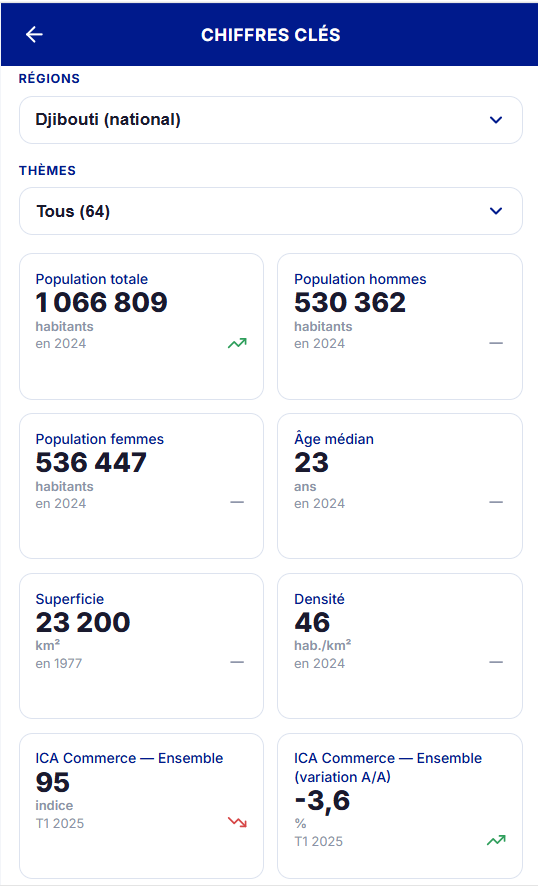
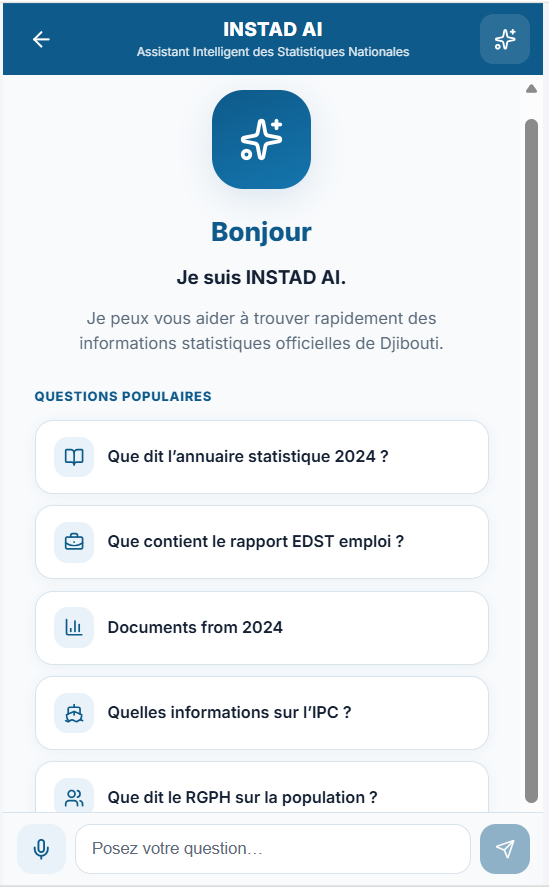
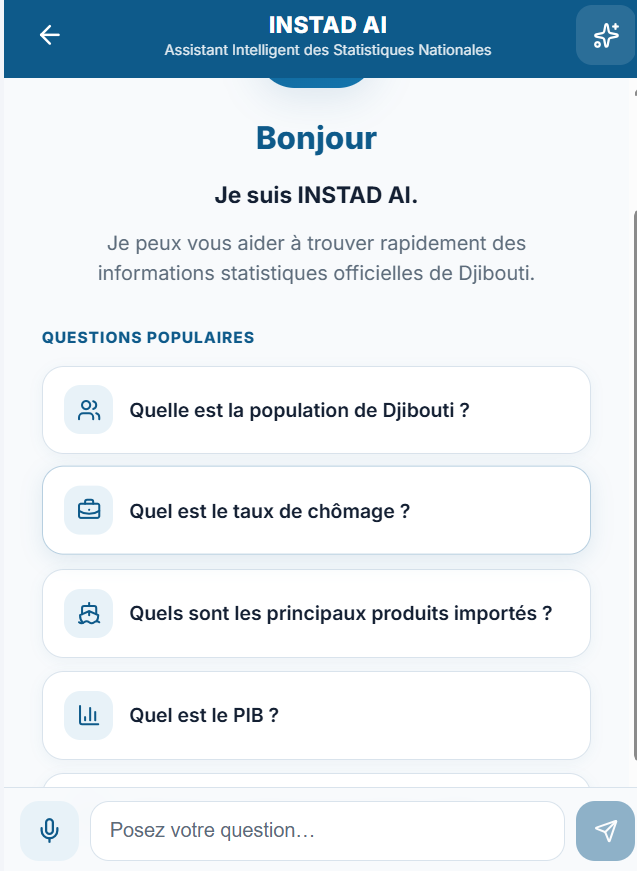
NSTAD AI transforms official Djibouti statistics into searchable, traceable answers with intelligent table extraction and verified sources.
-
-

-
-
-

-
-




Inspiration
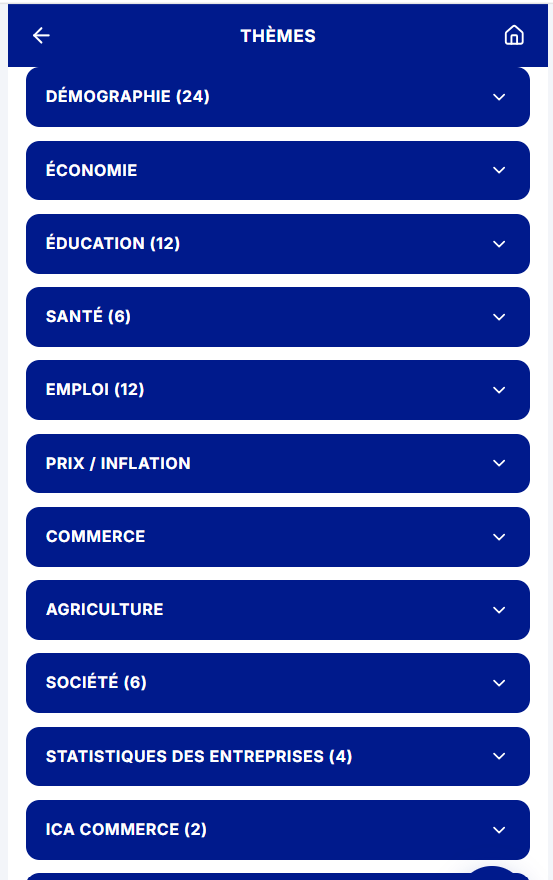
Finding reliable official statistics in Djibouti can be difficult. Statistical information is distributed across many PDF publications, annual reports, monthly bulletins, tables and different editions. A user may know the question they want to ask, but not which publication, page or table contains the answer.
We wanted to make this information accessible through a simple natural-language interface.
This is how we created INSTAD AI — Assistant Intelligent des Statistiques Nationales, an AI-powered assistant designed to help users search and understand official statistical publications from Djibouti.
What we built
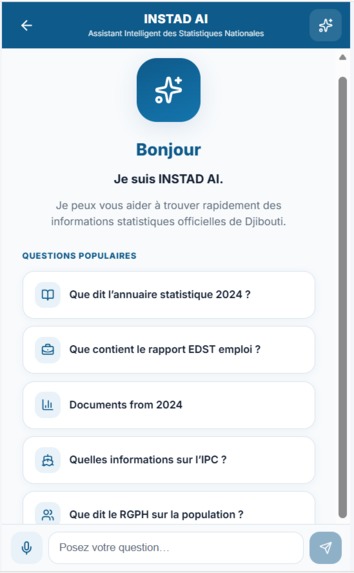
INSTAD AI allows users to ask questions in natural language such as:
- "Quel est le taux de chômage au 4ème trimestre 2025 ?"
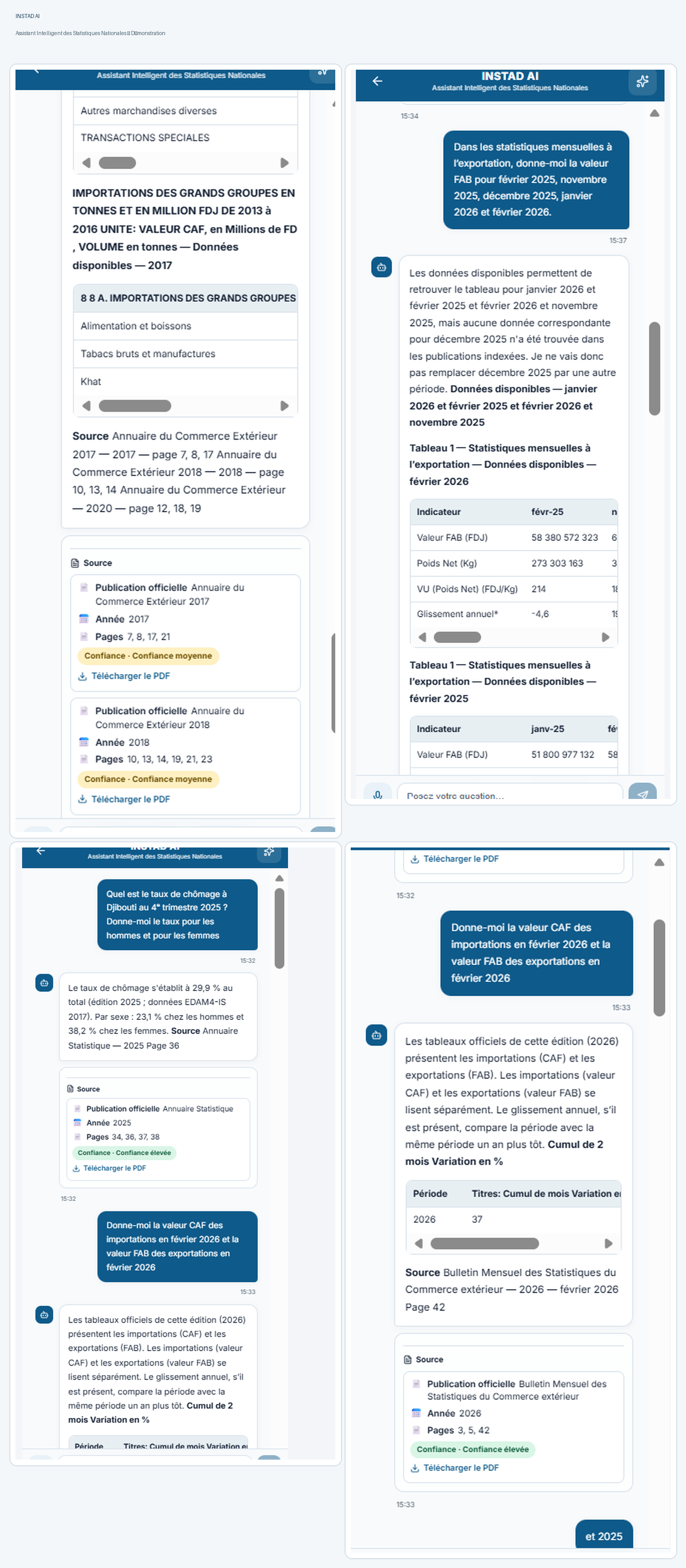
- "Donne-moi la valeur CAF des importations en février 2026."
- "Quelles sont les exportations des grands groupes entre 2016 et 2020 ?"
- "Compare les données entre plusieurs années."
- "Quelle est la proportion des femmes dans la population ?"
Instead of simply searching for keywords, the system analyzes the user's intent, identifies the relevant statistical subject, period, metric and document, retrieves the most relevant evidence, and produces an answer with its official source and page references.
The main challenge
The biggest challenge was not simply connecting an LLM to a database.
The real challenge was making AI understand statistical documents correctly.
Many of the publications contain complex tables. During PDF extraction, information such as monthly periods, table columns, metrics and values can lose their original structure.
For example, a table containing:
2025 | 2026 | Volume | Valeur | Variation
cannot safely be treated as ordinary text. The AI must understand which value belongs to which column and which metric.
We therefore built a deterministic table-resolution layer that reconstructs and verifies table evidence before allowing the AI to generate an answer.
Our approach
INSTAD AI combines several layers:
- Natural-language intent understanding
- Document and publication retrieval
- Semantic/vector retrieval
- Statistical subject and period detection
- Table reconstruction from extracted PDF content
- Deterministic table and cell resolution
- Relevance and hard-negative filtering
- Grounded answer generation
- Source and page attribution
- Fallback mechanisms when reliable evidence cannot be found
The system is designed around an important principle:
If the system cannot establish reliable evidence, it should say that the information could not be determined rather than inventing a statistic.
What we learned
Building INSTAD AI taught us that reliable AI for statistical data requires more than a powerful language model.
Retrieval, document structure, table reconstruction, period normalization, metric identification and verification are just as important as the LLM itself.
We also created a golden evaluation dataset and use it to measure the system continuously instead of fixing only individual problems when users report them.
Our goal is to progressively improve the reliability of AI access to Djibouti's official statistical information.
What's next for INSTAD AI
We want to continue improving:
- Multi-period and multi-publication questions
- Complex statistical tables
- Automatic verification of numerical answers
- Confidence and evidence verification
- Cross-publication comparisons
- Multilingual interaction
- Continuous evaluation across the entire statistical corpus
INSTAD AI is ultimately designed to become an intelligent gateway to Djibouti's official statistical knowledge.
Built With
- ai
- api
- augmented
- data
- express.js
- extraction
- generation
- javascript
- llm
- native
- natural
- node.js
- ocr
- openrouter
- pgvector
- postgresql
- processing
- rag
- react
- rest
- retrieval
- supabase
- table
- vector


Log in or sign up for Devpost to join the conversation.