-
-
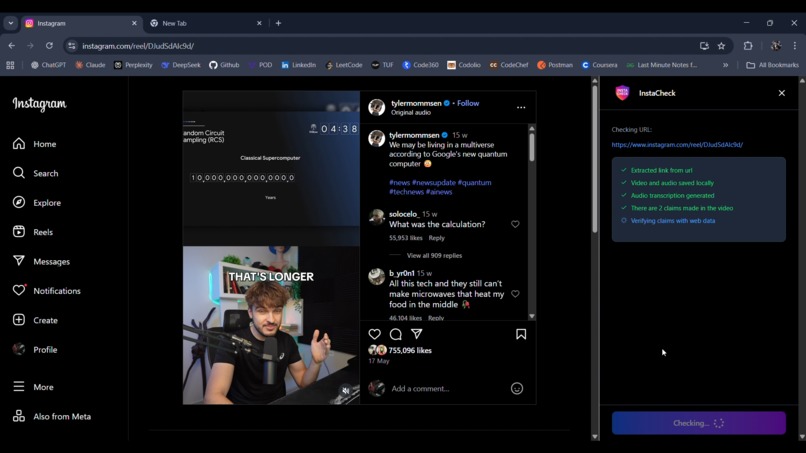
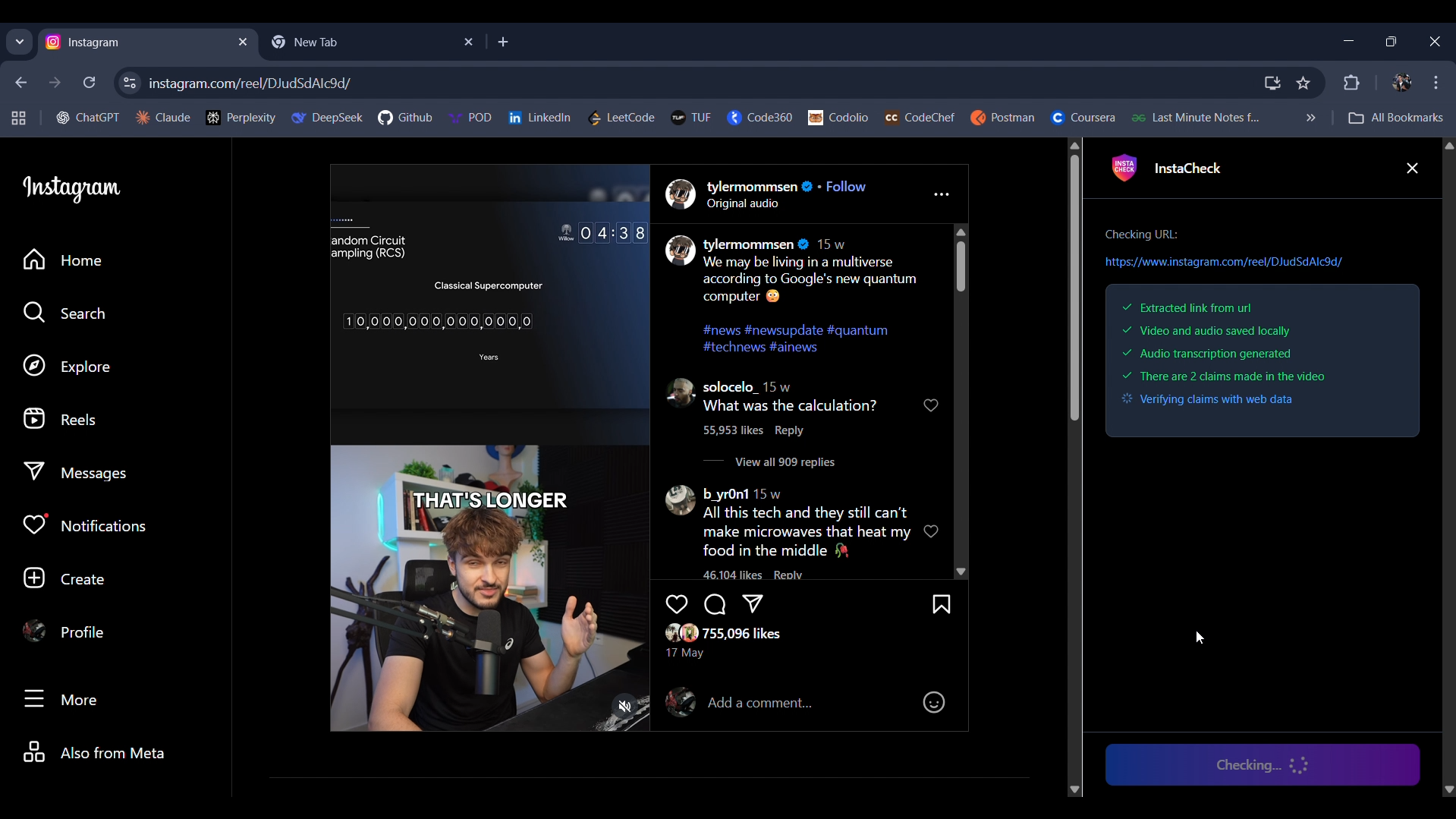
Extension is processing the reel
-
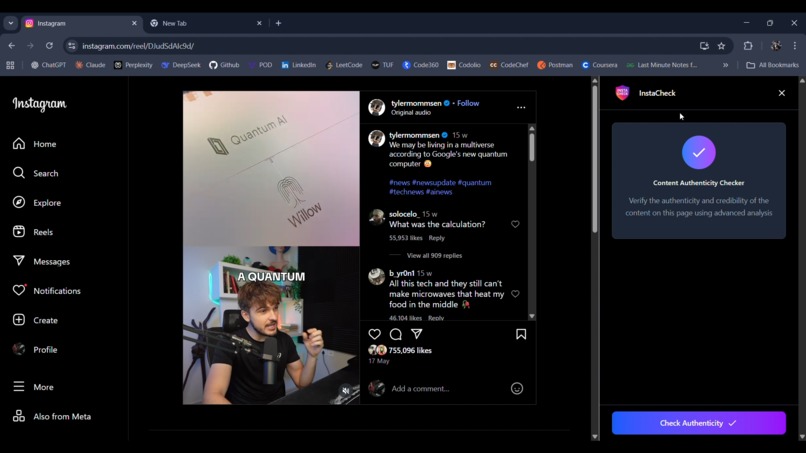
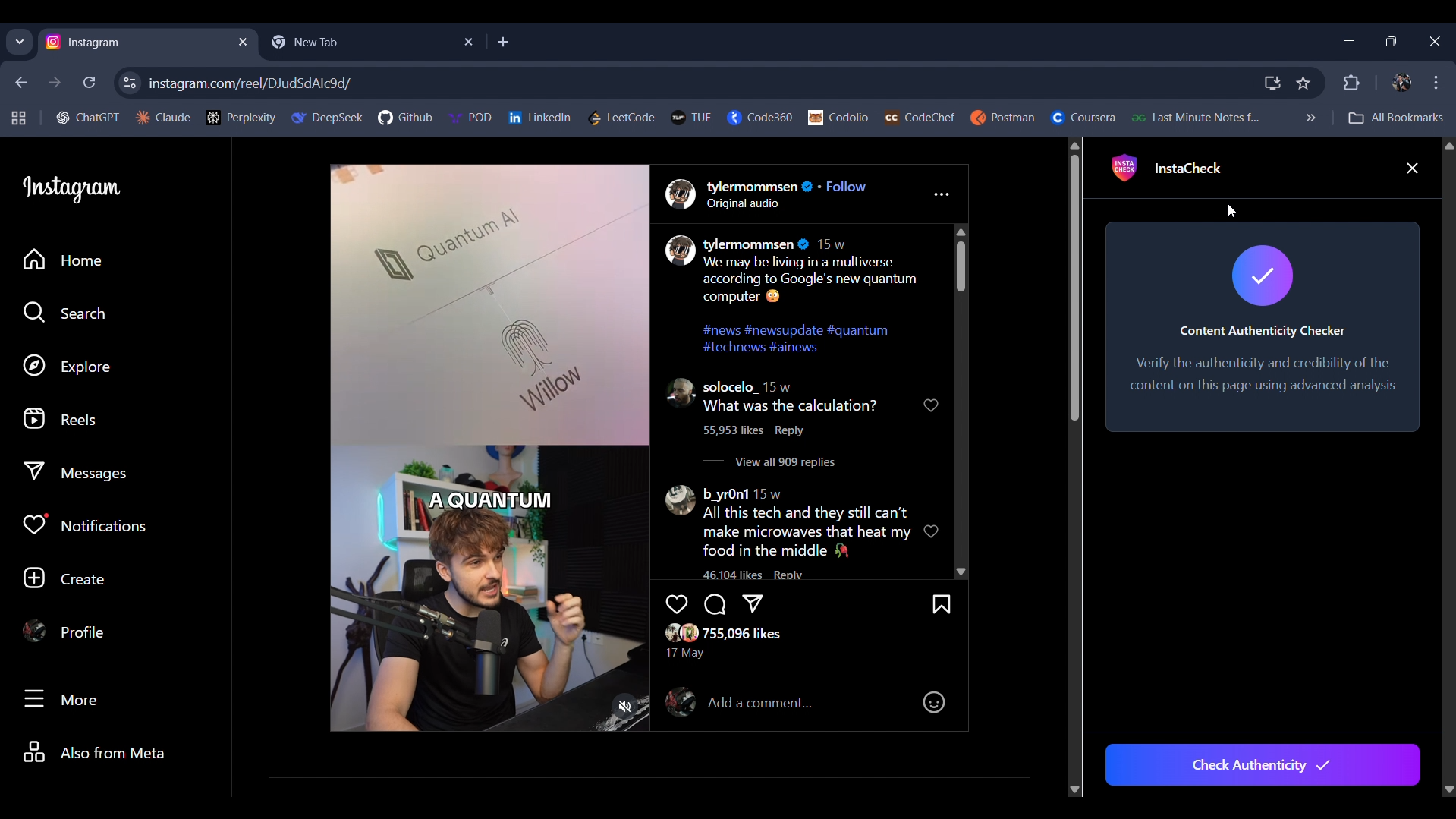
UI interface of extension
-
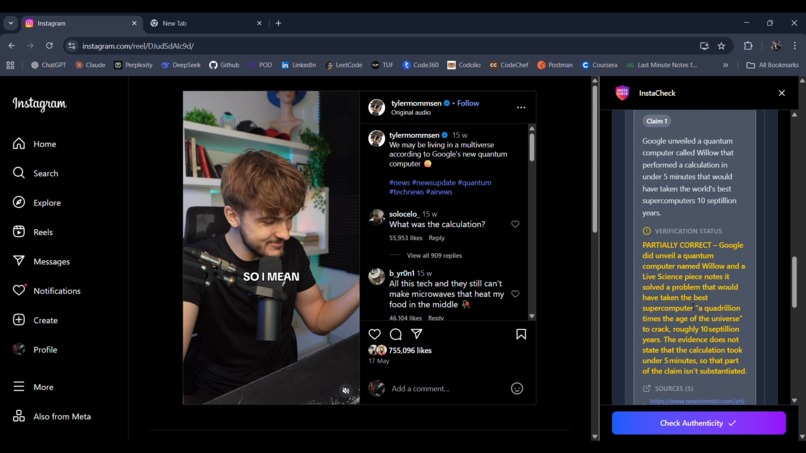
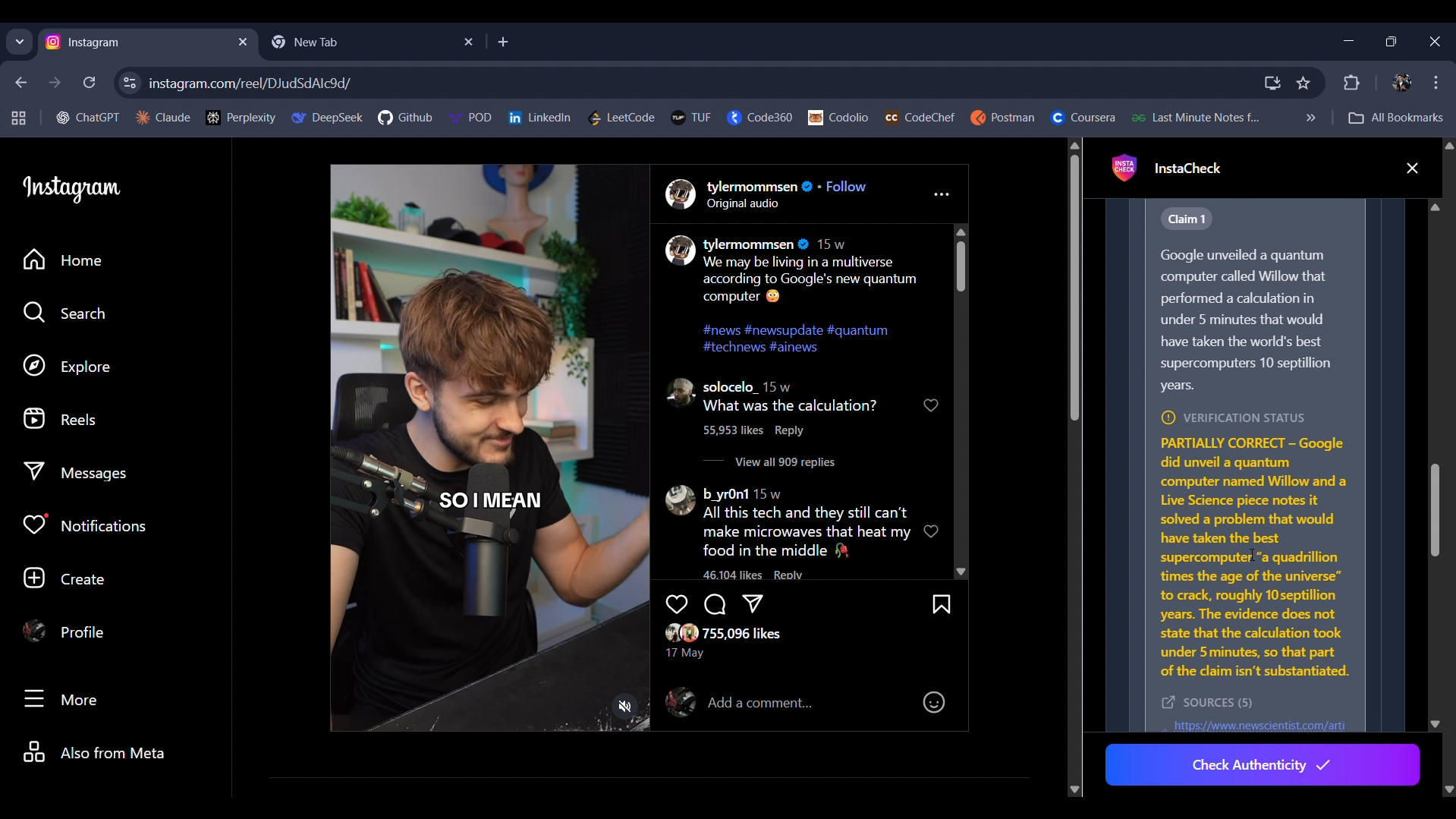
There were 2 claims in the video , and its the interpretation of 1st claim
-
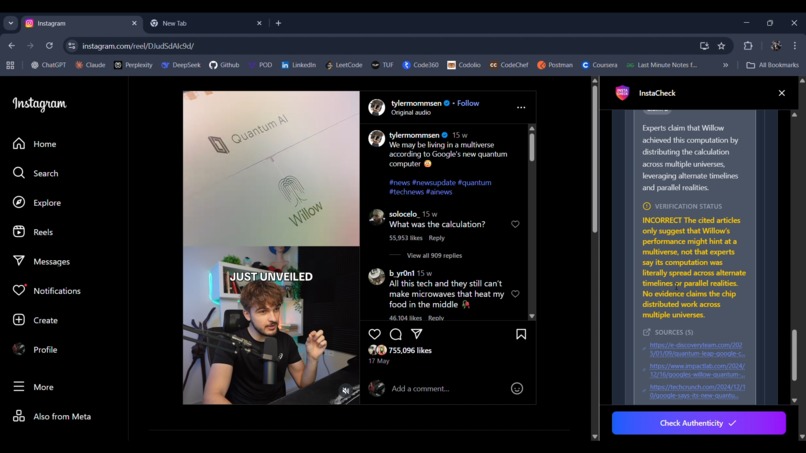
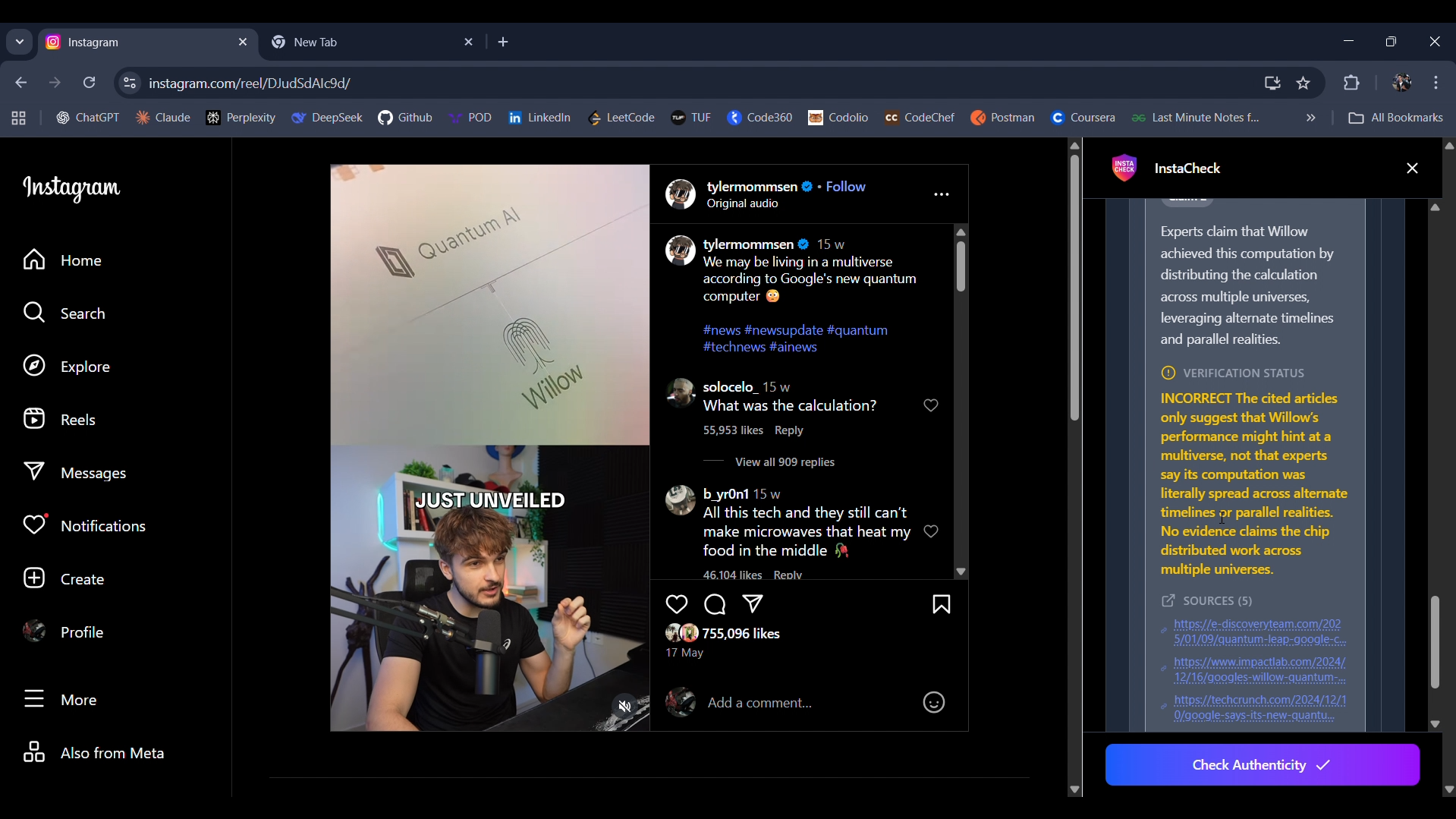
its the interpretation on 2nd Claim
-
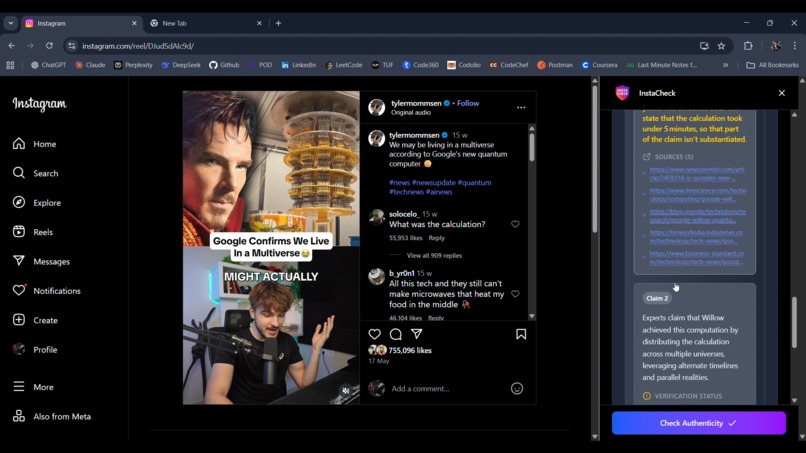
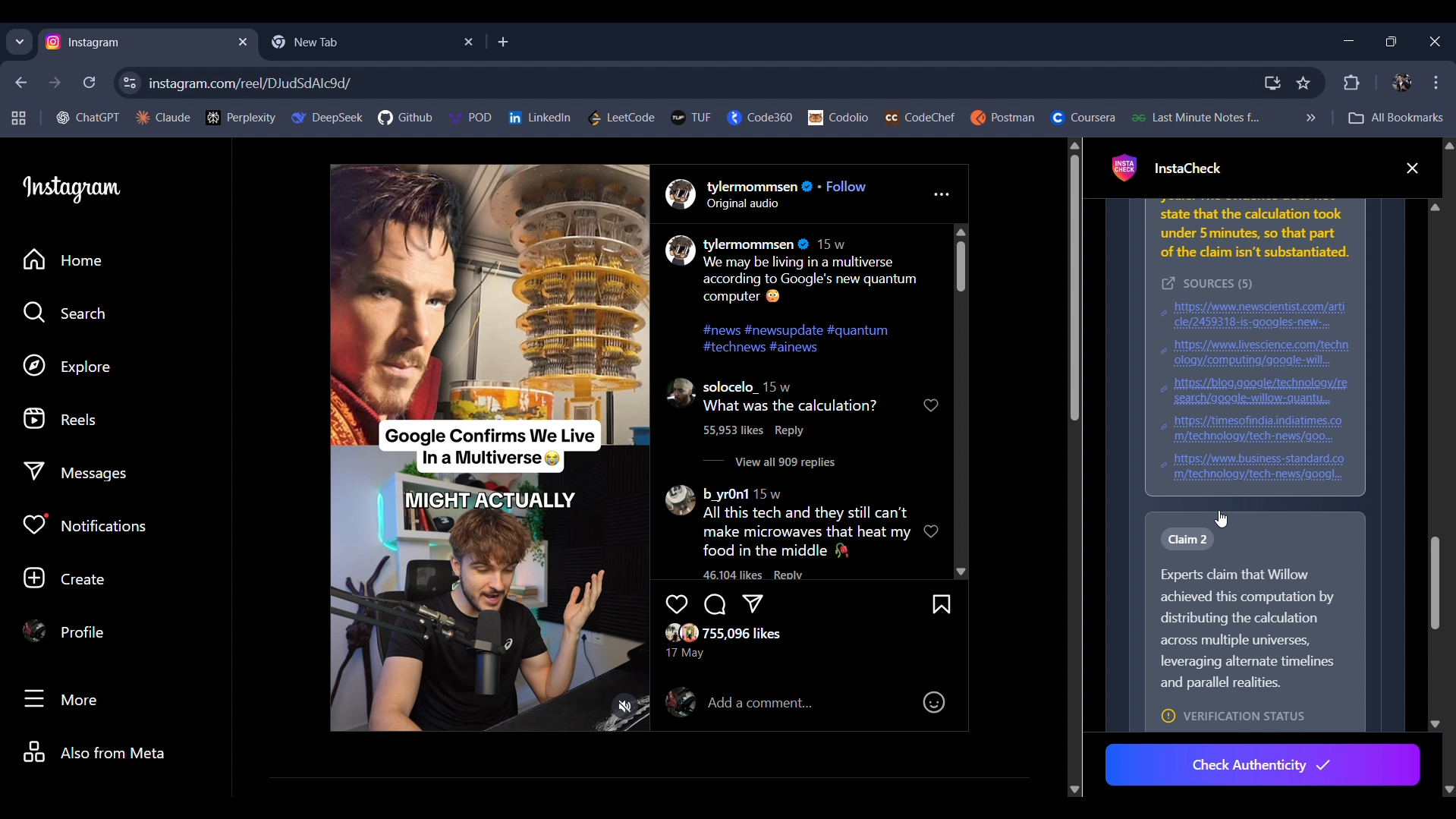
Its the source urls of 1st claim
-
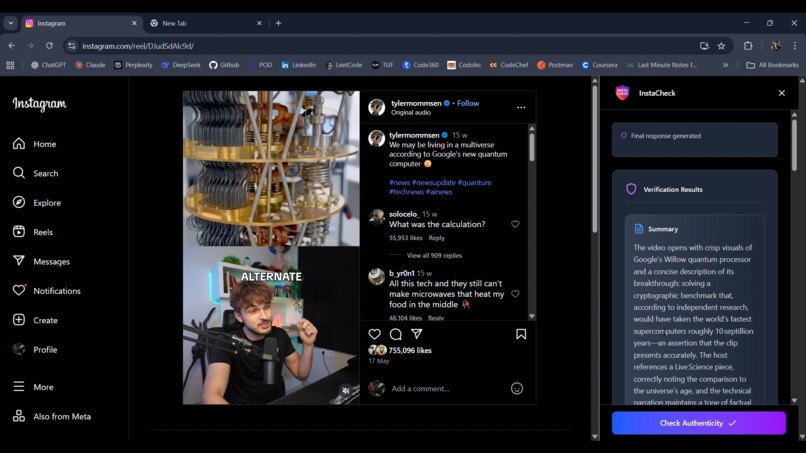
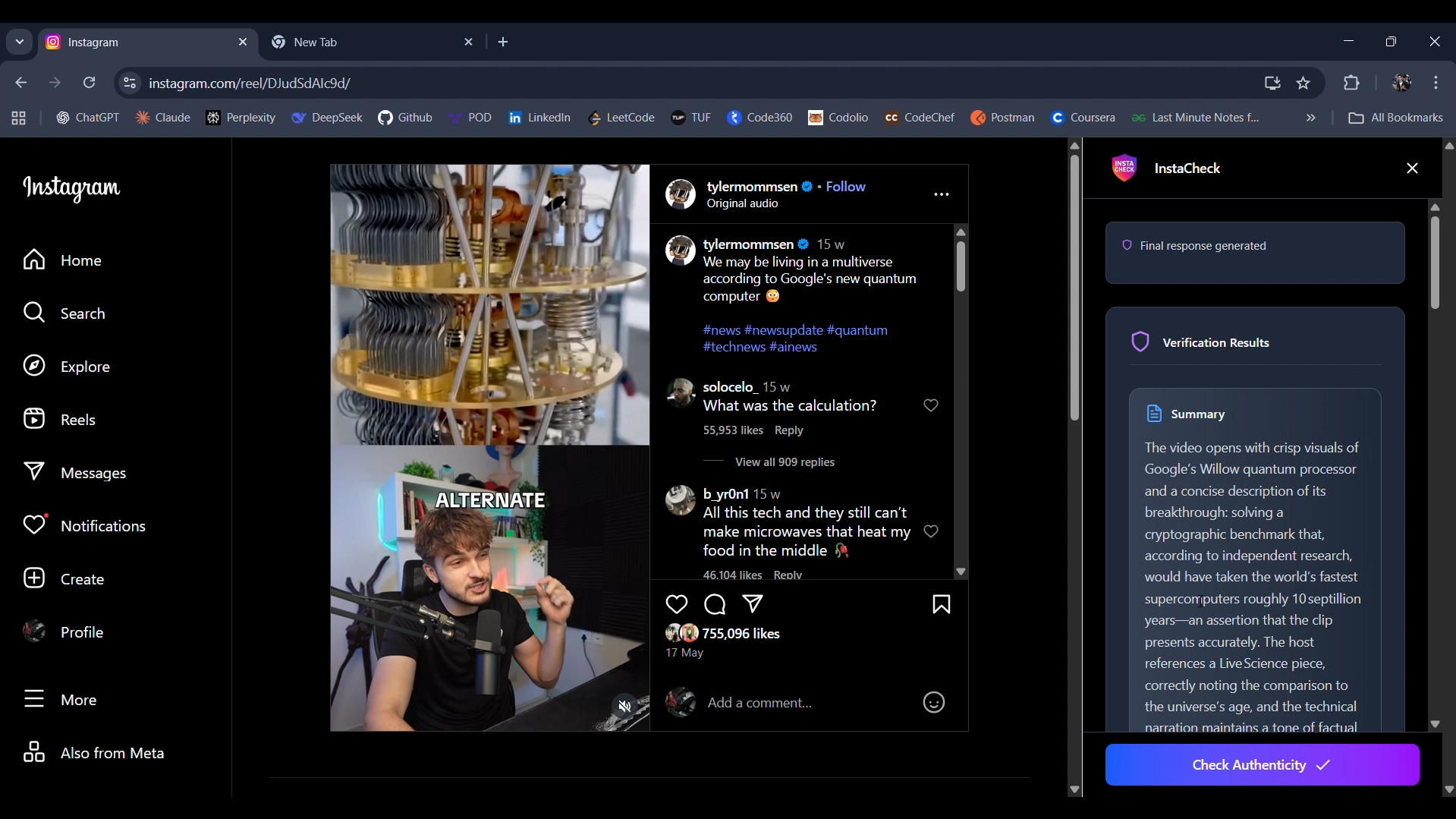
Extension generated the response and the overall summary is visible
Inspiration
Reels and short videos have become one of the world’s biggest sources of information, with over 1.8 billion users monthly consuming them. In fact, 66% of people rely on reels and shorts weekly for news.
But here’s the problem: these videos are often short, catchy, and persuasive — yet highly prone to misuse, manipulation, and misinformation. Algorithms amplify this influence, and unchecked claims can easily shape opinions or spread falsehoods at scale.
I’ve personally seen situations where friends repeated a “fact” from a reel that turned out to be completely wrong. It was embarrassing for them, but more importantly, it showed how easy it is for misinformation to spread without any real-time way to verify it.
That gap inspired me to build InstaCheck — a tool that brings real-time, claim-by-claim fact-checking into the short-video experience, so users can trust what they’re watching.
How I built it
I designed InstaCheck as an end-to-end pipeline, combining a Chrome extension frontend with a powerful AI backend:
1) Frontend (User Interface):
- Built a lightweight Chrome extension using React.js.
- Integrated directly into Instagram’s UI so users can fact-check with a single click, without disrupting their viewing flow.
2) Backend (Pipeline Orchestration):
- Implemented using FastAPI for efficient API handling.
- When a reel URL is submitted, the server fetches the source video and converts it to audio.
3) Transcription:
- Used OpenAI Whisper to transcribe the spoken content into accurate text.
4) Claim Extraction:
- Passed the transcript to GPT-OSS, which identifies and structures factual claims.
5) Evidence Gathering:
- Queried the web for supporting data through search APIs, website scraping, and a vector database for storing and retrieving relevant context.
6) Claim Verification:
- Each claim, paired with its evidence, is re-analyzed by GPT-OSS, which uses reasoning to classify it as true, misleading, or false.
7) Final Verdict:
- Compiled results are sent back to the Chrome extension, where the user sees a transparent verdict with sources.
This modular design ensures accuracy, scalability, and flexibility — while keeping the fact-checking process smooth and intuitive for the end user.
Challenges I ran into
- Latency issues: Running GPT-OSS locally took 45–60 seconds per request, making full pipeline execution 7–8 minutes per reel. Optimizing speed while preserving accuracy was tough.
- Scalability trade-offs: Balancing resource-heavy models (Whisper + GPT-OSS) with real-time usability.
- Claim structuring: Extracting clear, independent claims from unstructured speech was non-trivial.
- Evidence quality: Ensuring retrieved web data was relevant, trustworthy, and not biased.
- Frontend integration: Embedding results seamlessly into the Instagram flow without breaking UX.
Accomplishments that I am proud of
- Built a fully functional end-to-end fact-checking system from scratch in just a few days.
- Successfully combined speech-to-text, claim extraction, evidence retrieval, and reasoning into one automated pipeline.
- Created a Chrome extension that blends naturally with Instagram, requiring no extra effort from users.
- Achieved transparent, source-backed verdicts instead of simple yes/no responses.
- Managed to execute the project solo, covering both frontend and backend development.
What I learned
- The importance of efficient prompt engineering to reduce latency and improve claim clarity.
- How speech-to-text + LLM pipelines can work together for structured fact-checking.
- That retrieval quality matters as much as reasoning—weak evidence leads to weak verification.
- The challenges of balancing speed, accuracy, and scalability in real-time AI applications.
- Building user trust requires transparent explanations, not just binary answers.
What's next for InstaCheck
- Extending support beyond Instagram Reels to YouTube Shorts and other short-form video platforms.
- Exploring a potential collaboration with Meta to integrate fact-checking natively into their ecosystem.
- Optimizing performance with faster inference backends (like Groq or model distillation).
- Expanding beyond audio to analyze on-screen text and visuals for multimodal claim detection.
- Adding personalized credibility scores and dashboards to help users track authenticity trends.
Built With
- docker
- fastapi
- gpt-oss:20b
- groq
- ollama
- python
- react
- vector-databases
- websockets


Log in or sign up for Devpost to join the conversation.