-
-
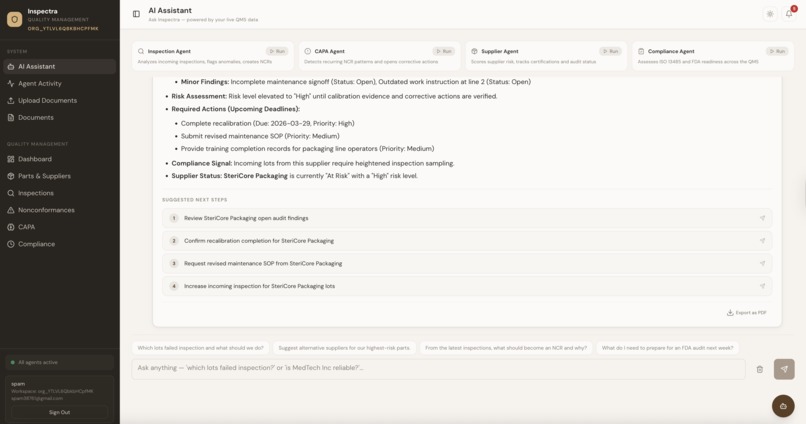
AI Assistant
-
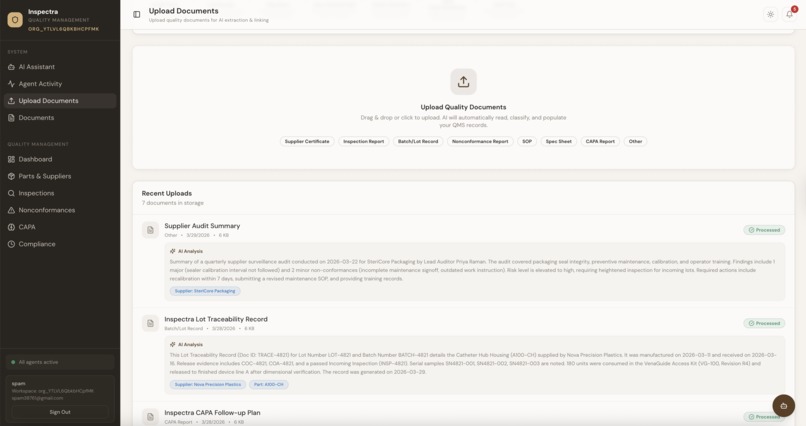
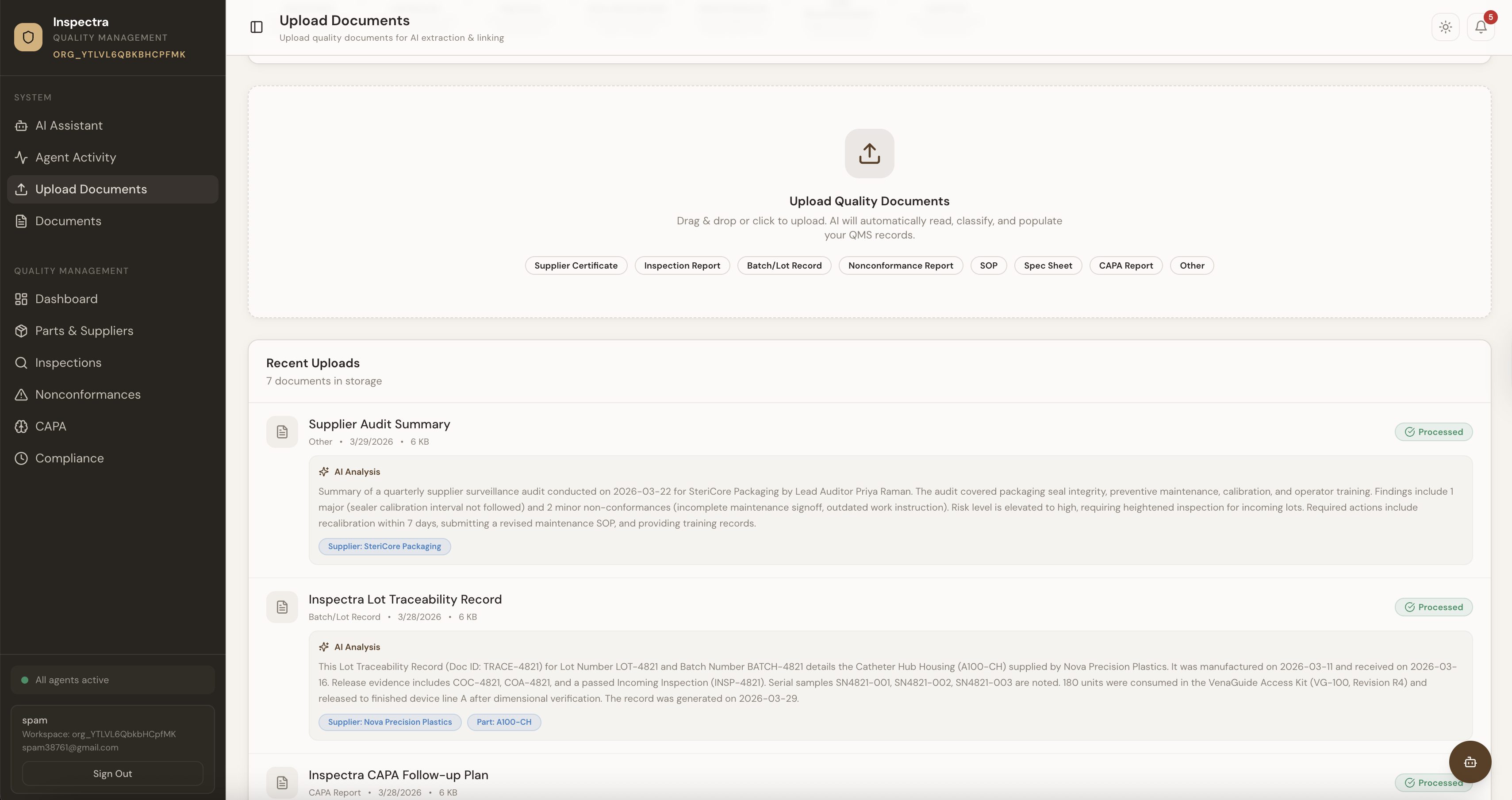
Uploading documents
-
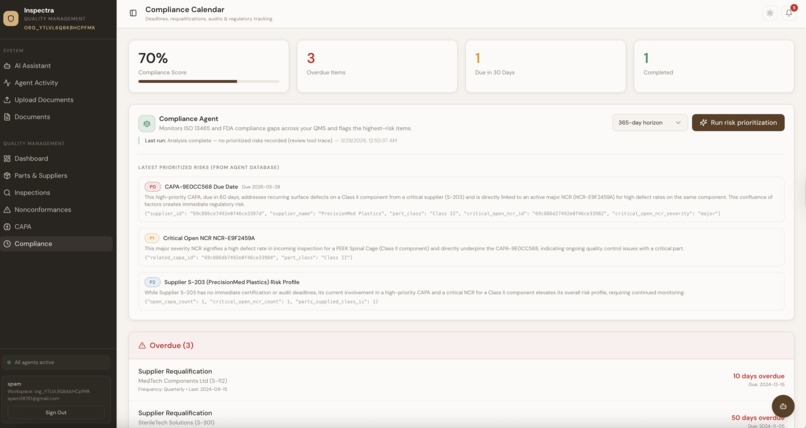
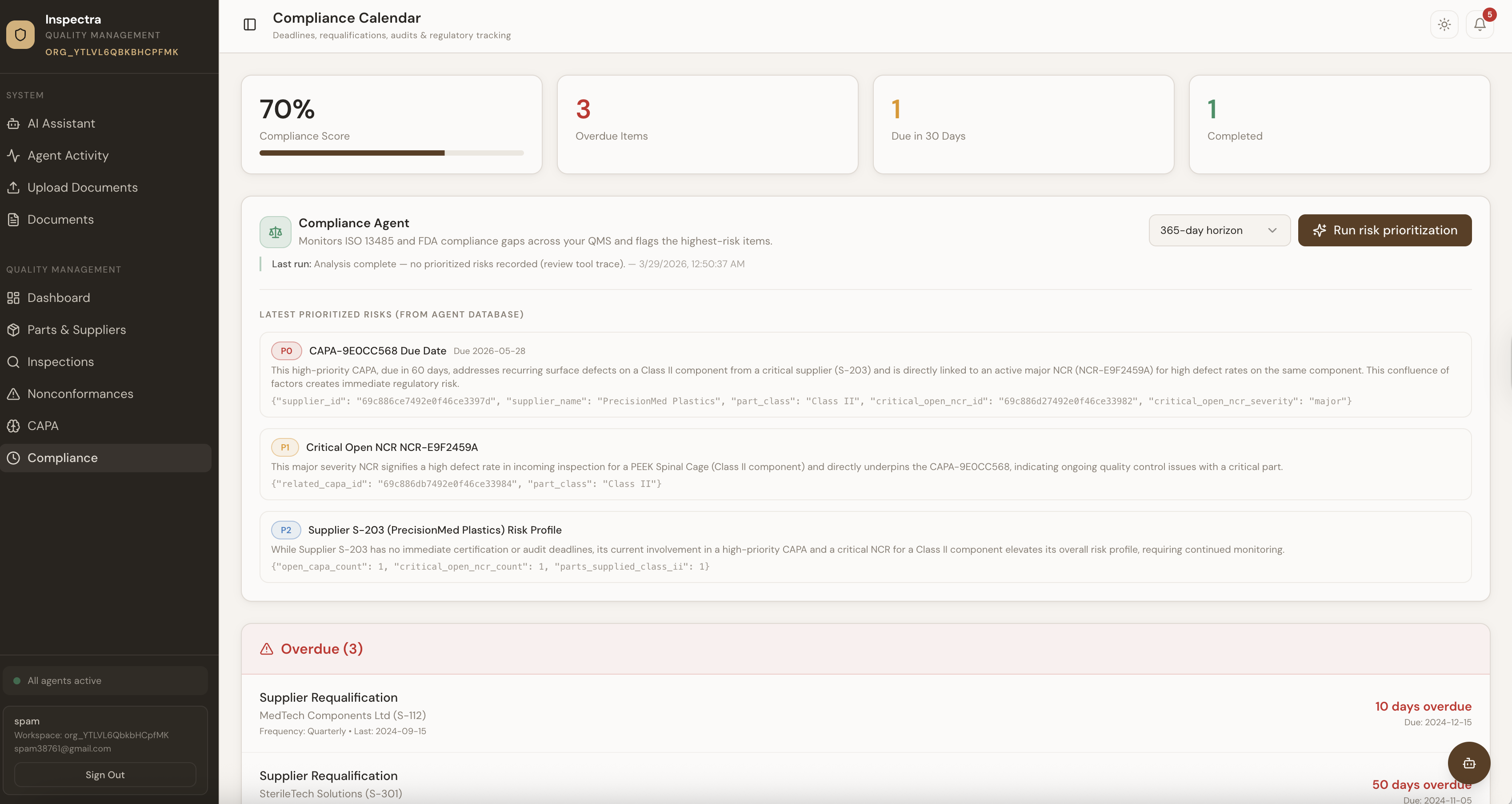
Compliance Page
Inspiration
Around 50% of U.S. Food and Drug Administration inspection findings stem from compliance failures—a statistic that underscores just how high the stakes are for medical device companies..
We've talked to professionals who work in the medical device industry, and through them, we got an honest look at what compliance really looks like on the ground at smaller companies. Medical device companies need to prove with documentation that every part, supplier, and process is safe, consistent, and traceable. This is a space that is highly regulated and profitable, yet much of this work is still managed through fragmented, manual systems. Small, overstretched teams are forced to balance quality, operations, and engineering simultaneously, all while knowing that a single missing document or unresolved issue could lead to a failed inspection, product recall, or even legal consequences.
Problematically, there is currently no automated solution that addresses this issue.
Thus, the gap between the stakes and the tools available to manage them is what led us to build Inspectra: a platform designed to give medtech teams a smarter, more proactive way to stay traceable, stay inspection-ready, and maintain FDA compliance.
What it does
Inspectra automates tedious data entry, document tracking, and reporting in 7 key ways:
Centralize and preserve all quality data: Store supplier qualifications, inspection results, lot records, NCRs (nonconformances), CAPAs (Corrective and Preventive Action), and quality documents in one place all while keeping original files intact and fully traceable to their source.
Turn documents into structured QMS records: Automatically convert unstructured PDFs into usable data, linking every extracted field back to its supporting evidence.
Standardize the quality workflow: Enforce an ISO 13485–aligned process across the full lifecycle from supplier onboarding → inspection → nonconformance → corrective action → closure.
Continuously detect compliance risks: Flag issues like overdue requalifications, failed inspections, unresolved NCRs, past-due CAPAs, and gaps in traceability.
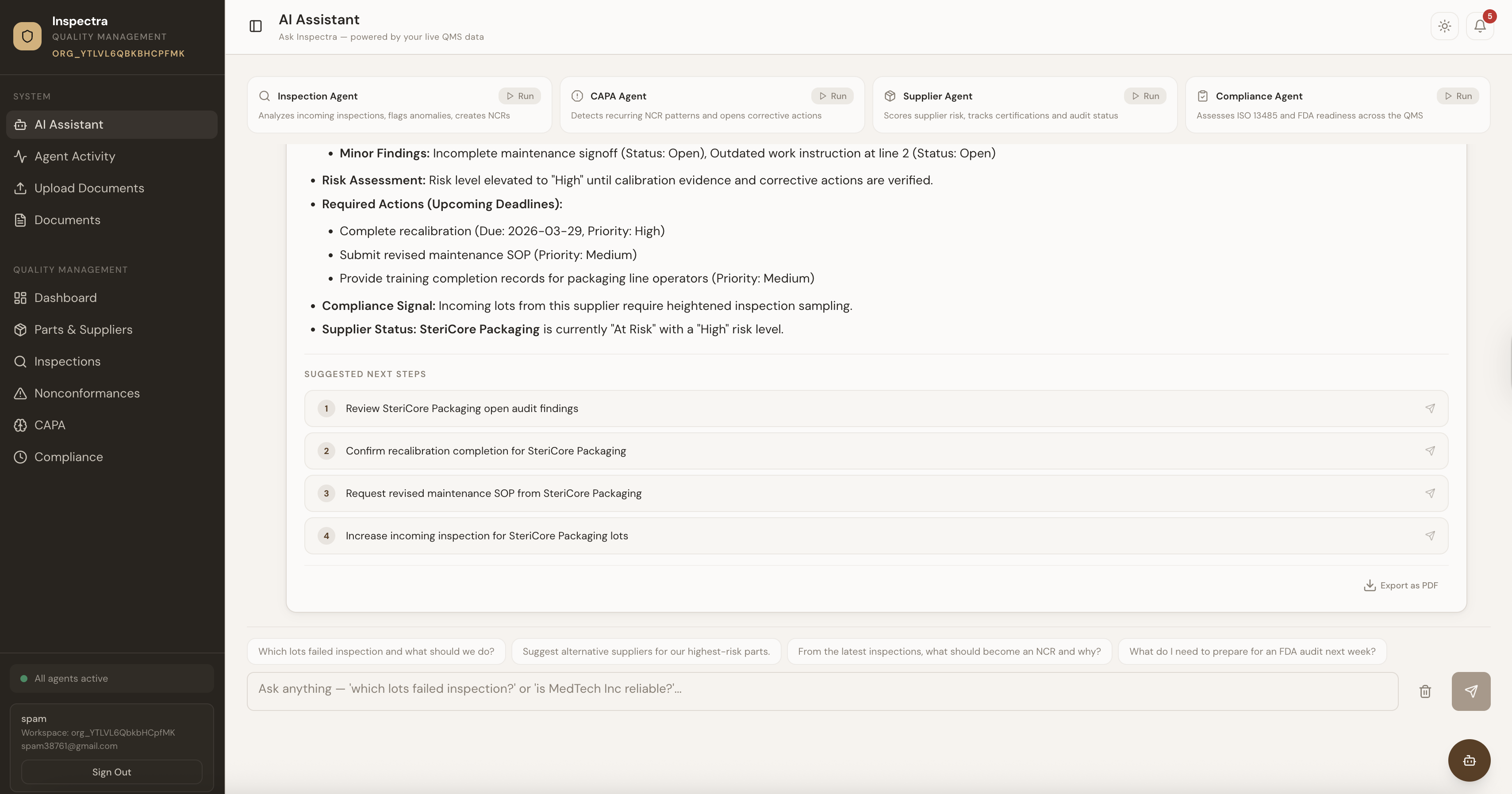
Prioritize high-risk issues automatically: Use specialized AI agents (Supplier, Inspection, CAPA, Compliance) to surface what needs attention first and perform targeted requests.
Enable natural-language Q&A: Allow users to ask questions and receive clear, evidence-backed answers powered by Gemini by retrieving both structured data and relevant document excerpts.
Generate audit-ready outputs: Instantly produce supplier inspection packets, ISO 13485 draft documentation, and compliance summaries—ready for FDA or notified body review.
How we built it
Inspectra is a full-stack system that combines modern web technologies with AI.
The frontend is built with React and TypeScript using Vite, Tailwind, and Radix UI. The backend is an Express API with a structured QMS data layer, backed by MongoDB, including GridFS for file storage and document chunking. Auth0 handles secure, organization-scoped authentication, and Google Gemini powers document extraction, assistant responses, and our agent layer.
At the core is a retrieval-augmented generation (RAG) pipeline: documents are uploaded, chunked, and stored, then the most relevant chunks and QMS records are retrieved and passed to Gemini as grounded context. This ensures responses are based on actual stored data rather than inference or guesswork.
We also built four specialized AI agents that work separately with Gemini covering compliance, supplier management, inspection, and CAPA that continuously monitor the system and prioritize risks before they escalate.
Challenges we ran into
- Extracting reliable, auditable structured data from inconsistent PDFs
- Medical-device compliance is highly domain-specific. We had to learn a lot of quality terminology and workflows very quickly. Things like supplier qualification, lot traceability, NCRs, CAPAs, and ISO 13485 are not simple to model correctly.
Accomplishments that we're proud of
- We built a fully functional QMS platform, not just a prototype
- Figuring out how to integrate tools we have never used before
- Successfully integrating RAG into our database
- Creating different agents that perform separate actions but are integrated in a single workflow
What we learned
- Flexibility is key: when some aspects of our project weren't working, we decided to create new plans on the spot and pivot the sponsor tracks we were focusing on.
- We learned how important it is to design around real workflows instead of building features in isolation.
What's next for Inspectra
We plan to further align with ISO 13485, develop smarter agents capable of recommending corrective actions rather than just flagging issues, integrate with external systems such as ERPs, supplier databases, and FDA infrastructure, introduce real-time collaboration and approval workflows, and scale the platform for production use by actual medical device companies.


Log in or sign up for Devpost to join the conversation.